74 books match the query 'Discourse analysis' and 5 start with r
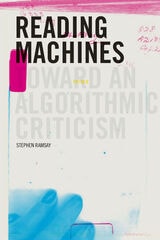
cover of Reading Machines: Toward and Algorithmic Criticism

Reading Machines

Toward and Algorithmic Criticism

Stephen Ramsay

University of Illinois Press, 2011
Besides familiar and now-commonplace tasks that computers do all the time, what else are they capable of? Stephen Ramsay's intriguing study of computational text analysis examines how computers can be used as "reading machines" to open up entirely new possibilities for literary critics. Computer-based text analysis has been employed for the past several decades as a way of searching, collating, and indexing texts. Despite this, the digital revolution has not penetrated the core activity of literary studies: interpretive analysis of written texts.
 
Computers can handle vast amounts of data, allowing for the comparison of texts in ways that were previously too overwhelming for individuals, but they may also assist in enhancing the entirely necessary role of subjectivity in critical interpretation. Reading Machines discusses the importance of this new form of text analysis conducted with the assistance of computers. Ramsay suggests that the rigidity of computation can be enlisted in the project of intuition, subjectivity, and play.
[more]
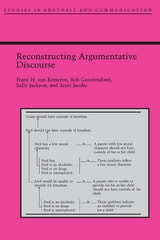
cover of Reconstructing Argumentative Discourse

Reconstructing Argumentative Discourse

Frans Van Eemeren

University of Alabama Press, 1993

 Reconstructing Argumentative Discourse analyzes argumentation in ordinary disputes. The analysis begins with an ideal model: a theoretical structure of discourse that might be used to resolve a dispute about the merits of two opposing cases. The ideal model does not describe actual argumentative practice. Argumentative discourse does not always seek genuine resolution and, when it does, the participants may not perform as ideal arguers.

A central challenge for argumentation theory is to give an account of argumentation occurring under less-than-ideal conditions and conducted by less-than-ideal participants. The authors offer detailed analysis of argument in such contexts as ordinary conversation, third party dispute mediation, and religious confrontation. An adequate analytic approach to such forms of discourse, the authors argue, must offer critical insight into actual practice; must begin with a defensible normative standard against which practice can be compared; and must also offer an applicable analytic machinery for making the comparison, so its methods can be tailored to empirical circumstances.
The authors position their study of argumentation within a general “normative pragmatics” characterized by a dual commitment to usefulness and adequacy in description. A distinctive set of practical applications and a distinctive view of practicality follow from this approach, characterized not by the search for generalizable means-end relationships but by the development and testing of plans for making real argumentation look as much as possible like ideal argumentation.
This book integrates for the first time the normative interest of dialectical theories of argumentation with the descriptive interests of the empirical study of everyday language use. This ambitious project is achieved by adopting a distinctively social and pragmatic view of argumentation—by seeing argumentation as a language activity structured for the function of resolving disagreements. The authors examine argumentation in a wide variety of contexts—including everyday conversation, campus evangelism, political speeches, newspaper letters to the editor, and the formal mediation of disputes. In doing so, they illustrate how to analyze the details of actual argumentation and tackle a variety of theoretical and methodological puzzles encountered in the effort to apply normative models to real life argumentation.
[more]
cover of Relations: An Anthropological Account

Relations

An Anthropological Account

Marilyn Strathern

Duke University Press, 2020
The concept of relation holds a privileged place in how anthropologists think and write about the social and cultural lives they study. In Relations, eminent anthropologist Marilyn Strathern provides a critical account of this key concept and its usage and significance in the English-speaking world. Exploring relation's changing articulations and meanings over the past three centuries, Strathern shows how the historical idiosyncrasy of using an epistemological term for kinspersons (“relatives”) was bound up with evolving ideas about knowledge-making and kin-making. She draws on philosophical debates about relation—such as Leibniz's reaction to Locke—and what became its definitive place in anthropological exposition, elucidating the underlying assumptions and conventions of its use. She also calls for scholars in anthropology and beyond to take up the limitations of Western relational thinking, especially against the background of present ecological crises and interest in multispecies relations. In weaving together analyses of kin-making and knowledge-making, Strathern opens up new ways of thinking about the contours of epistemic and relational possibilities while questioning the limits and potential of ethnographic methods.
[more]
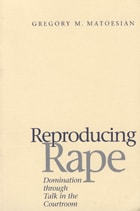
cover of Reproducing Rape: Domination through Talk in the Courtroom

Reproducing Rape

Domination through Talk in the Courtroom

Gregory M. Matoesian

University of Chicago Press, 1993

This book offers new insight into one of the most disturbing social problems of modern societies: rape. Using tape recordings of actual trials, Gregory M. Matoesian looks at the social construction of rape trials and at how a woman's experience of violation can be transformed in the courtroom into an act of routine, consensual sex.

Matoesian examines the language of the courtroom, focusing on how defense lawyers interpret and classify rape in a way that makes the victim's experience appear as a normal sexual encounter. He analyzes the language that defense attorneys use in cross-examination to argue that courtroom talk can shape the victim's testimony to fit male standards of legitimate sexual practice. On this view, cross-examination is an adversarial war of words through which lawyers manipulate reality and perpetuate the patriarchal domination of women.

Reproducing Rape will interest students and professionals in law, criminology, sociology, feminist theory, linguistics, and anthropology.

[more]
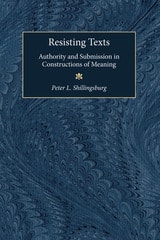
cover of Resisting Texts: Authority and Submission in Constructions of Meaning

Resisting Texts

Authority and Submission in Constructions of Meaning

Peter L. Shillingsburg

University of Michigan Press, 1998

"It is with no desire or hope to promote a correct or superior form of textuality, with no desire to correct a so-called interpretive or editorial textual abuse, nor any attempt to prevent anyone from doing anything imaginable with texts or books that I have undertaken this book. . . ." So writes Peter Shillingsburg in his introduction to this series of meditations on the possibilities of deriving "meaning" from the texts we read.
Shillingsburg argues that as humans we are and always will be interested in the past, in what was meant, in what was revealed inadvertently by a text--and that is all to the good. But we learn more and can compare notes better when we understand the principles that govern the ways we read. Resisting Texts approaches crucial questions about the practice of textual editing and literary criticism by posing questions in the form "If we take such and such to be the goal of our reading, then what will follow from that assumption?"
With humor and a lively imagination, Shillingsburg takes the reader on a fresh theoretical investigation of communication, understanding and misunderstanding, and textual satisfactions, drawing examples from Thackeray, Wordsworth, Melville, and others.
Resisting Texts will appeal to all who enjoy the varieties of critical approaches to the written word.
Peter L. Shillingsburg is Professor of English, University of North Texas.
[more]