162 books match the query 'Economics & Trade' and 10 start with r
cover of Reconstructing Europe's Trade and Payments: The European Payments Union

Reconstructing Europe's Trade and Payments

The European Payments Union

Barry Eichengreen

University of Michigan Press, 1993
This title was formally part of the Studies in International Trade Policy Series, now called Studies in International Economics.
[more]
cover of Reforming the Welfare State: Recovery and Beyond in Sweden

Reforming the Welfare State

Recovery and Beyond in Sweden

Edited by Richard B. Freeman, Birgitta Swedenborg, and Robert H. Topel

University of Chicago Press, 2010
Over the course of the twentieth century, Sweden carried out one of the most ambitious experiments by a capitalist market economy in developing a large and active welfare state. Sweden's generous social programs and the economic equality they fostered became an example for other countries to emulate. Of late, Sweden has also been much discussed as a model of how to deal with financial and economic crisis, due to the country's recovery from a banking crisis in the mid-1990s. At that time economists heatedly debated whether the welfare state caused Sweden's crisis and should be reformed—a debate with clear parallels to current concerns over capitalism. 
Bringing together leading economists, Reforming the Welfare State examines Sweden's policies in response to the mid-1990s crisis and the implications for the subsequent recovery. Among the issues investigated are the way changes in the labor market, tax and benefit policies, local government policy, industrial structure, and international trade affected Sweden's recovery. The way that Sweden addressed its economic challenges provides valuable insight into the viability of large welfare states, and more broadly, into the way modern economies deal with crisis.
[more]
cover of Regionalism and Rivalry: Japan and the U.S. in Pacific Asia

Regionalism and Rivalry

Japan and the U.S. in Pacific Asia

Edited by Jeffrey A. Frankel and Miles Kahler

University of Chicago Press, 1993

As Japan's newfound economic power leads to increased political power, there is concern that Japan may be turning East Asia into a regional economic bloc to rival the U.S. and Europe. In Regionalism and Rivalry, leading economists and political scientists address this concern by looking at three central questions: Is Japan forming a trading bloc in Pacific Asia? Does Japan use foreign direct investment in Southeast Asia to achieve national goals? Does Japan possess the leadership qualities necessary for a nation assuming greater political responsibility in international affairs?

The authors contend that although intraregional trade in East Asia is growing rapidly, a trade bloc is not necessarily forming. They show that the trade increase can be explained entirely by factors independent of discriminatory trading arrangements, such as the rapid growth of East Asian economies. Other chapters look in detail at cases of Japanese direct investment in Southeast Asia and find little evidence of attempts by Japan to use the power of its multinational corporations for political purposes. A third group of papers attempt to gauge Japan's leadership characteristics. They focus on Japan's "technology ideology," its contributions to international public goods, international monetary cooperation, and economic liberalization in East Asia.
[more]
cover of Regionalism versus Multilateral Trade Arrangements

Regionalism versus Multilateral Trade Arrangements

Edited by Takatoshi Ito and Anne O. Krueger

University of Chicago Press, 1997
There is no doubt that the open multilateral trading system after World War II was a key ingredient in the rapid economic development of the entire world. Especially in Hong Kong, Korea, Singapore, and Taiwan, exports increased dramatically both in absolute terms and as a percentage of GNP. In the 1980s, however, preferential trading arrangements (PTAs) began to emerge as significant factors affecting world trade. This volume contains thirteen papers that analyze the tensions between multilateral trading systems and preferential trade arrangements and the impact of these tensions on East Asia. The first four chapters introduce PTAs conceptually and focus on the unique political issues that these agreements involve. The next five essays present more direct empirical analyses of existing PTAs and their economic effects, primarily in East Asia. The last four papers concentrate on the outcomes of individual East Asian nations' trading policies in specific instances of preferential agreements.
[more]
cover of Regulating Finance: The Political Economy of Spanish Financial Policy from Franco to Democracy

Regulating Finance

The Political Economy of Spanish Financial Policy from Franco to Democracy

Arvid John Lukauskas

University of Michigan Press, 1997
In recent years many countries have liberalized their financial markets as a central element of their efforts to reform their economies and increase their economic growth rates. Financial deregulation leads to a fundamental restructuring of a country's economy and polity, as market forces, not state officials, begin to determine who obtains financial resources and at what cost. A critical question is whether countries can undertake a program of liberalization while undergoing democratic transformation. In this study, Arvid John Lukauskas explores why governments tightly regulate their country's financial system and why they choose to liberalize it. Using a rational choice approach, Lukauskas contends that public officials provide the dynamic behind the evolution of financial regulation as they seek to retain power and generate public revenue. Lukauskas argues that the nature of a country's political institutions shape the incentives facing politicians and influence whether they seek to regulate closely or liberalize financial markets in the pursuit of their goals. Lukauskas then tests his ideas in an in-depth case study of the evolution of financial policy in Spain, a country that transformed its financial system into a mostly market-based system after years of heavy state intervention, while undergoing a transformation from a dictatorship to a democracy. Contrary to the conventional wisdom that leaders will not undertake structural change during periods of democratization, he finds that leaders in Spain undertook financial liberalization despite opposition from powerful groups, because democratization gave Spanish leaders a strong incentive to improve economic performance through financial reform in order to compete for votes. Regulating Finance will be of interest to political scientists and economists interested in studying financial markets and the effects of regime change, including democratization, on economic reform.
[more]
cover of Regulatory Barriers and the Principle of Non-discrimination in World Trade Law: Past, Present, and Future

Regulatory Barriers and the Principle of Non-discrimination in World Trade Law

Past, Present, and Future

Thomas Cottier and Petros C. Mavroidis, Editors

University of Michigan Press, 2000
The University of Michigan Press is pleased to announce the second volume in an annual series, the World Trade Forum. The Forum's members include scholars, lawyers, and government and business practitioners working in the area of international trade, law, and policy. They meet annually to discuss integration issues in international economic relations, focusing on a new theme each year.
The World Trade Forum 1998 deals with the issue of regulatory barriers. Contributors focus their attention on the implications that government intervention has on the principle of nondiscrimination, the cornerstone of the World Trade Organization. The chapters, which cover both the positive and the normative level, deal in particular with the issue of "like product" definition, and with mutual recognition agreements. The relevant WTO case law is presented and analyzed, and the roundtable discussions are primarily aimed at clarifying to what extent a constitutional function should be assigned to the WTO organs, if at all.
Contributors include: Christoph Bail, Jacques Bourgeois, Marco Bronckers, Thomas Cottier, William Davey, Paul Demaret, Piet Eeckhout, Crawford Falconer, Olivier Guillod, Meinhard Hilf, Gary Horlick, Robert Howse, Robert Hudec, Patrick Low, Aaditya Mattoo, Petros C. Mavroidis, Patrick Messerlin, Damien Neven, Kalypso Nicolaidis, David Palmeter, Ernst Ulrich Petresmann, Andre Sapir, and Michel Waelbroeck.
Thomas Cottier is Professor of Law, Institute of European and International Economic Law, University of Bern Law School. Petros C. Mavroidis is Professor of Law, University of Neuchâtel.
[more]
cover of Reinventing the State: Economic Strategy and Institutional Change in Peru

Reinventing the State

Economic Strategy and Institutional Change in Peru

Carol Wise

University of Michigan Press, 2003
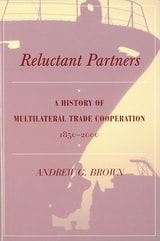
The political economic history of Latin America in the post-World War II era has largely been one of underachievement and opportunities lost. This all changed with the wave of market reforms that were implemented in the 1990s. However, the precise role of these reforms as an agent of change is still hotly debated. This in-depth analysis of the Peruvian case argues for an explanation that treats institutional innovation and state reconstruction as necessary conditions for the apparent success of the market in Latin America.
Exploring how state intervention has been both the cause of Latin America's economic downfall in the 1980s and the solution to its recovery, Reinventing the State analyzes three main phases of state intervention: the developmentalism that lasted until 1982, the state in retreat of the 1980s, and the streamlined state of the 1990s. Through a comprehensive examination of the Peruvian experience, the book explains the country's impressive turnaround from the standpoint of institutional modernization and internal state reform.
Written for a broad academic audience, the public-policy community, and the private sector, this book is also meant as a quick primer for any journalist, consultant, or private-sector analyst in need of an overview of the region's market-reform effort and how it has played out in Peru.
Carol Wise is Associate Professor, School of International Relations, University of Southern California.
[more]
cover of Reluctant Partners: A History of Multilateral Trade Cooperation, 1850-2000

Reluctant Partners

A History of Multilateral Trade Cooperation, 1850-2000

Andrew G. Brown

University of Michigan Press, 2003
With globalization drawing countries closer together, greater international cooperation is essential for peace and stability. The collective arrangement made by governments to manage their trade relations is one of the few successes of globalization. This book assesses the progress of multilateral trade cooperation, exploring the interests at work and the issues raised in successive postwar rounds of negotiations. It traces how the narrow perception of reciprocity has gradually yielded to a broader evaluation of the benefits to the regime as a whole as the major trading nations have mutually reduced trade barriers. Andrew G. Brown demonstrates the increasing importance of rule making and shows the diversity of issues on which negotiations have focused, such as customs procedures, technical standards, subsidies, anti-dumping duties, intellectual property rights, and the treatment of foreign direct investment. Despite the progress, however, the regime has remained vulnerable. The book also analyzes the major sources of strain that have been evident.
This is a nontechnical book for those curious about the possibilities for cooperation among states and should be of interest to both the nonspecialist and the specialist. It draws on more than one discipline to interpret the events, lying in the triangle bounded by political science, economics, and history.
Andrew G. Brown is a former Director of the General Analysis and Policies Division for the United Nations, New York.
[more]
cover of Revisiting U.S. Trade Policy: Decisions in Perspective

Revisiting U.S. Trade Policy

Decisions in Perspective

Alfred E. Eckes Jr.

Ohio University Press, 2000

In trade policy, as in many other areas of public policy, decision makers often confront present and future problems with little understanding of how similar disputes were resolved in the past. Too often, busy public officials had no time to write or record negotiating histories. Revisiting U.S. Trade Policy, which is certain to become a classic in the literature of trade negotiations, is just such a record.

Built on the oral histories of thirty-five former U.S. trade policymakers—including Michael Blumenthal, Alonzo McDonald, William Roth, and Robert S. Strauss—this unique record, prepared for publication by Alfred E. Eckes, revisits some of the most important moments of America’s trade liberalization program in the years after World War II.

From GATT to the World Trade Organization, these major players look back in candid hindsight at their decisions concerning trade policy and the effects that those decisions had on shaping the new international economic order.

[more]
cover of Rules of Origin in International Trade: A Comparative Study

Rules of Origin in International Trade

A Comparative Study

Edwin Vermulst, Jacques Bourgeois, and Paul Waer, Editors

University of Michigan Press, 1994

This title was formally part of the Studies in International Trade Policy Series, now called Studies in International Economics.
[more]