Results by title
295 books match the query 'Ecosystems & Habitats' and 11 start with r
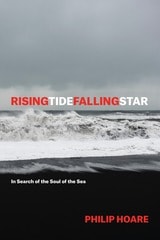
RISINGTIDEFALLINGSTAR
In Search of the Soul of the SeaPhilip Hoare
University of Chicago Press, 2018
Many of us visit the sea. Admire it. Even profess to love it. But very few of us live it. Philip Hoare does. He swims in the sea every day, either off the coast of his native Southampton or his adopted Cape Cod. He watches its daily and seasonal changes. He collects and communes with the wrack—both dead and never living—that it throws up on the shingle. He thinks with, at, through the sea.
All of which should prepare readers: RISINGTIDEFALLINGSTAR is no ordinary book. It mounts no straight-ahead argument. It hews to no single genre. Instead, like the sea itself, it moves, flows, absorbs, transforms. In its pages we find passages of beautiful nature and travel writing, lyrical memoir, seams of American and English history and much more. We find Thoreau and Melville, Bowie and Byron, John Waters and Virginia Woolf, all linked through a certain refusal to be contained, to be strictly defined—an openness to discovery and change. Running throughout is an air of elegy, a reminder that the sea is an ending, a repository of lost ships, lost people, lost ways of being. It is where we came from; for Hoare, it is where he is going.
“Every swim is a little death,” Hoare writes, “but it is also a reminder that you are alive.” Few books have ever made that knife’s edge so palpable. Read RISINGTIDEFALLINGSTAR. Let it settle into the seabed of your soul. You’ll never forget it.
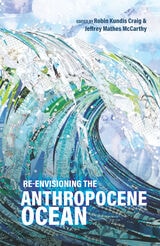
Re-envisioning the Anthropocene Ocean
Edited by Robin Kundis Craig and Jeffrey Mathes McCarthy
University of Utah Press, 2022
The world is at a critical moment, when humans must grapple with thinking about the planet’s oceans from ecological, physical, social, and legal perspectives. Warming ocean temperatures, changing currents, cultural displacement, Indigenous resilience, melting polar ice, habitat loss, are but a few of the global issues reflected in the planetary ocean as a front line in the unfolding drama of climate change. Re-envisioning the Anthropocene Ocean brings together leading scientists, lawyers, humanists, and Indigenous voices to tell of the ocean’s precarious position in the twenty-first century. The contributors affirm that the planetary ocean is crucial to our well-being and overdue for a positive change in public action to enhance the world’s resilience to climate change, ocean acidification, and other stressors. These essays engage that important work of positively re-imagining the ocean in the Anthropocene.
This volume brings diverse perspectives to the planet’s ocean future. New essays are contextualized with narratives woven by earlier ocean writers, showing readers how past perceptions of the ocean have led us to where we are today in terms of both problems and potential new visions. In this one volume, readers experience both the history of humanity’s multi- and interdisciplinary interactions with the ocean, find new perspectives on that history, and discover ideas for looking forward.
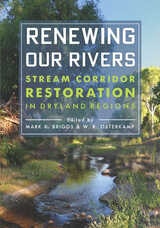
Renewing Our Rivers
Stream Corridor Restoration in Dryland RegionsEdited by Mark K. Briggs and W. R. Osterkamp
University of Arizona Press, 2020
Our rivers are in crisis and the need for river restoration has never been more urgent. Water security and biodiversity indices for all of the world’s major rivers have declined due to pollution, diversions, impoundments, fragmented flows, introduced and invasive species, and many other abuses.
Developing successful restoration responses are essential. Renewing Our Rivers addresses this need head on with examples of how to design and implement stream-corridor restoration projects. Based on the experiences of seasoned professionals, Renewing Our Rivers provides stream restoration practitioners the main steps to develop successful and viable stream restoration projects that last. Ecologists, geomorphologists, and hydrologists from dryland regions of Australia, Mexico, and the United States share case studies and key lessons learned for successful restoration and renewal of our most vital resource.
The aim of this guidebook is to offer essential restoration guidance that allows a start-to-finish overview of what it takes to bring back a damaged stream corridor. Chapters cover planning, such emerging themes as climate change and environmental flow, the nuances of implementing restoration tactics, and monitoring restoration results. Renewing Our Rivers provides community members, educators, students, natural resource practitioners, experts, and scientists broader perspectives on how to move the science of restoration to practical success.
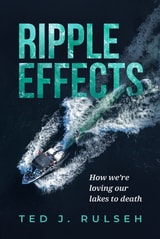
Ripple Effects
How We're Loving Our Lakes to DeathTed J. Rulseh
University of Wisconsin Press, 2022
In his engaging and conversational style, Ted Rulseh details each of these challenges and proposes achievable solutions. He draws on personal experience, interviews, academic research, and government reports to describe the state of the lakes, the stresses they are under, and avenues to successful lakeside living for a sustainable future. Ripple Effects will be a go-to source for all who love lakes and who advocate for their protection; its driving question is summed up by one of Rulseh’s interviewees: “We love this lake. What can we do to keep it healthy?”
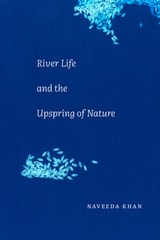
River Life and the Upspring of Nature
Naveeda Khan
Duke University Press, 2023

River Life and the Upspring of Nature
Naveeda Khan
Duke University Press, 2023
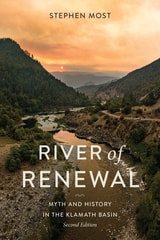
River of Renewal
Myth and History in the Klamath BasinStephen Most
Oregon State University Press, 2024
The only history of the entire Klamath Basin, River of Renewal tells the stories of the region’s diverse communities and stakeholders, including the government agencies that manage most of its land. Based on author Stephen Most’s original research and interviews with tribal leaders, ranchers, farmers, fishermen, forest managers, and others, River of Renewal is a political as well as an environmental history, one that underscores the power of commitment to a place and the vital importance of traditional knowledge in ecological stewardship. It offers an indispensable resource for anyone who wishes to better understand the peoples of the Klamath Basin and their extraordinary accomplishment of bringing about the removal of the four hydroelectric dams that harmed their cultures, economies, and environment for a century.
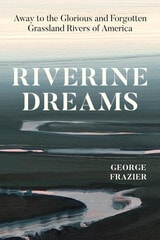
Riverine Dreams
Away to the Glorious and Forgotten Grassland Rivers of AmericaGeorge Frazier
University of Chicago Press, 2025
The North American grasslands that once covered vast areas of the central United States are now our most endangered ecosystems. But not far from any spot in the grasslands is a river. Grassland rivers are as central to the story of prairies as bison and bluestem. Defined as rivers that drain prairie watersheds, these waterways are crucial to plains ecosystems and no less endangered than the grasslands surrounding them. They are also enigmatic: some are restricted by local access laws and others have simply been forgotten. In any given year, fewer than a dozen people might lay eyes on tens of thousands of miles of America’s grassland rivers. But, as environmental writer George Frazier shows, following their twists and turns is one of the best ways to experience the wild essence of the prairies.
Riverine Dreams invites us on a trip along eight grassland rivers—including the Missouri, the Niobrara, and Purgatoire—traversing their environmental and cultural histories and introducing us to the people who study, paddle, and conserve them. This journey takes Frazier across the North American interior—from Montana and Colorado to Nebraska and Missouri—where he uncovers a remarkable movement to celebrate and preserve these natural treasures: nothing less than a grassland river revival.
The first accessible introduction to these waters, Riverine Dreams is a personal exploration of the rivers that are so vital to the health of the prairies.
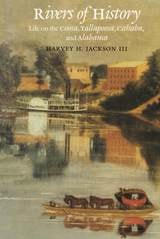
Rivers of History
Life on the Coosa, Tallapoosa, Cahaba, and AlabamaHarvey H. Jackson, III
University of Alabama Press, 1995
An illuminating study of how rivers shaped the history, culture, and environment of Alabama and the American South.
In Rivers of History, acclaimed historian Harvey H. Jackson III blends environmental history with compelling storytelling and traces the evolving relationship between people and rivers—from Indigenous communities who first depended on these waterways, to European settlers, to the development of modern towns and industries. Along the way, readers encounter stories of transportation and trade, conflict and cooperation, ecological change and conservation, all tied to the flow of these essential rivers.
Far more than a geographical study, Rivers of History demonstrates how waterways act as lifelines of human experience. Rivers shaped patterns of settlement, enabled agricultural and economic growth, and served as critical channels for communication across the American South. At the same time, they created challenges—flooding, environmental degradation, and competing demands for natural resources—that continue to influence life in the region today.
Jackson shows how the history of Alabama cannot be understood apart from its rivers. The Coosa, Tallapoosa, Cahaba, and Alabama rivers emerge not simply as physical features on a map, but as powerful forces that connect past and present, nature and society. His interdisciplinary approach—bringing together history, geography, and environmental studies—makes this work especially valuable for students, scholars, and general readers alike.
Accessible yet authoritative, Rivers of History is essential reading for anyone interested in Southern history, environmental change, or the enduring relationship between landscapes and human communities. It offers a compelling reminder that the story of a place is often written in the movement of its waters.
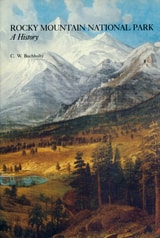
Rocky Mountain National Park
A HistoryC. W. Buchholtz
University Press of Colorado, 1983
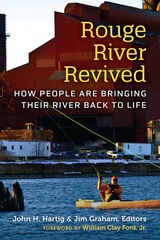
Rouge River Revived
How People Are Bringing Their River Back to LifeJohn H. Hartig and Jim Graham, Editors
University of Michigan Press, 2022
Rouge River Revived describes the river’s history from pre-European times into the 21st century. Chapters cover topics such as Native American life on the Rouge; indigenous flora and fauna over time; the river’s role in the founding of local cities; its key involvement in Detroit’s urban development and intensive industrialization; and the dramatic clean-up arising from citizen concern and activism. This book is not only a history of the environment of the Rouge River, but also of the complex and evolving relationship between humans and natural spaces.