Results by title
2728 books match the query 'Education' and 151 start with r
RSF
The Russell Sage Foundation Journal of the Social Sciences: Higher Education EffectivenessSteven G. Brint
Russell Sage Foundation, 2016
Beginning with the editors’ authoritative introduction, the contributors assess the effectiveness of U.S. higher education at the national, state, campus, and classroom levels. Several focus on the effects of the steep decline in state funding in recent years, which has contributed to rising tuition at most state universities. Steven Hemelt and David Marcotte find that the financial burdens of attendance, even at public institutions, is a significant and growing impediment for students from low-income families. John Witte, Barbara Wolfe, and Sara Dahill-Brown analyze 36 years of enrollment trends at the University of Wisconsin, Madison, and find increased enrollment of upper-income students, suggesting widening inequality of access.
James Rosenbaum and his coauthors examine the effectiveness of “college for all” policies and find that on a wide range of economic and job satisfaction measures, holders of sub-baccalaureate credentials outperform those who start but do not complete four-year colleges. Two papers – by Kevin Dougherty and coauthors and Michael Kurlaender and coauthors – find that the use of new regulatory mechanisms such as performance funding and rating systems are plagued by unintended consequences that can provide misleading measures of institutional effectiveness. Lynn Reimer and co-authors examine the effectiveness of the “promising practices” in STEM education (science, technology, engineering, and mathematics) promoted by the National Academy of Sciences, and find that they can increase completion rates among low-income, first-generation, and under-represented students.
Expanding college access and effectiveness is a key way to promote economic mobility. The important findings in this issue illuminate the strengths and weaknesses of the U.S. system of higher education and suggest new avenues for improving student outcomes.
RSF
The Russell Sage Foundation Journal of the Social Sciences: Spatial Foundations of InequalityGeorge Galster
Russell Sage Foundation, 2017
Articles in this issue explore the scale and dimensions of spatial inequality. Sean Reardon and coauthors develop a novel method of describing the joint distribution of race and income among neighborhoods. They demonstrate how blacks and Hispanics at all income levels typically live in substantially poorer neighborhoods than whites and Asians of the same income. Ann Owens investigates the relationship between residential segregation and school boundaries and finds that because parents often decide where to live based on school districts, school-age children live in more segregated neighborhoods than adults on the whole. John Hipp and Charis Kubrin examine how changes in the racial, ethnic, and economic composition of the areas that surround a given neighborhood affect it, and find that when inequality rises in a neighborhood’s surrounding areas, crime tends to increase in that neighborhood.
Other contributors study how space serves to maintain or reproduce inequalities. Anna Maria Santiago and coauthors find that neighborhood conditions—including racial and socioeconomic makeup and levels of violent crime—affect the chances that black and Latino youths will engage in risky behaviors, such as running away and using marijuana. For instance, low-income African American youths who live in neighborhoods inhabited by higher status residents are less likely to run away from home. Christopher Browning and coauthors examine the extent to which people of different socioeconomic status share space in their day-to-day lives, including working, shopping, and spending leisure time. They find that families of higher socioeconomic status are less likely to share common spaces with neighbors of any class, in part because they have more choice and control over where they go.
As the articles in this issue show, space is a core dimension of social stratification and is fundamental to understanding social and economic inequality.
RSF
The Russell Sage Foundation Journal of the Social Sciences: The Coleman Report and Educational Inequality Fifty Years LaterKarl Alexander
Russell Sage Foundation, 2016
The issue begins with a reassessment of the EEO’s major findings. Karl Alexander analyzes the report’s conclusion that families exert greater influence on children’s school performance than the schools themselves. He finds that family, school, and neighborhood all interact to shape children’s academic development in ways that are not always separable. Other contributors investigate how racial achievement gaps have changed since the report’s release. Sean Reardon finds that disparities in average school poverty rates between white and black students’ schools are the most powerful correlate of achievement gaps. Barbara Schneider and Guan Saw show that while blacks aspire to attend college at greater rates than whites, fewer blacks than whites now attend four-year colleges in part due to lesser access to college preparation activities, such as advanced-level academic courses.
Contributors also evaluate and update the EEO’s proposals to reduce longstanding socioeconomic and racial achievement gaps. Prudence L. Carter argues that effective policies for ending racial disparities must account for inequalities within schools as well as between them. Brian Jacob and coauthors explore whether technological advances since the EEO, including online courses, have the potential to reduce some of the educational inequalities associated with residential segregation. Ruth Turley shows how renewed partnerships between education researchers and policymakers at the local, regional, and national levels can improve disadvantaged students’ educational outcomes and increase racial and economic integration. By looking forward as well as back, this issue of RSF documents what educators and scholars have learned from fifty years of social science research on educational opportunity.
RSF
The Russell Sage Foundation Journal of the Social Sciences: The Elementary and Secondary Education Act at Fifty and BeyondDavid A. Gamson
Russell Sage Foundation, 2015
The ESEA has historically enabled the federal government to address educational inequality at the local level. Among the nine articles in the issue, Erica Frankenberg and Kendra Taylor discuss how the ESEA, in conjunction with the Civil Rights Act, accelerated desegregation in the South in the 1960s by withholding federal funding from school districts that failed to integrate. Rucker C. Johnson shows that higher ESEA spending in school districts between 1965 and 1980 led to increased likelihood of high school graduation for students, and low-income students in particular. Students in districts with higher spending were also less likely to repeat grades or to be suspended from school. Yet, as Patrick McGuinn shows, the institutional and administrative capacity of the U.S. Department of Education has never been sufficient to force instructional changes at the school level. This was particularly true with the 2001 renewal of the ESEA, the No Child Left Behind Act, which linked federal funding to schools’ test-score outcomes rather than to programs designed to combat social inequalities.
The issue also investigates the unintended consequences of the ESEA and offers solutions to offset them. As Patricia Gándara and Gloria Ladson-Billings demonstrate, ESEA reforms have, in some circumstances, led to the neglect of the needs of minority students and second-language learners. Gándara shows that No Child Left Behind requires “bilingual” education programs to focus on rapid acquisition of English, often to the detriment of those learning English as a second language. Ladson-Billings shows that the ESEA’s standardized testing mandates may suppress innovative teaching methods, and argues for reforms that use multidisciplinary approaches to craft new curricula. Bringing together research on the successes and shortcomings of the ESEA, this issue of RSF offers new insights into federal education policy and demonstrates that this landmark legislation remains a powerful force in the lives of educators and students fifty years after its initial implementation.
RSF
The Russell Sage Foundation Journal of the Social Sciences: The Fiftieth Anniversary of the Kerner Commission ReportSusan T. Gooden
Russell Sage Foundation, 2018
Articles in the issue examine the extent to which the recommendations in the Kerner Report contributed to policy changes and improvements in the social and economic well-being of urban residents . In their introduction, Gooden and Myers analyze changes in socioeconomic inequality between whites and blacks over the last five decades. They find that while the black poverty rate has declined and black educational attainment has increased, disparities still remain. Additionally, the income gap and disparities in unemployment between blacks and whites remain virtually unchanged. Rick Loessberg and John Koskinen similarly note the persistence of these disparities, but also show that some of the Kerner Report’s recommendations were adopted at local levels and have provided the foundation for increased racial diversity in media, law enforcement reforms, and public housing desegregation.
Other contributors study the urban areas that were sites of the riots. Reynolds Farley shows that in Detroit, residential segregation has declined and interracial marriage has increased over the last fifty years. However, on key economic measures such as income and wealth, African Americans have fallen even further behind whites than they were in 1967 due to dramatic changes in Detroit’s labor market. In their study of wealth inequality in Los Angeles, Melany De La Cruz-Viesca and coauthors show that much of the wealth gap between blacks and whites is due to disparities in home ownership, a subject neglected in the Kerner Report. Marcus Casey and Bradley Hardy study the evolution of African American neighborhoods since the Kerner Report and find that neighborhoods directly affected by riots in the 1960s still remain among the most economically disadvantaged today.
The Kerner Report endures as a classic touchstone in the nation’s search for a path toward equality. Together, the articles in this special issue demonstrate the long-term influence of the report and show where further progress is needed to close the racial divide.
RSF
The Russell Sage Foundation Journal of the Social Sciences: Using Administrative Data for Science and PolicyAndrew M. Penner
Russell Sage Foundation, 2019
In the twenty-first century, administrative data collected by the government, schools, hospitals, and other institutions are essential for effectively managing and evaluating public programs. Yet the U. S. lags behind many other countries when it comes to organizing these data and making linkages across different domains, such as education, health, and the labor market. This double issue of RSF, edited by sociologist Andrew Penner and developmental psychologist Kenneth Dodge, illustrates the tremendous potential of administrative data and provides guidance for the researchers and policymakers. Contributors across multiple disciplines demonstrate how linking disparate sources of administrative data can help us better understand the challenges faced by people in need, thereby improving the reach and efficiency of policy solutions.
Several contributors show how databases tracking educational attainment yield new insights into the role of schools in either ameliorating or perpetuating socioeconomic inequalities. Sean Reardon analyzes standardized test scores of roughly 45 million K-12 students nationwide to explore how educational opportunity varies by school districts over time. He finds that while affluent districts typically provide high levels of early childhood learning opportunities, there are some schools in high-poverty districts that do have increased average test scores between third and eighth grade. However, this growth still does not close the large achievement gap between low-and high-socioeconomic-status students. Megan Austin and coauthors, using student-level longitudinal data from Indiana, analyze the effects of school voucher programs on academic achievement and find that students who switch from a public to a private school with a voucher experience significant declines in achievement, particularly in math.
Other articles demonstrate how the analysis of administrative data can further our understanding of racial and gender inequality. Janelle Downing and Tim Bruckner link housing foreclosure records and birth records to show that foreclosures and related stresses during the Great Recession contributed to premature births and lower birth weights, particularly for Hispanic mothers and their children. Roberto Fernandez and Brian Rubineau investigate hiring data to explore how network recruitment, or recruitment through employer referrals, affects the “glass ceiling” in the workplace. They show that network recruitment increases women’s representation strongly at lower job levels, and to a lesser extent at higher levels.
Researchers now have unprecedented access to administrative data. As this issue shows, finding innovative ways to combine multiple data sets can facilitate partnerships between social scientists, administrators, and policymakers and extend our understanding of pressing social issues.
RSF
The Russell Sage Foundation Journal of the Social Sciences: Using Administrative Data for Science and PolicyAndrew M. Penner
Russell Sage Foundation, 2019
In the twenty-first century, administrative data collected by the government, schools, hospitals, and other institutions are essential for effectively managing and evaluating public programs. Yet the U. S. lags behind many other countries when it comes to organizing these data and making linkages across different domains, such as education, health, and the labor market. This double issue of RSF, edited by sociologist Andrew Penner and developmental psychologist Kenneth Dodge, illustrates the tremendous potential of administrative data and provides guidance for the researchers and policymakers. Contributors across multiple disciplines demonstrate how linking disparate sources of administrative data can help us better understand the challenges faced by people in need, thereby improving the reach and efficiency of policy solutions.
Several contributors show how databases tracking educational attainment yield new insights into the role of schools in either ameliorating or perpetuating socioeconomic inequalities. Sean Reardon analyzes standardized test scores of roughly 45 million K-12 students nationwide to explore how educational opportunity varies by school districts over time. He finds that while affluent districts typically provide high levels of early childhood learning opportunities, there are some schools in high-poverty districts that do have increased average test scores between third and eighth grade. However, this growth still does not close the large achievement gap between low-and high-socioeconomic-status students. Megan Austin and coauthors, using student-level longitudinal data from Indiana, analyze the effects of school voucher programs on academic achievement and find that students who switch from a public to a private school with a voucher experience significant declines in achievement, particularly in math.
Other articles demonstrate how the analysis of administrative data can further our understanding of racial and gender inequality. Janelle Downing and Tim Bruckner link housing foreclosure records and birth records to show that foreclosures and related stresses during the Great Recession contributed to premature births and lower birth weights, particularly for Hispanic mothers and their children. Roberto Fernandez and Brian Rubineau investigate hiring data to explore how network recruitment, or recruitment through employer referrals, affects the “glass ceiling” in the workplace. They show that network recruitment increases women’s representation strongly at lower job levels, and to a lesser extent at higher levels.
Researchers now have unprecedented access to administrative data. As this issue shows, finding innovative ways to combine multiple data sets can facilitate partnerships between social scientists, administrators, and policymakers and extend our understanding of pressing social issues.
Race among Friends
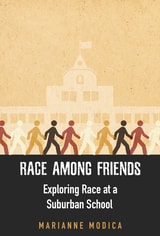
Exploring Race at a Suburban SchoolModica, Marianne
Rutgers University Press, 2015
This intriguing volume focuses on a “racially friendly” suburban charter school called Excellence Academy, highlighting the ways that students and teachers think about race and act out racial identity. Modica finds that even in an environment where students of all racial backgrounds work and play together harmoniously, race affects the daily experiences of students and teachers in profound but unexamined ways. Some teachers, she notes, feared that talking about race in the classroom would open them to charges of racism, so they avoided the topic. And rather than generate honest and constructive conversations about race, student friendships opened the door for insensitive racial comments by whites, resentment and silence by blacks, and racially biased administrative practices. In the end, the school’s friendly environment did not promote—and may have hindered—serious discussion of race and racial inequity.
The desire to ignore race in favor of a “colorblind society,” Modica writes, has become an entrenched part of American culture. But as Race Among Friends shows, when race becomes a taboo subject, it has serious ramifications for students and teachers of all ethnic origins.
Race and Biblical Studies
Antiracism Pedagogy for the ClassroomTat-siong Benny Liew
SBL Press, 2022
Classrooms as communities are temporary, but the racial effects can be long term.
The biblical studies classroom can be a site of personal and social transformation. To make it a space for positive change, the contributors to this volume question and reevaluate traditional teaching practices and assessment tools that foreground white, Western scholarship in order to offer practical guidance for an antiracist pedagogy. The introduction and fifteen essays provide tools for engaging issues of social context and scriptural authority, nationalism and religious identities, critical race theory, and how race, gender, and class can be addressed empathetically. Contributors Sonja Anderson, Randall C. Bailey, Eric D. Barreto, Denise Kimber Buell, Greg Carey, Haley Gabrielle, Wilda C. Gafney, Julián Andrés González Holguín, Sharon Jacob, Tat-siong Benny Liew, Francisco Lozada Jr., Shelly Matthews, Roger S. Nam, Wongi Park, Jean-Pierre Ruiz, Abraham Smith, and Kay Higuera Smith share their experience creating classrooms that are spaces that enable the production of new knowledge without reproducing a white subject of the geopolitical West.
Race and Class Matters at an Elite College
Elizabeth Aries
Temple University Press, 2008
In Race and Class Matters at an Elite College, Elizabeth Aries provides a rare glimpse into the challenges faced by black and white college students from widely different class backgrounds as they come to live together as freshmen. Based on an intensive study Aries conducted with 58 students at Amherst College during the 2005-2006 academic year, this book offers a uniquely personal look at the day-to-day thoughts and feelings of students as they experience racial and economic diversity firsthand, some for the first time.
Through online questionnaires and face-to-face interviews, Aries followed four groups of students throughout their first year of college: affluent whites, affluent blacks, less financially advantaged whites from families with more limited education, and less financially advantaged blacks from the same background. Drawing heavily on the voices of these freshmen, Aries chronicles what they learned from racial and class diversity—and what colleges might do to help their students learn more.
Race and Education, 1954-2007
Raymond Wolters
University of Missouri Press, 2008
In this compelling study, a scholar who has long observed the traumas of school desegregation uncovers the changes and difficulties with which public education has dealt over the last fifty years—and argues that some judicial decisions were ill-advised. Dealing candidly with matters usually considered taboo in academic discourse, Wolters argues that the Supreme Court acted correctly and in accordance with public sentiment in Brown but that it later took a wrong turn by equating desegregation with integration.
Retracing the history of desegregation and integration in America’s schools, Wolters distinguishes between several Court decisions, explaining that while Brown called for desegregation by requiring that schools deal with students on a racially nondiscriminatory basis, subsequent decisions—Green, Swann, Keyes—required actual integration through racial balancing. He places these decisions in the context of educational reform in the 1950s that sought to encourage bright students through advanced placement and honors courses—courses in which African American and Hispanic students were less likely to be enrolled. Then with the racial unrest of the 1960s, the pursuit of academic excellence yielded to concerns for uplifting disadvantaged youths and ensuring the predominance of middle-class peer groups in schools.
Wolters draws on rich historical records to document the devastating consequences of requiring racial balance and sheds new light on America’s legal, social, and cultural landscapes. He reexamines the educational theories of Kenneth Clark and James Coleman, and he challenges statistics that support the results of racial balancing by describing how school desegregation and integration actually proceeded in several towns, cities, and counties.
Race and Education is a bold challenge to political correctness in education and a corrective to the now widely accepted notion that desegregation and racially balanced integration are one and the same. It is essential reading for scholars of law and education and a wake-up call for citizens concerned about the future of America’s schools.
Race and Place
School Desegregation in Prince George's County, MarylandDeirdre Mayer Dougherty
Rutgers University Press, 2025
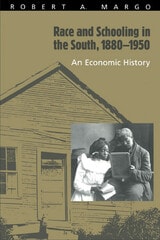
Race and Schooling in the South, 1880-1950
An Economic HistoryRobert A. Margo
University of Chicago Press, 1990
"A concise, lucid account of the bases of racial inequality in the South between Reconstruction and the Civil Rights era. . . . Deserves the careful attention of anyone concerned with historical and contemporary race stratification."—Kathryn M. Neckerman, Contemporary Sociology
"Margo has produced an excellent study, which can serve as a model for aspiring cliometricians. To describe it as 'required reading' would fail to indicate just how important, indeed indispensable, the book will be to scholars interested in racial economic differences, past or present."—Robert Higgs, Journal of Economic Literature
"Margo shows that history is important in understanding present domestic problems; his study has significant implications for understanding post-1950s black economic development."—Joe M. Richardson, Journal of American History
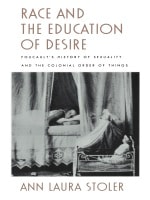
Race and the Education of Desire
Foucault's History of Sexuality and the Colonial Order of ThingsAnn Laura Stoler
Duke University Press, 1995
Drawing on Foucault’s little-known 1976 College de France lectures, Stoler addresses his treatment of the relationship between biopower, bourgeois sexuality, and what he identified as “racisms of the state.” In this critical and historically grounded analysis based on cultural theory and her own extensive research in Dutch and French colonial archives, Stoler suggests how Foucault’s insights have in the past constrained—and in the future may help shape—the ways we trace the genealogies of race.
Race and the Education of Desire will revise current notions of the connections between European and colonial historiography and between the European bourgeois order and the colonial treatment of sexuality. Arguing that a history of European nineteenth-century sexuality must also be a history of race, it will change the way we think about Foucault.
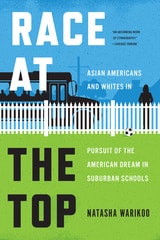
Race at the Top
Asian Americans and Whites in Pursuit of the American Dream in Suburban SchoolsNatasha Warikoo
University of Chicago Press, 2022
The American suburb conjures an image of picturesque privilege: manicured lawns, quiet streets, and—most important to parents—high-quality schools. These elite enclaves are also historically white, allowing many white Americans to safeguard their privileges by using public schools to help their children enter top colleges. That’s changing, however, as Asian American professionals increasingly move into wealthy suburban areas to give their kids that same leg up for their college applications and future careers.
As Natasha Warikoo shows in Race at the Top, white and Asian parents alike will do anything to help their children get to the top of the achievement pile. She takes us into the affluent suburban East Coast school she calls “Woodcrest High,” with a student body about one-half white and one-third Asian American. As increasing numbers of Woodcrest’s Asian American students earn star-pupil status, many whites feel displaced from the top of the academic hierarchy, and their frustrations grow. To maintain their children’s edge, some white parents complain to the school that schoolwork has become too rigorous. They also emphasize excellence in extracurriculars like sports and theater, which maintains their children’s advantage.
Warikoo reveals how, even when they are bested, white families in Woodcrest work to change the rules in their favor so they can remain the winners of the meritocracy game. Along the way, Warikoo explores urgent issues of racial and economic inequality that play out in affluent suburban American high schools. Caught in a race for power and privilege at the very top of society, what families in towns like Woodcrest fail to see is that everyone in their race is getting a medal—the children who actually lose are those living beyond their town’s boundaries.
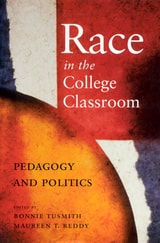
Race in the College Classroom
TuSmith, Bonnie
Rutgers University Press, 2002
Winner of the 2003 American Educational Studies Association Critics' Choice Awards
Winner of the 2003 Gustavus Myers Outstanding Book Award
Did affirmative action programs solve the problem of race on American college campuses, as several recent books would have us believe? If so, why does talking about race in anything more than a superficial way make so many students uncomfortable? Written by college instructors from many disciplines, this volume of essays takes a bold first step toward a nationwide conversation. Each of the twenty-nine contributors addresses one central question: what are the challenges facing a college professor who believes that teaching responsibly requires an honest and searching examination of race?
Professors from the humanities, social sciences, sciences, and education consider topics such as how the classroom environment is structured by race; the temptation to retreat from challenging students when faced with possible reprisals in the form of complaints or negative evaluations; the implications of using standardized evaluations in faculty tenure and promotion when the course subject is intimately connected with race; and the varying ways in which white faculty and faculty of color are impacted by teaching about race.
Race in the Multiethnic Literature Classroom
Edited by Cristina Stanciu and Gary Totten
University of Illinois Press, 2024
The contemporary rethinking and relearning of history and racism has sparked creative approaches for teaching the histories and representations of marginalized communities. Cristina Stanciu and Gary Totten edit a collection that illuminates these ideas for a variety of fields, areas of education, and institutional contexts.
The authors draw on their own racial and ethnic backgrounds to examine race and racism in the context of addressing necessary and often difficult classroom conversations about race, histories of exclusion, and racism. Case studies, reflections, and personal experiences provide guidance for addressing race and racism in the classroom. In-depth analysis looks at attacks on teaching Critical Race Theory and other practices for studying marginalized histories and voices. Throughout, the contributors shine a light on how a critical framework focused on race advances an understanding of contemporary and historical US multiethnic literatures for students around the world and in all fields of study.
Contributors: Kristen Brown, Nancy Carranza, Luis Cortes, Marilyn Edelstein, Naomi Edwards, Joanne Lipson Freed, Yadira Gamez, Lauren J. Gantz, Jennifer Ho, Shermaine M. Jones, Norell Martinez, Sarah Minslow, Crystal R. Pérez, Kevin Pyon, Emily Ruth Rutter, Ariel Santos, and C. Anneke Snyder
Race in the Schoolyard
Negotiating the Color Line in Classrooms and CommunitiesLewis, Amanda E
Rutgers University Press, 2003
"Race in the Schoolyard is a wonderful book for social scientists studying race, education, and childhood studies. The book showcases the talents of a gifted fieldworker whose theoretically rich work sits on the cutting edge of a growing body of scholarship examining the social worlds of children. School officials, parents, and, most especially, a new generation of teachers will benefit from these lessons on race."-American Journal of Sociology
"Instructors may recommend this book to students to whom the topic is surely vital and engrossing and for whom the text will be lively and engaging."-Contemporary Sociology
"Lewis moves beyond traditional research methods used to examine achievement gaps and differences in test scores to look closely at the realities of schooling. I highly recommend this work for every person involved in teaching and learning."-Multicultural Review
"Through eloquent case studies of three California elementary schools-a white-majority 'good' school, a mostly minority 'tough' school, and an integrated 'alternative' school-[Lewis] demonstrates that schools promote racial inequalities through their daily rituals and practices. Even the notion of a "color-blind" America-an especially popular ideal in the white school-perpetuates racism, Lewis argues, because it denies or dismisses the very real constraints that schools place on minorities. Lewis is nevertheless an optimist, insisting that schools can change ideas of race. . . . Highly recommended. Undergraduate collections and above."-Choice
"In this pioneering ethnography in elementary schools, Lewis shows brilliantly how racism is taught and learned in the small places of everyday life."-Joe Feagin, University of Florida and author of Racist America
"A wonderful and timely book. Ethnographically rich, theoretically sophisticated, and clearly written, this book addresses the ubiquitous issue of race in all its complexity."-Michèle Foster, author of Black Teachers on Teaching
"A compelling ethnography of the racial landscape of contemporary schools."-Barrie Thorne, author of Gender Play: Girls and Boys in School
Could your kids be learning a fourth R at school: reading, writing, 'rithmatic, and race?
Race in the Schoolyard takes us to a place most of us seldom get to see in action¾ our children's classrooms¾ and reveals the lessons about race that are communicated there. Amanda E. Lewis spent a year observing classes at three elementary schools, two multiracial urban and one white suburban. While race of course is not officially taught like multiplication and punctuation, she finds that it nonetheless insinuates itself into everyday life in schools.
Lewis explains how the curriculum, both expressed and hidden, conveys many racial lessons. While teachers and other school community members verbally deny the salience of race, she illustrates how it does influence the way they understand the world, interact with each other, and teach children. This eye-opening text is important reading for educators, parents, and scholars alike.

Race, Class, and Affirmative Action
Sigal Alon is an associate professor in the Department of Sociology and Anthropology at Tel-Aviv University.
Russell Sage Foundation, 2015
Alon finds that affirmative action at elite institutions in both countries is a key vehicle of mobility for disenfranchised students, whether they are racial and ethnic minorities or socioeconomically disadvantaged. Affirmative action improves their academic success and graduation rates and leads to better labor market outcomes. The beneficiaries of affirmative action in both countries thrive at elite colleges and in selective fields of study. As Alon demonstrates, they would not be better off attending less selective colleges instead.
Alon finds that Israel’s class-based affirmative action programs have provided much-needed entry slots at the elite universities to students from the geographic periphery, from high-poverty high schools, and from poor families. However, this approach has not generated as much ethnic diversity as a race-based policy would. By contrast, affirmative action policies in the United States have fostered racial and ethnic diversity at a level that cannot be matched with class-based policies. Yet, class-based policies would do a better job at boosting the socioeconomic diversity at these bastions of privilege. The findings from both countries suggest that neither race-based nor class-based models by themselves can generate broad diversity. According to Alon, the best route for promoting both racial and socioeconomic diversity is to embed the consideration of race within class-based affirmative action. Such a hybrid model would maximize the mobility benefits for both socioeconomically disadvantaged and minority students.
Race, Class, and Affirmative Action moves past political talking points to offer an innovative, evidence-based perspective on the merits and feasibility of different designs of affirmative action.
Race, Real Estate and Education
Inventing Gentrification in Philadelphia, 1960-2020Edward M. Epstein
Temple University Press, 2025
Epstein outlines the citywide context for the plan to create “University City” in West Philadelphia. He recounts the attempts to correct the segregation, overcrowding, and authoritarian management that plagued Philadelphia’s public schools. As the West Philadelphia Corporation, the proxy for the universities and hospitals, initiated gentrification efforts, the local community resisted and protested, causing the project to fail. The effort was revived with spectacular success, however, with the launch of the well-funded Penn Alexander School in 2001.
Race, Real Estate, and Education shows how the pursuit of urbanist ideals sometimes deepens neighborhood injustice. Epstein’s exploration of whether Philadelphia’s overall approach was beneficial or misguided presents a cautionary tale.
In the series Urban Life, Landscape, and Policy
Racial Melancholia, Racial Dissociation
On the Social and Psychic Lives of Asian AmericansDavid L. Eng and Shinhee Han
Duke University Press, 2018
Racism and Cultural Studies
Critiques of Multiculturalist Ideology and the Politics of DifferenceE. San Juan Jr.
Duke University Press, 2002
Individual chapters engage the themes of ethnicity versus racism, gender inequality, sexuality, and the politics of identity configured with the discourse of postcoloniality and postmodernism. Questions of institutional racism, social justice, democratization, and international power relations between the center and the periphery are explored and analyzed. San Juan fashions a critique of dominant disciplinary approaches in the humanities and social sciences and contends that “the racism question” functions as a catalyst and point of departure for cultural critiques based on a radical democratic vision. He also asks urgent questions regarding globalization and the future of socialist transformation of “third world” peoples and others who face oppression.
As one of the most notable cultural theorists in the United States today, San Juan presents a provocative challenge to the academy and other disciplinary institutions. His intervention will surely compel the attention of all engaged in intellectual exchanges where race/ethnicity serves as an urgent focus of concern.

Radical Collections
Re-examining the roots of collections, practices and information professionsEdited by Jordan Landes
University of London Press, 2018
Radical Hope
A Teaching ManifestoKevin M. Gannon
West Virginia University Press, 2020
Higher education has seen better days. Harsh budget cuts, the precarious nature of employment in college teaching, and political hostility to the entire enterprise of education have made for an increasingly fraught landscape. Radical Hope is an ambitious response to this state of affairs, at once political and practical—the work of an activist, teacher, and public intellectual grappling with some of the most pressing topics at the intersection of higher education and social justice.
Kevin Gannon asks that the contemporary university’s manifold problems be approached as opportunities for critical engagement, arguing that, when done effectively, teaching is by definition emancipatory and hopeful. Considering individual pedagogical practice, the students who are the primary audience and beneficiaries of teaching, and the institutions and systems within which teaching occurs, Radical Hope surveys the field, tackling everything from impostor syndrome to cell phones in class to allegations of a campus “free speech crisis.” Throughout, Gannon translates ideals into tangible strategies and practices (including key takeaways at the conclusion of each chapter), with the goal of reclaiming teachers’ essential role in the discourse of higher education.

Radical Transparency
Perspectives on Graduate Education in Writing StudiesJustin H. Cook
Utah State University Press, 2027
Radical Transparency brings together candid, powerful accounts of what it means to live, work, and labor as a graduate student in writing studies in today’s academy. At a moment when higher education is defined by precarity, burnout, widening inequities, and political uncertainty, this collection names, without sanitizing, the emotional, embodied, and institutional realities that shape graduate education.
Blending scholarly analysis with personal narrative, the chapters document graduate student experiences across writing studies, rhetoric and composition, and related fields. Contributors take up issues often rendered invisible in official program materials and institutional discourse, including disability and access, queer and crip temporalities, financial and labor precarity, mentoring breakdowns, emotional labor, care work, grief, and the hidden curricula that govern graduate life. Together, these chapters reveal how graduate students navigate systems that demand resilience while frequently withholding transparency, support, and care. Organized around three intersecting threads—navigating precarity, building networks of care, and reimagining academic work—Radical Transparency also introduces an emotional-labor tagging system that allows readers to trace recurring forms of labor and affective demand as they surface in different institutional contexts.
Whether read cover to cover or approached nonlinearly, the text invites readers to see connections accumulate—and patterns emerge. Radical Transparency is for graduate students who suspect they’re not broken. It is for faculty and administrators willing to sit with discomfort, accountability, and complicity. And it is for anyone who believes that transparency without action is insufficient and that telling the truth, collectively and aloud, is a form of resistance.
Radical Writing Center Praxis
A Paradigm for Ethical Political EngagementLaura Greenfield
Utah State University Press, 2019
Large, intersecting systems of oppression manifest in the everyday practices of institutions, classrooms, and writing centers. Local practices in turn influence the surrounding world. Radical Writing Center Praxis therefore challenges the writing center field to resist assumptions of political neutrality and instead to redefine itself in terms of more explicit ethical commitments. In this paradigm it is clear that to engage in anti-oppression work is not merely a special interest but rather a vital interest to all.
Introducing the concepts and vocabulary of radical politics, Radical Writing Center Praxis examines the tensions between the field’s professed beliefs and everyday practices and offers a process by which the writing center discipline as a whole might rebuild itself anew. It will be invaluable to writing center directors, tutors, scholars, and students as well as to administrators and compositionists.
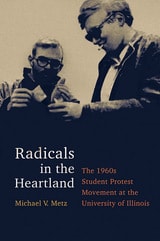
Radicals in the Heartland
The 1960s Student Protest Movement at the University of IllinoisMichael V. Metz
University of Illinois Press, 2019
Positioning the events in the context of their time, Michael V. Metz delves into the lives and actions of activists at the center of the drama. A participant himself, Metz draws on interviews, archives, and newspaper records to show a movement born in demands for free speech, inspired by a movement for civil rights, and driven to the edge by a seemingly never-ending war. If the sudden burst of irrational violence baffled parents, administrators, and legislators, it seemed inevitable to students after years of official intransigence and disregard. Metz portrays campus protesters not as angry, militant extremists but as youthful citizens deeply engaged with grave moral issues, embodying the idealism, naiveté, and courage of a minority of a generation.
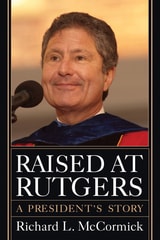
Raised at Rutgers
A President's StoryMcCormick, Richard L
Rutgers University Press, 2014
With understandable pride, McCormick recalls and relates Rutgers’s academic achievements during his presidency, including a renewed focus on undergraduate education and a significant increase in funding for research. Most dramatically, he chronicles the University’s protracted efforts to reclaim Robert Wood Johnson Medical School (and ultimately to acquire most of UMDNJ), a goal that was finally realized with crucial help from Governor Chris Christie and former governor Tom Kean.
Among the most honest accounts ever written of a college presidency, Raised at Rutgers takes the reader inside one of the best, and liveliest, public universities in America and highlights many of the most critical issues facing higher education today.
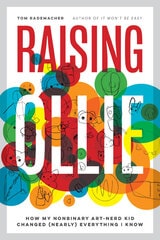
Raising Ollie
How My Nonbinary Art-Nerd Kid Changed (Nearly) Everything I KnowTom Rademacher
University of Minnesota Press, 2021
The account of one radically new school year for a Teacher of the Year and for his nonbinary, art-obsessed, brilliant child
Seven-year-old Ollie was researching local advanced school programs—because every second grader does that, right? Ollie, who used to hate weekends because they meant no school, was crying on the way to school almost every day. Sure, there were the slings and arrows of bullies and bad teachers, but, maybe worse, Ollie, a funny, anxious, smart kid with a thing for choir and an eye for graphic art, was gravely underchallenged and also struggling with identity and how to live totally as themselves. Ollie begged to switch to a new school with “kids like me,” where they wouldn’t feel so alone, or so bored, and so they made the change.
Raising Ollie is dad Tom Rademacher’s story (really, many stories) of that eventful and sometimes painful school year, parenting Ollie and relearning every day what it means to be a father and teacher. As Ollie—who is nonbinary and uses they/them pronouns, and prefers art to athletics, vegetables to cake, and animals to most humans—flourishes in their new school, Rademacher is making an eye-opening adjustment to a new school of his own, one that’s whiter and more suburban than anywhere he has previously taught, with a history of racial tension that he tries to address and navigate.
While Ollie is learning to code, 3D model, animate, speak Japanese, and finally feel comfortable at school, Rademacher increasingly sees how his own educational struggles, anxieties, and childhood upbringing are reflected in his teaching, writing, and parenting, as well as in Ollie’s experience. And with this story of one anything-but-academic year of inquiry and wonder, doubt and revelation, he shows us how raising a kid changes everything—and how much raising a kid like Ollie can teach us about who we are and what we’re doing in the world.

Raising Secular Jews
Yiddish Schools and Their Periodicals for American Children, 1917–1950Naomi Prawer Kadar
Brandeis University Press, 2016
Rank-and-File Rebels
Theories of Power and Change in the 2018 Education StrikesErin Dyke
University Press of Colorado, 2024
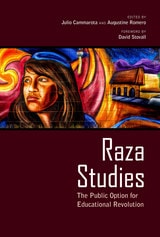
Raza Studies
The Public Option for Educational RevolutionEdited by Julio Cammarota and Augustine Romero; Foreword by David Stovall
University of Arizona Press, 2014
Inspired by Paulo Freire’s vision for critical pedagogy and Chicano activists of the 1960s, the designers of the program believed their program would encourage academic achievement and engagement by Mexican American students. With chapters by leading scholars, this volume explains how the program used “critically compassionate intellectualism” to help students become “transformative intellectuals” who successfully worked to improve their level of academic achievement, as well as create social change in their schools and communities.
Despite its popularity and success inverting the achievement gap, in 2010 Arizona state legislators introduced and passed legislation with the intent of banning MAS or any similar curriculum in public schools. Raza Studies is a passionate defense of the program in the face of heated local and national attention. It recounts how one program dared to venture to a world of possibility, hope, and struggle, and offers compelling evidence of success for social justice education programs.
Re-membering Culture
Erasure and Renewal in Hmong American EducationBic Ngo
University of Minnesota Press, 2024
The untold stories of resilience in Hmong American education
Re-membering Culture is a deep exploration of the intricate dynamics of cultural memory and education, centering the experiences of Hmong American students and educators. Arguing that the school, as a product of coloniality, perpetuates the marginalization and erasure of non-Western epistemologies, author Bic Ngo sheds light on the subtle yet impactful process of structured forgetting within the American education system. This politics of forgetting, in turn, contributes to the fragmentation of Hmong cultural heritage, identity, and community.
Based on a high school in an urban center with a considerable Hmong immigrant community, Ngo’s work draws on extensive ethnographic research with Hmong American community leaders, school administrators, parents, teachers, staff, and high school students to understand how they navigate the terrain of Western pedagogy while attempting to retain and preserve Hmong knowledge systems. Exploring a range of school experiences, Ngo traverses students’ challenges in balancing school with family life and the everyday cultural racism encountered in the classroom as well as grassroots efforts to preserve culture, including the establishment of a Hmong Cultural Club.
Highlighting these experiences and voices, Ngo provides a nuanced understanding of the challenges Hmong Americans face within an assimilationist society while contesting the dominant anti-immigrant narratives of refugee suffering and poverty. Through these practices of (re)storytelling, resurgence, and refusal, she underscores the agency of the Hmong American community, illuminating how the critical consciousness fostered by re-membering serves as a powerful tool in confronting white hegemonic ideologies in education.
Retail e-book files for this title are screen-reader friendly.
Reach Everyone, Teach Everyone
Universal Design for Learning in Higher EducationThomas J. Tobin
West Virginia University Press, 2018
Advocates for the rights of people with disabilities have worked hard to make universal design in the built environment “just part of what we do.” We no longer see curb cuts, for instance, as accommodations for people with disabilities, but perceive their usefulness every time we ride our bikes or push our strollers through crosswalks.
This is also a perfect model for Universal Design for Learning (UDL), a framework grounded in the neuroscience of why, what, and how people learn. Tobin and Behling show that, although it is often associated with students with disabilities, UDL can be profitably broadened toward a larger ease-of-use and general diversity framework. Captioned instructional videos, for example, benefit learners with hearing impairments but also the student who worries about waking her young children at night or those studying on a noisy team bus.
Reach Everyone, Teach Everyone is aimed at faculty members, faculty-service staff, disability support providers, student-service staff, campus leaders, and graduate students who want to strengthen the engagement, interaction, and performance of all college students. It includes resources for readers who want to become UDL experts and advocates: real-world case studies, active-learning techniques, UDL coaching skills, micro- and macro-level UDL-adoption guidance, and use-them-now resources.
Reaching All Writers
A Pedagogical Guide for Evolving College Writing ClassroomsJoanne Baird Giordano
Utah State University Press, 2023
Using threshold concepts and transfer as a foundation, the authors provide an invaluable resource for multiple contexts: instructors working off the tenure track and/or at multiple institutions; two-year college programs without a writing program administrator; and writing program graduate teaching assistant training courses. Each chapter includes an overview of a threshold concept, disciplinary background readings, practical teaching strategies, assignment and learning activity ideas, assessment principles, examples from student and instructor perspectives, and questions for reflection and discussion.
Reaching All Writers describes effective teaching practices to help all college writing instructors, regardless of their institutional contexts, make changes that support equitable and inclusive learning opportunities—with a focus on teaching students whose backgrounds and learning experiences are different from those with more educational or economic privilege. Both new and experienced teachers adapting first-year college writing courses will find the book’s blend of practical strategies and disciplinary knowledge a useful companion for facilitating new classroom and program needs or designing new teaching assistant training courses.
Read and Tell Stories
For parents, grandparents, aunts, uncles, and other loving adultsRosie Cutrer
Parkhurst Brothers, Inc., 2020
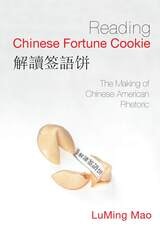
Reading Chinese Fortune Cookie
The Making of Chinese American RhetoricLuMing Mao
Utah State University Press, 2006
ecent scholarship tends to explain such influences as contributing to language hybridity---an advance over the traditional "deficit model." But Mao suggests that the "hybridity" approach is perhaps too arid or sanitized, missing rich nuances of mutual exchange, resistance, or even subversion. Through his concept of "togetherness in difference, Mao suggests that speakers of hybrid discourse may not be attempting the standard (and failing), but instead may be deliberately importing cultural material to create a distance between themselves and the standard. This practice, over time, becomes a process that transforms English, enriching and enlarging it through the infusion of non-Western discourse features, subverting power structures, and even providing unique humorous touches.
Of interest to scholars in composition, cultural studies, and linguistics as well, Reading Chinese Fortune Cookie leads in an important new direction for both our understanding and our teaching of English.
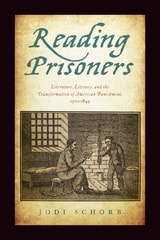
Reading Prisoners
Literature, Literacy, and the Transformation of American Punishment, 1700–1845Schorb, Jodi
Rutgers University Press, 2014
Reading Randomised Controlled Trials
Opening the BookRobert Savage, Amy Fox, Anneka Dawson, Helen Gray, and Clare Huxley
University College London, 2025
Reading Randomised Controlled Trials presents an illuminating exploration of how large-scale educational trials unfold in real-world settings, displaying the often-overlooked human decisions that shape their outcomes. Using the Flexible Phonics trial—an ambitious study involving nearly 3,000 children in 118 schools across England—as a case study, the authors examine the practical and ethical problems with conducting randomized controlled trials (RCTs) in education. Unlike pharmaceutical trials, educational RCTs operate in dynamic environments where factors such as teacher decision-making and school culture play a crucial role.
This book depicts the inner workings of education research and also underlines its broader significance, particularly in the wake of school closures during the COVID-19 pandemic. By focusing on early childhood literacy and the long-term impact of evidence-based interventions, Reading Randomised Controlled Trials provides important insights for educators and researchers seeking to bridge the gap between rigorous research and meaningful classroom practice. A must-read for those invested in improving educational outcomes, this book contests assumptions about what works in education—and why.
Reading Skills for Success
A Guide to Academic TextsThomas A. Upton and Katherine W. Brinkmeyer
University of Michigan Press, 2026
In this new edition, Reading Skills for Success continues to help students develop the reading skills and strategies they need to transition to reading material in mainstream academic settings. Designed for precollege readers and nonnative speakers of English alike, the fully revised book focuses on the text-based, linguistic preparedness necessary to quickly spot key information and organizational structure in texts and avoid miscomprehension.
Written by academic experts who are practicing teachers in ESL intensive English, the book is grounded in sound pedagogical methods. Teachers will work through specific reading strategies with students; use the general activities and sample academic chapters in the book to practice the strategies being taught; and then have the students turn to outside readings, like their academic textbooks, to practice the strategies they are learning. Accessible for teachers and students, Reading Skills for Success provides a guide for developing text-based processing skills to improve reading confidence.
In Reading Skills for Success, 2nd Edition, students will:
- Learn to use word-level clues to increase reading comprehension.
- Recognize different types of expository text structures.
- Develop study skills for intensive analytical reading of academic prose.
- Practice reading strategies for in-depth, long-term understanding of complex academic texts.
- Apply skills to excerpts from actual textbooks used in first-year college courses representing a wide variety of fields in the humanities, social sciences, and sciences.
CEFR level: A1-B1
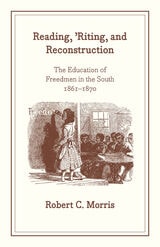
Reading, 'Riting, and Reconstruction
The Education of Freedmen in the South, 1861-1870Robert C. Morris
University of Chicago Press, 1981
This study of education for freedmen following Emancipation is the definitive treatment of the subject. Employing a wide range of sources, Robert C. Morris examines the organizations that staffed and managed black schools in the South, with particular attention paid to the activities of the Freedman’s Bureau. He looks as well at those who came to teach, a diverse group—white, black, Northern, Southern—and at the curricula and textbooks they used. While giving special emphasis to the Freedmen’s Bureau school program, Morris places the freedmen’s educational movement fully in its nineteenth-century context, relating it both to the antislavery crusade that preceded it and to the conservative era of race relations that followed.
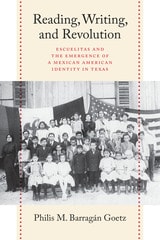
Reading, Writing, and Revolution
Escuelitas and the Emergence of a Mexican American Identity in TexasBy Philis M. Barragán Goetz
University of Texas Press, 2020
2022 National Association for Chicana and Chicano Studies Book Award
Tejas Foco Non-fiction Book Award, National Association for Chicana and Chicano Studies
2021 Tejano Book Prize, Tejano Genealogy Society of Austin
2021 Jim Parish Award for Documentation and Publication of Local and Regional History, Webb County Heritage Foundation
2021 Runner-up, Ramirez Family Award for Most Significant Scholarly Book
The first book on the history of escuelitas, Reading, Writing, and Revolution examines the integral role these grassroots community schools played in shaping Mexican American identity.
Language has long functioned as a signifier of power in the United States. In Texas, as elsewhere in the Southwest, ethnic Mexicans’ relationship to education—including their enrollment in the Spanish-language community schools called escuelitas—served as a vehicle to negotiate that power. Situating the history of escuelitas within the contexts of modernization, progressivism, public education, the Mexican Revolution, and immigration, Reading, Writing, and Revolution traces how the proliferation and decline of these community schools helped shape Mexican American identity.
Philis M. Barragán Goetz argues that the history of escuelitas is not only a story of resistance in the face of Anglo hegemony but also a complex and nuanced chronicle of ethnic Mexican cultural negotiation. She shows how escuelitas emerged and thrived to meet a diverse set of unfulfilled needs, then dwindled as later generations of Mexican Americans campaigned for educational integration. Drawing on extensive archival, genealogical, and oral history research, Barragán Goetz unravels a forgotten narrative at the crossroads of language and education as well as race and identity.

Readings in Primary Art Education
Edited by Steve Herne, Sue Cox, and Robert Watts
Intellect Books, 2009
Readings in Primary Art Education focuses on the challenges of and approaches to teaching art to primary-school students. Drawn from articles originally published in the International Journal of Art and Design, this volume gathers the work of the best scholars in the field and provides a critical framework for developing methods of teaching art to young students. Capturing the key issues and debates that are shaping both curricula and practice, Readings in Primary Art Education is an essential starting point for anyone involved in art education. This collection of essays will be a welcome addition to art and design education and will be of interest to those active in primary art and design education, including practicing teachers and scholars.
Realizing Educational Rights
Advancing School Reform through Courts and CommunitiesAnne Newman
University of Chicago Press, 2013
Newman argues that an adequate K–12 education is the right of all citizens, as a matter of equality, and emphasizes that this right must be shielded from the sway of partisan and majoritarian policy making far more than it currently is. She then examines how educational rights are realized in our current democratic structure, offering two case studies of leading types of rights-based activism: school finance litigation on the state level and the mobilization of citizens through community-based organizations. Bringing these case studies together with rich philosophical analysis, Realizing Educational Rights advances understanding of the relationships among moral and legal rights, education reform, and democratic politics.
Reasons and Feelings
Writing for the Humanities NowSarah Mesle
University of Chicago Press, 2025
Humanities experts today are embattled. In a world of crises undermining higher education at every turn, what can still motivate humanists to write? Galvanizing, imaginative, and unrepentantly nerdy, Sarah Mesle’s Reasons and Feeling offers practical writing and publishing advice alongside a forcefully affirmative account of why humanities writing matters.
Mesle proposes that writing can help envision sustainable community, but only when we recognize that humanist authority comes from both our reasons and our feelings. Alongside everyday compositional advice—including strategies for addressing different audiences, pitching publications, and managing writing anxiety—readers will find an account of how such craft practices connect to both their intellectual commitments and their historical conditions. Mesle shows how university-trained writers at all levels benefit from embracing a broader range of styles and affects. Doing so helps them harness their writing’s community-building potential and makes them better able to value their own expertise, whether they write for the classroom, in public venues, or for the specialized scholarly communities that share their niche, weird, or beloved, objects of study.
Reasons and Feelings draws on Mesle’s expertise as a professor of writing and her work as an editor helping academics shift between writing for scholarly venues and journalistic ones. In a voice that’s honest, warm, accessible, and bracingly funny, Reasons and Feelings gives humanists a path toward bolder fantasies of the worlds their writing can make.
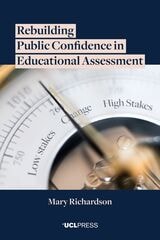
Rebuilding Public Confidence in Educational Assessment
Mary Richardson
University College London, 2022
Educational assessment is important. Yet it is easy to feel that schooling and other phases of education are shaped entirely by certain assessments and that assessment is only about exam results. The idea that grades can accurately describe the aims and outcomes of education is both reductive and pervasive. This book is about the stories we tell each other about educational assessment and how they impact public trust and confidence in educational assessment. It explains the roots and nature of assessment discourses and proposes a restructuring of the debate to rebuild public confidence. It aims to challenge dominant assessment discourses and demands a more nuanced, informed debate about what happens in and beyond schools, and how this influences public thinking. Using examples from international settings to explore the nature of trust in assessment discourses, this book shows how these discourses can be reframed so that all aspects of the assessment system—policymaking, school planning, home practice with students—can be delivered with confidence.
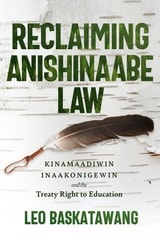
Reclaiming Anishinaabe Law
Kinamaadiwin Inaakonigewin and the Treaty Right to EducationLeo Baskatawang
University of Manitoba Press, 2023
Reclaiming Class
Women, Poverty, And The Promiseedited by Vivyan C. Adair and Sandra L. Dahlberg
Temple University Press, 2003
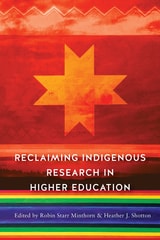
Reclaiming Indigenous Research in Higher Education
Minthorn, Robin Starr
Rutgers University Press, 2018
Recently, Native scholars have started to reclaim research through the development of their own research methodologies and paradigms that are based in tribal knowledge systems and values, and that allow inherent Indigenous knowledge and lived experiences to strengthen the research. Reclaiming Indigenous Research in Higher Education highlights the current scholarship emerging from these scholars of higher education. From understanding how Native American students make their way through school, to tracking tribal college and university transfer students, this book allows Native scholars to take center stage, and shines the light squarely on those least represented among us.
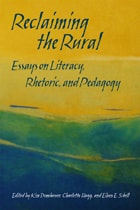
Reclaiming the Rural
Essays on Literacy, Rhetoric, and PedagogyEdited by Kim Donehower, Charlotte Hogg, and Eileen E. Schell
Southern Illinois University Press, 2012
In Reclaiming the Rural: Essays on Literacy, Rhetoric, and Pedagogy, editors Kim Donehower, Charlotte Hogg, and Eileen E. Schell bring together a diverse collection of essays that consider literacy, rhetoric, and pedagogy in the United States, Canada, and Mexico. The essays move beyond the typical arguments for preserving, abandoning, or modernizing by analyzing how rural communities sustain themselves through literate action. The contributors explore the rhetorics of water disputes in the western United States, the histories and influences of religious rhetorics in Mexico, agricultural and rural literacy curricula, the literacies of organizations such as 4-H and Academia de la Nueva Raza, and neoliberal rhetorics. Central to these examinations are the rural populations themselves, which include indigenous peoples in the rural United States, Canada, and Mexico, as well as those of European or other backgrounds.
The strength of the anthology lies in its multiple perspectives, various research sites, and the range of methodologies employed, including rhetorical analyses of economies and environments, media, and public spaces; classroom-based research; historical analysis and archival work; and qualitative research. The researchers engage the duality between the practices of everyday life in rural communities and the practices of reflecting on and making meaning.
Reclaiming the Rural reflects the continually changing, nuanced, context-dependent realities of rural life while acknowledging the complex histories, power struggles, and governmental actions that have affected and continue to affect the lives of rural citizens. This thought-provoking collection demonstrates the value in reclaiming the rural for scholarly and pedagogical analysis.