Results by title
198 books match the query 'Educational Policy & Reform' and 9 start with r
RSF
The Russell Sage Foundation Journal of the Social Sciences: The Coleman Report and Educational Inequality Fifty Years LaterKarl Alexander
Russell Sage Foundation, 2016
The issue begins with a reassessment of the EEO’s major findings. Karl Alexander analyzes the report’s conclusion that families exert greater influence on children’s school performance than the schools themselves. He finds that family, school, and neighborhood all interact to shape children’s academic development in ways that are not always separable. Other contributors investigate how racial achievement gaps have changed since the report’s release. Sean Reardon finds that disparities in average school poverty rates between white and black students’ schools are the most powerful correlate of achievement gaps. Barbara Schneider and Guan Saw show that while blacks aspire to attend college at greater rates than whites, fewer blacks than whites now attend four-year colleges in part due to lesser access to college preparation activities, such as advanced-level academic courses.
Contributors also evaluate and update the EEO’s proposals to reduce longstanding socioeconomic and racial achievement gaps. Prudence L. Carter argues that effective policies for ending racial disparities must account for inequalities within schools as well as between them. Brian Jacob and coauthors explore whether technological advances since the EEO, including online courses, have the potential to reduce some of the educational inequalities associated with residential segregation. Ruth Turley shows how renewed partnerships between education researchers and policymakers at the local, regional, and national levels can improve disadvantaged students’ educational outcomes and increase racial and economic integration. By looking forward as well as back, this issue of RSF documents what educators and scholars have learned from fifty years of social science research on educational opportunity.
RSF
The Russell Sage Foundation Journal of the Social Sciences: The Elementary and Secondary Education Act at Fifty and BeyondDavid A. Gamson
Russell Sage Foundation, 2015
The ESEA has historically enabled the federal government to address educational inequality at the local level. Among the nine articles in the issue, Erica Frankenberg and Kendra Taylor discuss how the ESEA, in conjunction with the Civil Rights Act, accelerated desegregation in the South in the 1960s by withholding federal funding from school districts that failed to integrate. Rucker C. Johnson shows that higher ESEA spending in school districts between 1965 and 1980 led to increased likelihood of high school graduation for students, and low-income students in particular. Students in districts with higher spending were also less likely to repeat grades or to be suspended from school. Yet, as Patrick McGuinn shows, the institutional and administrative capacity of the U.S. Department of Education has never been sufficient to force instructional changes at the school level. This was particularly true with the 2001 renewal of the ESEA, the No Child Left Behind Act, which linked federal funding to schools’ test-score outcomes rather than to programs designed to combat social inequalities.
The issue also investigates the unintended consequences of the ESEA and offers solutions to offset them. As Patricia Gándara and Gloria Ladson-Billings demonstrate, ESEA reforms have, in some circumstances, led to the neglect of the needs of minority students and second-language learners. Gándara shows that No Child Left Behind requires “bilingual” education programs to focus on rapid acquisition of English, often to the detriment of those learning English as a second language. Ladson-Billings shows that the ESEA’s standardized testing mandates may suppress innovative teaching methods, and argues for reforms that use multidisciplinary approaches to craft new curricula. Bringing together research on the successes and shortcomings of the ESEA, this issue of RSF offers new insights into federal education policy and demonstrates that this landmark legislation remains a powerful force in the lives of educators and students fifty years after its initial implementation.
RSF
The Russell Sage Foundation Journal of the Social Sciences: The Fiftieth Anniversary of the Kerner Commission ReportSusan T. Gooden
Russell Sage Foundation, 2018
Articles in the issue examine the extent to which the recommendations in the Kerner Report contributed to policy changes and improvements in the social and economic well-being of urban residents . In their introduction, Gooden and Myers analyze changes in socioeconomic inequality between whites and blacks over the last five decades. They find that while the black poverty rate has declined and black educational attainment has increased, disparities still remain. Additionally, the income gap and disparities in unemployment between blacks and whites remain virtually unchanged. Rick Loessberg and John Koskinen similarly note the persistence of these disparities, but also show that some of the Kerner Report’s recommendations were adopted at local levels and have provided the foundation for increased racial diversity in media, law enforcement reforms, and public housing desegregation.
Other contributors study the urban areas that were sites of the riots. Reynolds Farley shows that in Detroit, residential segregation has declined and interracial marriage has increased over the last fifty years. However, on key economic measures such as income and wealth, African Americans have fallen even further behind whites than they were in 1967 due to dramatic changes in Detroit’s labor market. In their study of wealth inequality in Los Angeles, Melany De La Cruz-Viesca and coauthors show that much of the wealth gap between blacks and whites is due to disparities in home ownership, a subject neglected in the Kerner Report. Marcus Casey and Bradley Hardy study the evolution of African American neighborhoods since the Kerner Report and find that neighborhoods directly affected by riots in the 1960s still remain among the most economically disadvantaged today.
The Kerner Report endures as a classic touchstone in the nation’s search for a path toward equality. Together, the articles in this special issue demonstrate the long-term influence of the report and show where further progress is needed to close the racial divide.
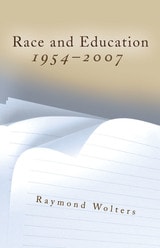
Race and Education, 1954-2007
Raymond Wolters
University of Missouri Press, 2008
In this compelling study, a scholar who has long observed the traumas of school desegregation uncovers the changes and difficulties with which public education has dealt over the last fifty years—and argues that some judicial decisions were ill-advised. Dealing candidly with matters usually considered taboo in academic discourse, Wolters argues that the Supreme Court acted correctly and in accordance with public sentiment in Brown but that it later took a wrong turn by equating desegregation with integration.
Retracing the history of desegregation and integration in America’s schools, Wolters distinguishes between several Court decisions, explaining that while Brown called for desegregation by requiring that schools deal with students on a racially nondiscriminatory basis, subsequent decisions—Green, Swann, Keyes—required actual integration through racial balancing. He places these decisions in the context of educational reform in the 1950s that sought to encourage bright students through advanced placement and honors courses—courses in which African American and Hispanic students were less likely to be enrolled. Then with the racial unrest of the 1960s, the pursuit of academic excellence yielded to concerns for uplifting disadvantaged youths and ensuring the predominance of middle-class peer groups in schools.
Wolters draws on rich historical records to document the devastating consequences of requiring racial balance and sheds new light on America’s legal, social, and cultural landscapes. He reexamines the educational theories of Kenneth Clark and James Coleman, and he challenges statistics that support the results of racial balancing by describing how school desegregation and integration actually proceeded in several towns, cities, and counties.
Race and Education is a bold challenge to political correctness in education and a corrective to the now widely accepted notion that desegregation and racially balanced integration are one and the same. It is essential reading for scholars of law and education and a wake-up call for citizens concerned about the future of America’s schools.

Race, Class, and Affirmative Action
Sigal Alon is an associate professor in the Department of Sociology and Anthropology at Tel-Aviv University.
Russell Sage Foundation, 2015
Alon finds that affirmative action at elite institutions in both countries is a key vehicle of mobility for disenfranchised students, whether they are racial and ethnic minorities or socioeconomically disadvantaged. Affirmative action improves their academic success and graduation rates and leads to better labor market outcomes. The beneficiaries of affirmative action in both countries thrive at elite colleges and in selective fields of study. As Alon demonstrates, they would not be better off attending less selective colleges instead.
Alon finds that Israel’s class-based affirmative action programs have provided much-needed entry slots at the elite universities to students from the geographic periphery, from high-poverty high schools, and from poor families. However, this approach has not generated as much ethnic diversity as a race-based policy would. By contrast, affirmative action policies in the United States have fostered racial and ethnic diversity at a level that cannot be matched with class-based policies. Yet, class-based policies would do a better job at boosting the socioeconomic diversity at these bastions of privilege. The findings from both countries suggest that neither race-based nor class-based models by themselves can generate broad diversity. According to Alon, the best route for promoting both racial and socioeconomic diversity is to embed the consideration of race within class-based affirmative action. Such a hybrid model would maximize the mobility benefits for both socioeconomically disadvantaged and minority students.
Race, Class, and Affirmative Action moves past political talking points to offer an innovative, evidence-based perspective on the merits and feasibility of different designs of affirmative action.
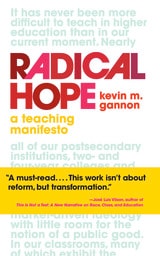
Radical Hope
A Teaching ManifestoKevin M. Gannon
West Virginia University Press, 2020
Higher education has seen better days. Harsh budget cuts, the precarious nature of employment in college teaching, and political hostility to the entire enterprise of education have made for an increasingly fraught landscape. Radical Hope is an ambitious response to this state of affairs, at once political and practical—the work of an activist, teacher, and public intellectual grappling with some of the most pressing topics at the intersection of higher education and social justice.
Kevin Gannon asks that the contemporary university’s manifold problems be approached as opportunities for critical engagement, arguing that, when done effectively, teaching is by definition emancipatory and hopeful. Considering individual pedagogical practice, the students who are the primary audience and beneficiaries of teaching, and the institutions and systems within which teaching occurs, Radical Hope surveys the field, tackling everything from impostor syndrome to cell phones in class to allegations of a campus “free speech crisis.” Throughout, Gannon translates ideals into tangible strategies and practices (including key takeaways at the conclusion of each chapter), with the goal of reclaiming teachers’ essential role in the discourse of higher education.
Realizing Educational Rights
Advancing School Reform through Courts and CommunitiesAnne Newman
University of Chicago Press, 2013
Newman argues that an adequate K–12 education is the right of all citizens, as a matter of equality, and emphasizes that this right must be shielded from the sway of partisan and majoritarian policy making far more than it currently is. She then examines how educational rights are realized in our current democratic structure, offering two case studies of leading types of rights-based activism: school finance litigation on the state level and the mobilization of citizens through community-based organizations. Bringing these case studies together with rich philosophical analysis, Realizing Educational Rights advances understanding of the relationships among moral and legal rights, education reform, and democratic politics.
Recommended Principles to Guide Academy-Industry Relationships
American Association of University Professors
University of Illinois Press, 2014
• Preserving the integrity of research and public respect for higher education
• Eliminating and managing individual and institutional financial conflicts of interest
• Maintaining unbiased hiring and recruitment policies
• Establishing grievance procedures and due process rights for faculty, graduate students, and academic professionals
• Mastering the complications of negotiations over patents and copyright
• Assuring the ethics of research involving human subjects.
In a time of dynamic change Recommended Principles to Guide Academy-Industry Relationships offers an indispensable and authoritative guide to sustaining integrity and tradition while achieving great things in twenty-first century academia.
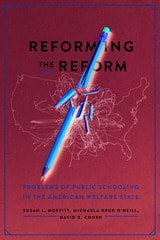
Reforming the Reform
Problems of Public Schooling in the American Welfare StateSusan L. Moffitt, Michaela Krug O'Neill, and David K. Cohen
University of Chicago Press, 2023
School reform is almost always born out of big dreams and well-meaning desires to change the status quo. But between lofty reform legislation and the students whose education is at stake, there are numerous additional policies and policymakers who determine how reforms operate. Even in the best cases, school reform initiatives can perpetuate problems created by earlier reforms or existing injustices, all while introducing new complications. In Reforming the Reform, political scientist Susan L. Moffitt, education policy scholar Michaela Krug O’Neill, and the late policy and education scholar David K. Cohen take on a wide-ranging examination of the many intricacies of school reform.
With a particular focus on policymakers in the spaces between legislation and implementation, such as the countless school superintendents and district leaders tasked with developing new policies in the unique context of their district or schools, the authors identify common problems that arise when trying to operationalize ambitious reform ideas. Their research draws on more than 250 interviews with administrators in Tennessee and California (chosen as contrasts for their different political makeup and centralization of the education system) and is presented here alongside survey data from across the United States as well as archival data to demonstrate how public schools shoulder enormous responsibilities for the American social safety net. They provide a general explanation for problems facing social policy reforms in federalist systems (including healthcare) and offer pathways forward for education policy in particular.