Results by title
76 books match the query 'Elite (Social sciences)' and 5 start with r
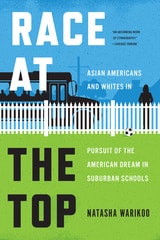
Race at the Top
Asian Americans and Whites in Pursuit of the American Dream in Suburban SchoolsNatasha Warikoo
University of Chicago Press, 2022
The American suburb conjures an image of picturesque privilege: manicured lawns, quiet streets, and—most important to parents—high-quality schools. These elite enclaves are also historically white, allowing many white Americans to safeguard their privileges by using public schools to help their children enter top colleges. That’s changing, however, as Asian American professionals increasingly move into wealthy suburban areas to give their kids that same leg up for their college applications and future careers.
As Natasha Warikoo shows in Race at the Top, white and Asian parents alike will do anything to help their children get to the top of the achievement pile. She takes us into the affluent suburban East Coast school she calls “Woodcrest High,” with a student body about one-half white and one-third Asian American. As increasing numbers of Woodcrest’s Asian American students earn star-pupil status, many whites feel displaced from the top of the academic hierarchy, and their frustrations grow. To maintain their children’s edge, some white parents complain to the school that schoolwork has become too rigorous. They also emphasize excellence in extracurriculars like sports and theater, which maintains their children’s advantage.
Warikoo reveals how, even when they are bested, white families in Woodcrest work to change the rules in their favor so they can remain the winners of the meritocracy game. Along the way, Warikoo explores urgent issues of racial and economic inequality that play out in affluent suburban American high schools. Caught in a race for power and privilege at the very top of society, what families in towns like Woodcrest fail to see is that everyone in their race is getting a medal—the children who actually lose are those living beyond their town’s boundaries.
Re-Forming the State
The Politics of Privatization in Latin America and EuropeHector E. Schamis
University of Michigan Press, 2002
The experience of privatization shows that the public and the private are neither contradictory nor mutually exclusive spheres, and that power relations between them are not necessarily zero-sum. To stress the point, the author borrows from the literature on state formation, which has extensively examined the historical processes of key private groups. The evidence presented shows why and how, by restructuring coalitional and institutional arenas, the state uses marketization to generate political order and to distribute political power. Thus, the author specifies the conditions under which political change is conceived in terms of and channeled through economic policy; in other words, how the state is "re-formed" through privatization. Re-forming the State thus highlights how privatization is simultaneously a movement from public to private, but also a movement from non-state to state, as the reduction of state assets leads to institutional changes that increase state capacities for defining and enforcing property rights, extracting revenue, and centralizing administrative and political resources.
Hector E. Schamis is Assistant Professor of Government, Cornell University.
Realignment in American Politics
Toward a TheoryEdited by Bruce A. Campbell and Richard J. Trilling
University of Texas Press, 1980
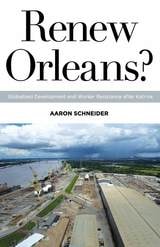
Renew Orleans?
Globalized Development and Worker Resistance after KatrinaAaron Schneider
University of Minnesota Press, 2018
Urban development after disaster, the fading of black political clout, and the onset of gentrification
Like no other American city, New Orleans since Hurricane Katrina offers powerful insight into issues of political economy in urban development and, in particular, how a city’s character changes after a disaster that spurs economic and political transition. In New Orleans, the hurricane upset an existing stalemate among rival factions of economic and political elites, and its aftermath facilitated the rise of a globally oriented faction of local capital.
In Renew Orleans? Aaron Schneider shows how some city leaders were able to access fragmented local institutions and capture areas of public policy vital to their development agenda. Through interviews and surveys with workers and advocates in construction, restaurants, shipyards, and hotel and casino cleaning, Schneider contrasts sectors prioritized during post-Katrina recovery with neglected sectors. The result is a fine-grained view of the way labor markets are structured to the advantage of elites, emphasizing how dual development produces wealth for the few while distributing poverty and exclusion to the many on the basis of race, gender, and ethnicity.
Schneider shows the way exploitation operates both in the workplace and the community, tracing working-class resistance that joins struggles for dignity at home and work. In the process, working classes and popular sectors put forth their own alternative forms of development.
Riot and Rebellion in Mexico
The Making of a Race War ParadigmAna Sabau
University of Texas Press, 2022
2023 Best Book in the Humanities, Latin American Studies Association Mexico Section
Challenging conventional narratives of Mexican history, this book establishes race-making as a central instrument for the repression of social upheaval in nineteenth-century Mexico rather than a relic of the colonial-era caste system.
Many scholars assert that Mexico’s complex racial hierarchy, inherited from Spanish colonialism, became obsolete by the turn of the nineteenth century as class-based distinctions became more prominent and a largely mestizo population emerged. But the residues of the colonial caste system did not simply dissolve after Mexico gained independence. Rather, Ana Sabau argues, ever-present fears of racial uprising among elites and authorities led to persistent governmental techniques and ideologies designed to separate and control people based on their perceived racial status, as well as to the implementation of projects for development in fringe areas of the country.
Riot and Rebellion in Mexico traces this race-based narrative through three historical flashpoints: the Bajío riots, the Haitian Revolution, and the Yucatán’s caste war. Sabau shows how rebellions were treated as racially motivated events rather than political acts and how the racialization of popular and indigenous sectors coincided with the construction of “whiteness” in Mexico. Drawing on diverse primary sources, Sabau demonstrates how the race war paradigm was mobilized in foreign and domestic affairs and reveals the foundations of a racial state and racially stratified society that persist today.