Results by title
681 books match the query 'English language' and 67 start with r
Race, Rhetoric, and Research Methods
Alexandria Lockett
University Press of Colorado, 2021
Racing Translingualism in Composition
Toward a Race-Conscious Translingualismedited by Tom Do and Karen Rowan
Utah State University Press, 2022
This collection extends the disciplinary conversations about translingualism by foregrounding the role race and racism play in the construction and maintenance of language differences. In doing so, the contributors examine the co-naturalization of race and language in order to theorize a race-conscious translingual praxis. The book begins by offering generative critiques of translingualism, centering on the ways in which the approach’s democratic orientation to language avoids issues of race, language, and power and appeals to colorblind racist tropes of equal opportunity. Following these critiques, contributors demonstrate the important intersections of race and translingualism by drawing upon voices typically marginalized by monolingual language ideologies and pedagogies. Finally, Racing Translingualism concludes by attending to the pedagogical implications of a race-conscious translingual praxis in writing and literacy education.
Making the case for race-conscious, rather than colorblind, theories and pedagogies, Racing Translingualism offers a unique take on how translingualism is theorized and practiced and moves the field forward through its direct consideration of the links between language, race, and racism.
Contributors: Lindsey Albracht, Steven Alvarez, Bethany Davila, Tom Do, Jaclyn Hilberg, Bruce Horner, Aja Martinez, Esther Milu, Stephanie Mosher, Yasmine Romero, Karen Rowan, Rachael Shapiro, Shawanda Stewart, Brian Stone, Victor Villanueva, Missy Watson
Radical Writing Center Praxis
A Paradigm for Ethical Political EngagementLaura Greenfield
Utah State University Press, 2019
Large, intersecting systems of oppression manifest in the everyday practices of institutions, classrooms, and writing centers. Local practices in turn influence the surrounding world. Radical Writing Center Praxis therefore challenges the writing center field to resist assumptions of political neutrality and instead to redefine itself in terms of more explicit ethical commitments. In this paradigm it is clear that to engage in anti-oppression work is not merely a special interest but rather a vital interest to all.
Introducing the concepts and vocabulary of radical politics, Radical Writing Center Praxis examines the tensions between the field’s professed beliefs and everyday practices and offers a process by which the writing center discipline as a whole might rebuild itself anew. It will be invaluable to writing center directors, tutors, scholars, and students as well as to administrators and compositionists.
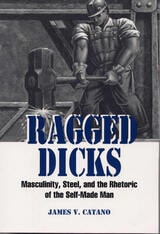
Ragged Dicks
Masculinity, Steel, and the Rhetoric of the Self-Made ManJames V. Catano
Southern Illinois University Press, 2001
Portraits of self-made men are rife in Western culture, as James V. Catano observes. Positive and negative, admittedly fictional and ostensibly factual, these portraits endure because the general rhetorical practice embodied in the myth of the self-made man enacts both the need and the very means for making oneself masculine: verbal power and prowess. The myth of the self-made man, in short, is part of ongoing rhetorical practices that constitute society, culture, and subjects.
To explain those practices and their effectiveness, Catano argues that the basic narrative achieves much of its effectiveness by engaging and enacting the traditional psychological dynamics of the family romance: preoedipal separation, oedipal conflict, and “proper” postoedipal self-definition and socialization.
To focus on the combined social, psychological, and rhetorical dynamics that constitute the ongoing activity he calls masculine self-making, Catano emphasizes a particular strand: masculinity and steelmaking. Pursuing that strand, he argues that these representations of masculine self-making are rhetorical enactments of cultural needs and desires, and that they are ongoing and formative arguments about what society and its individuals either are or should be.
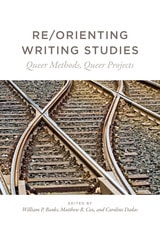
Re/Orienting Writing Studies
Queer Methods, Queer ProjectsWilliam P. Banks
Utah State University Press, 2018
While the humanities have engaged queer theory extensively, research methods have often been hermeneutic or interpretive. At the same time, social science approaches in composition research have foregrounded inquiry on human participants but have often struggled to understand where lesbian, gay, bisexual, transgender, and queer people fit into empirical research projects. Re/Orienting Writing Studies works at the intersections of humanities and social science methodologies to offer new insight into using queer methods for data collection and queer practices for framing research.
Contributors: Chanon Adsanatham, Jean Bessette, Nicole I. Caswell, Michael J. Faris, Hillery Glasby, Deborah Kuzawa, Maria Novotny, G Patterson, Stacey Waite, Stephanie West-Puckett
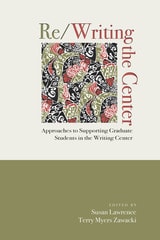
Re/Writing the Center
Approaches to Supporting Graduate Students in the Writing CenterSusan Lawrence
Utah State University Press, 2018
The essays in this volume show how to navigate the divide between traditional writing center theory and practices, developed to support undergraduate writers, and the growing demand for writing centers to meet the needs of advanced graduate writers. Contributors address core assumptions of writing center pedagogy, such as the concept of peers and peer tutoring, the emphasis on one-to-one tutorials, the positioning of tutors as generalists rather than specialists, and even the notion of the writing center as the primary location or center of the tutoring process. Re/Writing the Center offers an imaginative perspective on the benefits writing centers can offer to graduate students and on the new possibilities for inquiry and practice graduate students can inspire in the writing center.
Contributors: Laura Brady, Michelle Cox, Thomas Deans, Paula Gillespie, Mary Glavan, Marilyn Gray, James Holsinger, Elena Kallestinova, Tika Lamsal, Patrick S. Lawrence, Elizabeth Lenaghan, Michael A. Pemberton, Sherry Wynn Perdue, Doug Phillips, Juliann Reineke, Adam Robinson, Steve Simpson, Nathalie Singh-Corcoran, Ashly Bender Smith, Sarah Summers, Molly Tetreault, Joan Turner, Bronwyn T. Williams, Joanna Wolfe
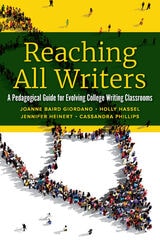
Reaching All Writers
A Pedagogical Guide for Evolving College Writing ClassroomsJoanne Baird Giordano
Utah State University Press, 2023
Using threshold concepts and transfer as a foundation, the authors provide an invaluable resource for multiple contexts: instructors working off the tenure track and/or at multiple institutions; two-year college programs without a writing program administrator; and writing program graduate teaching assistant training courses. Each chapter includes an overview of a threshold concept, disciplinary background readings, practical teaching strategies, assignment and learning activity ideas, assessment principles, examples from student and instructor perspectives, and questions for reflection and discussion.
Reaching All Writers describes effective teaching practices to help all college writing instructors, regardless of their institutional contexts, make changes that support equitable and inclusive learning opportunities—with a focus on teaching students whose backgrounds and learning experiences are different from those with more educational or economic privilege. Both new and experienced teachers adapting first-year college writing courses will find the book’s blend of practical strategies and disciplinary knowledge a useful companion for facilitating new classroom and program needs or designing new teaching assistant training courses.
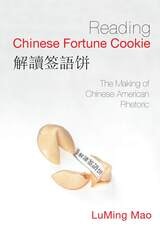
Reading Chinese Fortune Cookie
The Making of Chinese American RhetoricLuMing Mao
Utah State University Press, 2006
ecent scholarship tends to explain such influences as contributing to language hybridity---an advance over the traditional "deficit model." But Mao suggests that the "hybridity" approach is perhaps too arid or sanitized, missing rich nuances of mutual exchange, resistance, or even subversion. Through his concept of "togetherness in difference, Mao suggests that speakers of hybrid discourse may not be attempting the standard (and failing), but instead may be deliberately importing cultural material to create a distance between themselves and the standard. This practice, over time, becomes a process that transforms English, enriching and enlarging it through the infusion of non-Western discourse features, subverting power structures, and even providing unique humorous touches.
Of interest to scholars in composition, cultural studies, and linguistics as well, Reading Chinese Fortune Cookie leads in an important new direction for both our understanding and our teaching of English.
Reading Old English
A Primer and First Reader, Revised EditionROBERT HASENFRATZ
West Virginia University Press, 2010
With the immersion method dominating contemporary language learning, the knowledge of traditional grammar is at a low ebb, creating real barriers to any student wanting to learning dead or historical languages. This revised edition of Reading Old English aims to equip readers (advanced undergraduates, graduate students, and autodidacts) with the necessary tools to read the oldest recorded forms of the English language by explaining key language features clearly and methodically, without simplifying any of the core grammatical concepts. It includes a number of helpful exercises, a variety of interesting and unusual Old English texts to translate, as well as appendices covering the basics of traditional grammar and sound changes in Old English, along with an introduction to poetic structure.
Reading and Writing Instruction in the Twenty-First Century
Recovering and Transforming the Pedagogy of Robert ScholesEllen C. Carillo
Utah State University Press, 2021
In this volume, Scholes’s scholarship is included alongside original essays, providing a resource for those considering everything from the place of the English major in the twenty-first century to best practices for helping students navigate misinformation and disinformation. Reading and Writing Instruction in the Twenty-First Century not only keeps Scholes’s legacy alive but carries it on through a commitment, in Scholes’s (1998) own words, to “offer our students . . . the cultural equipment they are going to need when they leave us.”
Contributors:
Angela Christie, Paul T. Corrigan, Lynée Lewis Gaillet, Doug Hesse, Alice S. Horning, Emily J. Isaacs, Christopher La Casse, Robert Lestón, Kelsey McNiff, Thomas P. Miller, Jessica Rivera-Mueller, Christian Smith, Kenny Smith
Reading the East India Company 1720-1840
Colonial Currencies of GenderBetty Joseph
University of Chicago Press, 2003
Drawing on the British East India Company's records as well as novels, memoirs, portraiture and guidebooks, Joseph shows how the company's economic and archival practices intersected to produce colonial "fictions" or "truth-effects" that strictly governed class and gender roles—in effect creating a "grammar of power" that kept the far-flung empire intact. And while women were often excluded from this archive, Joseph finds that we can still hear their voices at certain key historical junctures. Attending to these voices, Joseph illustrates how the writing of history belongs not only to the colonial project set forth by British men, but also to the agendas and mechanisms of agency—of colonized Indian, as well as European women. In the process, she makes a valuable and lasting contribution to gender studies, postcolonial theory, and the history of South Asia.

Reading, Research, And Writing
Teaching InformationMary Snyder Broussard
Assoc of College & Research Libraries, 2017
Reagan and Public Discourse in America
Michael Weiler
University of Alabama Press, 1992
The authors show that more than any president since John F. Kennedy, Reagan’s influence flowed from his rhetorical practices. And he is remembered as having reversed certain trends and cast the U.S. on a new course. The contributors to this insightful collection of essays show that Reagan’s rhetorical tactics were matters of primary concern to his administration’s chief political strategists.
Rearticulating Writing Assessment for Teaching and Learning
Brian Huot
Utah State University Press, 2002
Brian Huot's aim for this book is both ambitious and provocative. He wants to reorient composition studies' view of writing assessment. To accomplish this, he not only has to inspire the field to perceive assessment--generally not the most appreciated area of study--as deeply significant to theory and pedagogy, he also has to counter some common misconceptions about the history of assessment in writing. In (Re)Articulating Writing Assessment, Huot advocates a new understanding, a more optimistic and productive one than we have seen in composition for a very long time. Assessment, as Huot points out, defines what is valued by a teacher or a society. What isn't valued isn't assessed; it tends to disappear from the curriculum. The dark side of this truth is what many teachers find troubling about large scale assessments, as standardized tests don't grant attention or merit to all they should. Instead, assessment has been used as an interested social mechanism for reinscribing current power relations and class systems.
Reasons and Feelings
Writing for the Humanities NowSarah Mesle
University of Chicago Press, 2025
Humanities experts today are embattled. In a world of crises undermining higher education at every turn, what can still motivate humanists to write? Galvanizing, imaginative, and unrepentantly nerdy, Sarah Mesle’s Reasons and Feeling offers practical writing and publishing advice alongside a forcefully affirmative account of why humanities writing matters.
Mesle proposes that writing can help envision sustainable community, but only when we recognize that humanist authority comes from both our reasons and our feelings. Alongside everyday compositional advice—including strategies for addressing different audiences, pitching publications, and managing writing anxiety—readers will find an account of how such craft practices connect to both their intellectual commitments and their historical conditions. Mesle shows how university-trained writers at all levels benefit from embracing a broader range of styles and affects. Doing so helps them harness their writing’s community-building potential and makes them better able to value their own expertise, whether they write for the classroom, in public venues, or for the specialized scholarly communities that share their niche, weird, or beloved, objects of study.
Reasons and Feelings draws on Mesle’s expertise as a professor of writing and her work as an editor helping academics shift between writing for scholarly venues and journalistic ones. In a voice that’s honest, warm, accessible, and bracingly funny, Reasons and Feelings gives humanists a path toward bolder fantasies of the worlds their writing can make.
Reclaiming Accountability
Improving Writing Programs through Accreditation and Large-Scale AssessmentsWendy Sharer
Utah State University Press, 2016
Reclaiming Accountability brings together a series of critical case studies of writing programs that have planned, implemented, and/or assessed the impact of large-scale accreditation-supported initiatives. The book reimagines accreditation as a way to leverage institutional or programmatic change.
Contributions to the volume are divided into three parts. Part 1 considers how specialists in composition and rhetoric can work most productively with accrediting bodies to design assessments and initiatives that meet requirements while also helping those agencies to better understand how writing develops and how it can most effectively be assessed. Parts 2 and 3 present case studies of how institutions have used ongoing accreditation and assessment imperatives to meet student learning needs through programmatic changes and faculty development. They provide concrete examples of productive curricular (part 2) and instructional (part 3) changes that can follow from accreditation mandates while providing guidance for navigating challenges and pitfalls that WPAs may encounter within shifting and often volatile local, regional, and national contexts.
In addition to providing examples of how others in the profession might approach such work, Reclaiming Accountability addresses assessment requirements beyond those in the writing program itself. It will be of interest to department heads, administrators, writing program directors, and those involved with writing teacher education, among others.
Contributors: Linda Adler-Kassner, William P. Banks, Remica Bingham-Risher, Melanie Burdick, Polina Chemishanova, Malkiel Choseed, Kyle Christiansen, Angela Crow, Maggie Debelius, Michelle F. Eble, Jonathan Elmore, Lorna Gonzalez, Angela Green, Jim Henry, Ryan Hoover, Rebecca Ingalls, Cynthia Miecznikowski, Susan Miller-Cochran, Cindy Moore, Tracy Ann Morse, Joyce Magnotto Neff, Karen Nulton, Peggy O’Neill, Jessica Parker, Mary Rist, Rochelle Rodrigo, Tulora Roeckers, Shirley K. Rose, Iris M. Saltiel, Wendy Sharer, Terri Van Sickle, Jane Chapman Vigil, David M. Weed
Reclaiming the Rural
Essays on Literacy, Rhetoric, and PedagogyEdited by Kim Donehower, Charlotte Hogg, and Eileen E. Schell
Southern Illinois University Press, 2012
In Reclaiming the Rural: Essays on Literacy, Rhetoric, and Pedagogy, editors Kim Donehower, Charlotte Hogg, and Eileen E. Schell bring together a diverse collection of essays that consider literacy, rhetoric, and pedagogy in the United States, Canada, and Mexico. The essays move beyond the typical arguments for preserving, abandoning, or modernizing by analyzing how rural communities sustain themselves through literate action. The contributors explore the rhetorics of water disputes in the western United States, the histories and influences of religious rhetorics in Mexico, agricultural and rural literacy curricula, the literacies of organizations such as 4-H and Academia de la Nueva Raza, and neoliberal rhetorics. Central to these examinations are the rural populations themselves, which include indigenous peoples in the rural United States, Canada, and Mexico, as well as those of European or other backgrounds.
The strength of the anthology lies in its multiple perspectives, various research sites, and the range of methodologies employed, including rhetorical analyses of economies and environments, media, and public spaces; classroom-based research; historical analysis and archival work; and qualitative research. The researchers engage the duality between the practices of everyday life in rural communities and the practices of reflecting on and making meaning.
Reclaiming the Rural reflects the continually changing, nuanced, context-dependent realities of rural life while acknowledging the complex histories, power struggles, and governmental actions that have affected and continue to affect the lives of rural citizens. This thought-provoking collection demonstrates the value in reclaiming the rural for scholarly and pedagogical analysis.
Reconstructing Response to Student Writing
A National Study from across the CurriculumDan Melzer
Utah State University Press, 2023
Presenting the results of a national study of teacher and peer response and student self-assessment at institutions of higher education across the United States, Melzer analyzes teacher and peer response to over 1,000 pieces of student writing as well as 128 student portfolio reflection essays. He draws on his analysis and on a comprehensive review of the literature on response to introduce a constructivist heuristic for response aimed at both composition instructors and instructors across disciplines. Melzer argues that teachers and researchers should focus less on teacher response to individual pieces of student writing and more on engaging in dialogue with student self-assessment and peer response, focusing on growth and transfer rather than products and grades.
Reconstructing Response to Student Writing, especially when taken together with Melzer’s previous book Assignments across the Curriculum, provides a comprehensive and large-scale view of college writing and responding across the curriculum in the United States.
Redefining Roles
The Professional, Faculty, and Graduate Consultant’s Guide to Writing CentersMegan Swihart Jewell
Utah State University Press, 2021
Thirty-two authors, consultants, and administrators from diverse centers—from large public four-year institutions to a private, online for-profit university—provide both theoretical frameworks and practical applications in eighteen chapters. Ten chapters focus on graduate consultants and address issues of authority, training, professional development, and mentoring, and eight focus on professional and faculty consultant training as well as specific issues of identity and authority. By sharing these voices, Redefining Roles broadens the very idea of writing centers while opening the door to more dialogue on the important role these practitioners play.
Redefining Roles is designed for writing center practitioners, scholars, and staff. It is also a necessary addition to help campus administrators in the ongoing struggle to validate the intellectually complex work that such staff performs.
Contributors: Fallon N. Allison, Vicki Behrens, Cassie J. Brownell, Matt Burchanoski, Megan Boeshart Burelle, Danielle Clapham, Steffani Dambruch, Elise Dixon, Elizabeth Festa, Will Fitzsimmons, Alex Frissell, Alex Funt, Genie Giaimo, Amanda Gomez, Lisa Lamson, Miriam E. Laufer, Kristin Messuri, Rebecca Nowacek, Kimberly Fahle Peck, Mark Pedretti, Irina Ruppo, Arundhati Sanyal, Anna Scanlon, Matthew Sharkey-Smith, Kelly A. Shea, Anne Shiell, Anna Sicari, Catherine Siemann, Meagan Thompson, Lisa Nicole Tyson, Marcus Weakley, Alex Wulff
Refiguring Prose Style
Possibilities For Writing Pedagogyedited by T. R. Johnson & Thomas Pace
Utah State University Press, 2005
For about two decades, say Johnson and Pace, the discussion of how to address prose style in teaching college writing has been stuck, with style standing in as a proxy for other stakes in the theory wars.
The traditional argument is evidently still quite persuasive to some—that teaching style is mostly a matter of teaching generic conventions through repetition and practice. Such a position usually presumes the traditional view of composition as essentially a service course, one without content of its own. On the other side, the shortcomings of this argument have been much discussed—that it neglects invention, revision, context, meaning, even truth; that it is not congruent with research; that it ignores 100 years of scholarship establishing composition's intellectual territory beyond "service."
The discussion is stuck there, and all sides have been giving it a rest in recent scholarship. Yet style remains of vital practical interest to the field, because everyone has to teach it one way or another.
A consequence of the impasse is that a theory of style itself has not been well articulated. Johnson and Pace suggest that moving the field toward a better consensus will require establishing style as a clearer subject of inquiry.
Accordingly, this collection takes up a comprehensive study of the subject. Part I explores the recent history of composition studies, the ways it has figured and all but effaced the whole question of prose style. Part II takes to heart Elbow's suggestion that composition and literature, particularly as conceptualized in the context of creative writing courses, have something to learn from each other. Part III sketches practical classroom procedures for heightening students' abilities to engage style, and part IV explores new theoretical frameworks for defining this vital and much neglected territory.
The hope of the essays here—focusing as they do on historical, aesthetic, practical, and theoretical issues—is to awaken composition studies to the possibilities of style, and, in turn, to rejuvenate a great many classrooms.
Refiguring Rhetorical Education
Women Teaching African American, Native American, and Chicano/a Students, 1865-1911Jessica Enoch
Southern Illinois University Press, 2008
Refiguring Rhetorical Education: Women Teaching African American, Native American, and Chicano/a Students, 1865-1911 examines the work of five female teachers who challenged gendered and cultural expectations to create teaching practices that met the civic and cultural needs of their students.
The volume analyzes Lydia Maria Child’s The Freedmen’s Book, a post–Civil War educational textbook for newly freed slaves; Zitkala Ša’s autobiographical essays published in the Atlantic Monthly in 1900 that questioned the work of off-reservation boarding schools for Native American students; and Jovita Idar, Marta Peña, and Leonor Villegas de Magnón’s contributions to the Spanish-language newspaper La Crónica in 1910 and 1911—contributions that offered language and cultural instruction their readers could not receive in Texas public schools.
Author Jessica Enoch explores the possibilities and limitations of rhetorical education by focusing on the challenges that Child, Zitkala Ša, Idar, Peña, and Villegas made to dominant educational practices. Each of these teachers transformed their seemingly apolitical occupation into a site of resistance, revising debilitating educational methods to advance culture-based and politicized teachings that empowered their students to rise above their subjugated positions.
Refiguring Rhetorical Education considers how race, culture, power, and language are both implicit and explicit in discussions of rhetorical education for marginalized students and includes six major tenets to guide present-day pedagogies for civic engagement.
Reflection In The Writing Classroom
Kathleen Blake Yancey
Utah State University Press, 1998
Yancey explores reflection as a promising body of practice and inquiry in the writing classroom. Yancey develops a line of research based on concepts of philosopher Donald Schon and others involving the role of deliberative reflection in classroom contexts. Developing the concepts of reflection-in-action, constructive reflection, and reflection-in-presentation, she offers a structure for discussing how reflection operates as students compose individual pieces of writing, as they progress through successive writings, and as they deliberately review a compiled body of their work-a portfolio, for example. Throughout the book, she explores how reflection can enhance student learning along with teacher response to and evaluation of student writing.
Reflection in the Writing Classroom will be a valuable addition to the personal library of faculty currently teaching in or administering a writing program; it is also a natural for graduate students who teach writing courses, for the TA training program, or for the English Education program.
Reflection-in-Motion
Reimagining Reflection in the Writing ClassroomJaclyn Fiscus-Cannaday
Utah State University Press, 2024
underrepresented viewpoints about how reflection works in the writing classroom. Jaclyn Fiscus-Cannaday examines how its availability is subject to teacher/student power dynamics, the literacies welcomed (or not) in the class, the past and present pedagogies that students are engaging with and attending to, and the interactions among humans, materials, and emotions within the rhetorical context. She adopts an intersectional feminist perspective for an inclusive view of how practitioners name, identify, and practice reflection in the everyday moments of writing classrooms.
Fiscus-Cannaday invokes a Black feminist qualitative research method that Venus Evans-Winters calls a “mosaic.” When researchers collect both traditional and nontraditional texts to create a full view of students’ and teachers’ interviews at three institutions (a Hispanic Serving Institution, a Historically Black College and University, and an Asian American Native American Pacific Islander Serving Institution), she finds that practitioners often build definitions from past experiences with reflection—and then use those definitions as terministic screens to decide if an activity can be named, identified, and practiced as reflection. These definitions hold different rhetorical effects: reflection-for-introspection, reflection-for-learning, reflection-for-mindfulness, and reflection-for-awareness.
Reflection is used for these different rhetorical effects, but because classrooms so often focus on the Westernized view and its emphasis on growth, reflection has the underused and undertheorized potential rhetorical effect of helping students investigate their identities and positionalities, acknowledge deep-rooted ideologies, and consider new perspectives so they can better work across difference. Reflection-in-Motion will inspire teachers and writing program administrators to listen to how students define and practice reflection and why—thus making room for more capacious definitions of reflection and student-centered practices of what reflection can do and be.
Reformers, Teachers, Writers
Curricular and Pedagogical InquiriesNeal Lerner
Utah State University Press, 2019
Lerner’s mixed-methods approach—quantitative, qualitative, textual, historical, narrative, and theoretical—reflects the importance and effects of curriculum in a wide variety of settings, whether in writing centers, writing classrooms, or students’ out-of-school lives, as well as the many methodological approaches available to understand curriculum in writing studies. The richness of this approach allows for multiple considerations of the distinction and relationship between pedagogy and curriculum. Chapters are grouped into three parts: disciplinary inquiries, experiential inquiries, and empirical inquiries, exploring the presence and effect of curriculum and its relationship to pedagogy in multiple sites, both historical and contemporary, and for multiple stakeholders.
Reformers, Teachers, Writers calls out writing studies’ inattention to curriculum, which hampers efforts to enact meaningful reform and to have an impact on larger conversations about education and writing. The book will be invaluable to scholars, teachers, and administrators interested in rhetoric and composition, writing studies, and education.
Reframing Rhetorical History
Cases, Theories, and MethodologiesEdited by Kathleen J. Turner and Jason Edward Black
University of Alabama Press, 2022
A collection of essays providing insights into new directions in rhetorical history
Kathleen J. Turner’s 1998 multicontributor volume Doing Rhetorical History: Concepts and Cases quickly became a foundational text in the field, and the studies in the book have served as an important roadmap for scholars undertaking such scholarship. In the decades since its publication, developments in rhetorical-historical research, engaged scholarship, and academic interventionism have changed the practice of rhetorical history tremendously.
To address this shift, Turner and Jason Edward Black have edited a much-anticipated follow-up volume: Reframing Rhetorical History: Cases, Theories, and Methodologies, which reassesses both history as rhetoric and rhetorical history as practice. This new book attends to a number of topics that have become not just hot-button issues in rhetorical scholarship but have entrenched themselves as anchors within the field. These include digital rhetoric, public memory, race and ethnicity, gender dynamics and sexualities, health and well-being, transnationalism and globalization, social justice, archival methods and politics, and colonialism and decoloniality.
The sixteen essays are divided into four major parts: “Digital Humanities and Culture” introduces methods and cases using twenty-first century technologies; “Identities, Cultures, and Archives” addresses race and gender within the contexts of critical race theory, gendered health rhetoric, race-based public memory, and class/sectionalism; “Approaches to Nationalism and Transnationalism” explores ideologies related to US and international cultures; and “Metahistories and Pedagogies” explores creative ways to approach the frame of metarhetorical history given what the field has learned since the publication of Doing Rhetorical History.
CONTRIBUTORS
Andrew D. Barnes / Jason Edward Black / Bryan Crable / Adrienne E. Hacker Daniels / Matthew deTar / Margaret Franz / Joe Edward Hatfield / J. Michael Hogan / Andre E. Johnson / Madison A. Krall / Melody Lehn / Lisbeth A. Lipari / Chandra A. Maldonado / Roseann M. Mandziuk / Christina L. Moss / Christopher J. Oldenburg / Sean Patrick O’Rourke / Daniel P. Overton / Shawn J. Parry-Giles / Philip Perdue / Kathleen J. Turner
Reframing Writing Assessment to Improve Teaching and Learning
Linda Adler-Kassner
Utah State University Press, 2010
Adler-Kassner and O'Neill show writing faculty and administrators how to frame discussions of writing assessment so that they accurately represent research-based practices, and promote assessments that are valid, reliable, and discipline-appropriate.
Public discourse about writing instruction is currently driven by ideas of what instructors and programs “need to do,” “should do,” or “are not doing,” and is based on poorly informed concepts of correctness and unfounded claims about a broad decline in educational quality. This discussion needs to be reframed, say Adler-Kassner and O'Neill, to help policymakers understand that the purpose of writing instruction is to help students develop critical thinking, reading, and writing strategies that will form the foundation for their future educations, professional careers, and civic engagement.
Reframing Writing Assessment to Improve Teaching and Learning is grounded in the best of writing assessment research, and focuses on how to communicate it effectively to publics beyond academe.
Rehearsing New Roles
How College Students Develop as WritersLee Ann Carroll
Southern Illinois University Press, 2002
In Rehearsing New Roles: How College Students Develop as Writers, Lee Ann Carroll argues for a developmental perspective to counter the fantasy held by many college faculty that students should, or could, be taught to write once so that ever after, they can write effectively on any topic, any place, any time. Carroll demonstrates in this volume why a one- or two-semester, first-year course in writing cannot meet all the needs of even more experienced writers. She then shows how students’ complex literacy skills develop slowly, often idiosyncratically, over the course of their college years, as they choose or are coerced to take on new roles as writers.
As evidence, Carroll offers a longitudinal study of a group of students and the literacy environment they experienced in a midsize, independent university. Her study follows the experiences that altered their conception of writing in college and fostered their growing capacities as writers.
Carroll’s analysis of the data collected supports a limited but still useful role for first-year composition, demonstrates how students do learn to write differently across the curriculum in ways that may or may not be recognized by faculty, and evaluates the teaching and learning practices that promote or constrain students’ development.
Reimagining Process
Online Writing Archives and the Future of Writing StudiesKyle Jensen
Southern Illinois University Press, 2015
For more than four decades, the dominant model for pedagogy and research in the field of composition has been a how-centered process approach to writing instruction, which involves studying the writing that students produce to expose the various stages of their writing process. By looking at notes, outlines, and multiple drafts, often presented by students together in the form of a portfolio, instructors can identify unproductive habits that students may have and provide techniques that help them improve their writing. In this groundbreaking volume, Kyle Jensen critiques traditional how-centered process instruction and presents a sound, practical methodology by which portfolios and online writing archives—digital interfaces that expose the marks of revision writers make during composition—might be employed to develop theories about what writing is: how it occurs, functions, circulates, creates meaning, and forms its subjects. Offering online writing archives as a way to envision a transdisciplinary approach to writing studies, Reimagining Process does not abandon the prevailing concepts of process pedagogy but rather casts them in wider contexts to conceive new ways of teaching and studying writing.
Reinventing (with) Theory in Rhetoric and Writing Studies
Essays in Honor of Sharon CrowleyAndrea Alden
Utah State University Press, 2019
For Crowley, theory is a basic building block of rhetoric “produced by and within specific times and locations as a means of opening other ways of believing or acting.” Doing theory, in this sense, is the practice of surveying the common sense of the community (doxa) and discovering the available means of persuasion (invention). The ultimate goal of doing theory is not to prescribe certain actions but to ascertain what options exist for rhetors to see the world differently, to discover new possibilities for thought and action, and thereby to effect change in the world.
The scholarship collected in Reinventing (with) Theory in Rhetoric and Writing Studies takes Crowley’s notion of theory as an invitation to develop new avenues for believing and acting. By reinventing the understanding of theory and its role in the field, this collection makes an important contribution to scholarship in rhetorical studies and writing studies. It will be valuable to scholars, teachers, and students interested in diverse theoretical directions in rhetoric and writing studies as well as in race, gender, and disability theories, religious rhetorics, digital rhetoric, and the history of rhetoric.
Publication supported in part by the Texas Tech University Humanities Center.
Contributors: Jason Barrett-Fox, Geoffrey Clegg, Kirsti Cole, Joshua Daniel-Wariya, Diane Davis, Rebecca Disrud, Bre Garrett, Catherine C. Gouge, Debra Hawhee, Matthew Heard, Joshua C. Hilst, David G. Holmes, Bruce Horner, William B. Lalicker, Jennifer Lin LeMesurier, James C. McDonald, Timothy Oleksiak, Dawn Penich-Thacker, J. Blake Scott, Victor J. Vitanza, Susan Wyche
Relations
An Anthropological AccountMarilyn Strathern
Duke University Press, 2020
Relevant Linguistics, Second Edition, Revised and Expanded
An Introduction to the Structure and Use of English for TeachersPaul W. Justice
CSLI, 2004
Each chapter of Relevant Linguistics leads students through descriptive analysis, helps them grasp linguistic concepts, and provides them with the reference materials necessary for their own teaching. This second edition contains more exercises as well as expanded and clarified explanations of the issues discussed in the first edition. Also included are more references to areas such as the history of English and semantics.
Relevant Linguistics
An Introduction to the Structure and Use of English for TeachersPaul W. Justice
CSLI, 2001
Remixing Composition
A History of Multimodal Writing PedagogyJason Palmeri
Southern Illinois University Press, 2012
Using the concept of the remix, Palmeri outlines practical pedagogical suggestions for how writing teachers can build upon this heritage with digital activities, assignments, and curricula that meet the needs of contemporary students. He details a pluralist vision of composition pedagogy that explains the ways that writing teachers can synthesize expressivist, cognitive, and social-epistemic approaches.
Palmeri reveals an expansive history of now forgotten multimodal approaches to composing moving images and sounds and demonstrates how current compositionists can productively remix these past pedagogies to address the challenges and possibilities of the contemporary digital era. A strikingly original take on the recent history of composition, Remixing Composition is an important work for the future of writing instruction in a digital age.
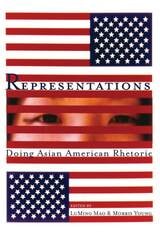
Representations
Doing Asian American RhetoricLuMing Mao and Morris Young
Utah State University Press, 2008
Mao, Young, and their contributors propose that Asian American discourse should be seen as a spacious form, one that deliberately and selectively incorporates Asian “foreign-ness” into the English of Asian Americans. These authors offer the concept of a dynamic “togetherness-in-difference” as a way to theorize the contact and mutual influence. Chapters here explore a rich diversity of histories, theories, literary texts, and rhetorical practices. Collectively, they move the scholarly discussion toward a more nuanced, better balanced, critically informed representation of the forms of Asian American rhetorics and the cultural work that they do.
Reproducing Rape
Domination through Talk in the CourtroomGregory M. Matoesian
University of Chicago Press, 1993
Matoesian examines the language of the courtroom, focusing on how defense lawyers interpret and classify rape in a way that makes the victim's experience appear as a normal sexual encounter. He analyzes the language that defense attorneys use in cross-examination to argue that courtroom talk can shape the victim's testimony to fit male standards of legitimate sexual practice. On this view, cross-examination is an adversarial war of words through which lawyers manipulate reality and perpetuate the patriarchal domination of women.
Reproducing Rape will interest students and professionals in law, criminology, sociology, feminist theory, linguistics, and anthropology.
Reprogrammable Rhetoric
Critical Making Theories and Methods in Rhetoric and CompositionMichael J. Faris
Utah State University Press, 2022
This collection offers nuanced theoretical perspectives on material and cultural rhetorics alongside practical tutorials for students, researchers, and teachers to explore critical making across traditional areas such as wearable sensors, Arduinos, Twitter bots, multimodal pedagogy, Raspberry Pis, and paper circuitry, as well as underexplored areas like play, gaming, text mining, bots, and electronic monuments.
Designed to be taught in upper division undergraduate and graduate classrooms, these tutorials will benefit non-expert and expert critical makers alike. All contributed codes and scripts are also available on Utah State University Press’s companion website to encourage downloading, cloning, and repurposing.
Contributors: Aaron Beveridge, Kendall Gerdes, Kellie Gray, Matthew Halm, Steven Hammer, Cana Uluak Itchuaqiyaq, John Jones, M.Bawar Khan, Bree McGregor, Sean Morey, Ryan Omizo, Andrew Pilsch, David Rieder, David Sheridan, Wendi Sierra, Nicholas Van Horn

Repurposing Composition
Feminist Interventions for a Neoliberal AgeShari J. Stenberg
Utah State University Press, 2015
In Repurposing Composition, Shari J. Stenberg responds to the increasing neoliberal discourse of academe through the feminist practice of repurposing. In doing so, she demonstrates how tactics informed by feminist praxis can repurpose current writing pedagogy, assessment, public engagement, and other dimensions of writing education.
Stenberg disrupts entrenched neoliberalism by looking to feminism’s long history of repurposing “neutral” practices and approaches to the rhetorical tradition, the composing process, and pedagogy. She illuminates practices of repurposing in classroom moments, student writing, and assessment work, and she offers examples of institutions, programs, and individuals that demonstrate a responsibility approach to teaching and learning as an alternative to top-down accountability logic.
Repurposing Composition is a call for purposes of work in composition and rhetoric that challenge neoliberal aims to emphasize instead a public-good model that values difference, inclusion, and collaboration.
Rescuing the Subject, 2nd Edition
A Critical Introduction to Rhetoric and the WriterSusan Miller. Foreword by Thomas P. Miller
Southern Illinois University Press, 2004
When it was first published in 1989, Susan Miller’s Rescuing the Subject: A Critical Introduction to Rhetoric and the Writer established a landmark pedagogical approach to composition based on the importance of the writer and the act of writing in the history of rhetoric. Widely used as an introduction to rhetoric and composition theory for graduate students, the volume was the first winner of the W. Ross Winterowd Award from JAC and is still one of the most frequently cited books in the field.
This first paperback edition includes a new introductory chapter in which Miller addresses changes in the field since the first edition, outlines new research, and surveys positions she no longer supports. A new foreword by Thomas P. Miller assesses the proven impact of Rescuing the Subject on the field of rhetoric and composition.
Situating modern composition theory in the historical context of rhetoric, Miller notes that throughout the eighteenth century, rhetoric referred to oral, not written, discourse. By contrast, her history of rhetoric contends oral and written discourse were related from the beginning. Taking a thematic rather than chronological approach, she shows how actual acts of writing comment on both rhetoric and composition.
Miller also asserts that contemporary composition study is the necessary cultural outcome of changing conditions for producing discourse, describing the history of rhetoric as the gradual and unstable relocation of discourse in conventions that only written language can create. She maintains teachers and historians of rhetoric must recognize that the contemporary writing they analyze and teach demands their attention to a “textual rhetoric” that allows theorizing the writer as always symbolically a student of situated meanings.
Researching Writing
An Introduction to Research MethodsJoyce Kinkead
Utah State University Press, 2016
Author Joyce Kinkead lays out the research process, including finding and defining questions, planning, and starting the research. Expository content introduces the language and methods of writing research, and specific methods are demonstrated in published examples, illustrating student work using student work and showing that it is possible for students to join the scholarly conversation in writing studies. Other features include student activities, instructor resources, student resources, and links to external content on journal websites, digital publications, YouTube, and similar work.
The first-ever textbook for research methods in writing studies for undergraduates, Researching Writing takes a hands-on approach that excites and engages students in the depth and complexities of research and will influence the creation of courses in new writing majors as the field continues to grow.
Response to Reform
Composition and the Professionalization of TeachingMargaret J. Marshall
Southern Illinois University Press, 2003
Response to Reform: Composition and the Professionalization of Teaching critiques the politics of labor and gender biases inherent in the composition workplace that prevent literacy teachers from attaining professional status and respect. Scrutinizing the relationship between scholarship and teaching, Margaret J. Marshall calls for a reconceptualization of what it means to prepare for and enter the field of composition instruction.
Interrogating the approach the education system takes to certify teachers without actually “professionalizing” their careers, Marshall contends that these programs rely on outdated rhetorics of labor that only widen the gap between teaching and other professional jobs. Such attempts to re-educate literacy teachers exploit and marginalize their work, and thus prevent them from claiming the status of academic professionals. In providing an overview of the history of and language used to literacy instruction, she also points out that while women are overrepresented in composition instruction, they are underrepresented in tenure track and administrative positions.
To correct and combat these inequities, Marshall advocates an alternate alignment of power structures and rhetorical choices. In a wide-ranging survey that sheds new light on the composition workplace as well as higher education at large, Response to Reform: Composition and the Professionalization of Teaching boldly asks us to do away with the reductive language we inherit from the past that characterize teaching and professionalization, as well as our customary responses to public criticism of education. The result is a new articulation of composition as a meritorious profession.
Retention, Persistence, and Writing Programs
Todd Ruecker
Utah State University Press, 2017
From scholars working in a variety of institutional and geographic contexts and with a wide range of student populations, Retention, Persistence, and Writing Programs offers perspectives on how writing programs can support or hinder students’ transitions to college. The contributors present individual and program case studies, student surveys, a wealth of institutional retention data, and critical policy analysis.
Rates of student retention in higher education are a widely acknowledged problem: although approximately 66 percent of high school graduates begin college, of those who attend public four-year institutions, only about 80 percent return the following year, with 58 percent graduating within six years. At public two-year institutions, only 60 percent of students return, and fewer than a third graduate within three years. Less commonly known is the crucial effect of writing courses on these statistics.
First-year writing is a course that virtually all students have to take; thus, writing programs are well-positioned to contribute to larger institutional conversations regarding retention and persistence and should offer themselves as much-needed sites for advocacy, research, and curricular innovation. Retention, Persistence, and Writing Programs is a timely resource for writing program administrators as well as for new writing teachers, advisors, administrators, and state boards of education.
Contributors: Matthew Bridgewater, Cristine Busser, Beth Buyserie, Polina Chemishanova, Michael Day, Bruce Feinstein, Patricia Freitag Ericsson, Nathan Garrett, Joanne Baird Giordano, Tawanda Gipson, Sarah E. Harris, Mark Hartlaub, Holly Hassel, Jennifer Heinert, Ashley J. Holmes, Rita Malenczyk, Christopher P. Parker, Cassandra Phillips, Anna Plemons, Pegeen Reichert Powell, Marc Scott, Robin Snead, Sarah Elizabeth Snyder, Sara Webb-Sunderhaus, Susan Wolff Murphy
Rethinking Peer Review
Critical Reflections on a Pedagogical PracticePhoebe Jackson
University Press of Colorado, 2024
Rethinking Your Writing
Rhetoric for Reflective WritersE. Shelley Reid
University Press of Colorado, 2025
Created from the start as an online book, Rethinking also helps support instructors as they engage students with many kinds of writing tasks, from typical first-year assignments like narratives and research-based arguments to writing that happens in response to more complex rhetorical situations, such as community-based writing, writing in multiple genres, and writing across disciplines:
- The modular, cross-linked design helps faculty assign and students locate information needed for any writing situation.
- In-depth, student-friendly sections guide students’ thinking on vital but less visible elements of writing, such as threshold concepts, rhetorical analysis, reflective practice, peer review, writers’ dispositions, critical reading, research processes, and questions of equity.
- A book-wide focus on how writers choose their approaches based on their goals, resources, and constraints supports learners who are exploring new genres and audiences, and lays the groundwork for discussion of how writers use tools like Generative AI.
- More than 70 innovative writing exercises help writers explore and practice relevant strategies.
In Rethinking Your Writing, E. Shelley Reid provides a versatile guide that can be tailored to the needs of almost any course or classroom. Whether you select a single module to supplement your current resources or use the text throughout your course, this book is designed to help you engage your students and deepen their understanding of how writers learn and succeed in school, their careers, and beyond.
Revising Moves
Writing Stories of (Re)MakingChristina LaVecchia
Utah State University Press, 2024
In these narrative-driven essays written by a wide range of writing professionals, Revising Moves describes revision as a messy, generative, and often collaborative act. These meditations reveal how revision is both a micro practice tracked by textual change and a macro phenomenon rooted in family life, institutional culture, identity commitments, and political and social upheaval. Contributors depict revision as a holistic undertaking and a radically contextualized, distributed practice that showcases its relationality to everything else. Authors share their revision processes when creating scholarly works, institutional and self-promoting documents, and creative projects. Through narrative the volume opens a window to what is often unseen in a finished text: months or years of work, life events that disrupt or alter writing plans, multiple draft changes, questions about writerly identity and positionality, layers of (sometimes contradictory) feedback, and much more.
Revisionary Rhetoric, Feminist Pedagogy, and Multigenre Texts
Julie Jung
Southern Illinois University Press, 2005
In this precise and provocative treatise, Julie Jung augments the understanding and teaching of revision by arguing that the process should entail changing attitudes rather than simply changing texts. Revisionary Rhetoric, Feminist Pedagogy, and Multigenre Texts proposes and demonstrates alternative ways of reading, writing, and teaching that hear silences in such a way as to generate personal, pedagogical, and professional revisions. As both a challenge to prevailing revision pedagogies and an elaboration of contemporary feminist rhetorics, the volume encourages students and instructors to examine their identities as scholars of rhetoric and composition and to question how and why revision is taught.
Jung analyzes feminist texts to identify a revisionary rhetoric that is, at its core, most concerned with creating a space in which to engage productively with issues of difference. This synthesis of feminist theory and revision studies yields a pedagogically useful definition of feminist rhetoric, through which Jung examines the insights afforded by multigenre texts in various related contexts: the academic essay, the discipline of rhetoric and composition studies, feminist composition, and the subfields of English studies including rhetoric and composition, literature, and creative writing. Jung illustrates how multigenre texts demand innovative methods of inquiry because they do not fit the conventions of any single genre. Because genre is inextricably tied to the construction of social identity, she explains, multigenre texts also offer a means for understanding and revising disciplinary identity.
Boldly making a case for the revisionary power of multigenre texts, Jung retheorizes revision as a process of disrupting textual clarity so that differences can be identified, contended with, and perhaps understood. Revisionary Rhetoric, Feminist Pedagogy, and Multigenre Texts makes great strides towards defining feminist rhetoric and ascertaining how revision can be theorized, not just practiced. Jung also provides a multigenre epilogue that explores the usefulness of reconceiving revision as a progression towards wholeness rather than perfection.
Revisiting Racialized Voice
African American Ethos in Language and LiteratureDavid G. Holmes
Southern Illinois University Press, 2004
Revisiting Racialized Voice:African American Ethos in Language and Literature argues that past misconceptions about black identity and voice, codified from the 1870s through the 1920s, inform contemporary assumptions about African American authorship and ethos. Tracing elements of racial consciousness in the works of Frederick Douglass, Charles Chesnutt, W. E. B. DuBois, Zora Neale Hurston, and others, David G. Holmes urges a revisiting of narratives from this period to strengthen and advance notions about racialized writing and to shape contemporary composition pedagogies.
Pointing to the intersection of African American identity, literature, and rhetoric, Revisiting Racialized Voice begins to construct rhetorically workable yet ideologically flexible definitions of black voice. Holmes maintains that political pressure to embrace“color blindness” endangers scholars’ ability to uncover links between racialized discourses of the past and those of the present, and he calls instead for a reassessment of the material realities and theoretical assumptions race represents and with which it has been associated.
Rewired
Research-Writing Partnerships Within TheRandall McClure
Assoc of College & Research Libraries, 2016
Reworking English in Rhetoric and Composition
Global Interrogations, Local InterventionsEdited by Bruce Horner and Karen Kopelson
Southern Illinois University Press, 2014
In Reworking English in Rhetoric and Composition, editors Bruce Horner and Karen Kopelson gather leading scholars and new voices in the field of rhetoric and composition to offer a dynamic new perspective on English as it is used today. This provocative volume explores the myriad ways in which English is constantly redefined, revised, and redirected through specific, located acts of writing, rhetoric, teaching, and learning. Contributors provide insightful contributions to the study of English from both national and international perspectives, revealing the language as a fluid and constantly changing manner of expression that challenges established notions.
In part one, “Reworking Language,” writers call into question the idea of language as a static, stable entity. In part two, “Locations and Migrations: Global/Local Interrogations,” contributors explore the impact of writing and teaching English in both in the United States and abroad, from Arkansas and Oklahoma to China, Jamaica, and Lebanon. Part three, “Pedagogical/Institutional Interventions,” addresses English in institutional settings and the implications for future pedagogical work. Each essay in this revolutionary volume substantiates two key premises for the rethinking of English: first, that languages are susceptible to constant change through the very acts of writing, teaching, and learning, and second, that this reworking occurs as it moves between various temporal and spatial locations.
Throughout the volume, the variety and flexibility of English across the globe are both advocated and revealed, rejecting dominant Anglophone perspectives and instead placing language in cross-cultural contexts. Brimming with informative and thought-provoking insights, Reworking English in Rhetoric and Composition breathes new life into the field and provides direction for scholars and teachers looking to the future of English.
Rewriting Composition
Terms of ExchangeBruce Horner
Southern Illinois University Press, 2016
Each chapter of Rewriting Composition focuses on one key term, discussing how limitations set by dominant definitions shape and direct what compositionists do and how they think about their work. The first chapter, “Composition,” critiques a discourse of composition as lacking and therefore as in need of being either put to an end, renamed, aligned with other fields, or supplemented with work in other disciplines or other forms of composition. Rather than seeing composition as something to be abandoned, replaced, or supplemented, Horner suggests ways of productively engaging with the ordinary work of composition whose ostensible lack is assumed in the dominant discourse. Subsequent chapters apply this reconsideration to other key terms, critiquing dominant conceptions of “language” and English as stable; examining how “labor” in composition is divorced from the productive force of social relations to which language work contributes; rethinking the terms of value by which the labor of composition teachers, administrators, and students is measured; and questioning the application of conventional definitions of professional academic disciplinarity to composition. By exposing limitations in dominant conceptions of the work of composition and by modeling and opening up space for new conceptions of key terms, Rewriting Composition offers teachers of composition and rhetoric, writing scholars, and writing program administrators the critical tools necessary for charting the future of composition studies.
Rewriting
How To Do Things With TextsJoseph Harris
Utah State University Press, 2006
"Like all writers, intellectuals need to say something new and say it well. But unlike many other writers, what intellectuals have to say is bound up with the books we are reading . . . and the ideas of the people we are talking with."
What are the moves that an academic writer makes? How does writing as an intellectual change the way we work from sources? In Rewriting, a textbook for the undergraduate classroom, Joseph Harris draws the college writing student away from static ideas of thesis, support, and structure, and toward a more mature and dynamic understanding. Harris wants college writers to think of intellectual writing as an adaptive and social activity, and he offers them a clear set of strategies—a set of moves—for participating in it.