162 books match the query 'Europe, Eastern' and 12 start with r

cover of Race and Photography: Racial Photography as Scientific Evidence, 1876-1980

Race and Photography

Racial Photography as Scientific Evidence, 1876-1980

Amos Morris-Reich

University of Chicago Press, 2015

Race and Photography studies the changing function of photography from the 1870s to the 1940s within the field of the “science of race,” what many today consider the paradigm of pseudo-science. Amos Morris-Reich looks at the ways photography enabled not just new forms of documentation but new forms of perception. Foregoing the political lens through which we usually look back at race science, he holds it up instead within the light of the history of science, using it to explore how science is defined; how evidence is produced, used, and interpreted; and how science shapes the imagination and vice versa.
           
Exploring the development of racial photography wherever it took place, including countries like France and England, Morris-Reich pays special attention to the German and Jewish contexts of scientific racism. Through careful reconstruction of individual cases, conceptual genealogies, and patterns of practice, he compares the intended roles of photography with its actual use in scientific argumentation. He examines the diverse ways it was used to establish racial ideologies—as illustrations of types, statistical data, or as self-evident record of racial signs. Altogether, Morris-Reich visits this troubling history to outline important truths about the roles of visual argumentation, imagination, perception, aesthetics, epistemology, and ideology within scientific study.  

[more]
cover of Races to Modernity: Metropolitan Aspirations in Eastern Europe, 1890–1940

Races to Modernity

Metropolitan Aspirations in Eastern Europe, 1890–1940

Martin Kohlrausch

Central European University Press, 2014

The comparative presentation of the birth of metropolises like St. Petersburg, Helsinki, Kiev, Belgrade, or Athens confirms the importance of the Western model as well as the influence of international experts on city planning at the periphery of Europe. In addition, this volume presents an alternative perspective that aims to understand the genesis of Eastern European cities with a metropolitan character or metropolitan aspirations as a process sui generis. The rapid expansion of metropolitan cities such as London and Paris began in the 17th and 18th centuries. Large parts of Central and Eastern Europe underwent urbanization and industrialization with considerable delay. Nevertheless beginning in the second half of the 19th century, the towns in the Romanov and Habsburg empires, as well as in the Balkans grew into cities and metropolitan areas. They changed at an astonishing pace. This transformation has long been interpreted as an attempt to overcome the economic and cultural backwardness of the region and to catch up to Western Europe.
[more]
cover of Red Army Red: Poems

Red Army Red

Poems

Jehanne Dubrow

Northwestern University Press, 2012

Displaying a sure sense of craft and a sharp facility for linking personal experience to the public realms of history and politics, Jehanne Dubrow’s Red Army Red chronicles the coming of age of a child of American diplomats in Eastern Europe in the 1980s. In the last moments of the Cold War, Poland—the setting for many of the poems—lurches fitfully from a society characterized by hardship and deprivation toward a free-market economy. The contradictions and turmoil generated by this transition are the context in which an adolescent girl awakens to her sexuality. With wit and subtlety, Dubrow makes apparent the parallels between the body and the body politic, between the fulfillment of individual and collective desires.
[more]
cover of Red Hangover: Legacies of Twentieth-Century Communism

Red Hangover

Legacies of Twentieth-Century Communism

Kristen Ghodsee

Duke University Press, 2017

In Red Hangover Kristen Ghodsee examines the legacies of twentieth-century communism twenty-five years after the Berlin Wall fell. Ghodsee's essays and short stories reflect on the lived experience of postsocialism and how many ordinary men and women across Eastern Europe suffered from the massive social and economic upheavals in their lives after 1989. Ghodsee shows how recent major crises—from the Russian annexation of Crimea and the Syrian Civil War to the rise of Islamic State and the influx of migrants in Europe—are linked to mistakes made after the collapse of the Eastern Bloc when fantasies about the triumph of free markets and liberal democracy blinded Western leaders to the human costs of "regime change." Just as the communist ideal has become permanently tainted by its association with the worst excesses of twentieth-century Eastern European regimes, today the democratic ideal is increasingly sullied by its links to the ravages of neoliberalism. An accessible introduction to the history of European state socialism and postcommunism, Red Hangover reveals how the events of 1989 continue to shape the world today.
[more]
cover of Religion and Nationalism in Soviet and East European Politics

Religion and Nationalism in Soviet and East European Politics

Pedro Ramet, ed.

Duke University Press, 1988
Religious organizations in many countries of the communist world have served as agents for the preservation, defense, and reinforcement of nationalist feelings, and in playing this role have frequently been a source of frustration to the Communist Party elites. Although the relationship between governments and religious groups varies according to the particular country and group in question, the mosaic of these relationships constitutes a revealing picture of the political reform shaping the lives of Soviet and East European citizens.
[more]
cover of Reluctant Realists: The CDU/DSU and West German Ostpolitik

Reluctant Realists

The CDU/DSU and West German Ostpolitik

Clay Clemens

Duke University Press, 1989
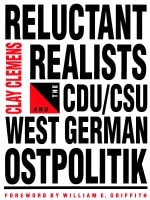
This is a study of the evolution of the West German Christian Democratic Union/Christian Social Union (CDU/CSU) approach to relations with the Soviet bloc (and particularly East Germany), from fierce antagonism to any accommodation with Communist regimes in 1969 to the growing acceptance of the necessity for rapprochement in the 1980s. Clay Clemens, basing his analyses on interviews with leading political figures as well as on party documents, examines the party’s changing ostpolitik position during the period in which it was in opposition (1969-82) and assesses the factors—international, domestic, and interparty—that brought about a change in that policy. A concluding section deals with events since 1982.
[more]
cover of Remaining Relevant after Communism: The Role of the Writer in Eastern Europe

Remaining Relevant after Communism

The Role of the Writer in Eastern Europe

Andrew Baruch Wachtel

University of Chicago Press, 2005

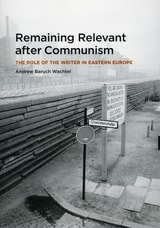
More than any other art form, literature defined Eastern Europe as a cultural and political entity in the second half of the twentieth century. Although often persecuted by the state, East European writers formed what was frequently recognized to be a "second government," and their voices were heard and revered inside and outside the borders of their countries. This study by one of our most influential specialists on Eastern Europe considers the effects of the end of communism on such writers.

According to Andrew Baruch Wachtel, the fall of the Berlin Wall and the creation of fledgling societies in Eastern Europe brought an end to the conditions that put the region's writers on a pedestal. In the euphoria that accompanied democracy and free markets, writers were liberated from the burden of grandiose political expectations. But no group is happy to lose its influence: despite recognizing that their exalted social position was related to their reputation for challenging political oppression, such writers have worked hard to retain their status, inventing a series of new strategies for this purpose. Remaining Relevant after Communism considers these strategies—from pulp fiction to public service—documenting what has happened on the East European scene since 1989.
[more]
cover of Remembering Communism: Private and Public Recollections of Lived Experience in Southeast Europe

Remembering Communism

Private and Public Recollections of Lived Experience in Southeast Europe

Contributors: Simina Bădica, Iskra Baeva, Tanya Boneva, Corina Cimpoieru, Liliana Deyanova, Albena Hranova, Nataliya Hristova, Petya Kabakchieva, Evgenia Kalinova, Anny Kirilova, Thomas Lindenberger, Tamás Lőnhárt, Izabella Main, Tsvetana Manova, Iliiana Marcheva, Vasil Markov, Andi Mihalache, Cătălina Mihalache, Milla Mineva, Cristina Petrescu, Dragoş Petrescu, Vania Stoyanova, Virgiliu Ţârău, Nikolai Vukov, Smaranda Vultur

Central European University Press, 2014

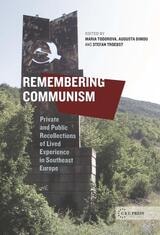
Remembering Communism examines the formation and transformation of the memory of communism in the post-communist period. The majority of the articles focus on memory practices in the post-Stalinist era in Bulgaria and Romania, with occasional references to the cases of Poland and the GDR. Based on an interdisciplinary approach, including history, anthropology, cultural studies and sociology, the volume examines the mechanisms and processes that influence, determine and mint the private and public memory of communism in the post-1989 era. The common denominator to all essays is the emphasis on the process of remembering in the present, and the modalities by means of which the present perspective shapes processes of remembering, including practices of commemoration and representation of the past.

The volume deals with eight major thematic blocks revisiting specific practices in communism such as popular culture and everyday life, childhood, labor, the secret police, and the perception of “the system”.
[more]
cover of Remembrance, History, and Justice: Coming to terms with traumatic pasts in democratic societies

Remembrance, History, and Justice

Coming to terms with traumatic pasts in democratic societies

Bogdan C. Iacob

Central European University Press, 2015
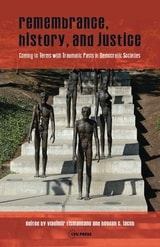
The twentieth century has left behind a painful and complicated legacy of massive trauma, monstrous crimes, radical social engineering, or collective/individual guilt syndromes that were often the premises for and the specters haunting the process of democratization in the various societies that emerged out of these profoundly de-structuring contexts. The present manuscript is a state of the art reassessment and analysis of how the interplay between memory, history, and justice generates insight that is multifariously relevant for comprehending the present and future of democracy without becoming limited to a Europe-centric framework of understanding. The manuscript is structured on three complementary and interconnected trajectories: the public use of history, politics of memory, and transitional justice. Key words 1. Europe, Eastern—Politics and government—1989– 2. Collective memory—Europe,Eastern. 3. Memory—Political aspects—Europe, Eastern. 4. Democratization—Social aspects—Europe, Eastern. 5. Europe, Eastern—Historiography—Socialaspects. 6. Europe, Eastern—Historiography—Political aspects. 7. Social justice—Europe, Eastern. 8. Post-communism—Europe, Eastern. 9. Fascism—Socialaspects—Europe, Eastern. 10. Dictatorship—Social aspects—Europe, Eastern.
[more]
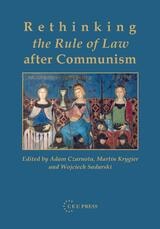
cover of Rethinking the Rule of Law after Communism

Rethinking the Rule of Law after Communism

Wojciech Sadurski

Central European University Press, 2005

In the original euphoria that attended the virtually simultaneous demise of so many dictatorships in the late 1980s and early 90s, there was a widespread belief that problems of 'transition' basically involved shedding a known past, and replacing it with an also-known future. This volume surveys and contributes to the prolific debates that occurred in the years between the collapse of communism and the enlargement of the European Union regarding the issues of constitutionalism, dealing with the past, and the rule of law in the post-communist world. Eminent scholars explore the issue of transitional justice, highlighting the distinct roles of legal and constitutional bodies in the post-transition period. The introduction seeks to frame the work as an intervention in the discussion of communism and transition-two stable and separate points-while emphasizing the instability of the post-transition moment.
[more]
cover of Retuning Culture: Musical Changes in Central and Eastern Europe

Retuning Culture

Musical Changes in Central and Eastern Europe

Mark Slobin

Duke University Press, 1996

As a measure of individual and collective identity, music offers both striking metaphors and tangible data for understanding societies in transition—and nowhere is this clearer than in the recent case of the Eastern Bloc. Retuning Culture presents an extraordinary picture of this phenomenon. This pioneering set of studies traces the tumultuous and momentous shifts in the music cultures of Central and Eastern Europe from the first harbingers of change in the 1970s through the revolutionary period of 1989–90 to more recent developments.
During the period of state socialism, both the reinterpretation of the folk music heritage and the domestication of Western forms of music offered ways to resist and redefine imposed identities. With the removal of state control and support, music was free to channel and to shape emerging forms of cultural identity. Stressing both continuity and disjuncture in a period of enormous social and cultural change, this volume focuses on the importance and evolution of traditional and popular musics in peasant communities and urban environments in Hungary, Poland, Romania, Russia, the Czech Republic, Ukraine, the former Yugoslavia, Macedonia, and Bulgaria. Written by longtime specialists in the region and considering both religious and secular trends, these essays examine music as a means of expressing diverse aesthetics and ideologies, participating in the formation of national identities, and strengthening ethnic affiliation.
Retuning Culture provides a rich understanding of music’s role at a particular cultural and historical moment. Its broad range of perspectives will attract readers with interests in cultural studies, music, and Central and Eastern Europe.

Contributors. Michael Beckerman, Donna Buchanan, Anna Czekanowska, Judit Frigyesi, Barbara Rose Lange, Mirjana Lausevic, Theodore Levin, Margarita Mazo, Steluta Popa, Ljerka Vidic Rasmussen, Timothy Rice, Carol Silverman, Catherine Wanner
[more]
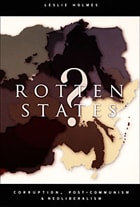
cover of Rotten States?: Corruption, Post-Communism, and Neoliberalism

Rotten States?

Corruption, Post-Communism, and Neoliberalism

Leslie Holmes

Duke University Press, 2006

Official corruption has become increasingly prevalent around the world since the early 1990s. The situation appears to be particularly acute in the post-communist states. Corruption—be it real or perceived—is a major problem with concrete implications, including a lowered likelihood of foreign investment. In Rotten States? Leslie Holmes analyzes corruption in post-communist countries, paying particular attention to Bulgaria, Hungary, Poland, and Russia, as well as China, which Holmes argues has produced, through its recent economic liberalization, a system similar to post-communism. As he points out, these countries offer useful comparisons: they vary in terms of size, religious orientation, ethnic homogeneity, and their approaches to and economic success with the transition from communism.

Drawing on data including surveys commissioned especially for this study, Holmes examines the causes and consequences of official corruption as well as ways of combating it. He focuses particular attention on the timing of the recent increase in reports of corruption, the relationship between post-communism and corruption, and the interplay between corruption and the delegitimation and weakening of the state. Holmes argues that the global turn toward neoliberalism—with its focus on ends over means, flexibility, and a reduced role for the state—has generated much of the corruption in post-communist states. At the same time, he points out that neoliberalism is perhaps the single most powerful tool for overcoming the communist legacy, which is an even more significant cause of corruption. Among the conclusions that Holmes draws is that a strong democratic state is needed in the early stages of the transition from communism in order to prevent corruption from taking hold.

[more]