Results by title
79 books match the query 'Evolution (Biology)' and 2 start with r
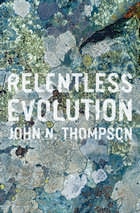
Relentless Evolution
John N. Thompson
University of Chicago Press, 2013
At a glance, most species seem adapted to the environment in which they live. Yet species relentlessly evolve, and populations within species evolve in different ways. Evolution, as it turns out, is much more dynamic than biologists realized just a few decades ago.
In Relentless Evolution, John N. Thompson explores why adaptive evolution never ceases and why natural selection acts on species in so many different ways. Thompson presents a view of life in which ongoing evolution is essential and inevitable. Each chapter focuses on one of the major problems in adaptive evolution: How fast is evolution? How strong is natural selection? How do species co-opt the genomes of other species as they adapt? Why does adaptive evolution sometimes lead to more, rather than less, genetic variation within populations? How does the process of adaptation drive the evolution of new species? How does coevolution among species continually reshape the web of life? And, more generally, how are our views of adaptive evolution changing?
Relentless Evolution draws on studies of all the major forms of life—from microbes that evolve in microcosms within a few weeks to plants and animals that sometimes evolve in detectable ways within a few decades. It shows evolution not as a slow and stately process, but rather as a continual and sometimes frenetic process that favors yet more evolutionary change.
[more]
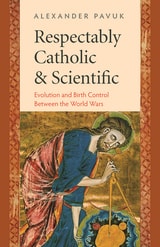
Respectably Catholic and Scientific
Evolution and Birth Control Between the World WarsAlexander Pavuk
Catholic University of America Press, 2021
Respectfully Catholic and Scientific traces the unexpected manner in which several influential liberal-progressive Catholics tried to shape how evolution and birth control were framed and debated in the public square in the era between the World Wars-- and the unintended consequences of their efforts.
A small but influential cadre of Catholic priests professionally trained in social sciences, Frs. John Montgomery Cooper, John A. Ryan, and John A. O’Brien, gained a hearing from mainline public intellectuals largely by engaging in dialogue on these topics using the lingua franca of the age, science, to the near exclusion of religious argumentation.
The Catholics’ approach was more than just tactical. It also derived from the subtle influence of Catholic theological Modernism, with its strong enthusiasm for science, and from an inclination toward scientism inherited from the Progressive Era’s social science milieu.
All three shared a fervent desire to translate the Catholic ethos, as they understood it, into the vocabulary of the modern age while circumventing anti-Catholic attitudes in the process. However, their method resulted in a series of unintended consequences whereby their arguments were not infrequently co-opted and used against both them and the institutional church they served.
Alexander Pavuk considers the complex role of both liberal religious figures and scientific elites in evolution and birth control discourse, and how each contributed in unexpected ways to the reconstruction of those topics in public culture. The reconstruction saw the topics themselves shift from matters considered largely within moral frameworks into bodies of kno
[more]