Results by title
484 books match the query 'Foreign relations' and 22 start with r
Rational Empires
Institutional Incentives and Imperial ExpansionLeo J. Blanken
University of Chicago Press, 2012
The nineteenth century marked the high point of imperialism, when tsarist Russia expanded to the Pacific and the sun was said never to set on the British Empire. Imperialism remains a perennial issue in international relations today, and nowhere is this more evident than in the intensifying competition for global resources.
Leo J. Blanken explains imperialism through an analysis of the institutions of both the expanding state and its targets of conquest. While democratic states favoring free trade generally resort to imperialism only to preempt aggressive rivals—or when they have reason to believe another state’s political institutions will not hold up when making bargains—authoritarian states tend toward imperialism because they don’t stand to benefit from free trade. The result is three distinct strategies toward imperialism: actors fighting over territory, actors peaceably dividing territory among themselves, and actors refraining from seizing territory altogether. Blanken examines these dynamics through three case studies: the scramble for Africa, the unequal treaties imposed on Qing Dynasty China, and the evolution of Britain’s imperial policy in India. By separating out the different types of imperialism, Blanken provides insight into its sources, as well as the potential implications of increased competition in the current international arena.

Rebels Against War
The American Peace Movement, 1933-1983Lawrence Wittner
Temple University Press, 1984
Red Chamber, World Dream
Actors, Audience, and Agendas in Chinese Foreign Policy and BeyondJing Sun
University of Michigan Press, 2021
Chinese president Xi Jinping is most famously associated with his “Chinese Dream” campaign, envisioning a great rejuvenation of the nation. Many observers, though, view China’s pursuit of this dream as alarming. They see a global power ready to abandon its low-profile diplomacy and eager to throw its weight around.
Red Chamber, World Dream represents an interdisciplinary effort of deciphering the Chinese Dream and its global impact. Jing Sun employs methods from political science and journalism and concepts from literature, sociology, psychology and drama studies, to offer a multilevel analysis of various actors’ roles in Chinese foreign policy making: the leaders, the bureaucrats, and its increasingly diversified public. This book rejects a simple dichotomy of an omnipotent, authoritarian state versus a suppressed society. Instead, it examines how Chinese foreign policy is constantly being forged and contested by interactions among its leaders, bureaucrats, and people. The competition for shaping China’s foreign policy also happens on multiple arenas: intraparty fighting, inter-ministerial feuding, social media, TV dramas and movies, among others. This book presents vast amounts of historical detail, many unearthed the first time in the English language. Meanwhile, it also examines China’s diplomatic responses to ongoing issues like the Covid-19 crisis. The result is a study multidisciplinary in nature, rich in historical nuance, and timely in contemporary significance.

Reflections in a Bloodshot Lens
America, Islam and the War of IdeasLawrence Pintak
Pluto Press, 2006
There exists today a tragic rift between Americans and the world’s Muslims. Yet in the immediate aftermath of 9/11, there was widespread sympathy for the U.S. throughout the Muslim world. This book explores what happened. It examines the disconnect that leads Americans and Muslims to view the same words and images in fundamentally different ways. Partly a result of a centuries-old 'us' against 'them' dichotomy, the problem is exacerbated by an increasingly polarised media and by leaders on both sides who either don't understand or don't care what impact their words and policies have in the world at large.
Journalist-scholar Lawrence Pintak, a former CBS News Middle East correspondent, argues that the Arab media revolution and the rise of 'patriot-journalists' in the US marginalized voices of moderation, distorting perceptions on both sides of the divide with potentially disastrous results.
Built on the author's extensive journalistic experience, the book will appeal to policymakers, students of media studies, Middle East studies and Islamic studies, and general current affairs readers.
Reluctant Interveners
America's Failed Responses to Genocide from Bosnia to DarfurEyal Mayroz
Rutgers University Press, 2020
Featured in the 2020 Association of University Presses Book, Jacket, and Journal Show
Why do we allow our governments to get away with “bystanding” to genocide? How can we, when alerted to the mass slaughter of innocents, still not take a stand? Reluctant Interveners provides the most comprehensive answers yet to these confronting questions, focusing on the complex relationships between the citizenry, the media, the political elites, and institutions in the most powerful nation in the world, the United States of America.
Eyal Mayroz offers a sobering account of the interactions between the governing and the governed, and the dynamics which transformed moral concerns for the lives of faraway “others” into cold political calculations. Exposed are the processes that turned the promise of “never again” to a recurring reality of ever again, the role of the office of the presidency in their advancement, and the resultant image of America as seen by the rest of the world. In a time of ubiquitous social media and populist revival, a greater role for the U.S. citizenry in decision-making on responses to genocide may be in the cards. The question is, in which directions will these trends take American foreign policy?
Reluctant Meister
How Germany's Past is Shaping Its European FutureStephen Green
Haus Publishing, 2014
Reluctant Realists
The CDU/DSU and West German OstpolitikClay Clemens
Duke University Press, 1989
Resistance in the Era of Nationalisms
Performing Identities in Taiwan and Hong KongHsin-I Cheng
Michigan State University Press, 2023
Reversing Course
Carter's Foreign Policy, Domestic Politics, and the Failure of ReformDavid Skidmore
Vanderbilt University Press, 1996
In Reversing Course, David Skidmore argues that President Carter's initial foreign policy agenda required a scaling back of U.S. commitments abroad, reflecting a decline in resources, as well as influence, in a world developing in ways necessarily reducing U.S. hegemony. By probing beneath the obvious and carefully sifting the abundant but poorly understood evidence, Skidmore finds at the root of Carter's failed effort an irresistible pressure to reverse a liberal foreign-policy agenda in order to address the effect at home of well-organized conservative criticism. For Skidmore, Carter's course "reversed" toward a traditional containment strategy vis-a-vis the Soviet Union not because of Soviet intransigence or faulty idealism but because Cold War politics sold better in the polls.
While offering significant theoretical arguments, Skidmore carefully anchors his thesis in the day-to-day political give and take among those personalities and events that provoked headlines and commentaries long before they were the stuff of history. Among the telling factors and events analyzed in this book are the Vance/Brzezinski conflict, the support and opposition of Howard Baker, the SALT II Treaty, the Panama Canal Treaties, and the Soviet occupation of Afghanistan, to mention only a few.
Although Skidmore draws conclusions that apply to the Reagan, Bush, and Clinton administrations as well, his focus is not on personality but on theory and underlying structures. He provides a demonstration that this structural approach can "be helpful not only in unraveling the mysteries of policy change under Carter but also in specifying the underlying sources of policy vacillation over much of the past two decades." .
Rising Powers and Foreign Policy Revisionism
Understanding BRICS Identity and Behavior Through TimeCameron G. Thies and Mark David Nieman
University of Michigan Press, 2017
State identity is investigated qualitatively through the use of role theory and the identification of national role conceptions. Both economic and militarized conflict behavior are examined using Bayesian change-point modeling, which identifies structural breaks in time series data, revealing potential wholesale revision of foreign policy. Using this innovative approach to show that the behavior of rising powers is governed not simply by the structural dynamics of power but also by the roles that these rising powers define for themselves, they assert that this process will likely lead to a much more evolutionary approach to foreign policy and will not necessarily generate international conflict.
Rising Star
The Meaning of Nikki Haley, Trump’s Unlikely AmbassadorJason A. Kirk
University of Arkansas Press, 2021
Risk-Taking in International Politics
Prospect Theory in American Foreign PolicyRose McDermott
University of Michigan Press, 1998
Risk plays a dramatic role in international relations as leaders make decisions about such issues as war and peace, disarmament, and about lowering economic barriers to trade and investment. How a country's leaders think about risk in making foreign policy decisions is important in understanding why and how they make decisions. Rose McDermott applies prospect theory, a theory developed by psychologists to understand decisionmaking under conditions of risk, to four cases in American foreign policy. Prospect theory suggests that decisionmakers who are confronting losses are more likely to take risks than are those decisionmakers who are satisfied with the status quo. The cases used to demonstrate this dynamic include: the Suez Crisis, the U-2 affair, the decisions surrounding the admission of the Shah of Iran to the United States in 1979, and the attempted rescue of the American hostages in Iran in 1980. McDermott shows how prospect theory enables us to understand cases that are otherwise inexplicable. Risk Taking in International Relations offers a unique application of a sophisticated psychological model to international relations theory. The book will be of interest to political scientists and psychologists interested in decision making, in international relations and in American foreign policy.
Rome’s Most Faithful Daughter
The Catholic Church and Independent Poland, 1914–1939Neal Pease
Ohio University Press, 2009
When an independent Poland reappeared on the map of Europe after World War I, it was widely regarded as the most Catholic country on the continent, as “Rome’s Most Faithful Daughter.” All the same, the relations of the Second Polish Republic with the Church—both its representatives inside the country and the Holy See itself—proved far more difficult than expected.
Based on original research in the libraries and depositories of four countries, including recently opened collections in the Vatican Secret Archives, Rome’s Most Faithful Daughter: The Catholic Church and Independent Poland, 1914–1939 presents the first scholarly history of the close but complex political relationship of Poland with the Catholic Church during the interwar period. Neal Pease addresses, for example, the centrality of Poland in the Vatican’s plans to convert the Soviet Union to Catholicism and the curious reluctance of each successive Polish government to play the role assigned to it. He also reveals the complicated story of the relations of Polish Catholicism with Jews, Freemasons, and other minorities within the country and what the response of Pope Pius XII to the Nazi German invasion of Poland in 1939 can tell us about his controversial policies during World War II.
Both authoritative and lively, Rome’s Most Faithful Daughter shows that the tensions generated by the interplay of church and state in Polish public life exerted great influence not only on the history of Poland but also on the wider Catholic world in the era between the wars.

Rough Rider in the White House
Theodore Roosevelt and the Politics of DesireSarah Watts
University of Chicago Press, 2003
In this book, Sarah Watts probes this dark side of the Rough Rider, presenting a fascinating psychological portrait of a man whose personal obsession with masculinity profoundly influenced the fate of a nation. Drawing on his own writings and on media representations of him, Watts attributes the wide appeal of Roosevelt's style of manhood to the way it addressed the hopes and anxieties of men of his time. Like many of his contemporaries, Roosevelt struggled with what it meant to be a man in the modern era. He saw two foes within himself: a fragile weakling and a primitive beast. The weakling he punished and toughened with rigorous, manly pursuits such as hunting, horseback riding, and war. The beast he unleashed through brutal criticism of homosexuals, immigrants, pacifists, and sissies—anyone who might tarnish the nation's veneer of strength and vigor. With his unabashed paeans to violence and aggressive politics, Roosevelt ultimately offered American men a chance to project their longings and fears onto the nation and its policies. In this way he harnessed the primitive energy of men's desires to propel the march of American civilization—over the bodies of anyone who might stand in its way.
Written with passion and precision, this powerful revisioning of an American icon will forever alter the way we see Theodore Roosevelt and his political legacy.
"A superb scholarly study of how Roosevelt built his political base on the aspiration and fears of men in a rapidly changing nation and world."—Charles K. Piehl, Library Journal
"A thought-provoking and innovative study of the dark side of Roosevelt's personality. . . . [Watt's] arguments are clear, passionate, and thoroughly supported."—Elizabeth A. Bennion, Journal of Interdisciplinary History
Ruling Indonesia
Jokowi's Presidency in an Age of Democratic Crisis and Great Power CompetitionMarcus Mietzner
University of Michigan Press, 2026
Joko Widodo—popularly called Jokowi—ruled Indonesia for a decade, from 2014 to 2024. The world’s fourth-largest nation and third-largest democracy, Indonesia had embarked on a messy democratic transition in the late 1990s, with the country’s ethnic and religious heterogeneity posing significant challenges to governance. Initially seen as a reformer who might challenge oligarchic structures, Jokowi was slowly but steadily seen as himself being a threat to democracy. By the time Jokowi wrapped up his presidency, he had achieved the highest approval ratings among Indonesia’s post-authoritarian presidents—and became the president with the tightest grip over Indonesia’s political elite.
Based on exclusive interviews with Jokowi and many of Indonesia’s top leaders, Ruling Indonesia shows Jokowi as a president obsessively preoccupied with his economic development agenda, subordinating all other aspects of governance to this goal. His focused approach delivered economic successes and unprecedented popularity, but also seriously undermined the health of Indonesia’s democratic institutions. Offering a holistic appraisal of his decade in office, Marcus Mietzner analyzes Jokowi’s domestic record in the context of his attempts to position Indonesia more favorably in the international competition for power and resources. Crucially, his obsession to push Indonesia closer to industrialized status while neglecting democratic development represented the ambitions and trials of many Global South leaders who are trying to juggle economic development, growing Sino-American tensions around the world, and concerns for democratic rights. As such, this book provides valuable insights into how the great power rivalry of the 21st century and the global recession of democracy are playing out in central arenas of the Global South.
Russia Container
Alexander Kluge
Seagull Books, 2022
Not just in light of a contested pipeline during the war in Ukraine but also after centuries of both exchange and rejection, Russia and Germany were and are as far away from each other as they are intrinsically linked. The geopolitical present seems critical, the signs pointing towards conflict and polarity.
In this hot climate, German author Alexander Kluge makes Russia the exclusive subject of his latest book, offering multiple perspectives: from that of the historical German patriots of the Napoleonic Wars of Liberation to the narrative point of view of Franz Kafka and Heiner Müller; from messianic yearning and utopian expectations of the twentieth century to the full-blown or near-miss catastrophes in the atomic age.
Composed in Kluge’s characteristic short-prose vignette style, interspersed with numerous images and often humorous asides, Russia Container is yet another brilliant and thought-provoking work from one of Europe’s most prolific and deeply intellectual literary genius. The volume includes a preface specially written to engage with the current events in Ukraine, making Kluge’s narratives even more timely and topical.

Russia and the United States
Nikolai V. Sivachev and Nikolai N. Yakovlev
University of Chicago Press, 1979
Sivachev and Yakolev trace the course of the U.S.-Russian relations from the years preceding the American Revolution to the 1970s, when human rights issues began to cause friction. Those relations, the authors believe, were characterized by America's repeated failure to take advantage of opportunities to improve them. Recognizing the controversial nature of the book, Sivachev said in an interview with the New York Times: "We did not set out to please the American reader, nor did the University of Chicago Press ask us to. On the contrary, they recommended that we should feel free to present our own views."
"Scholars and students of American foreign policy . . . are likely to be alternatively interested, intrigued, angered, and sometimes illuminated by some of the interpretations found in this work."—Perspective
"An American reader should not prejudge this book as simply another dreary contribution to the rhetoric of Soviet propaganda. It is more than this. The book is an expression of a view of the world that is truly and strikingly different from an American one and it is important to understand that it is a theory of reality that is shared by most, if not all, Soviet intellectuals who study America and its foreign policy. It is not enough simply to establish the inaccuracies and misrepresentations contained in such a view. One must go further and understand that such a view of reality is sincerely deeply held and that it is a part of a larger belief system that gives the authors' scholarly work coherence and meaning."—Boston Sunday Globe
Russia on the Danube
Empire, Elites, and Reform in Moldavia and Wallachia, 1812–1834Victor Taki
Central European University Press, 2021
One of the goals of Russia’s Eastern policy was to turn Moldavia and Wallachia, the two Romanian principalities north of the Danube, from Ottoman vassals into a controllable buffer zone and a springboard for future military operations against Constantinople. Russia on the Danube describes the divergent interests and uneasy cooperation between the Russian officials and the Moldavian and Wallachian nobility in a key period between 1812 and 1834. Victor Taki’s meticulous examination of the plans and memoranda composed by Russian administrators and the Romanian elite underlines the crucial consequences of this encounter. The Moldavian and Wallachian nobility used the Russian-Ottoman rivalry in order to preserve and expand their traditional autonomy. The comprehensive institutional reforms born out of their interaction with the tsar’s officials consolidated territorial statehood on the lower Danube, providing the building blocks of a nation state.
The main conclusion of the book is that although Russian policy was driven by self-interest, and despite the Russophobia among a great part of the Romanian intellectuals, this turbulent period significantly contributed to the emergence, several decades later, of modern Romania.
Russian Foreign Policy in Transition
Concepts and RealitiesAndrew Melville
Central European University Press, 2005
Russian-American Dialogue on Cultural Relations, 1776-1914
Edited by Norman E. Saul & Richard D. McKinzie
University of Missouri Press, 1996
Russian-American Dialogue on Cultural Relations, 1776-1914, the third volume in the Russian-American Dialogues series, provides English translations of the best Russian scholarship on cultural relations. Each essay originally appeared as an article in the former Soviet Union. Five issues are discussed: the contributions that each country made to the cultural life of the other; the correspondence and interactions between scientists, writers, and others from the two nations; the development of public perceptions and how these changed over time; the "American focus" in Russian periodicals during the nineteenth century; and the significant roles of Russians and the Russian presence in American history. The Russian articles on each of these subjects are followed by comments from American historians.
The articles by the Russian scholars make extensive use of and liberally cite material from Russian archives and publications. As a result, they provide American readers with new scientific exchanges, personalities, and points of view. The result is a plethora of new material for Western historians of Russia as well as of the United States. The book provides an opportunity for scholars to examine more thoroughly the relevant issues of Russian-American cultural relations.
An important scholarly contribution, Russian-American Dialogue on Cultural Relations, 1776-1914 brings a new dimension to the relationship between the United States and Russia before 1914. It will be of interest not only to historians of this period but to all historians and students of international cultural relations.
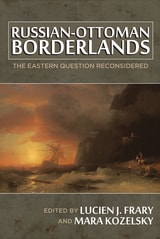
Russian-Ottoman Borderlands
The Eastern Question ReconsideredEdited by Lucien J. Frary and Mara Kozelsky
University of Wisconsin Press, 2014
The contributors address ethnicity, religion, popular attitudes, violence, dislocation and mass migration, economic rivalry, and great-power diplomacy. Through a variety of fresh approaches, they examine the consequences of the Eastern Question in the lives of those peoples it most affected, the millions living in the Russian and Ottoman Empires and the borderlands in between.
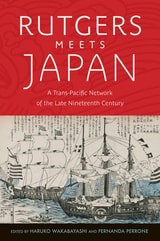
Rutgers Meets Japan
A Trans-Pacific Network of the Late Nineteenth CenturyHaruko Wakabayashi
Rutgers University Press, 2026
Griffis and Kusakabe were only a small piece of a vast transnational network of leading modernizers of Japan in the 1860s and 70s. The Japanese students in New Brunswick were young and innovative men of samurai and aristocratic lineage, who were sent by reform-minded leaders of Japan, which was undergoing a dramatic transformation. They came to New Brunswick seeking Western knowledge that was much needed for the modernization of a newly forming nation. New Brunswick became the hub of a network of Japanese nationals that extended to the major cities of New York, Philadelphia, and Boston, and from there to the smaller towns of New England. Once in New Brunswick, these Japanese students were embraced by Protestant ministers, educators, and missionaries—both men and women—whose network encompassed Rutgers College and the neighboring New Brunswick Theological Seminary, and which stretched to Dutch Reformed parishes throughout the Eastern seaboard, and westward as far as the Dutch enclave of Holland, Michigan. Meanwhile, the American teachers and missionaries who left for Japan became part of a network of reformist leaders and Japanese returnees that extended to schools, colleges, and missions in Japan, and formed the foundations of Japan’s modern educational system. Through contributions from scholars and archivists in the U.S., Canada, and Japan, Rutgers Meets Japan aims to reconstruct the early Rutgers-Japan connections and examine the role and impact of this transnational network on Japan and the U.S. in the late nineteenth century.