Results by title
130 books match the query 'Gay men' and 4 start with r
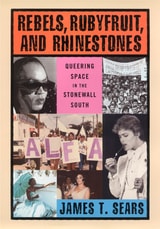
Rebels, Rubyfruit, and Rhinestones
Queering Space in the Stonewall SouthSears, James T.
Rutgers University Press, 2001
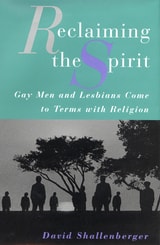
Reclaiming the Spirit
Gay Men and Lesbians Come to Terms with Their ReligionShallenberger, David
Rutgers University Press, 1998
In a world in which religion and homosexuality are often by definition incompatible, it is crucial to hear from gay men and women about how they perceive themselves to be religious or spiritual people. Eliciting powerful, frank, and sometimes troubling responses, David Shallenberger interviewed gay men and women who grew up in families that belonged to traditional religions-Jewish, Roman Catholic, and Protestant-that rejected homosexuality as an unacceptable life-style. When these children grew into adulthood and "came out," many rejected the religion of their childhood as they sought out a more accepting gay community. But once they became comfortable with their new gay identity, they began to experience a spiritual hunger and a desire to be part of a religious community. Some sought to return to the traditions from which they came; others desired membership in new religious communities.
The quest for an integration of homosexuality and spirituality is the focus of Reclaiming the Spirit. Shallenberger asks how individuals can balance both a gay and a religious identity, whether coming out is a spiritual experience, and how coming out affects an individual's relationship to a traditional religious community. Divided into chapters that correspond to the common stages of spiritual integration, Reclaiming the Spirit is immensely readable and introduces an important group of voices into the hotly contested debates surrounding religion and gay participation.

Remembrance of Things I Forgot
A NovelBob Smith
University of Wisconsin Press, 2011
“It’s safe to say your relationship is in trouble if the only way you can imagine solving your problems is by borrowing a time machine.”
In this wickedly comic, cross-country, time-bending journey, John confronts his own—and the nation’s—blunders, learning that a second chance at changing things for the better also brings new opportunities to screw them up. Through edgy humor, time travel, and droll one-liners, Bob Smith examines family dysfunction, suicide, New York City, and recent American history while effortlessly blending domestic comedy with science fiction. Part acidic political satire, part wild comedy, and part poignant social scrutiny, Remembrance of Things I Forgot is an uproarious adventure filled with sharp observations about our recent past.
InSight Out Book Club, featured selection
Bob Smith named one of Instinct magazine’s Leading Men 2011
Winner, Barbara Gittings Literature Award/Stonewall Book Awards, American Library Association
Finalist, Over the Rainbow Selection, American Library Association
Finalist, Green Carnation Prize, international prize for LGBT Literature
Amazon Top Ten Gay & Lesbian Books of 2011
Best Books for General Audiences, selected by the American Association of School Librarians
Best Books for General Audiences, selected by the Public Library Reviewers
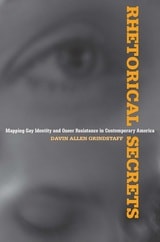
Rhetorical Secrets
Mapping Gay Identity and Queer Resistance in Contemporary AmericaDavin Allen Grindstaff
University of Alabama Press, 2006
Exploring how language shapes sexuality, power, and belonging.
Davin Allen Grindstaff, through a series of close textual analyses examining public discourse, uncovers the rhetorical modes of persuasion surrounding the construction of gay male sexual identity. In Part One, Grindstaff establishes his notion of the "rhetorical secret" central to constructions of gay male identity: the practice of sexual identity as a secret, its promise of a coherent sexual self, and the perpetuation of secrecy as a product and strategy of heteronormative discourse.
Grindstaff continues in Part Two to examine major issues related to contemporary conceptions of gay male identity: overturning sodomy laws; public debates over same-sex marriages; medical and social responses to the HIV/AIDS crisis; the rhetorical power of hyper-masculine body images and homoeroticism to creative communities; and, finally, what Grindstaff considers to be the most mysterious and significant rhetorical practice of all: coming out of the closet.
By investigating the public discourse--texts and images that circulate, produce knowledge, and become means of persuasion--surrounding the constructions of sexual identity, Grindstaff challenges heteronormative concepts of sexuality itself, thus creating new maps of social power and new paths of resistance.