Results by title
72 books match the query 'Indian authors' and 5 start with r
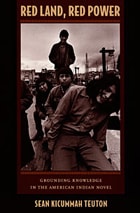
Red Land, Red Power
Grounding Knowledge in the American Indian NovelSean Kicummah Teuton
Duke University Press, 2008
While engaging a wide spectrum of Native American writing, Teuton focuses on three of the most canonized and, he contends, most misread novels of the era—N. Scott Momaday’s House Made of Dawn (1968), James Welch’s Winter in the Blood (1974), and Leslie Marmon Silko’s Ceremony (1977). Through his readings, he demonstrates the utility of tribal realism as an interpretive framework to explain social transformations in Indian Country during the Red Power era and today. Such transformations, Teuton maintains, were forged through a process of political awakening that grew from Indians’ rethought experience with tribal lands and oral traditions, the body and imprisonment, in literature and in life.
Red On Red
Native American Literary SeparatismCraig S. Womack
University of Minnesota Press, 1999
An entertaining and enlightening proposal for a new way to read Native American literature.
An entertaining and enlightening proposal for a new way to read Native American literature.
How can a square peg fit into a round hole? It can’t. How can a door be unlocked with a pencil? It can’t. How can Native literature be read applying conventional postmodern literary criticism? It can’t.That is Craig Womack’s argument in Red on Red. Indian communities have their own intellectual and cultural traditions that are well equipped to analyze Native literary production. These traditions should be the eyes through which the texts are viewed. To analyze a Native text with the methods currently dominant in the academy, according to the author, is like studying the stars with a magnifying glass.In an unconventional and piercingly humorous appeal, Womack creates a dialogue between essays on Native literature and fictional letters from Creek characters who comment on the essays. Through this conceit, Womack demonstrates an alternative approach to American Indian literature, with the letters serving as a “Creek chorus” that offers answers to the questions raised in his more traditional essays. Topics range from a comparison of contemporary oral versions of Creek stories and the translations of those stories dating back to the early twentieth century, to a queer reading of Cherokee author Lynn Riggs’s play The Cherokee Night.Womack argues that the meaning of works by Native peoples inevitably changes through evaluation by the dominant culture. Red on Red is a call for self-determination on the part of Native writers and a demonstration of an important new approach to studying Native works-one that engages not only the literature, but also the community from which the work grew.ISBN 0-8166-3022-4 Cloth £33.50 $47.95xxISBN 0-8166-3023-2 Paper £13.00 $18.95x288 Pages 5 7/8 x 9 November Translation inquiries: University of Minnesota Press
Red Weather
Janet McAdams
University of Arizona Press, 2012
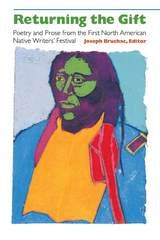
Returning the Gift
Poetry and Prose from the First North American Native Writers' FestivalEdited by Joseph Bruchac
University of Arizona Press, 1994
The anthology includes works from every corner of the continent, representing a wide range of tribal affiliations, languages, and cultures. By taking their peoples' literature back to them in the form of stories and songs, these writers see themselves as returning the gift of storytelling, culture, and continuance to the source from which it came. In addition to contributions by 92 writers are two introductory chapters: Joseph Bruchac comments on the current state of Native literature and the significance of the festival, and Geary Hobson traces the evolution of the event itself.
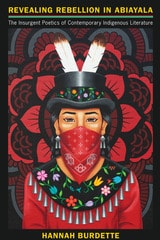
Revealing Rebellion in Abiayala
The Insurgent Poetics of Contemporary Indigenous LiteratureHannah Burdette
University of Arizona Press, 2019
Revealing Rebellion in Abiayala explores the intersections between Indigenous literature and social movements over the past thirty years through the lens of insurgent poetics. Author Hannah Burdette is interested in how Indigenous literature and social movements are intertwined and why these phenomena arise almost simultaneously in disparate contexts across the Americas.
Literature constitutes a key weapon in political struggles as it provides a means to render subjugated knowledge visible and to envision alternatives to modernity and coloniality. The surge in Indigenous literature and social movements is arguably one of the most significant occurrences of the twenty-first century, and yet it remains understudied. Revealing Rebellion in Abiayala bridges that gap by using the concept of Abiayala as a powerful starting point for rethinking inter-American studies through the lens of Indigenous sovereignty.