Results by title
167 books match the query 'Iowa' and 5 start with r
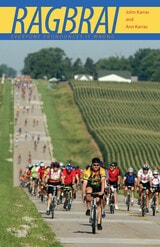
RAGBRAI
Everyone Pronounces It WrongJohn Karras
University of Iowa Press, 2009
RAGBRAI: Everyone Pronounces It Wrong is a celebration, a memoir, an entertainment. The book deals with the first 25 years of the famous bike ride. It describes the genesis of an event that has drawn hundreds of thousands of people to Iowa from all over the world and attempts to explain the ride's continued charm and appeal.
RAGBRAI is different from all other bicycle tours. The others, and there are dozens of cross-state rides held in the United States, attract mostly serious, dedicated cyclists who clench their teeth and ride hard all day. RAGBRAI has its share of these cyclists, but it's more inclusive. It is a huge, week long celebration with dancing in the streets and evening entertainments. It is a love affair between bicycle riders and the people of Iowa. The book captures the essence of all that.
Reading on the Middle Border
The Culture of Print in Late-Nineteenth-Century Osage, IowaChristine Pawley
University of Massachusetts Press, 2009
Christine Pawley investigates the use of print by "ordinary" Americans in the small, rural community of Osage, Iowa—the town that shaped Hamlin Garland—analyzing primary source material on education, religious life, a reading club, and business affairs. A major section of her study focuses on the public library, an institution that provides a valuable window into the reading practices of men and women of various ages, classes, ethnicities, and religions. An extensive database of library circulation and accessions information, combined with federal and state census data, sheds light on the elusive issue of "Who read what?"
Pawley explores the ways print confirmed or challenged people's economic, social, and religious world, and asks what values print expressed or confronted. She also raises questions relating to modes and contexts of reading, distinguishing between groups and individuals. The picture of print in Osage is complex and defies reduction, but by placing print in a community context and viewing printed materials as an expression of activities, not mere artifacts, Pawley enhances our understanding of the role of reading in American culture.

Reflecting a Prairie Town
A Year in PetersonDrake Hokanson
University of Iowa Press, 1994
In Reflecting a Prairie Town Drake Hokanson takes a prolonged look at a common place in an uncommon fashion. He presents Peterson, Iowa, through a singular combination of words and images, a remarkable synthesis of history, geography, direct observation, climatology, botany, oral history, archaeology, agricultural science, literature, geology, photography, and even a bit of astronomy. This vernacular landscape study is lavishly illustrated with photographs taken by the author, including stunning panoramic views.
The fundamental truth of experience on this continent has always lain in the challenges and opportunities of space. Place mattered because we were so few before the immensity of the land. But place at the same time rooted us in that immensity. Even now our appreciation for place is not quite dead; locked in our urban environments we continue to crave a “view,” be it of mountains, forests, or prairies. These “views” crop up unexpectedly as photographic murals in office buildings or posters in dentists' offices. It is to this stifled sense of the importance of place that Hokanson speaks; he invites us to remember and to be revitalized.
The magic of Reflecting a Prairie Town is the revelation that Peterson, Iowa, is a small town that is also uncannily large. In capturing the essence of this one place Hokanson helps us to understand our own worlds better—he asks the simple questions many of us would like to ask were we given the opportunity. To enter this book is to come back to a place we have never really seen before.
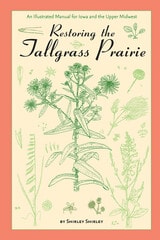
Restoring the Tallgrass Prairie
An Illustrated Manual for Iowa and the Upper MidwestShirley Shirley
University of Iowa Press, 1994
Iowa is the only state that lies entirely within the natural region of the tallgrass prairie. Early documents indicate that 95 percent of the state—close to 30 million acres—was covered by prairie vegetation at the time of Euro-American settlement. By 1930 the prairie sod had been almost totally converted to cropland; only about 30,000 acres of the original “great green sea” remained. Now, in this gracefully illustrated manual, Shirley Shirley has created a step-by-step guide to reconstructing the natural landscape of Iowa and the Upper Midwest.
Chapters on planning, obtaining and selecting plants and seeds, starting seeds indoors, preparing the site, planting, and maintenance set the stage for comprehensive species accounts. Shirley gives firsthand information on soil, moisture, sun, and pH requirements; location, size, and structure; blooming time and color; and propagation, germination, and harvesting for more than a hundred wildflowers and grasses.
Shirley's sketches—all drawn from native plants and from seedlings that she grew herself—will be valuable for even the most experienced gardener. While other books typically feature only the flowering plant, her careful drawings show the three stages of the seedlings, the flower, and the seedhead with seeds as well as the entire plant. This practical and attractive volume will help anyone dedicated to reconstructing the lost “emerald growth” of the historic tallgrass prairie.
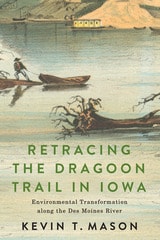
Retracing the Dragoon Trail in Iowa
Environmental Transformation along the Des Moines RiverKevin T. Mason
Michigan State University Press, 2026
In Retracing the Dragoon Trail in Iowa, historian Kevin T. Mason presents a vivid and deeply researched account of Iowa’s evolving landscape, beginning with the 1835 expedition of the First U.S. Dragoons. Drawing from archival records, maps, government surveys, Indigenous histories, and ecological data, Mason explores how Iowa’s prairies and wetlands gave way to farms, towns, and transportation networks. He situates these environmental shifts within the broader forces of Manifest Destiny, military expansion, and settler colonialism, while amplifying the voices of the Sauk, Meskwaki, Dakota, and other Indigenous nations whose histories are often marginalized.
But Mason doesn’t just write about history—he walks it. His 371-mile journey retracing the original dragoon route across Iowa blends scholarship with storytelling, captured through video essays, photography, and writing. This modern-day trek, featured on Iowa PBS’s Iowa Life and Iowa Public Radio’s Talk of Iowa, brings the past into the present, offering a compelling look at how landscapes remember. The result is a powerful contribution to environmental history, regional studies, and Indigenous scholarship—one that reveals the layered interactions between land use, policy, and historical change.