Results by title
50 books match the query 'Justice, Administration of' and 2 start with r
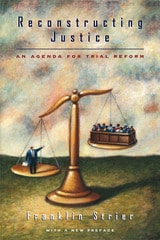
Reconstructing Justice
An Agenda for Trial ReformFranklin Strier
University of Chicago Press, 1996
In Reconstructing Justice, Franklin Strier doesn't simply describe problems with the American trial system; he proposes reforms. Arguing that lawyers need to share more power with the judge and jury, Strier recommends ways we can retain and improve our basic adversarial system. He suggests we eliminate peremptory challenges, give judges the authority to ask questions of witnesses, and limit the number of expert witnesses. Drawing from a wide variety of sources, including case histories, scholarly works, Blackstone's Commentaries, and The Federalist Papers, he argues that judicial reform is not only possible, but—because of the increased public coverage of trials and understanding of the need for reform—inevitable.
Franklin Strier brings this critical look at trial reform up to date with a new preface in which he discusses how the inordinate amount of public attention of the O. J. Simpson trial, and the power the attorneys had over the court in that case, shed new light on the trial system's weaknesses and inequities.
"Anyone with an interest in courtroom trials will be fascinated by Strier's analysis of the game of law and suggestions for reforming the trail system to provide justice in a greater number of cases. . . . Highly recommended."—Choice
[more]
Reimagining Courts
A Design for the Twenty-First CenturyVictor E Flango
Temple University Press, 2017
In their timely and topical book, Reimagining Courts, Victor Flango and Thomas Clarke argue that courts are a victim of their own success. Disputes that once were resolved either informally in the family or within the community are now handled mainly by courts, which strains government agency resources. The authors offer provocative suggestions for a thorough overhaul of American state and local courts, one that better fits the needs of a twenty-first century legal system.
Reimagining Courts recommends a triage process based upon case characteristics, litigant goals, and resolution processes. Courts must fundamentally reorganize their business processes around the concept of the litigant as a customer. Each adjudication process that the authors propose requires a different case management process and different amounts of judicial, staff, and facility resources.
Reimagining Courts should spark much-needed debate. This book will be of significant interest to lawyers, judges, and professionals in the court system as well as to scholars in public administration and political science.
[more]