Results by title
936 books match the query 'LGBTQ+ Studies' and 28 start with r
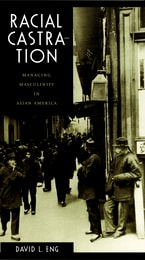
Racial Castration
Managing Masculinity in Asian AmericaDavid L. Eng
Duke University Press, 2001
Eng juxtaposes theortical discussions of Freud, Lacan, and Fanon with critical readings of works by Frank Chin, Maxine Hong Kingston, Lonny Kaneko, David Henry Hwang, Louie Chu, David Wong Louie, Ang Lee, and R. Zamora Linmark. While situating these literary and cultural productions in relation to both psychoanalytic theory and historical events of particular significance for Asian Americans, Eng presents a sustained analysis of dreamwork and photography, the mirror stage and the primal scene, and fetishism and hysteria. In the process, he offers startlingly new interpretations of Asian American masculinity in its connections to immigration exclusion, the building of the transcontinental railroad, the wartime internment of Japanese Americans, multiculturalism, and the model minority myth. After demonstrating the many ways in which Asian American males are haunted and constrained by enduring domestic norms of sexuality and race, Eng analyzes the relationship between Asian American male subjectivity and the larger transnational Asian diaspora. Challenging more conventional understandings of diaspora as organized by race, he instead reconceptualizes it in terms of sexuality and queerness.
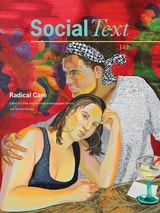
Radical Care
Hi'iliei Hobart and Tamara Kneese, special issue editors
Duke University Press, 0
Contributors. Nicole Charles, Elijah Adiv Edelman, Hi‘ilei Hobart, Tamara Kneese, Micki McGee, Leyla Savloff, Cotten Seiler, Dean Spade

Radical Desires
French Gay Liberation and Anticolonial CritiqueEdited by Hauke Branding and Julian Volz
Diaphanes, 2025
Despite a historically rich tradition of thinking about the relation between sexuality, desire, and revolution, there is little engagement with desire’s radicality today. This volume attends to the radicality of desire as a starting point for overcoming heteropatriarchal capitalism by turning to the specific radical homosexual critique as it was first formulated in France in the 1970s in the writings of the Mouvement de Libération des Femmes and the Front Homosexuel d’Action Révolutionnaire, as well as in the conceptions of their most important protagonists, Monique Wittig and Guy Hocquenghem.
Radical Desires seeks to emphasize the anti-identitarian character of the French gay liberation movement, as well as its implicit and explicit critique of gender and sexual binaries. At the same time, the volume is also interested in intersectionally expanding this critique by confronting it with anticolonial and queer of color perspectives. As French gay liberation activists’ relations to North African men were often problematic, several contributions engage with the latent orientalist and racist tropes that appear in the movement’s writings. By aiming to go beyond a mere historicization of these ambivalences and exploring which contemporary problems appear in a different light as a result, Radical Desires highlights the (dis-)continuous relationship between current debates and those in 1970s France.
To explore the multiplicity of forms with or in which these critiques were expressed, this volume places theoretical perspectives in conversation with artistic perspectives on queer liberation in a transnational context. Contributors include Friederike Beier, Antoine Idier, Émilie Notéris, Lukas Betzler, Mohammad Shawky Hassan, Sido Lansari, Todd Shepard, and Julian Volz.

Radical Family
Trailblazing Lesbian Moms Tell Their StoriesEdited by Margaret Mooney
Wisconsin Historical Society Press, 2025
A powerful collection of personal essays from lesbian moms who fought for the right to raise children
For generations, lesbians across the United States were systematically denied opportunities to raise children and build families, opportunities that were readily available to straight people. Radical Family honors the history-making struggles and triumphs of lesbian families in Madison, Wisconsin, who raised children in the 1980s, ’90s, and early 2000s—a time when lesbian motherhood was widely considered extreme and unnatural. In a collection of nine profoundly personal essays, the contributors recount their diverse paths to parenthood, as well as the hopes and challenges each family experienced. While the stories in Radical Family are unique, they all share a common thread: the mothers’ resilience and the risks they took, both small and sweeping, to defend their family’s right to exist.
For lesbians, the desire to raise children has historically been met with vilification and legal and social prejudice. Adoption agencies consistently rejected applications from out lesbians. Doctors and clinics refused to provide fertility treatments and other medical options to help them get pregnant. Lesbians who were able to raise children commonly lost custody to estranged spouses or grandparents.
Trailblazing lesbian mothers—and their children—fought to defy and, ultimately, shift this paradigm. Lesbian parents, like those in Radical Family, created informal networks in their local communities, where they could share survival strategies and find acceptance among other families that looked like theirs. With no rule book to guide them, and few laws to protect them, lesbian mothers created a new—some might even say radical—standard for what it means to be a family.
Over and over, the stories in Radical Family show how families fought back against hatred and homophobia with love, resilience, commitment, and creativity. Their stories deepen our understanding of what it means to be a mother—while showing how safety, belonging, and acceptance are universal human needs.
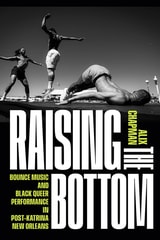
Raising the Bottom
Bounce Music and Black Queer Performance in Post-Katrina New OrleansAlix Chapman
Duke University Press, 2026

Rare and Commonplace Flowers
The Story of Elizabeth Bishop and Lota de Macedo SoaresOliveira, Carmen
Rutgers University Press, 2003
Rare and Commonplace Flowers—a Brazilian bestseller—tells the story of two women. Elizabeth Bishop, the Pulitzer Prize–winning American poet, sought artistic inspiration in Brazil. There she met and fell in love with Lota de Macedo Soares, a self-trained Brazilian architect. This dual biography—brilliantly researched, and written in a lively, novelistic style—follows their relationship from 1951 to 1967, the time when the two lived together in Brazil. The fact that these two women had an intimate relationship caused an uproar when it first came to public notice.
The relationship started out happily, yet ended tragically. In 1961, Soares became increasingly obsessed with building and administering Flamengo Park, Rio de Janeiro’s equivalent to New York City’s Central Park. Though she had been the driving force behind the park’s inception, the ultimate credit that was due her was stripped away because of petty politics and chicanery. As Soares’s career declined and Bishop’s flourished, their relationship crumbled.
Rare and Commonplace Flowers is a tale of two artists and two cultures, offering unique perspectives on both women and their work. Carmen L. Oliveira provides an unparalleled level of detail and insight, due to both her familiarity with Brazil as well as her access to the country’s artistic elite, many of whom had a direct connection with Bishop and Soares. Rare pictures of the two artists and their home bring this unique story to life.
Raving
McKenzie Wark
Duke University Press, 2023

Reading Sedgwick
Lauren Berlant, editor
Duke University Press, 2019
Contributors. Lauren Berlant, Kathryn Bond Stockton, Judith Butler, Lee Edelman, Jason Edwards, Ramzi Fawaz, Denis Flannery, Jane Gallop, Jonathan Goldberg, Meridith Kruse, Michael Moon, José Esteban Muñoz, Chris Nealon, Andrew Parker, H. A. Sedgwick, Karin Sellberg, Michael D. Snediker, Melissa Solomon, Robyn Wiegman
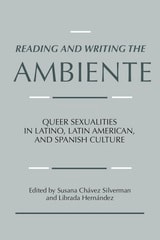
Reading and Writing the Ambiente
Queer Sexualities in Latino, Latin American, and Spanish CultureSusana Chávez-Silverman
University of Wisconsin Press, 2000
In this dynamic collection of essays, many leading literary scholars trace gay and lesbian themes in Latin American, Hispanic, and U.S. Latino literary and cultural texts. Reading and Writing the Ambiente is consciously ambitious and far-ranging, historically as well as geographically. It includes discussions of texts from as early as the seventeenth century to writings of the late twentieth century.
Reading and Writing the Ambiente also underscores the ways in which lesbian and gay self-representation in Hispanic texts differs from representations in Anglo-American texts. The contributors demonstrate that—unlike the emphasis on the individual in Anglo- American sexual identity—Latino, Spanish, and Latin American sexual identity is produced in the surrounding culture and community, in the ambiente. As one of the first collections of its kind, Reading and Writing the Ambiente is expressive of the next wave of gay Hispanic and Latin scholarship.
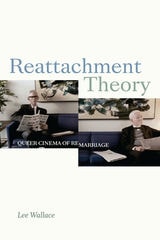
Reattachment Theory
Queer Cinema of RemarriageLee Wallace
Duke University Press, 2020
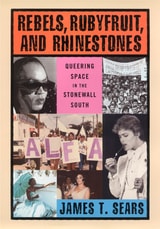
Rebels, Rubyfruit, and Rhinestones
Queering Space in the Stonewall SouthSears, James T.
Rutgers University Press, 2001
Receptive Bodies
Leo Bersani
University of Chicago Press, 2018
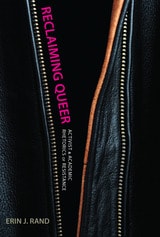
Reclaiming Queer
Activist and Academic Rhetorics of ResistanceErin J. Rand
University of Alabama Press, 2014
An examination of the rhetorical linkage of queer theory in the academy with street-level queer activism in the 1980s and early 1990s
The late 1980s and early 1990s were a defining historical moment for both queer activism and queer theory in the United States. LGBTQ communities, confronted with the fatal indifference and homophobia of the AIDS crisis, often responded with angry, militant forms of activism designed not merely to promote acceptance or tolerance, but to forge identity and strength from victimization and assert loudly and forcefully their rights to safety and humanity. The activist reclamation of the word “queer” is one marker of this shift in ideology and practice, and it was mirrored in academic circles by the concurrent emergence of the new field of “queer theory.” That is, as queer activists were mobilizing in the streets, queer theorists were producing a similar foment in the halls and publications of academia, questioning regulatory categories of gender and sexuality, and attempting to illuminate the heteronormative foundations of Western thought. Notably, the narrative of queer theory’s development often describes it as arising from or being inspired by queer activism.
In Reclaiming Queer, Erin J. Rand examines both queer activist and academic practices during this period, taking as her primary object the rhetorical linkage of queer theory in the academy with street-level queer activism. Through this strategic conjuncture of activism and academia, Rand grapples with the specific conditions for and constraints on rhetorical agency in each context. She examines the early texts that inaugurated the field of queer theory, Queer Nation’s infamous “Queers Read This” manifesto, Larry Kramer’s polemic speeches and editorials, the Lesbian Avengers’ humorous and outrageous antics, the history of ACT UP, and the more recent appearance of Gay Shame activism. From these activist and academic discourses, Rand builds a theory of rhetorical agency that posits queerness as the very condition from which agency emerges.
Reclaiming Queer thus offers a critical look at the rhetoric of queer activism, engages the history of queer theory’s institutionalization and the politics of its proliferation, suggests a radically contextual understanding of rhetorical agency and form, and argues for the centrality of queerness to all rhetorical action.
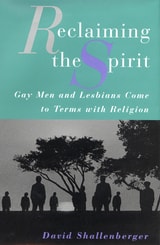
Reclaiming the Spirit
Gay Men and Lesbians Come to Terms with Their ReligionShallenberger, David
Rutgers University Press, 1998
In a world in which religion and homosexuality are often by definition incompatible, it is crucial to hear from gay men and women about how they perceive themselves to be religious or spiritual people. Eliciting powerful, frank, and sometimes troubling responses, David Shallenberger interviewed gay men and women who grew up in families that belonged to traditional religions-Jewish, Roman Catholic, and Protestant-that rejected homosexuality as an unacceptable life-style. When these children grew into adulthood and "came out," many rejected the religion of their childhood as they sought out a more accepting gay community. But once they became comfortable with their new gay identity, they began to experience a spiritual hunger and a desire to be part of a religious community. Some sought to return to the traditions from which they came; others desired membership in new religious communities.
The quest for an integration of homosexuality and spirituality is the focus of Reclaiming the Spirit. Shallenberger asks how individuals can balance both a gay and a religious identity, whether coming out is a spiritual experience, and how coming out affects an individual's relationship to a traditional religious community. Divided into chapters that correspond to the common stages of spiritual integration, Reclaiming the Spirit is immensely readable and introduces an important group of voices into the hotly contested debates surrounding religion and gay participation.

Recruiting Young Love
How Christians Talk about HomosexualityMark D. Jordan
University of Chicago Press, 2011
In the view of many Christians, the teenage years are simultaneously the most dangerous and the most promising. At the very moment when teens are trying to establish a sense of identity and belonging, they are beset by temptation on all sides—from the pressure of their peers to the nihilism and materialism of popular culture. Add the specter of homosexuality to the mix, and you’ve got a situation ripe for worry, sermonizing, and exploitation.
In Recruiting Young Love, Mark D. Jordan explores more than a half century of American church debate about homosexuality to show that even as the main lesson—homosexuality is bad, teens are vulnerable—has remained constant, the arguments and assumptions have changed remarkably. At the time of the first Kinsey Report, in 1948, homosexuality was simultaneously condemned and little discussed—a teen struggling with same-sex desire would have found little specific guidance. Sixty years later, church rhetoric has undergone a radical shift, as silence has given way to frequent, public, detailed discussion of homosexuality and its perceived dangers. Along the way, churches have quietly adopted much of the language and ideas of modern sexology, psychiatry, and social reformers—deploying it, for example, to buttress the credentials of anti-gay “deprogramming” centers and traditional gender roles.
Jordan tells this story through a wide variety of sources, including oral histories, interviews, memoirs, and even pulp novels; the result is a fascinating window onto the never-ending battle for the teenage soul.

Red Nails, Black Skates
Gender, Cash, and Pleasure on and off the IceErica Rand
Duke University Press, 2012
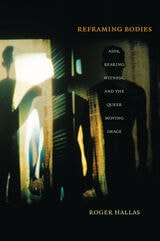
Reframing Bodies
AIDS, Bearing Witness, and the Queer Moving ImageRoger Hallas
Duke University Press, 2009
Challenging the entrenched media politics of who gets to speak, how, and to whom, Hallas offers a bold reconsideration of the intersubjective relations that connect filmmakers, subjects, and viewers. He explains how queer testimony reframes AIDS witnesses and their speech through its striking combination of direct address and aesthetic experimentation. In addition, Hallas engages recent historical changes and media transformations that have not only displaced queer AIDS media from activism to the archive, but also created new witnessing dynamics through the logics of the database and the remix. Reframing Bodies provides new insight into the work of Gregg Bordowitz, John Greyson, Derek Jarman, Matthias Müller, and Marlon Riggs, and offers critical consideration of important but often overlooked filmmakers, including Jim Hubbard, Jack Lewis, and Stuart Marshall.
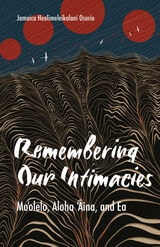
Remembering Our Intimacies
Mo'olelo, Aloha 'Aina, and EaJamaica Heolimeleikalani Osorio
University of Minnesota Press, 2021
Recovering Kānaka Maoli (Native Hawaiian) relationality and belonging in the land, memory, and body of Native Hawai’i
Hawaiian “aloha ʻāina” is often described in Western political terms—nationalism, nationhood, even patriotism. In Remembering Our Intimacies, Jamaica Heolimeleikalani Osorio centers in on the personal and embodied articulations of aloha ʻāina to detangle it from the effects of colonialism and occupation. Working at the intersections of Hawaiian knowledge, Indigenous queer theory, and Indigenous feminisms, Remembering Our Intimacies seeks to recuperate Native Hawaiian concepts and ethics around relationality, desire, and belonging firmly grounded in the land, memory, and the body of Native Hawai’i.
Remembering Our Intimacies argues for the methodology of (re)membering Indigenous forms of intimacies. It does so through the metaphor of a ‘upena—a net of intimacies that incorporates the variety of relationships that exist for Kānaka Maoli. It uses a close reading of the moʻolelo (history and literature) of Hiʻiakaikapoliopele to provide context and interpretation of Hawaiian intimacy and desire by describing its significance in Kānaka Maoli epistemology and why this matters profoundly for Hawaiian (and other Indigenous) futures.
Offering a new approach to understanding one of Native Hawaiians’ most significant values, Remembering Our Intimacies reveals the relationships between the policing of Indigenous bodies, intimacies, and desires; the disembodiment of Indigenous modes of governance; and the ongoing and ensuing displacement of Indigenous people.

Remembrance of Things I Forgot
A NovelBob Smith
University of Wisconsin Press, 2011
“It’s safe to say your relationship is in trouble if the only way you can imagine solving your problems is by borrowing a time machine.”
In this wickedly comic, cross-country, time-bending journey, John confronts his own—and the nation’s—blunders, learning that a second chance at changing things for the better also brings new opportunities to screw them up. Through edgy humor, time travel, and droll one-liners, Bob Smith examines family dysfunction, suicide, New York City, and recent American history while effortlessly blending domestic comedy with science fiction. Part acidic political satire, part wild comedy, and part poignant social scrutiny, Remembrance of Things I Forgot is an uproarious adventure filled with sharp observations about our recent past.
InSight Out Book Club, featured selection
Bob Smith named one of Instinct magazine’s Leading Men 2011
Winner, Barbara Gittings Literature Award/Stonewall Book Awards, American Library Association
Finalist, Over the Rainbow Selection, American Library Association
Finalist, Green Carnation Prize, international prize for LGBT Literature
Amazon Top Ten Gay & Lesbian Books of 2011
Best Books for General Audiences, selected by the American Association of School Librarians
Best Books for General Audiences, selected by the Public Library Reviewers
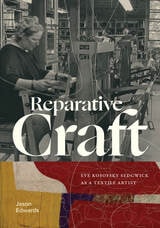
Reparative Craft
Eve Kosofsky Sedgwick as a Textile ArtistJason Edwards
Duke University Press, 2026
Respectably Queer
Diversity Culture in LGBT Activist OrganizationsJane Ward
Vanderbilt University Press, 2008
Respectably Queer reveals how neoliberal ideas about difference are becoming embedded in the daily life of a progressive movement and producing frequent conflicts over the meaning of "diversity." The author shows how queer activists are learning from the corporate model to leverage their differences to compete with other non-profit groups, enhance their public reputation or moral standing, and establish their diversity-related expertise. Ward argues that this instrumentalization of diversity has increased the demand for predictable and easily measurable forms of difference, a trend at odds with queer resistance.
Ward traces the standoff between the respectable world of "diversity awareness" and the often vulgar, sexualized, and historically unprofessional world of queer pride festivals. She spotlights dissenting voices in a queer organization where diversity has become synonymous with tedious and superficial workplace training. And she shows how activists fight back when prevailing diversity discourses-the ones that "diverse" people are compelled to use in order to receive funding-simply don't fit.

Rethinking Sex, Volume 17
Annemarie Jagose, Ann Cvetkovich, and Heather K. Love, special issue editors
Duke University Press, 0
In her contribution to this special issue, Rubin reflects on her earlier essay and examines developments in “pro-sex” feminism since the publication of “Thinking Sex.” Other noted scholars assess the significance of Rubin’s work for histories of sexuality and for new areas in queer studies, such as transgender studies, disability studies, and transnational studies. In honoring Rubin’s scholarship, the contributors address the history of sexual theory and politics and the forms that they might take in the twenty-first century.
Rhetorical Secrets
Mapping Gay Identity and Queer Resistance in Contemporary AmericaDavin Allen Grindstaff
University of Alabama Press, 2006
Exploring how language shapes sexuality, power, and belonging.
Davin Allen Grindstaff, through a series of close textual analyses examining public discourse, uncovers the rhetorical modes of persuasion surrounding the construction of gay male sexual identity. In Part One, Grindstaff establishes his notion of the "rhetorical secret" central to constructions of gay male identity: the practice of sexual identity as a secret, its promise of a coherent sexual self, and the perpetuation of secrecy as a product and strategy of heteronormative discourse.
Grindstaff continues in Part Two to examine major issues related to contemporary conceptions of gay male identity: overturning sodomy laws; public debates over same-sex marriages; medical and social responses to the HIV/AIDS crisis; the rhetorical power of hyper-masculine body images and homoeroticism to creative communities; and, finally, what Grindstaff considers to be the most mysterious and significant rhetorical practice of all: coming out of the closet.
By investigating the public discourse--texts and images that circulate, produce knowledge, and become means of persuasion--surrounding the constructions of sexual identity, Grindstaff challenges heteronormative concepts of sexuality itself, thus creating new maps of social power and new paths of resistance.
Rocking the Closet
How Little Richard, Johnnie Ray, Liberace, and Johnny Mathis Queered Pop MusicVincent Stephens
University of Illinois Press, 2019
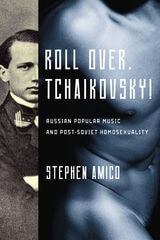
Roll Over, Tchaikovsky!
Russian Popular Music and Post-Soviet HomosexualityStephen Amico
University of Illinois Press, 2017
Centered on the musical experiences of homosexual men in St. Petersburg and Moscow, this ground-breaking study examines how post-Soviet popular music both informs and plays off of a corporeal understanding of Russian male homosexuality.
Drawing upon ethnography, musical analysis, and phenomenological theory, Stephen Amico offers an expert technical analysis of Russian rock, pop, and estrada music, dovetailing into an illuminating discussion of homosexual men's physical and bodily perceptions of music. He also outlines how popular music performers use song lyrics, drag, physical movements, images of women, sexualized male bodies, and other tools and tropes to implicitly or explicitly express sexual orientation through performance. Finally, Amico uncovers how such performances help homosexual Russian men to create their own social spaces and selves, in meaningful relation to others with whom they share a "nontraditional orientation."

Romaine Brooks
A LifeCassandra Langer
University of Wisconsin Press, 2015
Romaine Brooks: A Life introduces much fresh information from Langer's decades of research on Brooks and establishes this groundbreaking artist's centrality to feminism and contemporary sexual politics as well as to visual culture.

Romantic Sensation
The Queer Lives of Leon A. Belmont, 1853–1927Lizzie Ehrenhalt
University of Minnesota Press, 2026
Exploring gender and sexuality in the Gilded Age through one sensationalized life
Addie Liona Walker. Leon A. Belmont. Nova McClure Carr. Romantic Sensation tells the full story of this one ordinary person’s singular life. Assigned a female sex at birth, Addie was born in Massachusetts in 1853 and lived as a woman for twenty-five years. After transitioning in 1878, Addie became Leon and lived as a man for twenty-four years before making a second gender transition and living as a woman, Nova, for the rest of her life. Placing these milestones within the historical context of the late nineteenth and early twentieth centuries, Lizzie Ehrenhalt traces Belmont’s life, from child laborer to husband, from outlaw to heartthrob, and from stepfather to single mother.
Belmont was a Gilded Age celebrity: he made national news for breaking an ordinance against dressing as the “opposite” sex in Minneapolis, and he inspired a media frenzy when one of his girlfriends told police that he was a woman. While newspapers labeled Belmont a “curious and romantic sensation,” Ehrenhalt shows that he was not much of a sensation after all. Illuminating what his story can tell us about Americans’ developing understandings of sexuality and gender in the 1850s through the 1920s, she reveals how Belmont’s run-ins with police, doctors, courts, and reporters resonate in the evolution of the LGBTQIA+ identities we recognize today.
An empathetic case study of a figure often denied respect in the telling of his story, Romantic Sensation presents Belmont’s gender transitions not as puzzles in need of solving but as acts grounded in the cultural milieu of the Gilded Age. Traversing the dramatic economic upheavals of the second industrial revolution, the Era of Good Stealings, and the Great Railroad Strike of 1922, and spanning the Cult of Domesticity, the invention of sexology, and the rise of New Womanhood, Ehrenhalt uses Belmont’s example to demonstrate how trans, queer, and intersex histories are inseparable from American history.
Retail e-book files for this title are screen-reader friendly with images accompanied by short alt text and/or extended descriptions.
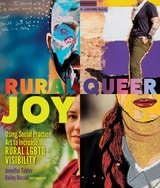
Rural Queer Joy
Using Social Practice Art to Increase Rural LGBTQ+ VisibilityJennifer Tabler
University of Wyoming Press, 2026
Blending social science, fine arts, and the humanities, Rural Queer Joy explores how the telling of rural LGBTQ+ stories affects young rural queer people today. The stories of well-known Wyoming LGBTQ+ people like Matthew Shepard, Sissy Goodwin, and Artemis Langford often center experiences of trauma and hardship, leaving little space for experiences of triumph or joy.
Author Jennifer Tabler and photographer Bailey Russel provided rural LGBTQ+ community members with an opportunity to represent their own experiences through participation in a social practice art project, asking what about being LGBTQ+ brings them joy. They then took the participants’ portraits and invited them to annotate these portraits with paint, markers, paper, or other media. This kind of social practice art provides an opportunity to engage in epistemic activism through the self-empowerment of marginalized voices and perspectives, while also centering visuals of rural queer people that counter existing stereotypes and add nuance to our understanding of rural LGBTQ+ people.
The dynamic artwork and quotes from young rural LGBTQ+ people displayed in this book highlight how their identities are sources of joy and opportunity rather than constraint and hardship. Rural and/or LGBTQ+ people, researchers, and teachers in the fields of community-engaged arts, gender studies, sociology of sexualities, and public humanities will find inspiration in Rural Queer Joy—inspiration to rethink what it means to be rural and LGBTQ+ as well as to use social practice art to increase the visibility of other underserved communities.