Results by title
4030 books match the query 'Language Arts & Disciplines' and 235 start with r

RDA Essentials
Thomas Brenndorfer
American Library Association, 2016
RDA Glossary
American Library Association, 2020
RDA Vocabularies for a Twenty-First Century Data Environment
American Library Association, 2010
RDA and Cartographic Resources
Paige G. Andrew
American Library Association, 2015
RDA and Serials Cataloging
Ed Jones
American Library Association, 2013
RDA
Resource Description and AccessAmerican Library Association, 2015
RDA
Resource Description and AccessAmerican Library Association, 2014
RDA
Resource Description and Access Print--2014 RevisionAmerican Library Association, 2014
RDA
Resource Description and Access Print--2015 RevisionAmerican Library Association, 2015
RDA
Strategies for ImplementationMagda El-Sherbini
American Library Association, 2013
REVISED STANDARDS AND GUIDELINES OF SERVICE for the Library of Congress Network of Libraries for the Blind and Physically Handicapped
American Library Association, 2011
RFID in Libraries
Lori Bowen Ayre
American Library Association, 2012
Race News
Black Journalists and the Fight for Racial Justice in the Twentieth CenturyFred Carroll
University of Illinois Press, 2017
Race, Rhetoric, and Research Methods
Alexandria Lockett
University Press of Colorado, 2021
Racing Translingualism in Composition
Toward a Race-Conscious Translingualismedited by Tom Do and Karen Rowan
Utah State University Press, 2022
This collection extends the disciplinary conversations about translingualism by foregrounding the role race and racism play in the construction and maintenance of language differences. In doing so, the contributors examine the co-naturalization of race and language in order to theorize a race-conscious translingual praxis. The book begins by offering generative critiques of translingualism, centering on the ways in which the approach’s democratic orientation to language avoids issues of race, language, and power and appeals to colorblind racist tropes of equal opportunity. Following these critiques, contributors demonstrate the important intersections of race and translingualism by drawing upon voices typically marginalized by monolingual language ideologies and pedagogies. Finally, Racing Translingualism concludes by attending to the pedagogical implications of a race-conscious translingual praxis in writing and literacy education.
Making the case for race-conscious, rather than colorblind, theories and pedagogies, Racing Translingualism offers a unique take on how translingualism is theorized and practiced and moves the field forward through its direct consideration of the links between language, race, and racism.
Contributors: Lindsey Albracht, Steven Alvarez, Bethany Davila, Tom Do, Jaclyn Hilberg, Bruce Horner, Aja Martinez, Esther Milu, Stephanie Mosher, Yasmine Romero, Karen Rowan, Rachael Shapiro, Shawanda Stewart, Brian Stone, Victor Villanueva, Missy Watson
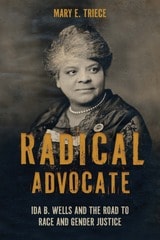
Radical Advocate
Ida B. Wells and the Road to Race and Gender JusticeMary E. Triece
University of Alabama Press, 2025
Pinpoints the persuasive strategies that typified Wells’s efforts to shape broader cultural conversations concerning the causes of racial, social, and gender inequity
Born into the brutal reality of slavery, Ida B. Wells rose to become an audacious journalist, teacher, and activist for racial and gender justice. In Radical Advocate, Mary E. Triece examines the rhetorical strategies employed by Wells to challenge deeply rooted systems of oppression, strategies that remain powerful and relevant today.
Triece introduces the concept of “radical embodied advocacy” to give an account of Wells’s unique position as a Black woman whose personal encounters with white violence were palpable, experienced physically and mentally. White men lynched Wells’s friends and threatened her own life, forcing her into exile after destroying the very press on which she wrote and edited. From this perspective, Wells understood lynching as linked to white economic and political control. Through a close analysis of Wells’s speeches, writings, and journalism, Triece reveals how Wells pioneered a form of “intersectional journalism” that centered the voices of those marginalized by race, gender, and class.
By examining Wells’s work through the lens of philosophy, rhetoric, and Black feminism, Triece underscores the epistemic challenges faced by marginalized advocates and the importance of their perspectives in shaping social change. Radical Advocate ultimately positions Wells as a prophetic figure whose insights into the systemic nature of racism remain profoundly relevant in today’s world.

Radical Collections
Re-examining the roots of collections, practices and information professionsEdited by Jordan Landes
University of London Press, 2018

Radical Transparency
Perspectives on Graduate Education in Writing StudiesJustin H. Cook
Utah State University Press, 2027
Radical Transparency brings together candid, powerful accounts of what it means to live, work, and labor as a graduate student in writing studies in today’s academy. At a moment when higher education is defined by precarity, burnout, widening inequities, and political uncertainty, this collection names, without sanitizing, the emotional, embodied, and institutional realities that shape graduate education.
Blending scholarly analysis with personal narrative, the chapters document graduate student experiences across writing studies, rhetoric and composition, and related fields. Contributors take up issues often rendered invisible in official program materials and institutional discourse, including disability and access, queer and crip temporalities, financial and labor precarity, mentoring breakdowns, emotional labor, care work, grief, and the hidden curricula that govern graduate life. Together, these chapters reveal how graduate students navigate systems that demand resilience while frequently withholding transparency, support, and care. Organized around three intersecting threads—navigating precarity, building networks of care, and reimagining academic work—Radical Transparency also introduces an emotional-labor tagging system that allows readers to trace recurring forms of labor and affective demand as they surface in different institutional contexts.
Whether read cover to cover or approached nonlinearly, the text invites readers to see connections accumulate—and patterns emerge. Radical Transparency is for graduate students who suspect they’re not broken. It is for faculty and administrators willing to sit with discomfort, accountability, and complicity. And it is for anyone who believes that transparency without action is insufficient and that telling the truth, collectively and aloud, is a form of resistance.

Radical Visions
New Perspectives on Special Collections CuratorshipJillian Cuellar
Society of American Archivists, 2026
Radical Writing Center Praxis
A Paradigm for Ethical Political EngagementLaura Greenfield
Utah State University Press, 2019
Large, intersecting systems of oppression manifest in the everyday practices of institutions, classrooms, and writing centers. Local practices in turn influence the surrounding world. Radical Writing Center Praxis therefore challenges the writing center field to resist assumptions of political neutrality and instead to redefine itself in terms of more explicit ethical commitments. In this paradigm it is clear that to engage in anti-oppression work is not merely a special interest but rather a vital interest to all.
Introducing the concepts and vocabulary of radical politics, Radical Writing Center Praxis examines the tensions between the field’s professed beliefs and everyday practices and offers a process by which the writing center discipline as a whole might rebuild itself anew. It will be invaluable to writing center directors, tutors, scholars, and students as well as to administrators and compositionists.
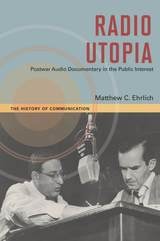
Radio Utopia
Postwar Audio Documentary in the Public InterestMatthew Ehrlich
University of Illinois Press, 2017
Radio, Morality, & Culture
Britain, Canada, and the United States, 1919 - 1945Robert S. Fortner
Southern Illinois University Press, 2005
Radio, Morality, and Culture: Britain, Canada, and the United States, 1919–1945 examines the moral controversies surrounding radio’s development during its formative years. In comparing the fledgling medium in Great Britain, Canada, and the United States, Robert S. Fortner documents how the church failed to participate in radio’s moral development and instead engaged in internecine warfare over issues of legitimacy and orthodoxy.
The church was arguing about theological turf and dealing with internal disputes while radio policy was being developed and communications history was being written. Fortner reveals how the church, doomed to play little more than a bit part in the future of radio, eventually lost its voice altogether in the continuing development of electronic media. Fortner effectively synthesizes cultural history and theory, communication studies, and the role religious organizations played in shaping the content and character of early radio. Geared to scholars of history, communications, and theology, Radio, Morality, and Culture provides a useful resource for research, scholarship, and public policy.
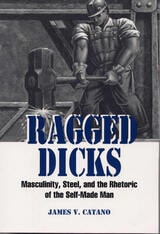
Ragged Dicks
Masculinity, Steel, and the Rhetoric of the Self-Made ManJames V. Catano
Southern Illinois University Press, 2001
Portraits of self-made men are rife in Western culture, as James V. Catano observes. Positive and negative, admittedly fictional and ostensibly factual, these portraits endure because the general rhetorical practice embodied in the myth of the self-made man enacts both the need and the very means for making oneself masculine: verbal power and prowess. The myth of the self-made man, in short, is part of ongoing rhetorical practices that constitute society, culture, and subjects.
To explain those practices and their effectiveness, Catano argues that the basic narrative achieves much of its effectiveness by engaging and enacting the traditional psychological dynamics of the family romance: preoedipal separation, oedipal conflict, and “proper” postoedipal self-definition and socialization.
To focus on the combined social, psychological, and rhetorical dynamics that constitute the ongoing activity he calls masculine self-making, Catano emphasizes a particular strand: masculinity and steelmaking. Pursuing that strand, he argues that these representations of masculine self-making are rhetorical enactments of cultural needs and desires, and that they are ongoing and formative arguments about what society and its individuals either are or should be.
Rainy Day Ready
Financial Literacy Programs and ToolsMelanie Welch
American Library Association, 2020
Rape, Agency, and Carceral Solutions
From Criminal Justice to Social JusticeLeland G. Spencer
University of Massachusetts Press, 2023
Winner of the 2023 National Communication Association's American Studies Division Outstanding Book Award
News media and popular culture in the United States have produced a conventional narrative of the outcomes of sexual abuse: someone perpetrates sexual violence, goes to trial, and is then punished with prison time. Survivors recede into the background, becoming minor characters in their own stories as intrepid prosecutors, police officers, and investigators gather evidence and build a case.
Leland G. Spencer explains how the stories we tell about sexual assault serve to reinforce rape culture, privileging criminal punishment over social justice and community-based responses to sexual violence. Examining a broad range of popular media, including news coverage of the Brock Turner case, Naomi Iizuka’s popular play Good Kids, the television program Criminal Minds, and the book turned television show 13 Reasons Why, Spencer demonstrates how these representations shore up the carceral state, perpetuate rape myths, blame victims, and excuse those who harm. While increased discussion about sexual violence represents feminist progress, these narratives assume that policing and prosecution are the only means of achieving justice, sidelining other potential avenues for confronting perpetrators and supporting victims.
Rare Books and Special Collections
Sidney E. Berger
American Library Association, 2014
Raveling the Brain
Toward a Transdisciplinary NeurorhetoricJordynn Jack
The Ohio State University Press, 2019
Jack first looks at the problem of “neurohype”—exaggerated or oversimplified claims that essentialize brains and make them “uncritically real”—questioning some of the fundamental assumptions about the brain that experimental protocols and psychological concepts rely on. Then, through examples of research on sex and gender, political orientation, and affect, Jack demonstrates how a rhetorical-material approach can help to generate alternative approaches to studying the brain that might mitigate the problem of neurohype. By raveling out the roots of neurohype and raveling back its use through time, Raveling the Brain shows how rhetoric and neuroscience might be raveled together, or intertwined, to create a stronger transdisciplinary approach that might enrich our understanding of those issues of interest to neuroscientists and humanists alike.
Re-imagining Doctoral Writing
Cecile Badenhorst
University Press of Colorado, 2021
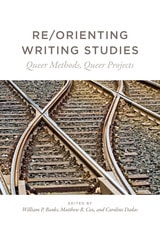
Re/Orienting Writing Studies
Queer Methods, Queer ProjectsWilliam P. Banks
Utah State University Press, 2018
While the humanities have engaged queer theory extensively, research methods have often been hermeneutic or interpretive. At the same time, social science approaches in composition research have foregrounded inquiry on human participants but have often struggled to understand where lesbian, gay, bisexual, transgender, and queer people fit into empirical research projects. Re/Orienting Writing Studies works at the intersections of humanities and social science methodologies to offer new insight into using queer methods for data collection and queer practices for framing research.
Contributors: Chanon Adsanatham, Jean Bessette, Nicole I. Caswell, Michael J. Faris, Hillery Glasby, Deborah Kuzawa, Maria Novotny, G Patterson, Stacey Waite, Stephanie West-Puckett
Re/Writing the Center
Approaches to Supporting Graduate Students in the Writing CenterSusan Lawrence
Utah State University Press, 2018
The essays in this volume show how to navigate the divide between traditional writing center theory and practices, developed to support undergraduate writers, and the growing demand for writing centers to meet the needs of advanced graduate writers. Contributors address core assumptions of writing center pedagogy, such as the concept of peers and peer tutoring, the emphasis on one-to-one tutorials, the positioning of tutors as generalists rather than specialists, and even the notion of the writing center as the primary location or center of the tutoring process. Re/Writing the Center offers an imaginative perspective on the benefits writing centers can offer to graduate students and on the new possibilities for inquiry and practice graduate students can inspire in the writing center.
Contributors: Laura Brady, Michelle Cox, Thomas Deans, Paula Gillespie, Mary Glavan, Marilyn Gray, James Holsinger, Elena Kallestinova, Tika Lamsal, Patrick S. Lawrence, Elizabeth Lenaghan, Michael A. Pemberton, Sherry Wynn Perdue, Doug Phillips, Juliann Reineke, Adam Robinson, Steve Simpson, Nathalie Singh-Corcoran, Ashly Bender Smith, Sarah Summers, Molly Tetreault, Joan Turner, Bronwyn T. Williams, Joanna Wolfe
Reaching All Writers
A Pedagogical Guide for Evolving College Writing ClassroomsJoanne Baird Giordano
Utah State University Press, 2023
Using threshold concepts and transfer as a foundation, the authors provide an invaluable resource for multiple contexts: instructors working off the tenure track and/or at multiple institutions; two-year college programs without a writing program administrator; and writing program graduate teaching assistant training courses. Each chapter includes an overview of a threshold concept, disciplinary background readings, practical teaching strategies, assignment and learning activity ideas, assessment principles, examples from student and instructor perspectives, and questions for reflection and discussion.
Reaching All Writers describes effective teaching practices to help all college writing instructors, regardless of their institutional contexts, make changes that support equitable and inclusive learning opportunities—with a focus on teaching students whose backgrounds and learning experiences are different from those with more educational or economic privilege. Both new and experienced teachers adapting first-year college writing courses will find the book’s blend of practical strategies and disciplinary knowledge a useful companion for facilitating new classroom and program needs or designing new teaching assistant training courses.
Reaction and Revolution
Rhetorics of the Radical RightKevin Musgrave
Michigan State University Press, 2027
Reaction and Revolution situates the resurgence of far-right movements and thinkers within a longer intellectual history that emerged primarily in interwar Germany—a philosophical conversation centered on political theology. Arguing that the more radically democratic modes of political theology offer better ways to understand and to counter the far right’s rhetorical appeal, this book offers a rhetorical-intellectual critique of three key thinkers and their allied movements: Paul Gottfried and the American paleoconservatives, Guillaume Faye and the French Identitarians, and Nick Land and the Dark Enlightenment. Kevin Musgrave argues that a radical political theology of race offers meaningful ways of challenging the right’s efforts to build a global imperium of whiteness and of reclaiming the promise of human dignity.
Read Me a Rhyme in Spanish and English
Rose Zertuche Treviño
American Library Association, 2009
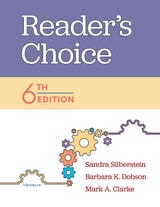
Reader's Choice, 6th Edition
Sandra Silberstein, Barbara K. Dobson, and Mark A. Clarke
University of Michigan Press, 2023
In this new edition, Reader's Choice continues its legacy of teaching skills for academic success. The new edition of the classic textbook teaches readers that the most important skill is selecting the best reading strategies for solving everyday reading challenges. The exercises and readings in Reader's Choice help students become independent, efficient readers.
Reader’s Choice provides 9 units that teach progressively more complex reading strategies. These units are accompanied by skills-focused activities as well as full reading passages. Units include readings and materials from respected news sites, commonly used items like transit maps, excerpts from well-known literary works such as Shirley Jackson’s “The Lottery,” and much more. Together, these readings provide engaging, real world examples that allow students to strengthen the reading skills vital to academic and career success.
In Reader’s Choice, 6th Edition, students will:
Reader’s Choice, 6th Edition is accompanied by a companion website featuring student resources and by a set of teaching materials supporting classroom use.
CEFR Levels: B1, B2, C1, C2
Readers' Advisory Service in the Public Library
Joyce G. Saricks
American Library Association, 2005

Reading Piers Plowman and the Pilgrim's Progress
Reception and the Protestant ReaderBarbara A. Johnson
Southern Illinois University Press, 1992
Centering her discussion on two historical "ways of reading"—which she calls the Protestant and the lettered—Barbara A. Johnson traces the development of a Protestant readership as it is reflected in the reception of Langland’s Piers Plowman and Bunyan’s Pilgrim’s Progress.
Informed by reader-response and reception theory and literacy and cultural studies, Johnson’s ambitious examination of these two ostensibly literary texts charts the cultural roles they played in the centuries following their composition, roles far more important than their modern critical reputations can explain.
Johnson argues that much more evidence exists about how earlier readers read than has hitherto been acknowledged. The reception of Piers Plowman, for example, can be inferred from references to the work, the apparatus its Renaissance printer inserted in his editions, the marginal comments readers inscribed both in printed editions and in manuscripts, and the apocryphal "plowman" texts that constitute interpretations of Langland’s poem. She demonstrates by example that what is culturally transmitted has not been just the work itself; it includes vestiges of past readers’ encounters with the text that are traceable both in the way a text is presented as well as in the way that presentation is received.
Conditioned more by religious, historical, and economic forces than by literary concerns, Langland’s poem became a part of the reformist tradition that culminated in Bunyan’s Pilgrim’s Progress. By understanding this tradition, Bunyan’s place in it, and the way the reception of The Pilgrim’s Progress illustrates the beginning of a new, more realistic fictional tradition, Johnson concludes, we can begin to delineate a more accurate history of the ways literature and society intersect, a history of readers reading.
Reading Ronell
Edited by Diane Davis
University of Illinois Press, 2008
Avital Ronell has won worldwide acclaim for her work across literature and philosophy, psychoanalysis and popular culture, political theory and feminism, art and rhetoric, drugs and deconstruction. In works such as The Test Drive, Stupidity, Crack Wars, and The Telephone Book, she has perpetually raised new and powerful questions about how we think, what thinking does, and how we fool ourselves about the troubled space between thought and action.
In this collection, some of today's most distinguished and innovative thinkers turn their attention to Ronell's teaching, writing, and provocations, observing how Ronell reads and what comes from reading her. By reading Ronell, and reading Ronell reading, contributors examine the ethico-political implications of her radical dislocations and carefully explicate, extend, and explore the paraconcepts addressed in her works.
Reading Sounds
Closed-Captioned Media and Popular CultureSean Zdenek
University of Chicago Press, 2015
These are the choices closed captioners face every day. Captioners must decide whether and how to describe background noises, accents, laughter, musical cues, and even silences. When captioners describe a sound—or choose to ignore it—they are applying their own subjective interpretations to otherwise objective noises, creating meaning that does not necessarily exist in the soundtrack or the script.
Reading Sounds looks at closed-captioning as a potent source of meaning in rhetorical analysis. Through nine engrossing chapters, Sean Zdenek demonstrates how the choices captioners make affect the way deaf and hard of hearing viewers experience media. He draws on hundreds of real-life examples, as well as interviews with both professional captioners and regular viewers of closed captioning. Zdenek’s analysis is an engrossing look at how we make the audible visible, one that proves that better standards for closed captioning create a better entertainment experience for all viewers.
Reading Together, Reading Apart
Identity, Belonging, and South Asian American CommunityTamara Bhalla
University of Illinois Press, 2016
Tamara Bhalla blends a case study with literary and textual analysis to illuminate this phenomenon. Her fascinating investigation considers institutions from literary reviews to the marketplace to social media and other technologies, as well as traditional forms of literary discussion like book clubs and academic criticism. Throughout, Bhalla questions how her subjects' circumstances, desires, and shared race and class, limit the values they ascribe to reading. She also examines how ideology circulating around a body of literature or a self-selected, imagined community of readers shapes reading itself and influences South Asians' powerful, if contradictory, relationship with ideals of cultural authenticity.
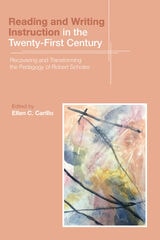
Reading and Writing Instruction in the Twenty-First Century
Recovering and Transforming the Pedagogy of Robert ScholesEllen C. Carillo
Utah State University Press, 2021
In this volume, Scholes’s scholarship is included alongside original essays, providing a resource for those considering everything from the place of the English major in the twenty-first century to best practices for helping students navigate misinformation and disinformation. Reading and Writing Instruction in the Twenty-First Century not only keeps Scholes’s legacy alive but carries it on through a commitment, in Scholes’s (1998) own words, to “offer our students . . . the cultural equipment they are going to need when they leave us.”
Contributors:
Angela Christie, Paul T. Corrigan, Lynée Lewis Gaillet, Doug Hesse, Alice S. Horning, Emily J. Isaacs, Christopher La Casse, Robert Lestón, Kelsey McNiff, Thomas P. Miller, Jessica Rivera-Mueller, Christian Smith, Kenny Smith
Reading in a Digital Age
David M. Durant
Against the Grain, LLC, 2017
The Charleston Briefings are written by authorities who provide an effective, readable overview of their topics—not an academic monograph. The intended audience is busy nonspecialist readers who want to be informed concerning important issues in our industry in an accessible and timely manner.
How is reading changing in the digital environment? How will it continue to change? Are we headed for an all- digital future? Or does print still have a place in the reading environment? Does format matter? What do readers tell us they want? This brief monograph offers librarians, publishers, vendors, and others an overview of these key issues as well as advice on how their institutions should approach the print versus digital controversy.

Reading, Research, And Writing
Teaching InformationMary Snyder Broussard
Assoc of College & Research Libraries, 2017
Readings from Classical Rhetoric
Edited by Patricia P. Matsen, Philip Rollinson, and Marion Sousa
Southern Illinois University Press, 1990
Here, for the first time in one volume, are all the extant writings focusing on rhetoric that were composed before the fall of Rome.
This unique anthology of primary texts in classical rhetoric contains the work of 24 ancient writers from Homer through St. Augustine, including Herodotus, Thucydides, Plato, Aristotle, Cicero, Quintilian, Tacitus, and Longinus.
Along with many widely recognized translations, special features include the first English translations of works by Theon and Nicolaus, as well as new translations of two works by important sophists, Gorgias’ encomium on Helen and Alcidamas’ essay on composition.
The writers are grouped chronologically into historical periods, allowing the reader to understand the scope and significance of rhetoric in antiquity. Introductions are included to each period, as well as to each writer, with writers’ biographies, major works, and salient features of excerpts.
Readings in Japanese Natural Language Processing
Edited by Francis Bond, et al.
CSLI, 2014
Readings in Linguistics I & II
Edited by Eric P. Hamp, Martin Joos, Fred W. Householder, and Robert Austerlitz
University of Chicago Press, 1995
Real Presences
George Steiner
University of Chicago Press, 1989
In Real Presences, George Steiner, whom A. S. Byatt praised as "a late, late, late, late Renaissance man," addressed one of the most challenging and important questions about art and human understanding: Can there be major dimensions of a poem, a painting, a musical composition created in the absence of God? Or is God always a real presence in the arts? Drawing examples from across centuries and cultures, Steiner passionately argues that a transcendent reality grounds all genuine art and human communication.
Real-World Teen Services
Jennifer Velásquez
American Library Association, 2015
Reality Bites
Rhetoric and the Circulation of Truth Claims in U.S. Political CultureDana L. Cloud
The Ohio State University Press, 2018
Reality Exploration and Discovery
Pattern Interaction in Language and LifeEdited by Linda Ann Uyechi and Lian-Hee Wee
CSLI, 2009
The twenty-five papers in this volume present current analyses of a variety of data and, more significantly, illustrate the various analytical tools available to linguists in the quest for deeper comprehension of the puzzles, questions, and problems they confront in natural language. The distinguished authors collected here explore interactions between linguistic structure and sound patterns across a diverse set of languages. The integrating theme of the volume is the influence of K. P. Mohanan’s philosophy of inquiry, derived not only from his rich body of diverse work but also from the fresh perspectives and intellectual vitality that he has shared with colleagues and students in a career spanning over three decades.
Rearticulating Writing Assessment for Teaching and Learning
Brian Huot
Utah State University Press, 2002
Brian Huot's aim for this book is both ambitious and provocative. He wants to reorient composition studies' view of writing assessment. To accomplish this, he not only has to inspire the field to perceive assessment--generally not the most appreciated area of study--as deeply significant to theory and pedagogy, he also has to counter some common misconceptions about the history of assessment in writing. In (Re)Articulating Writing Assessment, Huot advocates a new understanding, a more optimistic and productive one than we have seen in composition for a very long time. Assessment, as Huot points out, defines what is valued by a teacher or a society. What isn't valued isn't assessed; it tends to disappear from the curriculum. The dark side of this truth is what many teachers find troubling about large scale assessments, as standardized tests don't grant attention or merit to all they should. Instead, assessment has been used as an interested social mechanism for reinscribing current power relations and class systems.