Results by title
622 books match the query 'Language Study' and 13 start with r
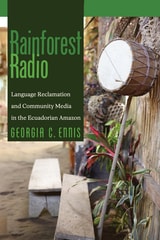
Rainforest Radio
Language Reclamation and Community Media in the Ecuadorian AmazonGeorgia C. Ennis
University of Arizona Press, 2025
Napo Kichwa communities in the Upper Ecuadorian Amazon find themselves doubly marginalized by settler colonialism and well-intentioned language revitalization projects.
In Rainforest Radio Georgia C. Ennis provides a comprehensive ethnographic exploration of Amazonian Kichwa community media, offering a unique look at how Indigenous broadcast and performance media facilitate linguistic and cultural reclamation in the Ecuadorian Amazon.
This work offers a critical analysis of how standardized language revitalization efforts, like the imposition of Unified Kichwa, can inadvertently perpetuate linguistic oppression. Ennis follows producers, performers, and consumers to understand the role of media in language reclamation. Through extensive fieldwork, she provides vivid portrayals of community efforts to sustain the language and cultural practices of their elders amid environmental and social upheaval.
Meticulously researched and beautifully written, Rainforest Radio is an essential work for anthropologists, linguists, and social scientists interested in language revitalization, Indigenous media, and environmental justice. This book showcases the transformative potential of community-driven media initiatives, highlighting the innovative responses of Napo Kichwa activists to the unique challenges they face. It serves as a powerful model for those working on similar issues worldwide, demonstrating the critical role of community media in language reclamation and cultural sustainability.
Reader's Choice, 6th Edition
Sandra Silberstein, Barbara K. Dobson, and Mark A. Clarke
University of Michigan Press, 2023
In this new edition, Reader's Choice continues its legacy of teaching skills for academic success. The new edition of the classic textbook teaches readers that the most important skill is selecting the best reading strategies for solving everyday reading challenges. The exercises and readings in Reader's Choice help students become independent, efficient readers.
Reader’s Choice provides 9 units that teach progressively more complex reading strategies. These units are accompanied by skills-focused activities as well as full reading passages. Units include readings and materials from respected news sites, commonly used items like transit maps, excerpts from well-known literary works such as Shirley Jackson’s “The Lottery,” and much more. Together, these readings provide engaging, real world examples that allow students to strengthen the reading skills vital to academic and career success.
In Reader’s Choice, 6th Edition, students will:
Reader’s Choice, 6th Edition is accompanied by a companion website featuring student resources and by a set of teaching materials supporting classroom use.
CEFR Levels: B1, B2, C1, C2
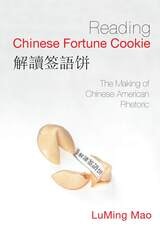
Reading Chinese Fortune Cookie
The Making of Chinese American RhetoricLuMing Mao
Utah State University Press, 2006
ecent scholarship tends to explain such influences as contributing to language hybridity---an advance over the traditional "deficit model." But Mao suggests that the "hybridity" approach is perhaps too arid or sanitized, missing rich nuances of mutual exchange, resistance, or even subversion. Through his concept of "togetherness in difference, Mao suggests that speakers of hybrid discourse may not be attempting the standard (and failing), but instead may be deliberately importing cultural material to create a distance between themselves and the standard. This practice, over time, becomes a process that transforms English, enriching and enlarging it through the infusion of non-Western discourse features, subverting power structures, and even providing unique humorous touches.
Of interest to scholars in composition, cultural studies, and linguistics as well, Reading Chinese Fortune Cookie leads in an important new direction for both our understanding and our teaching of English.
Reading Greek with Jonah
A Mini-Course in Ancient GreekJames McDonough
Catholic University of America Press, 2026
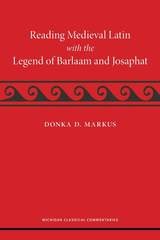
Reading Medieval Latin with the Legend of Barlaam and Josaphat
Donka D. Markus
University of Michigan Press, 2018
In Reading Medieval Latin with the Legend of Barlaam and Josaphat, Donka D. Markus offers comprehensive commentary on the 13th-century Dominican theologian Jacobus de Voragine’s retelling of the ancient story of the life of the Buddha that will resonate with contemporary students of Latin.
Jacobus’s version of the legend serves as a compelling, original Latin text. Vividly conveyed through parables, fables, and anecdotes, it naturally lends itself to a critical consideration of ethical principles and philosophical truths commonly shared across many cultures. With its rich stylistic devices and authentic classical Latin word order, it provides superb training for reading rhetorical prose before advancing to the works of more complex classical prose authors. At the same time, the text offers a unique opportunity for systematically learning the special features of Late and Medieval Latin. Included in this volume are two presentations of Jacobus’s text: one maintaining the original orthography reflecting Latin as it appears in medieval manuscripts, and one in which the orthography follows Classical Latin norms.
This textbook is designed for intermediate-level learners of Classical or Medieval Latin, whether in college, high school, or by self-directed study. The 5,000-word narrative text lends itself to a semester-long experience of reading one continuous work of prose. Each of the legend’s embedded stories can also be read as an independent selection with the help of the ample commentary, vocabulary, and grammar guidance. The extensive introduction provides the necessary background to contextualize the legend in its Latin iteration and sufficient historical information to make the reading meaningful for those without prior knowledge of Buddhism or medieval history. Additionally, this work makes Latin attractive to students of diverse backgrounds, as it highlights the language’s important role in disseminating the universally shared cultural legacy of humanity.
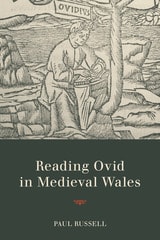
Reading Ovid in Medieval Wales
Paul Russell
The Ohio State University Press, 2017
Russell argues that this annotated version of the Ars amatoria arose out of the teaching traditions of the Carolingian world and that the annotation, as we have it, was the product of a cumulative process of glossing and commenting on the text. He then surveys other glossed Ovid manuscripts to demonstrate how that accumulation was built up. Russell also explores the fascinating issue of why Ovid’s love poetry should be used to teach Latin verse in monastic contexts. Finally, he discusses the connection between this manuscript and the numerous references to Ovid in later Welsh poetry, suggesting that the Ovidian references should perhaps be taken to refer to love poetry more generically.
Reading Skills for Success
A Guide to Academic TextsThomas A. Upton and Katherine W. Brinkmeyer
University of Michigan Press, 2026
In this new edition, Reading Skills for Success continues to help students develop the reading skills and strategies they need to transition to reading material in mainstream academic settings. Designed for precollege readers and nonnative speakers of English alike, the fully revised book focuses on the text-based, linguistic preparedness necessary to quickly spot key information and organizational structure in texts and avoid miscomprehension.
Written by academic experts who are practicing teachers in ESL intensive English, the book is grounded in sound pedagogical methods. Teachers will work through specific reading strategies with students; use the general activities and sample academic chapters in the book to practice the strategies being taught; and then have the students turn to outside readings, like their academic textbooks, to practice the strategies they are learning. Accessible for teachers and students, Reading Skills for Success provides a guide for developing text-based processing skills to improve reading confidence.
In Reading Skills for Success, 2nd Edition, students will:
- Learn to use word-level clues to increase reading comprehension.
- Recognize different types of expository text structures.
- Develop study skills for intensive analytical reading of academic prose.
- Practice reading strategies for in-depth, long-term understanding of complex academic texts.
- Apply skills to excerpts from actual textbooks used in first-year college courses representing a wide variety of fields in the humanities, social sciences, and sciences.
CEFR level: A1-B1
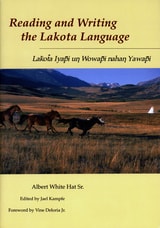
Reading and Writing Lakota Language
Albert White Hat Sr
University of Utah Press, 1999
Though Reading and Writing the Lakota Language is thorough in its inclusion of conjugation, syntax, and sentence, it emphasizes vocabulary and pronunciation. Author Albert White Hat Sr. presents Lakota philosophy as it applies to specific grammar lessons. Moreover, he documents the impact of the acculturation process on the language, showing how Lakota evolved as a result of non-Indian influences. The textual example offers new information and interpretation of Lakota society, even to scholars who specialize n Plains cultures. Beyond language instruction, readers will value the book for its cultural insights, humorous stories, and its entertaining tone.
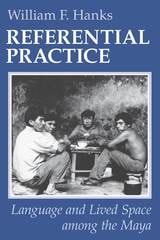
Referential Practice
Language and Lived Space among the MayaWilliam F. Hanks
University of Chicago Press, 1990
As his central case, Hanks undertakes a comprehensive analysis of deixis—linguistic forms that fix reference in context, such as English I, you, this, that, here, and there. He shows that Maya deixis is a basic cultural construct linking language with body space, domestic space, agricultural and ritual practices, and other fields of social activity. Using this as a guide to ethnographic description, he discovers striking regularities in person reference and modes of participation, the role of perception in reference, and varieties of spatial orientation, including locative deixis. Traditionally considered a marginal area in linguistics and virtually untouched in the ethnographic literature, the study of referential deixis becomes in Hanks's treatment an innovative and revealing methodology.
Referential Practice is the first full-length study of actual deictic use in a non-Western language, the first in-depth study of speech practice in Yucatec Maya culture, and the first detailed account of the relation between routine conversation, embodiment, and ritual discourse.
Refugee Students
What Every ESL Teacher Needs to KnowJeffra Flaitz
University of Michigan Press, 2018

Responding to Writing
A Practical Sourcebook for InstructorsDana R. Ferris, Grant Eckstein, and Betsy Gilliland
University of Michigan Press, 2027
Responding to Writing brings together practical, cutting-edge ideas from teachers who spend their days working with student writers and trying to make feedback genuinely useful. The book shares classroom approaches that have been tested in real courses, from high school settings to college and graduate programs. It shows how teachers, peers, and students themselves can make feedback a more collaborative and manageable part of writing instruction.
Each chapter presents a student‑centered approach that helps writers feel supported and more in control of their own writing and revision process. In addition to a summary of the approach with light background and context, readers will find straightforward examples, tools, and routines they can adapt to their own classrooms, including ways to use technology, build reflection into assignments, and support writers with varied backgrounds and needs. This book offers working instructors a set of dependable methods for helping students improve as writers while keeping feedback purposeful and humane.
Revitalization Lexicography
The Making of the New Tunica DictionaryPatricia M. Anderson
University of Arizona Press, 2020
Revitalization Lexicography provides a detailed account of creating a dictionary meant to move a once-sleeping language into a language of active daily use. This unique look under the hood of lexicography in a small community highlights the ways in which the dictionary was intentionally leveraged to shape the Tunica language as it inevitably changes throughout revitalization. Tunica, one of the heritage languages of the Tunica-Biloxi Tribe of Marksville, Louisiana, has been undergoing active revitalization since 2010. The current generation of speakers began learning Tunica, a once-sleeping language, through written documentation. Now enough Tunica speakers to confer amongst themselves when questionable language use arises.
Marrying both the theoretical and the practical aspects that contributed to the Tunica dictionary, this book discusses complex lexicographic tasks in a manner accessible to both academic and community readers. This work is firmly backdropped in a fieldwork approach that centers the community as owners of all aspects of their revitalization project. This book provides concrete and practical considerations for anyone attempting to create a dictionary. Contrasting examples from Tunica and English dictionaries, this book challenges readers to rethink their relationship to dictionaries in general. A must-read for anyone who has ever touched a dictionary.
Rubrics
What Every Teacher Needs to KnowDeborah Crusan and Robyn Brinks Lockwood
University of Michigan Press, 2026
As workloads and work responsibilities continue to increase, assessment often causes teachers anxiety. Rubrics: What Every Teacher Needs to Know is a handbook that combines theory and pragmatism in clear language to help pre- and in-service teachers and teacher trainers obtain assessment information quickly and efficiently. While many teachers do not realize that creating an assignment is creating an assessment, they should go hand in hand. This book highlights both the value of rubrics and the value of assessment literacy, which is the knowledge, skills, and abilities needed to create, administer, and understand the results of assessments to improve student learning.
Rubrics provides new and experienced teachers with the tools to become more transparent assessors of their students’ writing, reading, listening, speaking, grammar, and vocabulary. Deborah Crusan and Robyn Brinks Lockwood bring their expertise in assessment and English for academic purposes to address the challenges teachers face in writing clear assignments and grading them fairly. They emphasize that teachers need to think about what they want their students to be able to do, clarify their expectations to their students, and convey those expectations on a rubric/scoring guide. While transparent, step-by-step instructions are included in the book to help teachers create their own assignments and assessments, the appendix materials containing ready-made assignments and their accompanying rubrics will be sure to delight busy teachers.