Results by title
276 books match the query 'Legal History' and 9 start with r
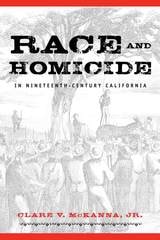
Race And Homicide In Nineteenth-Century California
Clare V. McKanna
University of Nevada Press, 2007
Nineteenth-century California was a society in turmoil, with a rapidly growing population, booming mining camps, insufficient or nonexistent law-enforcement personnel, and a large number of ethnic groups with differing attitudes toward law and personal honor. Violence, including murder, was common, and legal responses varied broadly. Available now for the first time in paperback, Race and Homicide in Nineteenth-Century California examines coroners’ inquest reports, court case files, prison registers, and other primary and printed sources to analyze patterns of homicide and the state’s embryonic justice system. Author Clare V. McKanna discovers that the nature of crimes varied with the ethnicity of perpetrators and victims, as did the conduct and results of trials and sentencing patterns. He presents specific case studies and a vivid portrait of an unruly society in flux. Enhanced with testimony from contemporary sources and illustrated with period photographs, this study richly portrays a frontier society where the law was neither omnipotent nor impartial.
Race and the Law in South Carolina
From Slavery to Jim CrowJohn W. Wertheimer
Amherst College Press, 2023
“Recent arguments in African American History have emphasized the theme of continuity. . . . Race and Law in South Carolina recovers the theme of change over time by showing just how things have changed, and it does so through patient, thick description.” —H. Robert Baker, Georgia State University
“This book and its concomitant student project is an exciting endeavor. . . . The cases are captivating and accessibly written, making this a possible college classroom read.” —Vanessa Blanck, Rowan University
Radical Enfranchisement in the Jury Room and Public Life
Sonali Chakravarti
University of Chicago Press, 2019
With Radical Enfranchisement in the Jury Room and Public Life, Sonali Chakravarti offers a full-throated defense of juries as a democratic institution. She argues that juries provide an important site for democratic action by citizens and that their use should be revived. The jury, Chakravarti argues, could be a forward-looking institution that nurtures the best democratic instincts of citizens, but this requires a change in civic education regarding the skills that should be cultivated in jurors before and through the process of a trial. Being a juror, perhaps counterintuitively, can guide citizens in how to be thoughtful rule-breakers by changing their relationship to their own perceptions and biases and by making options for collective action salient, but they must be better prepared and instructed along the way.
Radical Enfranchisement in the Jury Room and Public Life
Sonali Chakravarti
University of Chicago Press, 2019
This is an auto-narrated audiobook edition of this book.
With Radical Enfranchisement in the Jury Room and Public Life, Sonali Chakravarti offers a full-throated defense of juries as a democratic institution. She argues that juries provide an important site for democratic action by citizens and that their use should be revived. The jury, Chakravarti argues, could be a forward-looking institution that nurtures the best democratic instincts of citizens, but this requires a change in civic education regarding the skills that should be cultivated in jurors before and through the process of a trial. Being a juror, perhaps counterintuitively, can guide citizens in how to be thoughtful rule-breakers by changing their relationship to their own perceptions and biases and by making options for collective action salient, but they must be better prepared and instructed along the way.
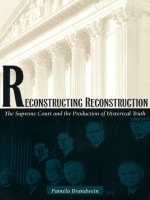
Reconstructing Reconstruction
The Supreme Court and the Production of Historical TruthPamela Brandwein
Duke University Press, 1999
Delving into the circumstances, assumptions, and rhetoric that shaped the “official” story of Reconstruction, Brandwein describes precisely how a dominant interpretation of events ultimately emerged and what its implications have been for twentieth-century judicial decisions, particularly for Supreme Court rulings on civil rights. While analyzing interpretive disputes about slavery, Brandwein offers a detailed rescoring of post–Civil War legislative and constitutional history, including analysis of the original understanding of the Fourteenth Amendment. She identifies the perspectives on Reconstruction that were endorsed or rejected by the Supreme Court. Explaining what it meant—theoretically and practically—to resolve Reconstruction debates with a particular definition of slavery, Brandwein recounts how the Northern Democratic definition of “ending” slavery was not the only definition, just the one that prevailed. Using a familiar historical moment to do new interpretive work, she outlines a sociology of constitutional law, showing how subjective narrative construction can solidify into opaque institutional memory.
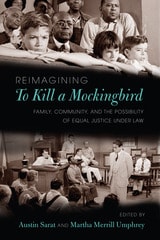
Reimagining "To Kill a Mockingbird"
Family, Community, and the Possibility of Equal Justice under LawAustin Sarat
University of Massachusetts Press, 2013
The readings in this volume peel back the film's visual representation of the many-layered social world of Maycomb, Alabama, offering sometimes counterintuitive insights through the prism of a number of provocative contemporary theoretical and interpretive questions. What, they ask, is the relationship between the subversion of social norms and the doing of justice or injustice? Through what narrative and visual devices are some social hierarchies destabilized while others remain hegemonic? How should we understand the sacrifices characters make in the name of justice, and comprehend their failures in achieving it?
Asking such questions casts light on the film's eccentricities and internal contradictions and suggests the possibility of new interpretations of a culturally iconic text. The book examines the context that gave meaning to the film's representation of race and how debates about family, community, and race are played out and reframed in law.
Contributors include Colin Dayan, Thomas L. Dumm, Susan Sage Heinzelman, Linda Ross Meyer, Naomi Mezey, Imani Perry, and Ravit Reichman.
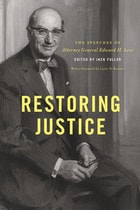
Restoring Justice
The Speeches of Attorney General Edward H. LeviEdward H. Levi
University of Chicago Press, 2013
Serving at an almost unprecedentedly difficult time, Levi was among the most admired attorney generals of the modern era. Published here for the first time, the speeches in Restoring Justice offer a superb sense of the man and his work.
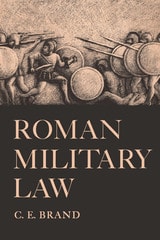
Roman Military Law
By C. E. Brand
University of Texas Press, 1968
Rome was the law-giver for much of the modern world. She was also the greatest military power of antiquity, operating her military organization with remarkable efficiency and effectiveness throughout most of the then-known world. In view of the importance of both the legal and military aspects of the Roman Empire, an account of their combination in a system of disciplinary control for the Roman armies is of considerable significance to historians in both fields—and, in fact, to scholars in general. In Roman Military Law, C. E. Brand describes this system of control.
Since a characterization of such a system can be made most meaningful only against a background of Roman constitutional government and in the light of ideologies current at the time, Brand follows his initial “Note on Sources” with a sketch of the contemporary Roman scene. This first section includes a discussion of the Roman constitution and an examination of Roman criminal law.
The history of Rome, as a republic, principate, and empire, extended over a period of a thousand years, so any attempt to represent a generalized picture must be essentially a matter of extraction and condensation from the voluminous literature of the whole era. Nevertheless, from the fantastic evolution that is the history of Rome, Brand has been able to construct a more or less static historical mosaic that may be considered typically “Roman.” This comes into sharpest focus during the period of the Punic Wars, when the city and its people were most intensely Roman. The picture of the Roman armies is set into this basic framework, in chapters dealing with military organization, disciplinary organization, religion and discipline, and offenses and punishments.
The final section of the book considers briefly the vast changes in Roman institutions that came about under the armies of the Empire, and then concludes with the Latin text and an English translation of the only known code of Roman military justice, promulgated sometime during the later Empire, preserved in Byzantine literature, and handed down to medieval times in Latin translations of Byzantine Greek law, which it has heretofore been confused.
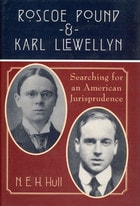
Roscoe Pound and Karl Llewellyn
Searching for an American JurisprudenceN. E. H. Hull
University of Chicago Press, 1997
Through meticulous archival research, Hull shows how the intellectual battles of the day took place against a network of private and public relationships and demonstrates how Pound's and Llewellyn's ideas of jurisprudence sprang from a kind of intellectual bricolage, the pragmatic assemblage of parts rather than the development of a unified whole, that is peculiarly American. Humorous, engaging, and provocative, Roscoe Pound and Karl Llewellyn uncovers the roots of American jurisprudence in the lives of two of its most compelling figures.