Results by title
275 books match the query 'Letters' and 5 start with r

Reading Galileo's Letters
Experiments in Friendship, Knowledge, and CommunityEdited by Paula Findlen and Hannah Marcus
University of Chicago Press, 2027
Essays by many of the foremost experts on Galileo offer an interdisciplinary approach to the legendary scientist’s correspondence.
The Tuscan mathematician, physicist, and astronomer Galileo Galilei (1564–1642) is one of history’s most iconic and controversial figures. Letters form the backbone of what one early Galileo scholar called the “private Galileo,” and his correspondence is indeed a record of his family and friendships; his intellectual evolution; his professional interactions with other scientific figures; and his relations with patrons, brokers, and publishers. Last, but hardly least, his letters are a unique cultural artifact of Galileo the writer and master of vernacular prose.
Galileo’s correspondence crossed Europe in public mail pouches, through diplomatic messengers, and was written in code. Today, there are 3,272 surviving letters to or from Galileo and his many friends, family members, disciples, and rivals across Europe. This volume examines these letters as an essential aspect of Galileo’s personal and scientific career. They are what the editors call his “experiments in friendship,” which enabled, abetted, and often served as early drafts of the theories in his published works. This collaborative volume brings together different approaches, case studies, and forms of expertise—historical and literary, intellectual and material, archival and digital. It is a must-read for all Galileo enthusiasts and anyone interested in how to make the most of a rich record of correspondence.
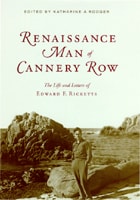
Renaissance Man of Cannery Row
The Life and Letters of Edward F. RickettsEdward F. Ricketts, edited by Katharine A. Rodger
University of Alabama Press, 2002
This portrait of one of John Steinbeck's closest friends illuminates the life and work of a figure central to the development of scientific and literary thought in the 20th century.
Marine biologist Edward F. Ricketts is perhaps best known as the inspiration for John Steinbeck's most empathic literary characters Doc in Cannery Row, Slim in Of Mice and Men, Jim Casy in The Grapes of Wrath, and Lee in East of Eden. The correspondence of this accomplished scientist, writer, and philosopher reveals the influential exchange of ideas he shared with such prominent thinkers and artists as Henry Miller, Joseph Campbell, Ellwood Graham, and James Fitzgerald, in addition to Steinbeck, all of whom were drawn to Ricketts's Monterey Bay laboratory, a haven of intellectual discourse and Bohemian culture in the 1930s and 1940s.
The 125 previously unpublished letters of this collection, housed at the Stanford University Library, document the broad range of Ricketts's interests and accomplishments during the last 12 and most productive years of his life. His handbook on Pacific marine life, Between Pacific Tides, is still in print, now in its fifth edition. The biologist's devotion to ecological conservation and his evolving philosophy of science as a cross-disciplinary, holistic pursuit led to the publication of The Sea of Cortez. Many of Ricketts's letters discuss his studies of the Pacific littoral and his theories of “phalanx” and transcendence. Epistles to family members, often tender and humorous, add dimension and depth to Steinbeck's mythologized depictions of Ricketts. Katharine A. Rodger has enriched the correspondence with an introductory biographical essay and a list of works cited.

Reporting the Chinese Revolution
The Letters of Rayna ProhmeGregor Benton and Arthur J. Knodel
Pluto Press, 2007
The book consists of letters Prohme wrote to her closest friend and her husband in the period immediately before, during and after the Wuhan interlude. Her reporting brought her into contact with many major political figures including Madam Sun Yat-sen (a prominent figure in the opposition to Chiang Kai-shek) and Mikhail Borodin (a chief Soviet advisor in China).
This book provides an unusual and often moving insight into a fascinating period in modern Chinese history.
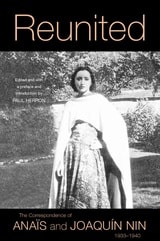
Reunited
The Correspondence of Anaïs and Joaquín Nin, 1933–1940Anaïs Nin
Ohio University Press, 2020
The incestuous affair between the writer Anaïs Nin and her father, the pianist-composer Joaquín Nin, is well documented in the volume of her unexpurgated diary published under the title Incest. What has been missing from that account is Joaquín’s point of view. Reunited: The Correspondence of Anaïs and Joaquín Nin, 1933–1940 presents more than one hundred intimate communications between these two artistic geniuses, revealing not only the dynamics of their complex relationship but also why Anaïs spent her life in a never-ending battle to feel loved, appreciated, and understood.
Reunited collects the correspondence between Anaïs and Joaquín just before, during, and after the affair, which commenced in 1933, twenty years after he had abandoned his ten-year-old daughter and the rest of his family. These letters were long believed to have been destroyed and lost to history. In 2006, however, a folder containing Joaquín’s original letters to his daughter was discovered in Anaïs’s Los Angeles home, along with a second folder of her letters to him. Together, these letters tell the story of an absent father’s attempt to reconnect with his adult daughter and how that rapprochement quickly turned into an illicit sexual relationship.
Robert B. Heilman and Eric Voegelin
A Friendship in Letters, 1944-1984Edited & Intro by Charles R. Embry & Foreword by Champlin B. Heilman
University of Missouri Press, 2004
Heilman and Voegelin first became acquainted around 1941, when Voegelin delivered a guest lecture for the political science department at Louisiana State University. At that time, Heilman was teaching in the English department at LSU along with Robert Penn Warren and Cleanth Brooks. What began as simple exchanges after Voegelin moved to LSU soon grew into full-fledged correspondence—beginning with an eight-page letter by Voegelin commenting on Heilman’s manuscripton Shakespeare’s King Lear. Their correspondence lasted until four months before Voegelin’s death in January 1985.
These letters represent Voegelin’s most prolonged correspondence with a native-born American scholar and provide readers with an insight into Voegelin as a literary critic. While Voegelin’s analysis of Henry James’s The Turn of the Screw is well known, these letters reveal the context from which the analysis grew. Additional comments by Voegelin on Mann, Eliot, Shakespeare, Homer, Proust, Flaubert, and other significant writers are uncovered throughout his exchanges with Heilman.
Readers will appreciate not only Heilman’s elegant style but also his efforts to clarify for himself the meaning and implications of Voegelin’s developing philosophy. Heilman’s questions are often ones that readers of Voegelin continue to ask today. In his queries, as well as in the exposition of his theories of tragedy and melodrama, human nature, and expressionist drama, Heilman displays a canny perception of the philosophical issues and problems of modernity that sustained their interdisciplinary discussion. The letters exchanged by Robert B. Heilman and Eric Voegelin demonstrate the warm friendship these two scholars shared and illuminate many of the turns and transformations in their work as they developed as thinkers.