Results by title
161 books match the query 'Material culture' and 5 start with r
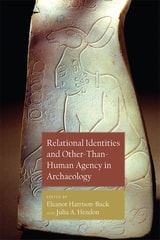
Relational Identities and Other-than-Human Agency in Archaeology
Eleanor Harrison-Buck
University Press of Colorado, 2020
Relational Identities and Other-than-Human Agency in Archaeology explores the benefits and consequences of archaeological theorizing on and interpretation of the social agency of nonhumans as relational beings capable of producing change in the world. The volume cross-examines traditional understanding of agency and personhood, presenting a globally diverse set of case studies that cover a range of cultural, geographical, and historical contexts.
Agency (the ability to act) and personhood (the reciprocal qualities of relational beings) have traditionally been strictly assigned to humans. In case studies from Ghana to Australia to the British Isles and Mesoamerica, contributors to this volume demonstrate that objects, animals, locations, and other nonhuman actors also potentially share this ontological status and are capable of instigating events and enacting change. This kind of other-than-human agency is not a one-way transaction of cause to effect but requires an appropriate form of reciprocal engagement indicative of relational personhood, which in these cases, left material traces detectable in the archaeological record.
Modern dualist ontologies separating objects from subjects and the animate from the inanimate obscure our understanding of the roles that other-than-human agents played in past societies. Relational Identities and Other-than-Human Agency in Archaeology challenges this essentialist binary perspective. Contributors in this volume show that intersubjective (inherently social) ways of being are a fundamental and indispensable condition of all personhood and move the debate in posthumanist scholarship beyond the polarizing dichotomies of relational versus bounded types of persons. In this way, the book makes a significant contribution to theory and interpretation of personhood and other-than-human agency in archaeology.
Contributors:
Susan M. Alt, Joanna Brück, Kaitlyn Chandler, Erica Hill, Meghan C. L. Howey, Andrew Meirion Jones, Matthew Looper, Ian J. McNiven, Wendi Field Murray, Timothy R. Pauketat, Ann B. Stahl, Maria Nieves Zedeño
Remain
Ioana B. Jucan
University of Minnesota Press, 2018
Engaging with remains and remainders of media cultures
As new, as current, as now—this is primarily our understanding of technologies and their mediating of our social constructions. But past media and past practices continue to haunt and inflect our present social and technical arrangements. To trace this haunting, two performance theorists and a media theorist engage in this volume with remains and remainders of media cultures through the lenses of theatre and performance studies and of media archaeology. They address the temporalities and materialities of remain(s), the production of obsolescence in relation to the live body, and considerations of cultural memory as well as of infrastructure and the natural history of media culture.
Rhetoric as a Posthuman Practice
Casey Boyle
The Ohio State University Press, 2018
Through case studies of the media art of glitch, urban explorers’ use of social media, and DIY digital networks, this book then reconsiders how practice/exercise functions when the once essential bodies of the individual and a society—the two primary categories authorized by a humanist paradigm—become less reliable categories from which we might orient rhetorical action. In sum, the book argues that rhetorical practice is irreducible to the traditions and categories of humanism and must now exercise its posthuman capacities.
Rhetoric, Through Everyday Things
Edited by Scot Barnett and Casey Boyle
University of Alabama Press, 2016
The fifteen essays in Rhetoric, Through Everyday Things persuasively overturn the stubborn assumption that objects are passive tools in the hands of objective human agents. Rhetoric has proved that forms of communication such as digital images, advertising, and political satires do much more than simply lie dormant, and Rhetoric, Through Everyday Things shows that objects themselves also move, circulate, and produce opportunities for new rhetorical publics and new rhetorical actions. Objects are not simply inert tools but are themselves vibrant agents of measurable power.
Organizing the work of leading and emerging rhetoric scholars into four broad categories, the collection explores the role of objects in rhetorical theory, histories of rhetoric, visual rhetoric, literacy studies, rhetoric of science and technology, computers and writing, and composition theory and pedagogy. A rich variety of case studies about objects such as women’s bicycles in the nineteenth century, the QWERTY keyboard, and little free libraries ground this study in fascinating, real-life examples and build on human-centered approaches to rhetoric to consider how material elements—human and nonhuman alike—interact persuasively in rhetorical situations.
Taken together, Rhetoric, Through Everyday Things argues that the field of rhetoric’s recent attention to material objects should go further than simply open a new line of inquiry. To maximize the interdisciplinary turn to things, rhetoricians must seize the opportunity to reimagine and perhaps resolve rhetoric’s historically problematic relationship to physical reality and ontology. By tapping the rich resource of inanimate agents such as "fish, political posters, plants, and dragonflies,” rhetoricians can more fully grasp the rhetorical implications at stake in such issues.
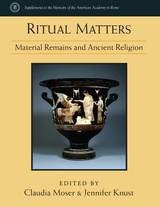
Ritual Matters
Material Remains and Ancient ReligionClaudia Moser and Jennifer Knust, editors
University of Michigan Press, 2017
Material remains of religious practices may reveal striking local continuity, but they also highlight points of change, as distinct moments of manufacture and use transformed both sites and objects. Yet not every religious practice leaves a trace: the embodied use of imperial statuary, the rationale for the design of particular sacred books or the ephemeral “magical” implements designed by local religious experts leave few traces, if any, and are therefore less amenable to material investigation. What does remain, however, challenges any neat association between representation and reality or literary claim and practical application.
This volume represents a significant contribution to the material approach of studying the ancient Mediterranean’s diverse religious practices. In addition to volume editors Claudia Moser and Jennifer Knust, contributors include Henri Duday, Gunnel Ekroth, David Frankfurter, Richard Gordon, Valérie Huet, William Van Andringa, and Zsuzsanna Várhelyi. Topics covered include funerary remains, sacrificial practices, “magic,” Roman altars, imperial reliefs and statuary, and the role of sacred books.