364 books match the query 'Michigan' and 10 start with r
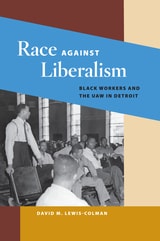
cover of Race against Liberalism: Black Workers and the UAW in Detroit

Race against Liberalism

Black Workers and the UAW in Detroit

David M. Lewis-Colman

University of Illinois Press, 2007

Race against Liberalism examines how black worker activism in Detroit shaped the racial politics of the labor movement and the white working class. David M. Lewis-Colman traces the substantive, long-standing disagreements between liberals and the black workers who embraced autonomous race-based action. As he shows, black autoworkers placed themselves at the center of Detroit's working-class politics and sought to forge a kind of working class unity that accommodated their interests as African Americans. The book covers the independent caucuses in the 1940s and the Trade Union Leadership Council in the 1950s; the black power movement and Revolutionary Union Movements of the mid-1960s; and the independent race-based activism of the 1970s that resulted in Coleman Young's 1973 election as the city's first black mayor.
[more]
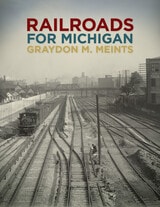
cover of Railroads for Michigan

Railroads for Michigan

Graydon M. Meints

Michigan State University Press, 2013
In this thoroughly researched history, Graydon Meints tells the fascinating story of the railroad’s arrival and development in Michigan. An engaging and accessible text, the book describes the long-awaited and often-troubled advent of the railroad in the state, the building of which shifted from private to public efforts and back again, amid tumultuous social, business, and political developments. The railroad would come to play a role in almost every critical event in Michigan’s history, including the Civil War, the Granger Movement, and the Gilded Age, before beginning to wane following the arrival of the automobile, the Interstate Commerce Commission, World War I, and the Great Depression. A brief growth spurt during World War II was short-lived, and it was followed by the collapse of several major railroads and the formation of Amtrak and Conrail. Looking ahead to the future of the railroad in the Great Lakes region, Meints assesses the strengths and shortcomings of this revolutionary invention. With careful attention to the personal impact of the railroad, Meints recognizes in brief biographies the many men and women responsible for the development and operation of Michigan railroads, as well as the triumphs, tragedies, and spaces that shaped their lives and work.
[more]
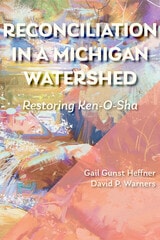
cover of Reconciliation in a Michigan Watershed: Restoring Ken-O-Sha

Reconciliation in a Michigan Watershed

Restoring Ken-O-Sha

Gail Gunst Heffner

Michigan State University Press, 2024

Like many American urban waterways, Ken-O-Sha has been in decline for nearly two hundred years. Once life-supporting, the waterway now known as Plaster Creek is life-threatening. In this provocative book, scholars and environmentalists Gail Gunst Heffner and David P. Warners explore the watershed’s ecological, social, spiritual, and economic history to determine what caused the damage, and describe more recent efforts to repair it. Heffner and Warners provide insight into the concept of reconciliation ecology, as enacted through their group, Plaster Creek Stewards,who together with community partners refuse to accept the status quo of a contaminated creek unfit for children’s play, severely reduced biological diversity, and environmental injustices. Their work reveals that reconciliation ecology needs to focus not only on repairing damaged human–nature relationships, but also on the relationships between people groups, including Indigenous North Americans and the descendants of European colonizers.
[more]
cover of Right in Michigan's Grassroots: From the KKK to the Michigan Militia

Right in Michigan's Grassroots

From the KKK to the Michigan Militia

JoEllen McNergney Vinyard

University of Michigan Press, 2011

"A real contribution to Michigan history that gets to the root of the movements in twentieth-century American history that upon reflection can bring a certain discomfort and unease."
---Francis X. Blouin, Director of the Bentley Historical Library, University of Michigan

Throughout the twentieth century, Michigan became home to nearly every political movement in America that emerged from the grassroots. Citizens organized on behalf of concerns on the "left," on the "right," and in the "middle of the road." Right in Michigan's Grassroots: From the KKK to the Michigan Militia is about the people who supported movements that others, then and later, would denounce as disgraceful---members of the Ku Klux Klan during the 1920s, the followers of Father Charles Coughlin in the 1930s, anti-Communists and the John Birch Society in the post–World War II era, and the members of the Michigan Militia who first appeared in the 1990s.

The book explores the complex historical circumstances in Michigan that prompted the emergence of these organizations and led everyday men and women to head off, despite ridicule or condemnation, with plans unsanctioned and tactics unorthodox, variously brandishing weapons of intimidation, discrimination, fearmongering, and terror. Drawing heavily on primary sources, including the organizations' files and interviews with some of their leaders and surviving members, JoEllen Vinyard provides a far more complete portrait of these well-known extremist groups than has ever been available.

[more]
cover of Ripple Effects: How We're Loving Our Lakes to Death

Ripple Effects

How We're Loving Our Lakes to Death

Ted J. Rulseh

University of Wisconsin Press, 2022

Lakes are among the Upper Midwest’s greatest treasures and most valuable natural resources. The Great Lakes define the region, and thousands of smaller lakes offer peace, joy, and recreation to millions. And yet, in large part because of the numbers of people who enjoy the local waterways, the lakes of Wisconsin, Michigan, and Minnesota face numerous challenges. Invasive species, pollution, defective septic systems, inadequate shoreland zoning laws, and climate change are present and increasingly existential threats. We are, quite possibly, loving our lakes to death.

In his engaging and conversational style, Ted Rulseh details each of these challenges and proposes achievable solutions. He draws on personal experience, interviews, academic research, and government reports to describe the state of the lakes, the stresses they are under, and avenues to successful lakeside living for a sustainable future. Ripple Effects will be a go-to source for all who love lakes and who advocate for their protection; its driving question is summed up by one of Rulseh’s interviewees: “We love this lake. What can we do to keep it healthy?”
[more]
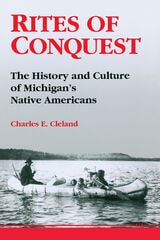
cover of Rites of Conquest: The History and Culture of Michigan's Native Americans

Rites of Conquest

The History and Culture of Michigan's Native Americans

Charles E. Cleland

University of Michigan Press, 1992

For many thousands of years before the arrival of Europeans, Michigan's native peoples, the Anishnabeg, thrived in the forests and along the shores of the Great Lakes. Theirs were cultures in delicate social balance and in economic harmony with the natural order. Rites of Conquest details the struggles of Native Americans Michigan—the Ojibwa, Ottawa, and Potawatomi, and their neighbors—to maintain unique traditions in the wake of contact with Euro-Americans. The French quest for furs, the colonial aggression of the British, and the invasion of native homelands by American settlers is the backdrop for this fascinating saga of their resistance and accommodation to the new social order. Minavavana's victory at Fort Michilimackinac, Pontiac's attempts to expel the British, Pokagon's struggle to maintain a Michigan homeland, and Big Abe Le Blanc's fight for fishing rights are a few of the many episodes recounted in the pages of this book.

Beyond wars and warriors, Rites of Conquest is also about diplomacy and negotiation, mythology and magic, birth and death, and the joys and trials of daily life in the native villages of the Great Lakes region. Today, Michigan's Native American citizens struggle to solve problems that are a legacy of their past, while they attempt to maintain a distinctive place within modern society. In facing this challenge they often turn to the values and traditions that set them apart as the most enduring peoples of the Great Lakes region.
[more]
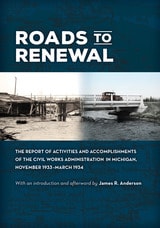
cover of Roads to Renewal: The Report of Activities and Accomplishments of the Civil Works Administration in Michigan, November 1933–March 1934

Roads to Renewal

The Report of Activities and Accomplishments of the Civil Works Administration in Michigan, November 1933–March 1934

James R. Anderson

Michigan State University Press, 2020

This publication makes available to historians and general readers a little-known document mapping the achievement of a crucial initiative in the plans for recovery from the harshest blows of the Great Depression, in one of America’s hardest-hit states. It presents a historically unique case history of the Federal Civil Works Administration, established by Franklin D. Roosevelt’s New Deal. The CWA addressed the issues of unemployment and destitution brought on by the Depression, specifically in Michigan. With a contextualizing introduction and afterword by historian James R. Anderson, the republication of this report—with its wealth of data and statistics, and its compelling information about the extent of the crisis and of the government’s initiatives—brings to light fascinating aspects of how critical (and impactful) such interventions were in the context of unprecedented economic challenges.
[more]
cover of Roman Brick Stamps in the Kelsey Museum

Roman Brick Stamps in the Kelsey Museum

John P. Bodel

University of Michigan Press, 1983
A catalogue of the largest known collection of brick stamps outside Italy
[more]
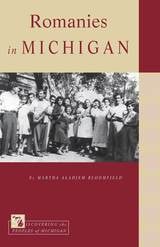
cover of Romanies in Michigan

Romanies in Michigan

Martha Aladjem Bloomfield

Michigan State University Press, 2019
This groundbreaking book relates the oral histories of Romanies in the United States. It focuses on the Hungarian-Slovak Romani musical community originally from Delray, Michigan, as well as others from outlying areas in and near Michigan. Originally Romanies came from India and hundreds of years ago traveled to Europe, Latin America, the United States, and, eventually, Michigan. Their stories provide a different voice from the stereotypical, bigoted newspaper articles from Michigan newspapers in the late nineteenth century through today that reflect law enforcement agencies’ prejudices or “racial profiling.” Romanies in Michigan introduces their diverse, rich, resilient history in Michigan, based on oral histories, photographs, newspaper articles, legal documents, and other research. The book explores traditional modes of travel; Romanies’ identity, history, perspective, and challenges with non-Romanies; their feelings as a minority group; and their self-efficacy, respect, and pride in their culture and work.
[more]
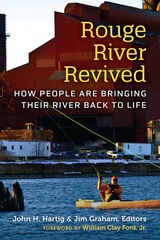
cover of Rouge River Revived: How People Are Bringing Their River Back to Life

Rouge River Revived

How People Are Bringing Their River Back to Life

John H. Hartig and Jim Graham, Editors

University of Michigan Press, 2022

The Rouge River is a mostly urbanized watershed of about 500 square miles populated by nearly 1.4 million people. While not geographically large, the river has played an outsized role in the history of southeast Michigan, most famously housing Ford Motor Company’s massive Rouge Factory, designed by architect Albert Kahn and later memorialized in Diego Rivera’s renowned “Detroit Industry” murals. In recent decades, the story of the Rouge River has also been one of grassroots environmental activism. After pollution from the Ford complex and neighboring factories literally caused the river to catch on fire in 1969, community groups launched a Herculean effort to restore and protect the watershed. Today the Rouge stands as one of the most successful examples of urban river revival in the country.

Rouge River Revived describes the river’s history from pre-European times into the 21st century. Chapters cover topics such as Native American life on the Rouge; indigenous flora and fauna over time; the river’s role in the founding of local cities; its key involvement in Detroit’s urban development and intensive industrialization; and the dramatic clean-up arising from citizen concern and activism. This book is not only a history of the environment of the Rouge River, but also of the complex and evolving relationship between humans and natural spaces.
[more]