Results by title
129 books match the query 'Natural resources' and 8 start with r
Reckoning at Eagle Creek
The Secret Legacy of Coal in the HeartlandJeff Biggers
Southern Illinois University Press, 2010
Set in the ruins of his family’s strip-mined homestead in the Shawnee National Forest in southern Illinois, award-winning journalist and historian Jeff Biggers delivers a deeply personal portrait of the overlooked human and environmental costs of our nation’s dirty energy policy. Beginning with the policies of Thomas Jefferson and Andrew Jackson, chronicling the removal of Native Americans and the hidden story of legally sanctioned black slavery in the land of Lincoln, Reckoning at Eagle Creek vividly describes the mining wars for union recognition and workplace safety, and the devastating consequences of industrial strip-mining. At the heart of our national debate over climate change and the crucial transition toward clean energy, Biggers exposes the fallacy of “clean coal” and shatters the marketing myth that southern Illinois represents the “Saudi Arabia of coal.”
Reckoning at Eagle Creek is ultimately an exposé of “historicide,” one that traces coal’s harrowing legacy through the great American family saga of sacrifice and resiliency and the extraordinary process of recovering our nation’s memory.
Renewing Our Rivers
Stream Corridor Restoration in Dryland RegionsEdited by Mark K. Briggs and W. R. Osterkamp
University of Arizona Press, 2020
Our rivers are in crisis and the need for river restoration has never been more urgent. Water security and biodiversity indices for all of the world’s major rivers have declined due to pollution, diversions, impoundments, fragmented flows, introduced and invasive species, and many other abuses.
Developing successful restoration responses are essential. Renewing Our Rivers addresses this need head on with examples of how to design and implement stream-corridor restoration projects. Based on the experiences of seasoned professionals, Renewing Our Rivers provides stream restoration practitioners the main steps to develop successful and viable stream restoration projects that last. Ecologists, geomorphologists, and hydrologists from dryland regions of Australia, Mexico, and the United States share case studies and key lessons learned for successful restoration and renewal of our most vital resource.
The aim of this guidebook is to offer essential restoration guidance that allows a start-to-finish overview of what it takes to bring back a damaged stream corridor. Chapters cover planning, such emerging themes as climate change and environmental flow, the nuances of implementing restoration tactics, and monitoring restoration results. Renewing Our Rivers provides community members, educators, students, natural resource practitioners, experts, and scientists broader perspectives on how to move the science of restoration to practical success.
Resource Radicals
From Petro-Nationalism to Post-Extractivism in EcuadorThea Riofrancos
Duke University Press, 2020
Resourceful Kingdoms
Customary Institutions, Contested Ownership, and Community Development in AfricaShingirai Taodzera
Ohio University Press, 0
Resourceful Kingdoms investigates the struggle for control over Uganda’s emerging oil sector, centering on the Bunyoro Kingdom’s unsuccessful effort to secure ownership of resources discovered on its ancestral lands. Drawing on extensive fieldwork, the book shows how the military-backed National Resistance Movement government consolidated authority over an estimated two billion barrels of oil, while Bunyoro communities experienced displacement, land loss, political tension, and significant environmental harm even before production began. The Bunyoro case reflects a wider pattern in which rural, resource-rich populations across Africa are marginalized as governments and multinational corporations convert natural resources into state-centered revenues.
The book further explores how indigenous kingdoms might come to own resources and channel revenues toward sustainable, culturally grounded development. Through comparative case studies of Uganda’s powerful Buganda Kingdom and South Africa’s Bafokeng Kingdom—widely recognized for community-based mineral ownership and effective wealth management—Resourceful Kingdoms illustrates how traditional institutions can pair with corporate structures, private land ownership, and diversified investment strategies to strengthen community prosperity.
From this analysis emerges strategic coexistence, a new framework that outlines how kingdoms can secure resource rights independent of shifting state policies or corporate social-responsibility initiatives. Presented as both a philosophy and a set of practical steps, strategic coexistence urges kingdoms to formalize land ownership, build strong indigenous governance systems, create community-owned corporations, reinvest resource revenues in long-term development, and transition away from dependence on extractive industries. Resourceful Kingdoms ultimately repositions African kingdoms as dynamic, contemporary governance institutions with significant potential to influence natural resource administration and advance community well-being.
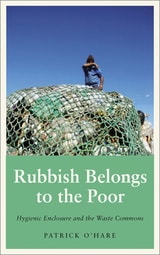
Rubbish Belongs to the Poor
Hygienic Enclosure and the Waste CommonsPatrick O’Hare
Pluto Press, 2021

Rubbish Belongs to the Poor
Hygienic Enclosure and the Waste CommonsPatrick O’Hare
Pluto Press, 2021
Rules, Games, and Common-Pool Resources
Elinor Ostrom, Roy Gardner, and James Walker
University of Michigan Press, 1994
Explores ways that the tragedy of the commons can be avoided by people who use common-property resources
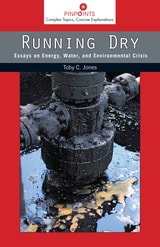
Running Dry
Essays on Energy, Water, and Environmental CrisisJones, Toby Craig
Rutgers University Press, 2015