226 books match the query 'New Jersey' and 8 start with r
cover of Raised at Rutgers: A President's Story

Raised at Rutgers

A President's Story

McCormick, Richard L

Rutgers University Press, 2014

In Raised at Rutgers, Richard L. McCormick tells what it is like to run a major state university and vividly portrays the often contentious environment in which a university president operates today. He unsparingly recounts his decade of leadership, including his own missteps—those we know about and those we didn’t—as he strove to obtain adequate resources for the university, to overhaul the often confusing organization of the New Brunswick campus, to manage the growth and success of intercollegiate athletics, and to deepen Rutgers’s acceptance of its obligations as the state university of New Jersey.

With understandable pride, McCormick recalls and relates Rutgers’s academic achievements during his presidency, including a renewed focus on undergraduate education and a significant increase in funding for research. Most dramatically, he chronicles the University’s protracted efforts to reclaim Robert Wood Johnson Medical School (and ultimately to acquire most of UMDNJ), a goal that was finally realized with crucial help from Governor Chris Christie and former governor Tom Kean.

Among the most honest accounts ever written of a college presidency, Raised at Rutgers takes the reader inside one of the best, and liveliest, public universities in America and highlights many of the most critical issues facing higher education today.
[more]
cover of Rediscover the Hidden New Jersey

Rediscover the Hidden New Jersey

Roberts, Russell

Rutgers University Press, 2015
Did you know—
—that a New Jerseyan was the first president of the United States?
—that New Jersey was the site of the first organized college football game?
—that New Jersey was the location of one of the most devastating espionage attacks of World War I?
—that the heroics of a New Jersey woman saved thousands of people from dying of yellow fever?
—that one of the first American folk heroes lived in New Jersey—and jumped off waterfalls?

These and other fascinating stories can be found in the newly updated Rediscover the Hidden New Jersey, a treasury of New Jersey stories that celebrate the unique heritage and importance of the Garden State. Russell Roberts has scoured New Jersey, from High Point to Cape May, to bring readers a delightful potpourri of facts, essays, lists, photos, stories, and legends about New Jersey. Readers will learn how New Jersey used to be the center of the motion picture universe, the origin of the Jersey Devil and other popular tall tales, where Norman Mailer and Abbot & Costello were born, where Aaron Burr and Leo, the M-G-M lion, lie buried, and much more. Learn about the geology of New Jersey, find out about the state’s ever-changing weather, and how New Jersey was chosen for the famous (or infamous) War of the Worlds radio broadcast that panicked the nation. All this and more is in Rediscover the Hidden New Jersey, the ultimate New Jersey book.

This revised edition contains new sections on Lawnside, the Morris Canal, Albert Einstein in Princeton, The Bordentown Manual Training School, Rockefeller/Ocean County Park, the bicycle railroad, Morro Castle, Alice Paul, and more.
[more]
cover of Reflections on the Pandemic: COVID and Social Crises in the Year Everything Changed

Reflections on the Pandemic

COVID and Social Crises in the Year Everything Changed

Teresa Politano

Rutgers University Press, 2024

Reflections on the Pandemic: COVID and Social Crises in the Year Everything Changed is a collection of essays, poems, and artwork that captures the raw energy and emotion of 2020 from the perspective of the Rutgers University community. The project features work from a diverse group of Rutgers scholars, students, staff, and alumni. Reflecting on 2020 from a number of perspectives – mortality, justice, freedom, equality, democracy, family, health, love, hate, economics, history, medicine, science, social justice, the environment, art, food, sanity – the book features contributions by Evie Shockley, Joyce Carol Oates, Naomi Jackson, Ulla Berg, Grace Lynne Haynes, Jordan Casteel, and President Jonathan Holloway, among others. This book, through its rich and imaginative storytelling at the intersection of scholarly expertise and personal narrative, brings readers into the hearts and minds of not just the Rutgers community but the world.

Contributors include: Patricia Akhimie, Marc Aronson, Ulla D. Berg, Stephanie Bonne, Stephanie Boyer, Kimberly Camp, Jordan Casteel, Kelly-Jane Cotter, Mark Doty, David Dreyfus, Adrienne E. Eaton, Katherine C. Epstein, Leah Falk, Paul G. Falkowski, Rigoberto González, James Goodman, David Greenberg, Angelique Haugerud, Grace Lynne Haynes, Leslieann Hobayan, Jonathan Holloway, James W. Hughes, Naomi Jackson, Amy Jordan, Vikki Katz, Mackenzie Kean, Robert E. Kopp, Christian Lighty, Stephen Masaryk, Louis P. Masur, Revathi V. Machan, Yalidy Matos, Belinda McKeon, Susan L. Miller, Yehoshua November, Joyce Carol Oates, Mary E. O’Dowd, Katherine Ognyanova, David Orr,  Gregory Pardlo, Steve Pikiell, Teresa Politano, en Purkert, Nick Romanenko, Evie Shockley, Caridad Svich, and Didier William​.
[more]
cover of Reforming Public Welfare: A Critique of the Negative Income Tax Experiment

Reforming Public Welfare

A Critique of the Negative Income Tax Experiment

Peter H. Rossi

Russell Sage Foundation, 1976
Shows what happens when a specific social policy is tried out on an experimental basis prior to being enacted into law. By providing a trial of a variety of negative income tax plans carried out over a three-year period in four communities, the New Jersey-Pennsylvania Income Maintenance Experiment was designed to observe whether income maintenance would lead to reduced work effort on the part of those who received subsidies. This book evaluates the final project reportso n the experiment issued by Mathematica, Inc. and the Institute for Reasearch on Poverty at the University of Wisconsin. A Publication in the Continuities in Evaluation Research Series.
[more]
cover of Ritual Healing in Surburban America

Ritual Healing in Surburban America

McGuire, Meredith

Rutgers University Press, 1988
"One of the more provocative studies of why middle America is making increasing use of ritual healing and what that choice tells us of problems with biomedical care in technological institutions. . . . A welcome addition to anthropological studies of ritual healing in other societies, and it illuminates a huge component of our health care system that is poorly understood."--Arthur Kleinman, M.D., Harvard University "An all too rare volume, namely a scholarly work on the practice of healing in suburban or what we might call middle-class America. McGuire, perhaps uniquely, has set out the religious or 'ritual' healing beliefs and practices that are usually strictly segregated and kept apart. . . . Anyone who takes seriously the need to understand 'healing' . . . should obtain this book."--Health and Healing "The power of the book is in the larger cultural analysis it offers . . . a valuable contribution to medical sociology."--Sociological Analysis "This welcome study of nonmedical healing among upper-middle-class and middle-class persons in Essex County, New Jersey, clearly shows how individuals become attracted to and influenced by alternative healing techniques."--Choice "Develops an innovative sociological approach to the study of alternative healing practices through a methodologically sound qualitative study. . . . The high quality of research and conceptualization and the meticulous documentation of the relevant literature make [this book] essential reading for those interested in the sociology and anthropology of religion and of medicine, and in the study of health and illness in contemporary America."--Contemporary Sociology "A major contribution."--The Christian Century "The remarkable strength of this book about the exotic in the commonplace is that it demonstrates both that ritual healing is widespread in the heartland of medical technology, and that the wide variety of ritual healing practices are based on similar structures."--Culture, Medicine, and Psychiatry
[more]
cover of Roads of Home

Roads of Home

Beck, Henry

Rutgers University Press, 1983

"None of this is orderly, store-bought legend or folklore. This is the way people talk, sought out and recorded by one who loves both the people and the talk."--The New York Times

Long regarded as folklife classics, Henry Charlton Beck's books are vivid recreations of the back roads, small towns, and legends that give New Jersey its special character. Father Henry Charlton Beck, who lived in New Jersey nearly all his life, was the author of numerous books on New Jersey folklife, state editor of the Camden Courier-Post, and writer for the Newark Star-Ledger. He is considered New Jersey's first folklorist and his painstaking work has left us with a rich collection of tales.
[more]
cover of Rubin ' Hurricane' Carter and the American Justice System

Rubin ' Hurricane' Carter and the American Justice System

Wice, Paul B

Rutgers University Press, 2000

Winner of the 2001 New Jersey Author's Award by the New Jersey Academic Alliance

Paul Wice takes the famous case of Rubin “Hurricane” Carter to another level of scrutiny as he puts the criminal justice system itself on trial. The case illustrates many of the strengths and weaknesses of our nation’s much maligned criminal justice system while affirming the power and resoluteness of the human spirit.

Early on the morning of June 17, 1966, the sound of gunfire echoed through the quite streets of Paterson, New Jersey, as four people were shot, three fatally, inside the Lafayette Bar and Grill. Twenty-nine-year-old Rubin “Hurricane” Carter, a prominent professional boxer, along with his companion, John Artis, were arrested and charged with committing this brutal crime. Prosecutors would later theorize that the murders were racially motivated — Carter and Artis are black, the victims white — to avenge the killing of a black Paterson tavern owner. Despite barely credible and oft-times contradictory evidence presented by both sides, a year after the killings Carter and Artis were convicted of murder and sentenced to life in prison. A second jury upheld the previous convictions in 1976. Artis was imprisoned until 1981, when he was released on parole.  Carter remained in jail until 1988, when acting prosecutor John Goceljak elected not to pursue a third trial following the reversal of the 1976 retrial by the Federal District Court, a decision ultimately affirmed by the Circuit Court of Appeals and the U.S. Supreme Court. With the release of the widely discussed movie on Carter starring Denzel Washington, the case has again become visible and controversial.

Wice follows the torturous legal path of this case as it wound its way through first the New Jersey then the federal justice system for the next twenty-two years. His interpretations are informed by interviews with key members of both the prosecution and defense as well as previously unused court documents and transcripts. Wice evaluates the Carter case within a larger theoretical framework to illustrate many of the critical weaknesses of the adversary system and appeals process that is so basic to the American judicial system. Here is what can happen when police and prosecutors act unprofessionally, when critical witnesses lie, and when the justice system itself is unwilling to correct its errors or admit its mistakes.
[more]
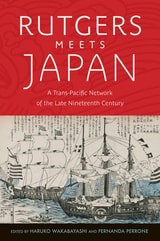
cover of Rutgers Meets Japan: A Trans-Pacific Network of the Late Nineteenth Century

Rutgers Meets Japan

A Trans-Pacific Network of the Late Nineteenth Century

Haruko Wakabayashi

Rutgers University Press, 2026

In 1867 Kusakabe Taro, a young samurai from Fukui, Japan, began studying at Rutgers as its first foreign student. Three years later, in 1870, his former tutor, friend, and Rutgers graduate, William Elliot Griffis, left for Japan to teach English and Science for three and a half years. The year 2020 marked the 150th anniversary of two landmark events in the history of the Rutgers-Japan relationship: the untimely death of Kusakabe only weeks before his graduation, and his friend Griffis’ departure to Japan. 

Griffis and Kusakabe were only a small piece of a vast transnational network of leading modernizers of Japan in the 1860s and 70s. The Japanese students in New Brunswick were young and innovative men of samurai and aristocratic lineage, who were sent by reform-minded leaders of Japan, which was undergoing a dramatic transformation. They came to New Brunswick seeking Western knowledge that was much needed for the modernization of a newly forming nation. New Brunswick became the hub of a network of Japanese nationals that extended to the major cities of New York, Philadelphia, and Boston, and from there to the smaller towns of New England. Once in New Brunswick, these Japanese students were embraced by Protestant ministers, educators, and missionaries—both men and women—whose network encompassed Rutgers College and the neighboring New Brunswick Theological Seminary, and which stretched to Dutch Reformed parishes throughout the Eastern seaboard, and westward as far as the Dutch enclave of Holland, Michigan. Meanwhile, the American teachers and missionaries who left for Japan became part of a network of reformist leaders and Japanese returnees that extended to schools, colleges, and missions in Japan, and formed the foundations of Japan’s modern educational system. Through contributions from scholars and archivists in the U.S., Canada, and Japan, Rutgers Meets Japan aims to reconstruct the early Rutgers-Japan connections and examine the role and impact of this transnational network on Japan and the U.S. in the late nineteenth century.
[more]