Results by title
77 books match the query 'Nietzsche, Friedrich Wilhelm' and 2 start with r
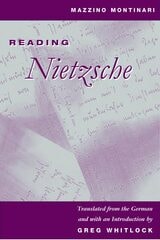
Reading Nietzsche
Mazzino Montinari
University of Illinois Press, 1982
An important figure in the development of Nietzsche scholarship, Mazzino Montinari (1928-86) dedicated himself to the detailed study of the philosopher’s writings. This lifetime of scholarship crystallized in Montinari’s work as coeditor of the critical edition of Nietzsche’s collected writings. Reading Nietzsche, now available in English for the first time, is a group of essays that grew out of this monumental work.
In Reading Nietzsche Montinari tackles such subjects as the relationship between Nietzsche and Wagner, early drafts of Thus Spoke Zarathustra, and the philosopher’s reputation among the Nazis and Marxists of the 1930s and 1940s. He also deals authoritatively with a number of figures who have had an unfortunate influence upon the way Nietzsche has been understood, from the chief Nazi interpreter of Nietzsche, Alfred Bäumler, to the chief Marxist interpreter, Georg Lukàcs, to Nietzsche’s sister, Elisabeth.
In Reading Nietzsche Montinari tackles such subjects as the relationship between Nietzsche and Wagner, early drafts of Thus Spoke Zarathustra, and the philosopher’s reputation among the Nazis and Marxists of the 1930s and 1940s. He also deals authoritatively with a number of figures who have had an unfortunate influence upon the way Nietzsche has been understood, from the chief Nazi interpreter of Nietzsche, Alfred Bäumler, to the chief Marxist interpreter, Georg Lukàcs, to Nietzsche’s sister, Elisabeth.
[more]
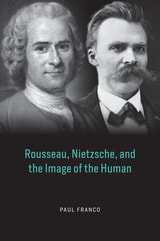
Rousseau, Nietzsche, and the Image of the Human
Paul Franco
University of Chicago Press, 2021
Rousseau and Nietzsche presented two of the most influential critiques of modern life and much can still be learned from their respective analyses of problems we still face.
In Rousseau, Nietzsche, and the Image of the Human, Paul Franco examines the relationship between Jean-Jacques Rousseau and Friedrich Nietzsche, arguably the two most influential shapers and explorers of the moral and cultural imagination of late modernity. Both thinkers leveled radical critiques of modern life, but those critiques differed in important respects. Whereas Rousseau focused on the growing inequality of modern society and the hypocrisy, self-division, and loss of civic virtue it spawned, Nietzsche decried the democratic equality he identified with Rousseau and the loss of individual and cultural greatness it entailed. Franco argues, however, that Rousseau and Nietzsche are more than mere critics; they both put forward powerful alternative visions of how we ought to live. Franco focuses specifically on their views of the self and its realization, their understandings of women and the relation between the sexes, and their speculative conceptions of politics. While there are many similarities in their positive visions, Franco argues that it is the differences between them from which we have most to learn.
In Rousseau, Nietzsche, and the Image of the Human, Paul Franco examines the relationship between Jean-Jacques Rousseau and Friedrich Nietzsche, arguably the two most influential shapers and explorers of the moral and cultural imagination of late modernity. Both thinkers leveled radical critiques of modern life, but those critiques differed in important respects. Whereas Rousseau focused on the growing inequality of modern society and the hypocrisy, self-division, and loss of civic virtue it spawned, Nietzsche decried the democratic equality he identified with Rousseau and the loss of individual and cultural greatness it entailed. Franco argues, however, that Rousseau and Nietzsche are more than mere critics; they both put forward powerful alternative visions of how we ought to live. Franco focuses specifically on their views of the self and its realization, their understandings of women and the relation between the sexes, and their speculative conceptions of politics. While there are many similarities in their positive visions, Franco argues that it is the differences between them from which we have most to learn.
[more]