Results by title
68 books match the query 'Performance art' and 3 start with r
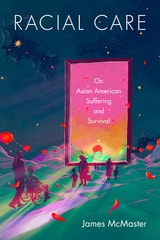
Racial Care
On Asian American Suffering and SurvivalJames McMaster
Duke University Press, 2025
In Racial Care, James McMaster studies the forms of care that Asian Americans have taken up to survive the suffering they experience under neoliberal capitalism and white supremacy in the United States. He shows that racialized labors of care can cut multiple ways: sustaining life for its recipients, draining life from its performers. Uplifting examples of this dynamic from Asian American theater, performance art, visual culture, film, poetry, protest, and everyday life, McMaster advances a racialized ethics and politics of care forged from the insights of feminist, queer, and disability theory. He argues that racial care in the Asian American case must respond both to the specific sort of neglect Asian Americans face as a consequence of model minority racialization and to the urgent needs for care that exist among other racialized and colonized peoples. Following the lead of artists and writers like Kristina Wong, Mark Aguhar, Kimberly Alidio, Julia Cho, kt shorb, and Jess X. Snow, Racial Care provides a path forward for all seeking to sustain multiply marginalized Asian American life in times of overlapping crisis.
[more]
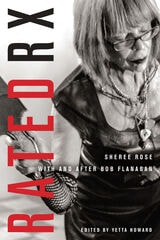
Rated RX
Sheree Rose with and after Bob FlanaganEdited by Yetta Howard
The Ohio State University Press, 2020
“The thing that people don’t understand is that Bob was my invention,” says Sheree Rose, the oft-overlooked partner of the late “supermasochist” performance artist Bob Flanagan. Unpacking this statement is at the heart of this important collection, which seeks to recuperate and showcase Rose’s contributions as performer, photographer, writer, and cultural innovator. While Rose is mostly known for blurring the boundaries between art and lived experience in the context of her full-time, mistress-slave relationship with Flanagan, Rated RX shifts focus from Flanagan to Rose, presenting a feminist project that critically reassesses the artistic legacies of Sheree Rose.
Curated with attention to queer-crip subjectivities and transgressive feminisms, Rated RX includes essays by and interviews with scholars, artists, and Rose’s collaborators that address gender politics, archival practices, minority embodiment, and disability in Rose’s work as well as more than eighty photographs and rare archival materials reflecting Rose’s recent and past performances. Offering a necessary corrective, Rated RX is the first collection to underscore Sheree Rose as a legendary figure in performance art and BDSM subcultural history, reflecting her lifetime of involvement in documenting the underground and the transformative role her work plays in sexual, subcultural, and art exhibitionism.
Curated with attention to queer-crip subjectivities and transgressive feminisms, Rated RX includes essays by and interviews with scholars, artists, and Rose’s collaborators that address gender politics, archival practices, minority embodiment, and disability in Rose’s work as well as more than eighty photographs and rare archival materials reflecting Rose’s recent and past performances. Offering a necessary corrective, Rated RX is the first collection to underscore Sheree Rose as a legendary figure in performance art and BDSM subcultural history, reflecting her lifetime of involvement in documenting the underground and the transformative role her work plays in sexual, subcultural, and art exhibitionism.
[more]
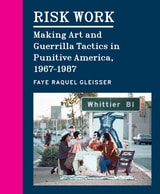
Risk Work
Making Art and Guerrilla Tactics in Punitive America, 1967–1987Faye Raquel Gleisser
University of Chicago Press, 2023
How artists in the US starting in the 1960s came to use guerrilla tactics in performance and conceptual art, maneuvering policing, racism, and surveillance.
As US news covered anticolonialist resistance abroad and urban rebellions at home, and as politicians mobilized the perceived threat of “guerrilla warfare” to justify increased police presence nationwide, artists across the country began adopting guerrilla tactics in performance and conceptual art. Risk Work tells the story of how artists’ experimentation with physical and psychological interference from the late 1960s through the late 1980s reveals the complex and enduring relationship between contemporary art, state power, and policing.
Focusing on instances of arrest or potential arrest in art by Chris Burden, Adrian Piper, Jean Toche, Tehching Hsieh, Pope.L, the Guerrilla Girls, Asco, and PESTS, Faye Raquel Gleisser analyzes the gendered, sexualized, and racial politics of risk-taking that are overlooked in prevailing, white-centered narratives of American art. Drawing on art history and sociology as well as performance, prison, and Black studies, Gleisser argues that artists’ anticipation of state-sanctioned violence invokes the concept of “punitive literacy,” a collectively formed understanding of how to protect oneself and others in a carceral society.
[more]