Results by title
130 books match the query 'Philosophers' and 4 start with r
Reading Ronell
Edited by Diane Davis
University of Illinois Press, 2008
Avital Ronell has won worldwide acclaim for her work across literature and philosophy, psychoanalysis and popular culture, political theory and feminism, art and rhetoric, drugs and deconstruction. In works such as The Test Drive, Stupidity, Crack Wars, and The Telephone Book, she has perpetually raised new and powerful questions about how we think, what thinking does, and how we fool ourselves about the troubled space between thought and action.
In this collection, some of today's most distinguished and innovative thinkers turn their attention to Ronell's teaching, writing, and provocations, observing how Ronell reads and what comes from reading her. By reading Ronell, and reading Ronell reading, contributors examine the ethico-political implications of her radical dislocations and carefully explicate, extend, and explore the paraconcepts addressed in her works.
René Girard and the Western Philosophical Tradition, volume 1
Philosophy, Violence, and MimesisAndreas Wilmes
Michigan State University Press, 2024
This is the first collective scholarly effort at situating René Girard in relation to the Western philosophical tradition. Volume 1 features chapters on Plato, Augustine of Hippo, Niccolò Machiavelli, Thomas Hobbes, Blaise Pascal, Baruch Spinoza, Jean-Jacques Rousseau, Adam Smith, Immanuel Kant, Georg Wilhelm Friedrich Hegel, Friedrich Wilhelm Joseph Schelling, Alexis de Tocqueville, Søren Kierkegaard, and René Girard.
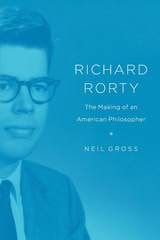
Richard Rorty
The Making of an American PhilosopherNeil Gross
University of Chicago Press, 2008
The child of a pair of leftist writers who worried that their precocious son “wasn’t rebellious enough,” Rorty enrolled at the University of Chicago at the age of fifteen. There he came under the tutelage of polymath Richard McKeon, whose catholic approach to philosophical systems would profoundly influence Rorty’s own thought. Doctoral work at Yale led to Rorty’s landing a job at Princeton, where his colleagues were primarily analytic philosophers. With a series of publications in the 1960s, Rorty quickly established himself as a strong thinker in that tradition—but by the late 1970s Rorty had eschewed the idea of objective truth altogether, urging philosophers to take a “relaxed attitude” toward the question of logical rigor. Drawing on the pragmatism of John Dewey, he argued that philosophers should instead open themselves up to multiple methods of thought and sources of knowledge—an approach that would culminate in the publication of Philosophy and the Mirror of Nature, one of the most seminal and controversial philosophical works of our time.
In clear and compelling fashion, Gross sets that surprising shift in Rorty’s thought in the context of his life and social experiences, revealing the many disparate influences that contribute to the making of knowledge. As much a book about the growth of ideas as it is a biography of a philosopher, Richard Rorty will provide readers with a fresh understanding of both the man and the course of twentieth-century thought.
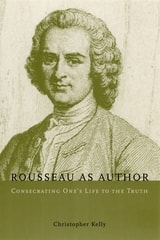
Rousseau as Author
Consecrating One's Life to the TruthChristopher Kelly
University of Chicago Press, 2002
Unlike many other writers of his day, Rousseau refused to publish anonymously, even though he risked persecution for his writings. But Rousseau felt that authors must be self-restrained, as well as bold, and must carefully consider the potential political effects of what they might publish: sometimes seeking the good conflicts with writing the truth. Kelly shows how this understanding of public authorship played a crucial role in Rousseau's conception—and practice—of citizenship and political action.
Rousseau as Author will be a groundbreaking book not just for Rousseau scholars, but for anyone studying Enlightenment ideas about authorship and responsibility.