Results by title
230 books match the query 'Physics' and 8 start with r
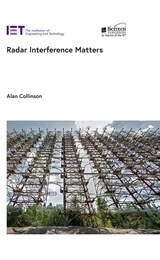
Radar Interference Matters
Alan Collinson
The Institution of Engineering and Technology, 2026
Radar Interference Matters is rooted in 25 years of real-world radar interference experience. The author began work on a radar interference investigation in 2000, expecting it to last six months - yet aspects are still ongoing. Many interference and coexistence cases followed over the years, and these have shaped a wider understanding of spectrum coexistence, safeguarding, and interference management. Professionals often had to "feel their way through" these problems due to a lack of structured guidance. That gap in practical, experience-based knowledge provided the inspiration for the book.
[more]
Reasoning with the Infinite
From the Closed World to the Mathematical UniverseMichel Blay
University of Chicago Press, 1998
Until the Scientific Revolution, the nature and motions of heavenly objects were mysterious and unpredictable. The Scientific Revolution was revolutionary in part because it saw the advent of many mathematical tools—chief among them the calculus—that natural philosophers could use to explain and predict these cosmic motions. Michel Blay traces the origins of this mathematization of the world, from Galileo to Newton and Laplace, and considers the profound philosophical consequences of submitting the infinite to rational analysis.
"One of Michael Blay's many fine achievements in Reasoning with the Infinite is to make us realize how velocity, and later instantaneous velocity, came to play a vital part in the development of a rigorous mathematical science of motion."—Margaret Wertheim, New Scientist
"One of Michael Blay's many fine achievements in Reasoning with the Infinite is to make us realize how velocity, and later instantaneous velocity, came to play a vital part in the development of a rigorous mathematical science of motion."—Margaret Wertheim, New Scientist
[more]
Recent Advances in High-Power Electromagnetics
Felix Vega
The Institution of Engineering and Technology, 2024
We live in a modern world powered by large, complex systems, including financial markets, communication networks, transportation networks, and security infrastructure. Sensitive electronics are omnipresent, making them increasingly vulnerable to high-power electromagnetic (HPEM) threats - an emerging risk capable of disrupting critical networks and the infrastructure they support. This book explores recent advances in HPEM sources, electromagnetic compatibility (EMC), strategies for protecting against intentional electromagnetic interference (IEMI) and detection and mitigation of these threats.
[more]

Reflection in the Waves
The Interdividual Observer in a Quantum Mechanical WorldPablo Bandera
Michigan State University Press, 2019
The incredible success of quantum theory as a mathematical model makes it especially frustrating that we cannot agree on a plausible philosophical or metaphysical description of it. Some philosophers of science have noticed certain parallels between quantum theory and the philosophy of Thomas Aquinas, and these parallels are deepened and strengthened if the “observer” of modern physics is associated with the “intellect” of scholastic ontology. In this case we are talking about a human observer. But this type of observer has a unique quality that is not considered at all by either physics or scholastic philosophy—the human observer is mimetic and therefore “interdividual.” By taking this fundamental anthropological fact into account, it turns out that the critical gaps still separating Aquinas from modern physicists can be effectively closed, reconciling the realism of Aquinas with the empirical evidence of quantum mechanics. This book explores this new bridge between the physical and the human—a bridge essentially designed by scholastic theory, clarified by mimetic theory, and built by quantum theory—and the path it opens to that metaphysical understanding for which philosophers of modern science have been striving. It is an understanding, not merely of the physical but of physics in the fuller sense of what is real and what is true. Here the reader will find a physics that describes the natural world and our place as mimetic observers within it.
[more]

Relativistic Astrophysics, 2
The Structure and Evolution of the UniverseYa. B. Zel'dovich and I. D. Novikov
University of Chicago Press, 1983
Though the kinematics of the evolving universe became known decades ago, research into the physics of processes occurring in the expanding universe received a reliable observational and theoretical basis only in more recent years. These achievements have led in turn to the emergence of new problems, on which an unusually active assault has begun.
This second volume of Relativistic Astrophysics provides a remarkably complete picture of the present state of cosmology. It is a synthesis of the theoretical foundations of contemporary cosmology, which are derived from work in relativity, plasma theory, thermodynamics, hydrodynamics, and particle physics. It presents the theoretical work that explains, describes, and predicts the nature of the universe, the physical process that occur in it, the formation of galaxies, the synthesis of the light elements, and the cosmological singularity and the theory of gravitation.
This book, long and eagerly awaited, is essential for everyone whose work is related to cosmology and astrophysics.
[more]
Representing Electrons
A Biographical Approach to Theoretical EntitiesTheodore Arabatzis
University of Chicago Press, 2005
Both a history and a metahistory, Representing Electrons focuses on the development of various theoretical representations of electrons from the late 1890s to 1925 and the methodological problems associated with writing about unobservable scientific entities.
Using the electron—or rather its representation—as a historical actor, Theodore Arabatzis illustrates the emergence and gradual consolidation of its representation in physics, its career throughout old quantum theory, and its appropriation and reinterpretation by chemists. As Arabatzis develops this novel biographical approach, he portrays scientific representations as partly autonomous agents with lives of their own. Furthermore, he argues that the considerable variance in the representation of the electron does not undermine its stable identity or existence.
Raising philosophical issues of contentious debate in the history and philosophy of science—namely, scientific realism and meaning change—Arabatzis addresses the history of the electron across disciplines, integrating historical narrative with philosophical analysis in a book that will be a touchstone for historians and philosophers of science and scientists alike.
[more]
Restricted Data
The History of Nuclear Secrecy in the United StatesAlex Wellerstein
University of Chicago Press, 2021
The first full history of US nuclear secrecy, from its origins in the late 1930s to our post–Cold War present.
The American atomic bomb was born in secrecy. From the moment scientists first conceived of its possibility to the bombings of Hiroshima and Nagasaki and beyond, there were efforts to control the spread of nuclear information and the newly discovered scientific facts that made such powerful weapons possible. The totalizing scientific secrecy that the atomic bomb appeared to demand was new, unusual, and very nearly unprecedented. It was foreign to American science and American democracy—and potentially incompatible with both. From the beginning, this secrecy was controversial, and it was always contested. The atomic bomb was not merely the application of science to war, but the result of decades of investment in scientific education, infrastructure, and global collaboration. If secrecy became the norm, how would science survive?
Drawing on troves of declassified files, including records released by the government for the first time through the author’s efforts, Restricted Data traces the complex evolution of the US nuclear secrecy regime from the first whisper of the atomic bomb through the mounting tensions of the Cold War and into the early twenty-first century. A compelling history of powerful ideas at war, it tells a story that feels distinctly American: rich, sprawling, and built on the conflict between high-minded idealism and ugly, fearful power.
[more]
Retro-reflective Beamforming Technique for Microwave Power Transmission
Mingyu Lu
The Institution of Engineering and Technology, 2024
Microwave power transmission technology, which is a sub-discipline of the wireless power transmission technology, aims to transmit electrical power without using wires/cables in the microwave frequency band. The retro-reflective beamforming technique has the potential to enable efficient and safe microwave power transmission, as it includes the following two technical elements. First, a directional microwave beam is generated as the carrier of wireless power. Second, the microwave power beam could be steered in real time toward mobile wireless power receiver(s). This book offers a comprehensive narrative of retro-reflective beamforming in the context of microwave power transmission.
[more]