Results by title
8 books match the query 'Styles'
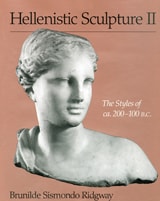
Hellenistic Sculpture II
The Styles of ca. 200–100 B.C.Brunilde Sismondo Ridgway
University of Wisconsin Press, 2008
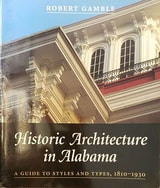
Historic Architecture in Alabama
A Guide to Styles and Types, 1810-1930Robert S. Gamble
University of Alabama Press, 2001
Discover the stories behind Alabama’s timeless structures.
Robert Gamble outlines in detail the primary architectural currents and styles that have surfaced in Alabama over the years and defined the state's built landscape. The structures and styles, all well-illustrated,range from folk houses and early settlement buildings to railway terminals, churches, libraries, municipal and university buildings, palatial private mansions, and modest homes. Structures from every period and every major stylistic era—Federal, Greek Revival, Gothic Revival, Italianate, Romanesque and Mission Revival, and the Richardsonian—are documented meticulously, along with examples of early—Modern buildings, including Alabama's only Frank Lloyd Wright structure and skyscrapers from the Chicago school.
More than 200 photographs, supplemented by sketches, plans, and etchings, provide the general reader and the design professional with images of Alabama architecture in all its variety and range. Many illustrations offer rare views of buildings long since demolished. A substantial glossary of architectural terms and a thorough bibliography enhance this standard sure to be welcomed anew by any lover of old buildings, whether weekend rambler or serious student.
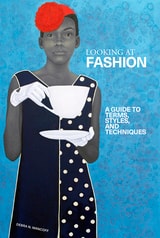
Looking at Fashion
A Guide to Terms, Styles, and TechniquesDebra N. Mancoff
J. Paul Getty Trust, The, 2024
Whether in art or life, fashion makes a statement. It gives form to the temper of the times and the motives of the moment, charting shifts in society, status, technology, and economy. Fashion is shaped by both high and popular culture and reveals the influence of individuals from diverse socioeconomic backgrounds.
Spanning the centuries and representing a global point of view, Looking at Fashion is a guide to the elements that make clothing practical, wearable, stylish, and distinctive. Created for scholars, students, fashionistas, and anyone who wants to expand their understanding of world culture through the history of dress, this book provides a rich and varied lexicon of the vocabulary that describes and explains the most essential components of garments and techniques of clothing construction. Ranging from basic pieces and their individual parts to structure, embellishments, and innovations, Looking at Fashion offers insights into the evolution of dress in terms of style, fit, and design. Gorgeous color illustrations, including paintings, photographs, historical garments, and custom drawings, reveal the interrelationship of fashion and art from antiquity to now.
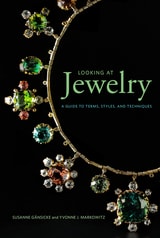
Looking at Jewelry
A Guide to Terms, Styles, and TechniquesSusanne Gänsicke
J. Paul Getty Trust, The, 2019
The fascination with personal adornment is universal. It is a preoccupation that is primal, instinctive, and uniquely human. Jewelry encompasses a seemingly endless number of ornaments produced across time and in all cultures. The range of materials and techniques used in its construction is extraordinary, even revolutionary, with new substances and methods of fabrication added with every generation. In any given society, master artisans have devoted their time, energy, and talent to the fine art of jewelry making, creating some of the most spectacular objects known to humankind.
This volume, geared toward jewelry makers, scholars, scientists, students, and fashionistas alike, begins with a lively introduction that offers a cultural history of jewelry and its production. The main text provides information on the most common, iconic, and culturally significant forms of jewelry and also covers materials, techniques, and manufacturing processes. Containing more than eighty color illustrations, this guide will be invaluable to all those wishing to increase their understanding and enjoyment of the art of jewelry.
Playful Frames
Styles of Widescreen CinemaSteven Rybin
Rutgers University Press, 2024

Styles of Scientific Thought
The German Genetics Community, 1900-1933Jonathan Harwood
University of Chicago Press, 1992
The first book-length treatment of genetics in Germany, Styles of Scientific Thought demonstrates the influence of culture on science by comparing the American with the German scientific traditions. Harwood examines the structure of academic and research institutions, the educational backgrounds of geneticists, and cultural traditions, among many factors, to explain why the American approach was much more narrowly focussed than the German.
This tremendously rich book fills a gap between histories of the physical sciences in the Weimar Republic and other works on the humanities and the arts during the intellectually innovative 1920s, and it will interest European historians, as well as sociologists and philosophers of science.
The Book of American Windsor Furniture
Styles and TechnologiesJohn Kassay
University of Massachusetts Press, 1998
Combining comfort, simplicity, and craftsmanship, Windsor chairs have long been prized by collectors. Introduced from England in the early 1700s, the Windsor style took hold in America first as seating for the well-to-do and later as the favorite chair of the general population. Included in the Windsor family are stools, tables, settees, high chairs, cradles, and candle stands, but the greatest variety is found in the chairs, which range from comb-back to bow-back to step-down versions. Their makers took advantage of the natural properties of different woods for particular components of the chairs, employing hickory, red oak, or ash for bent parts, maple for turnings, and pine for seats.
Kassay meticulously documents all of these features and styles with drawings so accurate and precise that amateur furniture makers can use them as blueprints for creating Windsor reproductions. The drawings are complemented by narrative descriptions, photographs, and a list of measured parts for each of the pieces under discussion.
The Technical Image
A History of Styles in Scientific ImageryEdited by Horst Bredekamp, Vera Dünkel, and Birgit Schneider
University of Chicago Press, 2015
Opening with a set of key questions about artistic representation in science, technology, and medicine, The Technical Image then investigates historical case studies focusing on specific images, such as James Watson’s models of genes, drawings of Darwin’s finches, and images of early modern musical automata. These case studies in turn are used to illustrate broad themes ranging from “Digital Images” to “Objectivity and Evidence” and to define and elaborate upon fundamental terms in the field. Taken as a whole, this collection will provide analytical tools for the interpretation and application of scientific and technological imagery.