Results by title
267 books match the query 'Poetics' and 14 start with r
Radical Affections
Essays on the Poetics of OutsideMiriam Nichols
University of Alabama Press, 2011
In 1950 the poet Charles Olson published his influential essay “Projective Verse” in which he proposed a poetry of “open field” composition—to replace traditional closed poetic forms with improvised forms that would reflect exactly the content of the poem.
The poets and poetry that have followed in the wake of the “projectivist” movement—the Black Mountain group, the New York School, the San Francisco Renaissance, and the Language poets—have since been studied at length. But more often than not they have been studied through the lens of continental theory with the effect that these highly propositional, pragmatic, and adaptable forms of verse were interpreted in very cramped, polemical ways.
Miriam Nichols highlights many of the impulses original to the thinking and methods of each poet: appeals to perceptual experience, spontaneity, renewed relationships with nature, engaging the felt world—what Nichols terms a “poetics of outside”—focusing squarely on experiences beyond the self-regarding self. As Nichols states, these poets may well “represent the last moment in recent cultural history when a serious poet could write from perception or pursue a visionary poetics without irony or quotation marks and expect serious intellectual attention.”
Radical Artifice
Writing Poetry in the Age of MediaMarjorie Perloff
University of Chicago Press, 1992
Radical Poetics
Essays on Literature & CultureKhadijah Queen
University of Michigan Press, 2025
Instead of operating from a base of unquestioned thought and systemic tradition, Radical Poetics presents more inclusive and accurate ways of contemplating literary work. Building on ideas and theoretical practices from Édouard Glissant, Toni Morrison, bell hooks, Saidiya Hartman, and Kimberlé Crenshaw, Queen reads for where love is present as well as for where it is absent—tracing systems of thought and aesthetic choices to track how characters are portrayed in terms of race, gender, class, and disability. She analyzes short stories, novels, nonfiction narratives, poetry, and a play from authors such as Herman Melville, Kate Chopin, Dionne Brand, Frances Ellen Watkins Harper, Ma-ka-tai-me-she-kia-kiak, Sor Juana Inés de la Cruz, Natasha Trethewey, and Muriel Rukeyser. Queen’s essays offer shifts in thinking about language—beyond calling out the ways language punishes vulnerability, entrenches harm, and suppresses true intercultural communication. Her intuitive approach aims to correct inaccuracies that have served as a foundation for the discriminatory thinking that undergirds American institutions and culture, particularly the continued glorification of violence. Radical Poetics makes a case for the imperative and practical value of understanding poetics beyond artistic and academic spaces and into everyday life.
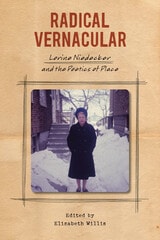
Radical Vernacular
Lorine Niedecker and the Poetics of PlaceElizabeth Willis
University of Iowa Press, 2008
Aesthetically linked with the New York Objectivist poets, Niedecker remained committed to her community in rural Wisconsin despite the grinding poverty that dogged her throughout her life. Largely self-taught, Niedecker formed attachments through her voracious reading and correspondence, but she also delighted in the disruptive richness of vernacular usage and in the homegrown, improvisational aesthetics that thrived within her immediate world. Niedecker wrote from a highly attenuated concern with biological, cultural, and political sustainability and, in her stridently modernist poems, anticipated many of the most urgent concerns in twenty-first-century poetics. In Radical Vernacular, Elizabeth Willis collects essays by leading poets and scholars that make a major contribution to the study of an important but long overlooked American poet.
This pathbreaking volume contains essays by seventeen leading scholars: Rae Armantrout, Glenna Breslin, Michael Davidson, Rachel Blau DuPlessis, Ruth Jennison, Peter Middleton, Jenny Penberthy, Mary Pinard, Patrick Pritchett, Peter Quartermain, Lisa Robertson, Elizabeth Robinson, Eleni Sikelianos, Jonathan Skinner, Anne Waldman, Eliot Weinberger, and Elizabeth Willis.
Radium of the Word
A Poetics of MaterialityCraig Dworkin
University of Chicago Press, 2020
Radium of the Word takes its title from Mina Loy’s poem for Gertrude Stein, which hails her as the Madame “Curie / of the laboratory / of vocabulary.” In this spirit, Dworkin considers prose as a dynamic literary form, characterized by experimentation. Dworkin draws on examples from writers as diverse as Lyn Hejinian, William Faulkner, and Joseph Roth. He takes up the status of the proper name in Modernism, with examples from Stein, Loy, and Guillaume Apollinaire, and he offers in-depth analyses of individual authors from the counter-canon of the avant-garde, including P. Inman, Russell Atkins, N. H. Pritchard, and Andy Warhol. The result is an inspiring intervention in contemporary poetics.
Reading Duncan Reading
Robert Duncan and the Poetics of DerivationStephen Collis
University of Iowa Press, 2012
In part two, the volume turns to examinations of poets who can be seen to in some way derive from Duncan—and so in turn reveals another angle of Duncan’s derivative poetics. J. P. Craig traces Nathaniel MacKey’s use of Duncan’s “would-be shaman,” Catherine Martin sees Duncan’s influence in Susan Howe’s “development of a poetics where the twin concepts of trespass and ‘permission’ hold comparable sway,” and Ross Hair explores poet Ronald Johnson’s “reading to steal.” These and other essays collected here trace paths of poetic affiliation and affinity and hold them up as provocative possibilities in Duncan’s own inexhaustible work.
Reading at the Limits of Poetic Form
Dematerialization in Adorno, Blanchot, and CelanJacob McGuinn
Northwestern University Press, 2024
How does literary objecthood contend with the challenge of writing objects that emerge at an extreme limit of material presence? Jacob McGuinn delves into the ways literature writes this indeterminate presence in the context of pre- and post-’68 Paris, a vital moment in the history of criticism. The works of poet Paul Celan, philosopher Theodor Adorno, and writer Maurice Blanchot highlight how the complexities of reading such a dematerialized object are part of the indeterminacy of material itself. Indeterminate objects—glass, snow, walls, screens—are subjects Celan describes as existing in “meridian” space, while for Adorno and Blanchot, criticism not only responds to this indeterminacy but also takes it as its condition. Reading at the Limits of Poetic Form: Dematerialization in Adorno, Blanchot, and Celan shows how these readings simultaneously limit the object of criticism and outline alternative ways of thinking that lie between the models of critical formalism and historicism, ultimately revealing the possible materiality of literature in unrealized history, incomplete politics, and nondetermining thinking.
Reading the Difficulties
Dialogues with Contemporary American Innovative PoetryThomas Fink
University of Alabama Press, 2013
New Strategies for Reading the Most Innovative Poetry of Our Time.
Definitions of what constitutes innovative poetry are innumerable and are offered from every quarter. Some critics and poets argue that innovative poetry concerns free association (John Ashbery), others that experimental poetry is a “re-staging” of language (Bruce Andrews) or a syntactic and cognitive break with the past (Ron Silliman and Lyn Hejinian). The tenets of new poetry abound.
But what of the new reading that such poetry demands? Essays in Reading the Difficulties ask what kinds of stances allow readers to interact with verse that deliberately removes many of the comfortable cues to comprehension—poetry that is frequently nonnarrative, nonrepresentational, and indeterminate in subject, theme, or message.
Some essays in Thomas Fink and Judith Halden-Sullivan’s collection address issues of reader reception and the way specific stances toward reading support or complement the aesthetic of each poet. Others suggest how we can be open readers, how innovative poetic texts change the very nature of reader and reading, and how critical language can capture this metamorphosis. Some contributors consider how the reader changes innovative poetry, what language reveals about this interaction, which new reading strategies unfold for the audiences of innovative verse, and what questions readers should ask of innovative verse and of events and experiences that we might bring to reading it.
Reading the Illegible
Rainer Rumold
Northwestern University Press, 2003
In his scrutiny of selected works, and with reference to a rich variety of textual materials--from popular and scientific texts to visual art, political and cultural theories, and experimental films--Dworkin proposes a new way of apprehending the radical formalism of so-called unreadable texts. Dworkin unveils what he describes as "the politics of the poem"--what is signified by its form, enacted by its structures, and implicit in the philosophy of language; how it positions its reader; and other questions relating to the poem as material object. In doing so, he exposes the mechanics and function of truly radical formalism as a practice that move beyond aesthetic considerations into the realms of politics and ideology. Reading the Illegible asks us to reconsider poetry as a physical act, and helps us to see how the range of a text's linguistic and political maneuvers depends to a great extent on the material conditions of reading and writing as well as the mechanics of reproduction.
Readings
The Poetics of Blanchot, Joyce, Kakfa, Kleist, Lispector, and TsvetayevaHelene Cixous
University of Minnesota Press, 1991
Readings: The Poetics of Blanchot, Joyce, Kafka, Kleist, Lispector, and Tsvetayeva offers striking and novel textual studies of major literary figures and emergent authors. Selected from Cixous’s seminars taught between 1980 and 1986 at the Universite de Paris VII (Saint-Denis) and at the College International de Philosophie, the texts chronicle the French intellectual scene with its shifting tastes over the decade following May 1986.
In their simple and accessible language, the texts can be read as inspiration for Cixous’s fictional and critical practices. They not only introduce readers to emergent texts from Brazil and Russia, such as Clarice Lispector’s “Foreign Legion” and Marina Tsvetayeva’s “Mother and Music,” but also give new, incisive insights into Joyce’s Portrait of the Artist and Kafka’s “Before the Law.” Drawing from philosophy and psychoanalysis, Readings: The Poetics of Blanchot, Joyce, Kafka, Kleist, Lispector, and Tsvetayeva can be read side-by-side with Reading with Clarice Lispector, as an ongoing meditation on ethics and poetics.Also from MinnesotaReading with Clarice LispectorHelene CixousEdited, translated, and introduced by Verena Andermatt ConleyFor Cixous, Lispector’s work represents one of the finest examples of ecriture feminine in that she practices, in writing, what Cixous is searching for in her theoretical practice: the giving, spending, and inscribing of pleasure; an apprenticeship in the lessons of life.Theory and History of Literature, volume 73
Rhymes in the Flow
How Rappers Flip the BeatMacklin Smith and Aurko Joshi
University of Michigan Press, 2020
Despite its global popularity, rap has received little scholarly attention in terms of its poetic features. Rhymes in the Flow systematically analyzes the poetics (rap beats, rhythms, rhymes, verse and song structures) of many notable rap songs to provide new insights on rap artistry and performance. Defining and describing the features of what rappers commonly call flow, the authors establish a theory of the rap line as they trace rap’s deepest roots and stylistic evolution—from Anglo-Saxon poetry to Lil Wayne—and contextualize its complex poetics. Rhymes in the Flow helps explain rap’s wide appeal by focusing primarily on its rhythmic and thematic power, while also claiming its historical, cultural, musical, and poetic importance.
Richer Entanglements
Essays and Notes on Poetry and PoemsGregory Orr
University of Michigan Press, 1993
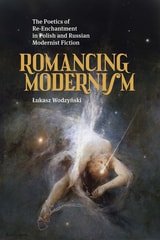
Romancing Modernism
The Poetics of Re-Enchantment in Polish and Russian Modernist FictionLukasz Wodzynski
University of Wisconsin Press, 2026
In the development of modernist fiction, perhaps no artistic product has had as vaunted a place as the novel, a genre theorized primarily with recourse to Western authors. Here, Łukasz Wodzyński challenges the primacy of the novel as the organizing principle of modernist prose in East-Central Europe, particularly in Poland and Russia. By carefully studying some of the most innovative texts in Polish and Russian from the early twentieth century, Wodzyński posits that the “novel” genre has hindered our understanding of long modernist narratives.
Instead, he proposes to read these pathbreaking works as a twentieth-century reclamation of the romance. Specifically, he argues that these latter-day romances channel early modernist apocalyptic and utopian ideals through popular genres like science fiction and adventure narratives—and thus imagine a human future freed from modern fixations on control, efficiency, and utility. The romance form, he suggests, was uniquely poised to address the deep civilizational anxieties underwriting modernist literary publications in East-Central Europe. Understanding these works and the ways in which they spoke to these anxieties thus informs not only the study of Polish and Russian literature but also the development of modernism itself.
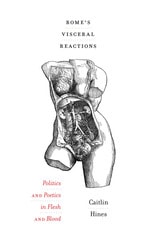
Rome's Visceral Reactions
Politics and Poetics in Flesh and BloodCaitlin Hines
University of Michigan Press, 2026
Caitlin Hines follows the history of viscera from its earliest attestations through the end of the Julio-Claudian period and considers the works of Lucretius, Cicero, Vergil, Livy, Ovid, Seneca, and Lucan. Applying theories of embodied cognition and semantic change, Hines demonstrates how Roman authors influenced the development of their language through the invention, reception, and affirmation of innovative meanings and how pressing political and cultural crises could shape, and be shaped in return, by the sophisticated linguistic games of the Roman literary elite.