Results by title
704 books match the query 'Political Process' and 36 start with r
RSF
The Russell Sage Foundation Journal of the Social Sciences: Immigrants Inside Politics/Outside CitizenshipJames A. McCann
Russell Sage Foundation, 2016
Several articles examine the incorporation of the foreign-born into American politics. Katharine Donato and Samantha Perez track differences in Latinos’ political ideologies by gender and find that among new immigrants, women tend to hold more conservative political views than men. However, after living in the U.S. for five years, Latinas report themselves as more liberal; after fifteen years of U.S. residence, Latino men view themselves as more conservative. Frank D. Bean and Susan K. Brown show that due to “membership exclusion”—or significant relegation to the margins of society—undocumented immigrants have less political knowledge than those with green cards or driver’s licenses, regardless of how long they have resided here. Melissa Michelson explores how politicians’ expanded outreach to Latino communities during the 2012 election season helped reverse a decades-long trend of declining trust in the government among Latinos.
Other articles compare the political behavior of Latinos to that of other ethnic groups. Jan Leighley and Jonathan Nagler find that while the demographic patterns central to predicting whites’ political engagement—such as income and education levels—do not predict Latinos’ voting turnout, increased political outreach to Latinos has led to greater turnout. Leonie Huddy, Lily Mason, and Nechama Horwitz find that, similar to African Americans, Latino immigrants who both strongly identify with a minority group (in this case, Hispanic) and perceive discrimination against that group are more likely to align themselves with the Democratic Party.
With Latinos constituting an increasing percentage of the population, understanding how and when they participate in our political system is vital for policymakers, scholars, and advocates. The analyses in this issue of RSF provide contribute to our understanding of how immigrants and their descendants navigate American democracy.
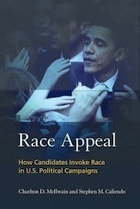
Race Appeal
How Candidates Invoke Race in U.S. Political CampaignsAuthored by Charlton D. McIlwain and Stephen M. Caliendo
Temple University Press, 2011
In our evolving American political culture, whites and blacks continue to respond very differently to race-based messages and the candidates who use them. Race Appeal examines the use and influence such appeals have on voters in elections for federal office in which one candidate is a member of a minority group.
Charlton McIlwain and Stephen Caliendo use various analysis methods to examine candidates who play the race card in political advertisements. They offer a compelling analysis of the construction of verbal and visual racial appeals and how the news media covers campaigns involving candidates of color.
Combining rigorous analyses with in-depth case studies-including an examination of race-based appeals in the historic 2008 presidential election—Race Appeal is a groundbreaking work that represents the most extensive and thorough treatment of race-based appeals in American political campaigns to date.
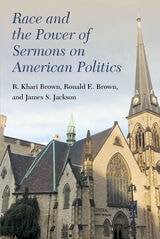
Race and the Power of Sermons on American Politics
R. Khari Brown, Ronald E. Brown, and James S. Jackson
University of Michigan Press, 2021
This book examines the intersection of race, political sermons, and social justice. Religious leaders and congregants who discuss and encourage others to do social justice embrace a form of civil religion that falls close to the covenantal wing of American civil religious thought. Clergy and members who share this theological outlook frame the nation as being exceptional in God’s sight. They also emphasize that the nation’s special relationship with the Creator is contingent on the nation working toward providing opportunities for socioeconomic well-being, freedom, and creative pursuits. God’s covenant, thus, requires inclusion of people who may have different life experiences but who, nonetheless, are equally valued by God and worthy of dignity. Adherents to such a civil religious worldview would believe it right to care for and be in solidarity with the poor and powerless, even if they are undocumented immigrants, people living in non-democratic and non-capitalist nations, or members of racial or cultural out-groups. Relying on 44 national and regional surveys conducted between 1941 and 2019, Race and the Power of Sermons on American Politics explores how racial experiences impact the degree to which religion informs social justice attitudes and political behavior. This is the most comprehensive set of analyses of publicly available survey data on this topic.
Race to the Bottom
How Racial Appeals Work in American PoliticsLaFleur Stephens-Dougan
University of Chicago Press, 2020
Challenging what we think we know about race and politics, LaFleur Stephens-Dougan argues that candidates across the racial and political spectrum engage in “racial distancing,” or using negative racial appeals to communicate to racially moderate and conservative whites—the overwhelming majority of whites—that they will not disrupt the racial status quo. Race to the Bottom closely examines empirical data on racialized partisan stereotypes to show that engaging in racial distancing through political platforms that do not address the needs of nonwhite communities and charged rhetoric that targets African Americans, immigrants, and others can be politically advantageous. Racialized communication persists as a well-worn campaign strategy because it has real electoral value for both white and black politicians seeking to broaden their coalitions. Stephens-Dougan reveals that claims of racial progress have been overstated as our politicians are incentivized to employ racial prejudices at the expense of the most marginalized in our society.

Race, Elections, and Power in Modern Brazil
Andrew Janusz
University of Michigan Press, 2027
While Brazil is famous for its history of racial diversity and was once revered as a “racial democracy,” its political arena is a site of separation. Elected officials in the country, which has the largest African descendant population of any country outside of Africa, are overwhelmingly white. Why are Afro-Brazilians not elected in proportion to their population size? And how does their underrepresentation affect the policymaking process?
In Race, Elections, and Power in Modern Brazil, Andrew Janusz argues that race shapes who runs for public office, who is elected, and who they represent. Drawing on surveys, interviews, and administrative election datasets, he shows that white politicians have several electoral advantages over their Afro-Brazilian competitors. Due to social stereotypes and racism, white Brazilians are more likely than Afro-Brazilians to be recruited by party elites, raise campaign funds, and be favored by voters. Using original data on legislator behavior, Janusz also finds that Brazil’s predominately white lawmakers are largely unresponsive to the needs of marginalized Afro-Brazilians and less likely than their Afro-Brazilian counterparts to advance legislation that would meaningfully enhance their quality of life. Providing compelling empirical evidence that Brazil is a racialized democracy, this book offers an accessible and eye-opening look at the central role race plays in Brazilian politics.
Radical American Partisanship
Mapping Violent Hostility, Its Causes, and the Consequences for DemocracyNathan P. Kalmoe and Lilliana Mason
University of Chicago Press, 2022
Political violence is rising in the United States, with Republicans and Democrats divided along racial and ethnic lines that spurred massive bloodshed and democratic collapse earlier in the nation’s history. The January 6, 2021 insurrection and the partisan responses that ensued are a vivid illustration of how deep these currents run. How did American politics become so divided that we cannot agree on how to categorize an attack on our own Capitol?
For over four years, through a series of surveys and experiments, Nathan P. Kalmoe and Lilliana Mason have been studying radicalism among ordinary American partisans. In this groundbreaking book, they draw on new evidence—as well as insights from history, psychology, and political science—to put our present partisan fractiousness in context and to explain broad patterns of political and social change. Early chapters reveal the scope of the problem, who radical partisans are, and trends over time, while later chapters identify the conditions that partisans say justify violence and test how elections, political violence, and messages from leaders enflame or pacify radical views. Kalmoe and Mason find that ordinary partisanship is far more dangerous than pundits and scholars have recognized. However, these findings are not a forecast of inevitable doom; the current climate also brings opportunities to confront democratic threats head-on and to create a more inclusive politics. Timely and thought-provoking, Radical American Partisanship is vital reading for understanding our current political landscape.

Radicalism in the States
The Minnesota Farmer-Labor Party and the American Political EconomyRichard M. Valelly
University of Chicago Press, 1989
Richard M. Valelly treats in detail the political economy of the Minnesota Farmer-Labor Party (1918-1944), the most successful radical, state-level party in American history. With the aid of numerous interviews of surviving organizers and participants in the party's existence, Valelly recreates the party's rise to power and subsequent decline, seeking answers to some broad, developmental questions. Why did this type of politics arise, and why did it collapse when it did? What does the party's history tell us about national political change? The answers lie, Valelly argues, in America's transition from the political economy of the 1920s to the New Deal. Combining case study and comparative state politics, he reexamines America's political economy prior to the New Deal and the scope and ironies of the New Deal's reorganization of American politics. The results compellingly support his argument that the federal government's increasing intervention in the economy profoundly transformed state politics. The interplay between national economy policy-making and federalism eventually reshaped the dynamics of interest-group politics and closed off the future of "state-level radicalism." The strength of this argument is highlighted by Valelly's cross-national comparison with Canadian politics. In vivid contrast to the fate of American movements, "province level radicalism" thrived in the Canadian political environment.
In the course of analyzing one of the "supressed alternatives" of American politics, Valelly illuminates the influence of the national political economy on American political development. Radicalism in the States will interest students of economic protest, of national policy-making, of interest-group politics and party politics.
Radicals, Reformers, and Reactionaries
The Prisoner's Dilemma and the Collapse of Democracy in Latin AmericaYoussef Cohen
University of Chicago Press, 1994
Focusing on the experiences of Chile and Brazil, Cohen argues that what thwarted democratic reforms in Latin America was a classic case of prisoner's dilemma. Moderates on the left and the right knew the benefits of coming to a mutual agreement on socio-economic reforms. Yet each feared that, if it cooperated, the other side could gain by colluding with the radicals. Unwilling to take this risk, moderate groups in both countries splintered and joined the extremists. The resulting disorder opened the way for military control.
Cohen further argues that, in general, structural explanations of political phenomena are inherently flawed; they incorrectly assume that beliefs, preferences, and actions are caused by social, political, and economic structures. One cannot explain political outcomes, Cohen argues, without treating beliefs and preferences as partly independent from structures, and as having a causal force in their own right.
Rationality of Irrationality
Political Determinants and Effects of Party Position BlurringKyung Joon Han
University of Michigan Press, 2022
Citizens in democracies complain that political parties’ positions on major issues are too ambiguous for them to confidently understand. Why is party position ambiguity so common? Are party positions ambiguous because political parties fail in forming clear policies or because they deliberately blur their positions? Rationality of Irrationality argues that political parties are motivated to strategically blur their position on an issue when they struggle with a certain disadvantage in the issue. Specifically, political parties present an ambiguous position when their own supporters are divided in their stances on the issue. A political party also blurs position stances when voters do not acknowledge that the party has the ability and integrity to solve problems related to the issue. Political parties blur their position in these cases because ambiguous party positions divert voters’ attention from the issue. Voters support a political party whose policy positions on major issues are close to their own stances. However, voters cannot confidently and exactly estimate party positions on an issue when they are only ambiguous.
Re/presenting Class
Essays in Postmodern MarxismJ . K. Gibson-Graham, Stephen Resnick, and Richard Wolff, eds.
Duke University Press, 2001
Investigating a wide range of cases, the essays illuminate, for instance, the organizational and cultural means by which unmeasured surpluses—labor that occurs outside the formal workplace‚ such as domestic work—are distributed and put to use. Editors Resnick and Wolff, along with J. K. Gibson-Graham, bring theoretical essays together with those that apply their vision to topics ranging from the Iranian Revolution to sharecropping in the Mississippi Delta to the struggle over the ownership of teaching materials at a liberal arts college. Rather than understanding class as an element of an overarching capitalist social structure, the contributors—from radical and cultural economists to social scientists—define class in terms of diverse and ongoing processes of producing, appropriating, and distributing surplus labor and view class identities as multiple, changing, and interacting with other aspects of identity in contingent and unpredictable ways.
Re/presenting Class will appeal primarily to scholars of Marxism and political economy.
Contributors. Carole Biewener, Anjan Chakrabarti, Stephen Cullenberg, Fred Curtis, Satyananda Gabriel, J. K. Gibson-Graham, Serap Kayatekin, Bruce Norton, Phillip O’Neill, Stephen Resnick, David Ruccio, Dean Saitta, Andriana Vlachou, Richard Wolff
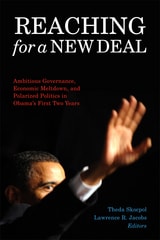
Reaching for a New Deal
Ambitious Governance, Economic Meltdown, and Polarized Politics in Obama's First Two YearsTheda Skocpol
Russell Sage Foundation, 2011
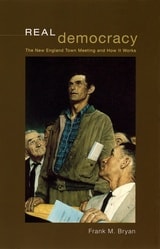
Real Democracy
The New England Town Meeting and How It WorksFrank M. Bryan
University of Chicago Press, 2003
A nationally recognized expert on this topic, Bryan has now done just that. Studying 1,500 town meetings in his home state of Vermont, he and his students recorded a staggering amount of data about them—238,603 acts of participation by 63,140 citizens in 210 different towns. Drawing on this evidence as well as on evocative "witness" accounts—from casual observers to no lesser a light than Aleksandr Solzhenitsyn—Bryan paints a vivid picture of how real democracy works. Among the many fascinating questions he explores: why attendance varies sharply with town size, how citizens resolve conflicts in open forums, and how men and women behave differently in town meetings. In the end, Bryan interprets this brand of local government to find evidence for its considerable staying power as the most authentic and meaningful form of direct democracy.
Giving us a rare glimpse into how democracy works in the real world, Bryan presents here an unorthodox and definitive book on this most cherished of American institutions.
Realignment in American Politics
Toward a TheoryEdited by Bruce A. Campbell and Richard J. Trilling
University of Texas Press, 1980
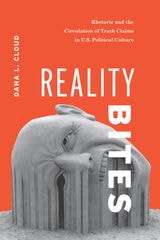
Reality Bites
Rhetoric and the Circulation of Truth Claims in U.S. Political CultureDana L. Cloud
The Ohio State University Press, 2018
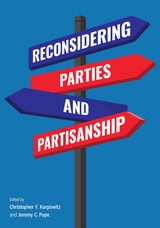
Reconsidering Parties and Partisanship
Edited by Christopher F. Karpowitz and Jeremy C. Pope
University of Michigan Press, 2026
The scholars here approach parties from the standpoint of partisan and social identities, polarization, the prevalence of independents (and pseudo-independents), political campaigns, and more. In linking the different faces or levels—party-in-the-electorate, party-in-government, and party-as-an-organization—the chapters provide a wide-ranging set of theories and ideas to consider. Through this exploration, Reconsidering Parties and Partisanship provides a valuable road map for partisanship in our current era.
Readers will learn
- How conditional party government seems to work in this highly partisan era
- How donors and pressure groups have taken ownership over campaigns
- How independents are often undercover partisans, but who also feel repelled by the existing parties—even the one they typically support
- How various identities converge to produce partisan affection (when that exists)
- How partisanship relates to ideology.
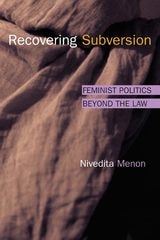
Recovering Subversion
Feminist Politics beyond the LawNivedita Menon
University of Illinois Press, 2004
Is the language of rights enough to foster real social and political change? Nivedita Menon explores the relationship between law and feminist politics by examining the contemporary Indian women's movement with comparisons to France and the United States. She argues that the intersection of feminist politics, law, and the state often paradoxically and severely distorts important ethical and emancipatory impulses of feminism.
Menon reviews historical challenges to the liberal notion of rights from Marxist, feminist, postcolonial, and critical legal scholars, and analyzes current Indian debates on topics including abortion, sexual violence, and Parliamentary quotas for women. Far from being a call to withdraw from the arena of law, Recovering Subversion instead urges feminists everywhere to recognize the limits of "rights discourse" and pleads for a politics that goes beyond its boundaries.
Red Against Blue
The Liberal Party in Colombian Politics, 1863 - 1899Helen Delpar
University of Alabama Press, 1981
A landmark study of Liberalism, political conflict, and nation-building in Colombia.
Red Against Blue: The Liberal Party in Colombian Politics, 1863–1899 is a seminal study of the political forces that shaped modern Colombia during the nineteenth century. In this carefully researched work, historian Helen Delpar traces the rise, dominance, decline, and transformation of the Colombian Liberal Party, offering readers a deeper understanding of one of Latin America's most influential political movements. Through extensive use of political writings, personal papers, electoral records, and contemporary sources, Delpar reconstructs the complex world of Colombian politics during an era marked by ideological conflict, regional division, constitutional experimentation, and recurring civil unrest.
The book examines the period from the adoption of the federal Constitution of 1863 through the end of the nineteenth century, when Liberal leaders sought to shape Colombia's political future while confronting growing opposition from Conservative rivals. Delpar explores the origins of Colombian Liberalism, the development of party ideology, the regional bases of political support, and the personalities who guided the party through both triumph and defeat. Her analysis reveals a political movement that was far more diverse and dynamic than conventional interpretations have suggested.
As Liberal influence declined in the 1880s and Conservatives consolidated power under the Regeneration movement, political tensions intensified. Delpar shows how these struggles helped lay the groundwork for the devastating War of the Thousand Days at the century's close, one of the most significant conflicts in Colombian history.
Combining narrative history with insightful political analysis, Red Against Blue remains an indispensable resource for students and scholars of Latin American history, political development, democracy, and nation-building. It offers a compelling portrait of a society grappling with questions of power, ideology, regional identity, and the meaning of political participation in a rapidly changing world.
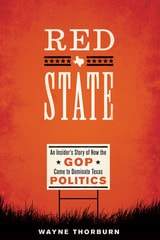
Red State
An Insider's Story of How the GOP Came to Dominate Texas PoliticsBy Wayne Thorburn
University of Texas Press, 2014
In November 1960, the Democratic party dominated Texas. The newly elected vice president, Lyndon Johnson, was a Texan. Democrats held all thirty statewide elective positions. The state legislature had 181 Democrats and no Republicans or anyone else. Then fast forward fifty years to November 2010. Texas has not voted for a Democratic president since 1976. Every statewide elective office is held by Republicans. Representing Texas in Washington is a congressional delegation of twenty-five Republicans and nine Democrats. Republicans control the Texas Senate by a margin of nineteen to twelve and the Texas House of Representatives by 101 to 49.
Red State explores why this transformation of Texas politics took place and what these changes imply for the future. As both a political scientist and a Republican party insider, Wayne Thorburn is especially qualified to explain how a solidly one-party Democratic state has become a Republican stronghold. He analyzes a wealth of data to show how changes in the state’s demographics—including an influx of new residents, the shift from rural to urban, and the growth of the Mexican American population—have moved Texas through three stages of party competition, from two-tiered politics, to two-party competition between Democrats and Republicans, and then to the return to one-party dominance, this time by Republicans. His findings reveal that the shift from Democratic to Republican governance has been driven not by any change in Texans’ ideological perspective or public policy orientation—even when Texans were voting Democrat, conservatives outnumbered liberals or moderates—but by the Republican party’s increasing identification with conservatism since 1960.

Reflections in a Bloodshot Lens
America, Islam and the War of IdeasLawrence Pintak
Pluto Press, 2006
There exists today a tragic rift between Americans and the world’s Muslims. Yet in the immediate aftermath of 9/11, there was widespread sympathy for the U.S. throughout the Muslim world. This book explores what happened. It examines the disconnect that leads Americans and Muslims to view the same words and images in fundamentally different ways. Partly a result of a centuries-old 'us' against 'them' dichotomy, the problem is exacerbated by an increasingly polarised media and by leaders on both sides who either don't understand or don't care what impact their words and policies have in the world at large.
Journalist-scholar Lawrence Pintak, a former CBS News Middle East correspondent, argues that the Arab media revolution and the rise of 'patriot-journalists' in the US marginalized voices of moderation, distorting perceptions on both sides of the divide with potentially disastrous results.
Built on the author's extensive journalistic experience, the book will appeal to policymakers, students of media studies, Middle East studies and Islamic studies, and general current affairs readers.
Reforming Legislatures
American Voters and State Ballot Measures, 1792-2020Peverill Squire
University of Missouri Press, 2024
Legislatures are ubiquitous in the American political experience. First created in Virginia in 1619, they have existed continuously ever since. Indeed, they were established in even the most unlikely of places, notably in sparsely populated frontier settlements, and functioned as the focal point of every governing system devised.
Despite the ubiquity of state legislatures, we know remarkably little about how Americans have viewed them as organizations, in terms of their structures, rules, and procedures. But with the rise of modern public opinion surveys in the twentieth century, we now have extensive data on how Americans have gauged legislative performance throughout the many years. That said, the responses to the questions pollsters typically pose reflect partisanship, policy, and personality. Generally, respondents respond favorably to legislatures controlled by their own political party and those in power during good economic times. Incumbent lawmakers get ratings boosts from having personalities, “home styles” that mesh with those of their constituents. These relationships are important indicators of people’s thoughts regarding the current performance of their legislatures and legislators, but they tell us nothing about attitudes toward the institution and its organizational characteristics.
This study offers a unique perspective on what American voters have historically thought about legislatures as organizations and legislators as representatives. Rather than focusing on responses to surveys that ask respondents how they rate the current performance of lawmakers and legislatures, this study leverages the most significant difference between national and state politics: the existence of ballot propositions in the latter. At the national level Americans have never had any say over Congress’s structure, rules, or procedures. In contrast, at the state level they have had ample opportunities over the course of more than two centuries to shape their state legislatures. The data examined here look at how people have voted on more than 1,500 state ballot propositions targeting a wide array of legislative organizational and parliamentary features. By linking the votes on these measures with the public debates preceding them, this study documents not only how American viewed various aspects of their legislatures, but also whether their opinions held constant or shifted over time. The findings reported paint a more nuanced picture of Americans’ attitudes toward legislatures than the prevailing one derived from survey research. When presented with legislative reform measures on which concrete choices were offered and decisions on them had to be made, the analyses presented here reveal that, counter to the conventional wisdom that people loved their representatives but hated the legislature, voters usually took charitable positions toward the institution while harboring skeptical attitudes about lawmakers’ motives and behaviors.
Religion and the Demise of Liberal Rationalism
The Foundational Crisis of the Separation of Church and StateJ. Judd Owen
University of Chicago Press, 2001
J. Judd Owen answers these questions with a remarkable critical analysis of four twentieth-century liberal and postliberal thinkers: John Dewey, John Rawls and, most extensively, Richard Rorty and Stanley Fish. His unique readings of these theorists and their approaches to religion lead him to conclusions that are meticulously constructed and surprising, arguing against the perception of liberalism as simple moral or religious neutrality, calling into question the prevailing justifications for separation of church and state, and challenging the way we think about the very basis of constitutional government.
Replace the State
How to Change the World When Elections and Protests FailSasha Davis
University of Minnesota Press, 2025
A practical call to action against oppression
Across the globe, millions of people have participated in protests and marches, donated to political groups, or lobbied their representatives with the aim of creating lasting social change, overturning repressive laws, or limiting environmental destruction. Yet very little seems to improve for those affected by rapacious governments. Replace the State brings new hope for social justice movements by looking to progressive campaigns that have found success by unconventional, and more direct, means.
Sasha Davis, an activist and scholar of radical environmental advocacy, focuses on the strategies of movements, many of them Indigenous, that have occupied contested sites and demonstrated their effectiveness at managing or governing them. Including case studies of resistance to development on Indigenous lands in Hawai‘i, nuclear testing in the Nevada desert, and the U.S. military occupation of Okinawa, he offers insight and direction for activists, students, academics, and others dedicated to protecting and improving the well-being of their communities and beyond.
It would be easy to succumb to pessimism and political apathy in the face of governing institutions that are increasingly unresponsive to calls for change and repressive in response to protest, even as they violate human rights, ignore existential climate catastrophes, and concentrate power into fewer and fewer hands. Instead, Davis finds inspiration for genuine political change through social movements that are successfully “replacing the state” and taking over the day-to-day governance of threatened places. From contesting environmental abuse to reasserting Indigenous sovereignty, these social movements demonstrate how people can collectively wrest control over their communities from oppressive governments and manage them with a more egalitarian ethics of care.
Retail e-book files for this title are screen-reader friendly with images accompanied by short alt text and/or extended descriptions.
Republic on the Wire
Cable Television, Pluralism, and the Politics of New Technologies, 1948-1984McMurria, John
Rutgers University Press, 2017
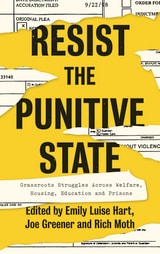
Resist the Punitive State
Grassroots Struggles Across Welfare, Housing, Education and PrisonsEmily Luise Hart
Pluto Press, 2019
Resist the Punitive State
Grassroots Struggles Across Welfare, Housing, Education and PrisonsEmily Luise Hart
Pluto Press, 2019

Rethinking the Rule of Law after Communism
Wojciech Sadurski
Central European University Press, 2005
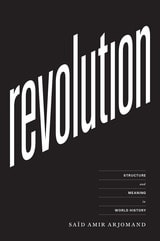
Revolution
Structure and Meaning in World HistorySaïd Amir Arjomand
University of Chicago Press, 2019
In this authoritative new book, Saïd Amir Arjomand reaches back to antiquity to propose a unified theory of revolution. Revolution illuminates the stories of premodern rebellions from the ancient world, as well as medieval European revolts and more recent events, up to the Arab Spring of 2011. Arjomand categorizes revolutions in two groups: ones that expand the existing body politic and power structure, and ones that aim to erode—but paradoxically augment—their authority. The revolutions of the past, he tells us, can shed light on the causes of those of the present and future: as long as centralized states remain powerful, there will be room for greater, and perhaps forceful, integration of the politically disenfranchised.
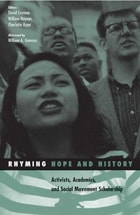
Rhyming Hope and History
Activists, Academics, and Social Movement ScholarshipDavid Croteau
University of Minnesota Press, 2005
Contributors: Kevin M. Carragee, Suffolk U; Catherine Corrigall-Brown, U of California, Irvine; Myra Marx Ferree, U of Wisconsin, Madison; Richard Flacks, U of California, Santa Barbara; Adria D. Goodson; Richard Healy and Sandra Hinson, Grassroots Policy Project; David Meyer, U of California, Irvine; Cynthia Peters, Worker Education Program of the Service Employees International Union, Local 2020; Barbara Risman, North Carolina State U; Robert J. S. Ross, Clark U; Leila J. Rupp, U of California, Santa Barbara; Cassie Schwerner, Schott Foundation; Valerie Sperling, Clark U; David A. Snow, U of California, Irvine; Verta Taylor, U of California, Santa Barbara.
David Croteau is formerly associate professor of sociology and anthropology at Virginia Commonwealth University. William Hoynes is professor of sociology and director of media studies at Vassar College. Charlotte Ryan is codirector of the Media Research and Action Project at Boston College. William A. Gamson is professor of sociology at Boston College.
Riot!
Civil Insurrection From Peterloo to the Present DayIan Hernon
Pluto Press, 2006
Riot! covers, with a reporter's eye, almost 200 years of civil disturbance on mainland Britain, and gives a voice to some of the remarkable men and women involved. Ian Hernon shows that resistance played a part, not always beneficially, in the creation of proper parliamentary democracy, the welfare state, the trade union movement, the rights of immigrants and civil liberties. All of these, it can be argued, are under renewed attack today.
Hernon tells the story of a largely unacknowledged tradition of violent protest in Britain, from the martyrs of Peterloo to the drug-fuelled street violence of today. Riot! charts how the struggles of individual groups of workers turned into a broader campaign for electoral reform and justice; how excessive use of state force failed to extinguish the fires; how the trade unions pressed for wider social justice; how Thatcherism reversed decades of gradual reform and sparked social turmoil; and how a "good" riot played a part in her downfall. Finishing with an account of the anti-globalisation movement and G8 protests, this lively book shows how the ugly roar of a mob has perhaps done more to change society than measured parliamentary debate.
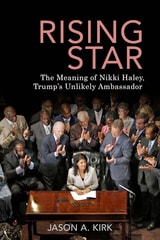
Rising Star
The Meaning of Nikki Haley, Trump’s Unlikely AmbassadorJason A. Kirk
University of Arkansas Press, 2021
Risk Management and Political Culture
Sheila Jasanoff
Russell Sage Foundation, 1986
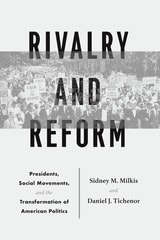
Rivalry and Reform
Presidents, Social Movements, and the Transformation of American PoliticsSidney M. Milkis and Daniel J. Tichenor
University of Chicago Press, 2019
Rivalry and Reform explores the relationship between presidents and social movements throughout history and into the present day, revealing the patterns that emerge from the epic battles and uneasy partnerships that have profoundly shaped reform. Through a series of case studies, including Abraham Lincoln and abolitionism, Lyndon Johnson and the civil rights movement, and Ronald Reagan and the religious right, Sidney M. Milkis and Daniel J. Tichenor argue persuasively that major political change usually reflects neither a top-down nor bottom-up strategy but a crucial interplay between the two. Savvy leaders, the authors show, use social movements to support their policy goals. At the same time, the most successful social movements target the president as either a source of powerful support or the center of opposition. The book concludes with a consideration of Barack Obama’s approach to contemporary social movements such as Black Lives Matter, United We Dream, and Marriage Equality.

Roads, Runways and Resistance
From the Newbury Bypass to Extinction RebellionSteve Melia
Pluto Press, 2021
'As a movement for social change it is important that we understand our own history. This is a compelling read.'
From the anti-roads protests of the 1990s to HS2 and Extinction Rebellion, conflict and protest have shaped the politics of transport. In 1989, Margaret Thatcher's government announced 'the biggest road-building programme since the Romans.' This is the inside story of the thirty tumultuous years that have followed.
Roads, Runways and Resistance draws on over 50 interviews with government ministers, advisors and protestors - many of whom, including 'Swampy', speak here for the first time about the events they describe. It is a story of transport ministers undermined by their own Prime Ministers, protestors attacked or quietly supported by the police, and smartly-dressed protestors who found a way onto the roof of the Houses of Parliament.
Today, as a new wave of road building and airport expansion threatens to bust Britain's carbon budgets, climate change protestors find themselves on a collision course with the government. Melia asks, what difference did the protests of the past make? And what impacts might today's protest movements have on the transport of the future?
Routing the Opposition
Social Movements, Public Policy, and DemocracyDavid S. Meyer
University of Minnesota Press, 2005
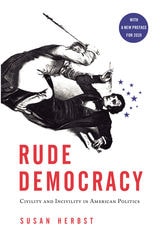
Rude Democracy
Civility and Incivility in American PoliticsAuthored by Susan Herbst
Temple University Press, 2020
Democracy is, by its very nature, often rude. But there are limits to how uncivil we should be. In her timely and important book, Rude Democracy, Susan Herbst explores the ways we discuss public policy, how we treat each other as we do, and how we can create a more civil national culture.
Herbst uses the examples of Sarah Palin and Barack Obama to illustrate her case. She scrutinizes Palin as both victim and perpetrator of incivility, including close analysis of her speeches on the 2008 campaign trail, the tone at her rallies, and her interactions with her audience. Turning to Barack Obama, Herbst argues that a key 2009 speech reveals much about his own perspective on American civility as it pertains to contentious issues such as abortion, and notes, too, what the controversy surrounding the speech reveals about the nature of public opinion in the United States. She also dissects Palin’s and Obama’s roles in the 2009 health care debate. Finally, in a fascinating chapter, Herbst examines how young people come to form their own attitudes about civility and political argument.
In Rude Democracy, Susan Herbst insists that Americans need to recognize the bad tendencies and habits we have developed, use new media for more effective debate, and develop a tougher and more strategic political skin. She urges us to boost both the intelligence and productivity of our debates, noting that the effort demands a commitment to the nature of argument itself. Rude Democracy outlines a plan for moving forward and creating a more civil climate for American politics.
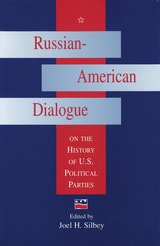
Russian-American Dialogue on the History of U.S. Political Parties
Edited by Joel H. Silbey
University of Missouri Press, 2000
Russian-American Dialogue on the History of U.S. Political Parties is the fourth volume in the Russian-American Dialogues series—a series that brings together scholars in the former Soviet Union and the United States who share an interest in the study of America's heritage and its importance to contemporary Russia.
In this valuable work, Russian scholars such as N. V. Sivachev, Alexander S. Manykin, and Vladimir V. Sogrin examine the history of American political parties and the role they played across two centuries. The Russians draw their own conclusions about the durability of the two-party system, giving careful consideration to historical crises—the secessionist movement and the Civil War, the reform era of the Populists and Progressives at the turn of the twentieth century, the Great Depression and the New Deal—in which the two-party structure was tested. Russian perspectives are also applied in analyzing the evolution of particular parties, from the rise and fall of the nineteenth-century Whigs to the shifting balance between twentieth-century Democrats and Republicans. The dialogue is then developed through commentaries by American historians such as Allan G. Bogue and Theodore J. Lowi and through counter-responses, often strongly expressed, by the Russian authors.
This lively exchange of ideas helps advance an understanding of key aspects of American party history and offers thought-provoking discussions of comparative international studies and historiography. Because the book provides unique perspectives on the American partisan experience by non-American specialists, it will be welcomed by all historians, as well as by anyone with an interest in the American-Russian connection.