Results by title
8812 books match the query 'Political Science' and 436 start with r
RSF
The Russell Sage Foundation Journal of the Social Sciences: Administrative Burden and Inequality in Policy implementationPamela Herd
Russell Sage Foundation, 2023
Administrative burdens are the learning, compliance, and psychological costs that individuals incur during encounters with public services. While some burdens are created unintentionally, others are deliberately constructed as barriers to limit claims to programs and services. Often, burdens fall most heavily on marginalized groups, preventing them from resources they need. In this double issue of RSF public administration scholar Pamela Herd, economist Hilary Hoynes, political scientists Jamila Michener and Donald Moynihan, and an interdisciplinary group of contributors explore how administrative burdens shape inequality.
Issue 1 examines how administrative burdens impact Medicaid and health inequality, student loan repayment programs, and immigration to the U.S. Emily Rauscher and Ailish Burns find that combinations of reforms to reduce administrative burdens in the late 1980s increased Medicaid enrollment and improved infant health nearly as much as Medicaid expansion. Adam Goldstein and colleagues show that administrative burdens in enrolling in income-driven repayment student loan programs causes borrowers with lower socioeconomic status to be disproportionately excluded from these programs. Lilly Yu finds that dramatic changes to immigration law and policy during the Trump Administration led immigration lawyers to inadvertently exacerbate inequality among undocumented and vulnerable immigrants’ access to legal representation.
Issue 2 looks at the role of administrative burdens in experiences with child and family support programs, the child welfare system, disaster and housing relief programs, and housing support programs. Carolyn Barnes and colleagues find that mothers’ perceptions of the costs and benefits of participation in the Special Supplemental Nutrition Assistance Program for Women, Infants, and Children (WIC) vary over time and influence whether they choose to enroll or continue participating in the program. Ethan J. Raker and Tyler M. Woods find applications from poor communities of color for Federal Emergency Management Agency (FEMA) housing aid after Hurricanes Katrina and Rita were disproportionately denied or delayed due to burdensome program requirements and implementation. Stephanie Casey Pierce and Stephanie Moulton reveal that reforms to reduce administrative burden in foreclosure programs are associated with a significant increase in the rate of benefit receipt and decrease in the foreclosure rate. Frank Edwards and colleagues show child welfare system-involved parents must navigate considerable administrative burdens in order to retain custody of their children.
This volume of RSF sheds light on the origins, experiences, and consequences of administrative burdens.
RSF
The Russell Sage Foundation Journal of the Social Sciences: Administrative Burden and Inequality in Policy implementationPamela Herd
Russell Sage Foundation, 2023
Administrative burdens are the learning, compliance, and psychological costs that individuals incur during encounters with public services. While some burdens are created unintentionally, others are deliberately constructed as barriers to limit claims to programs and services. Often, burdens fall most heavily on marginalized groups, preventing them from resources they need. In this double issue of RSF public administration scholar Pamela Herd, economist Hilary Hoynes, political scientists Jamila Michener and Donald Moynihan, and an interdisciplinary group of contributors explore how administrative burdens shape inequality.
Issue 1 examines how administrative burdens impact Medicaid and health inequality, student loan repayment programs, and immigration to the U.S. Emily Rauscher and Ailish Burns find that combinations of reforms to reduce administrative burdens in the late 1980s increased Medicaid enrollment and improved infant health nearly as much as Medicaid expansion. Adam Goldstein and colleagues show that administrative burdens in enrolling in income-driven repayment student loan programs causes borrowers with lower socioeconomic status to be disproportionately excluded from these programs. Lilly Yu finds that dramatic changes to immigration law and policy during the Trump Administration led immigration lawyers to inadvertently exacerbate inequality among undocumented and vulnerable immigrants’ access to legal representation.
Issue 2 looks at the role of administrative burdens in experiences with child and family support programs, the child welfare system, disaster and housing relief programs, and housing support programs. Carolyn Barnes and colleagues find that mothers’ perceptions of the costs and benefits of participation in the Special Supplemental Nutrition Assistance Program for Women, Infants, and Children (WIC) vary over time and influence whether they choose to enroll or continue participating in the program. Ethan J. Raker and Tyler M. Woods find applications from poor communities of color for Federal Emergency Management Agency (FEMA) housing aid after Hurricanes Katrina and Rita were disproportionately denied or delayed due to burdensome program requirements and implementation. Stephanie Casey Pierce and Stephanie Moulton reveal that reforms to reduce administrative burden in foreclosure programs are associated with a significant increase in the rate of benefit receipt and decrease in the foreclosure rate. Frank Edwards and colleagues show child welfare system-involved parents must navigate considerable administrative burdens in order to retain custody of their children.
This volume of RSF sheds light on the origins, experiences, and consequences of administrative burdens.
RSF
The Russell Sage Foundation Journal of the Social Sciences: Anti-poverty Policy Initiatives for the United StatesLawrence M. Berger
Russell Sage Foundation, 2018
Over 40 million Americans live in poverty with limited opportunities for upward mobility. With an economy characterized by large numbers of unstable and low-wage jobs, a fraying social safety net, and stagnant wages, what public policy reforms might increase the number of low-income families and individuals escaping poverty? This special double issue of RSF, edited by poverty researchers Lawrence M. Berger, Maria Cancian, and Katherine A. Magnuson, includes many innovative, evidence-based anti-poverty policy proposals crafted by leading social science researchers and policy analysts.
The first issue highlights initiatives that restructure tax and transfer programs to extend greater support to low-income families, regardless of work status. H. Luke Shaefer and colleagues would replace the current child tax credit and child tax exemption in the federal income tax with an unconditional universal child allowance. They estimate that this would reduce child poverty by about 40 percent. Maria Cancian and Daniel Meyer propose a new child support initiative that institutes a guaranteed minimum monthly support payment for every child living with a single parent, using public funds to bridge the gap when that amount exceeds what the noncustodial parent can reasonably pay. Sara Kimberlin and colleagues propose a renter’s tax credit in the federal income tax for poor households facing increasing rental costs that would benefit 70 percent of renters struggling with high rents.
The second issue analyzes policies that would reduce the extent of low-wage work by boosting education, training, and access to better jobs. Teresa Eckrich Sommer and colleagues propose expanding the Head Start program to combine parental education, job training, and employment opportunities along with existing early childhood education programs to better serve the needs of both parents and children. Mark Paul and colleagues propose a federal jobs guarantee of full-time employment, at a living wage and with benefits, for all adults seeking work. Diana Strumbos and colleagues propose a national community college program, based on a successful model used by the City University of New York, to provide disadvantaged students who enroll full-time with advising, academic, career, and financial supports.
Together, the policies proposed in this double issue provide an evidence-based blueprint for anti-poverty reforms that would benefit millions of people in need.
RSF
The Russell Sage Foundation Journal of the Social Sciences: Big Data in Political EconomyHoward Rosenthal
Russell Sage Foundation, 2016
Among other topics, the articles in this issue demonstrate how large-scale data sources can be used to analyze campaign contributions and political participation. Adam Bonica outlines the development of a comprehensive “map” of the American political system that collects, processes, and organizes data on politicians’ campaign finances, policy positions, and voting records, and makes such information available to voters. Drew Dimmery and Andrew Peterson show how web-based data-gathering techniques can augment such a map to include political contributions made by nonprofits, which are often overlooked or not fully transparent. Deniz Igan links campaign contribution data to both policymakers’ voting records and financial institutions’ lending behavior and shows that legislators who were heavily lobbied by institutions engaging in risky lending, such as subprime lenders, were more likely to vote for deregulation. Chris Tausanovitch connects big data on voters’ income and policy preferences to the voting records of their congressional representatives in order to study how effectively the political system represents voters of different income levels. And Sharyn O’Halloran and coauthors discuss how big data can augment traditional observational research by replacing tedious hand coding of volumes of text with automated procedures.
As research in political economy increasingly focuses on the role of money in shaping the outcomes of elections and policymaking, new methods of aggregating and examining financial data have become central. Together, the papers in this volume show how big data provides unprecedented opportunities for social scientists to better understand the links between politics and markets.
RSF
The Russell Sage Foundation Journal of the Social Sciences: Immigrants Inside Politics/Outside CitizenshipJames A. McCann
Russell Sage Foundation, 2016
Several articles examine the incorporation of the foreign-born into American politics. Katharine Donato and Samantha Perez track differences in Latinos’ political ideologies by gender and find that among new immigrants, women tend to hold more conservative political views than men. However, after living in the U.S. for five years, Latinas report themselves as more liberal; after fifteen years of U.S. residence, Latino men view themselves as more conservative. Frank D. Bean and Susan K. Brown show that due to “membership exclusion”—or significant relegation to the margins of society—undocumented immigrants have less political knowledge than those with green cards or driver’s licenses, regardless of how long they have resided here. Melissa Michelson explores how politicians’ expanded outreach to Latino communities during the 2012 election season helped reverse a decades-long trend of declining trust in the government among Latinos.
Other articles compare the political behavior of Latinos to that of other ethnic groups. Jan Leighley and Jonathan Nagler find that while the demographic patterns central to predicting whites’ political engagement—such as income and education levels—do not predict Latinos’ voting turnout, increased political outreach to Latinos has led to greater turnout. Leonie Huddy, Lily Mason, and Nechama Horwitz find that, similar to African Americans, Latino immigrants who both strongly identify with a minority group (in this case, Hispanic) and perceive discrimination against that group are more likely to align themselves with the Democratic Party.
With Latinos constituting an increasing percentage of the population, understanding how and when they participate in our political system is vital for policymakers, scholars, and advocates. The analyses in this issue of RSF provide contribute to our understanding of how immigrants and their descendants navigate American democracy.
RSF
The Russell Sage Foundation Journal of the Social Sciences: Immigration and Changing IdentitiesKay Deaux
Russell Sage Foundation, 2018
Several articles explore how immigrants negotiate their positions in the racial hierarchy and how they perceive themselves in relation to native-born groups. Michael Jones-Correa and coauthors find that while Mexican immigrants are more likely to identify as Americans the more they report positive interactions with both native-born whites and blacks, Indian immigrants’ identification with being American is largely shaped by positive interactions just with whites. Prema Kurien shows that in response to the wave of hate crimes after 9/11, Sikh Americans sought to be recognized as an American religious minority, as well as an ethnic group distinct from Indian Americans. In their study of the children of immigrants in middle adulthood, Cynthia Feliciano and Rubén G. Rumbaut find that some second-generation immigrants retain a strong attachment to an ethnic identity into their late thirties, but that ethnic identification for others wanes as their social identities as parents, workers, or spouses become more important.
Other contributors investigate the extent to which longer-established Americans respond to increased immigration. Maureen Craig and Jennifer Richeson show that whites living in areas with large or increasing racial minority populations are more likely to believe that anti-white discrimination is on the rise. Deborah Schildkraut and Satia Morotta similarly find that when millennials—particularly those who identify as white and Republican—are exposed to information on the changing racial makeup of the U.S., they express more conservative political views.
At a time when questions of immigration and national identity are at the forefront of our political and public discourse, understanding how immigrants and their offspring influence—and are influenced by—conceptions of race and identity is critical for social scientists. This issue provides key insights into the challenges of a rapidly changing population.
RSF
The Russell Sage Foundation Journal of the Social Sciences: The Deportation System and Its AftermathCaitlin Patler
Russell Sage Foundation, 2025
The United States is home to the largest deportation system in the world: Between 2001 and 2022, U.S. Immigration and Customs Enforcement (ICE) carried out nearly 6.5 million deportations. Deportation is often framed as a singular event that happens to an individual. However, as public policy scholar Caitlin Patler and political scientist Brad Jones argue in this issue of RSF, deportation is a system that encompasses premigration, within-U.S., and post-deportation contexts and outcomes. With Congress recently approving a massive expansion of the US deportation system, understanding its consequences is more important than ever before.
In this issue, an interdisciplinary group of contributors explore the wide range of impacts of the U.S. deportation system. The introductory chapter by Patler and Jones defines the U.S. deportation system and provides a comprehensive historical context for understanding its causes and consequences. Mass deportation is enabled primarily through the merging of U.S. immigration and criminal laws. Ian Peacock explores the proliferation of 287(g) agreements, which deputize local law enforcement to enforce immigration law. He shows that counties with stronger ties to public official associations, such as the National Sheriff’s Association and the Major County Sheriffs of America, were more likely to adopt identical 287(g) agreements, devote more jail space to ICE detainees, and comply with ICE detainer requests at higher rates. The issue also presents empirical analyses of the consequences of the US deportation system. Articles by Youngjin Stephanie Hong and colleagues, Cora Bennett and colleagues, and J. Jacob Kirksey and Carolyn Sattin-Bajaj, link deportation to reduced Head Start enrollment, lower K-12 test scores, and declines in college enrollment, respectively. The remaining articles turn to the aftermath of deportation. Erin R. Hamilton and colleagues show that between 2015 and 2020, 11,000 individuals were de facto deportees—family members who leave the country because another family member has been deported—in Mexico, with a disproportionate number being women and children. Further highlighting the importance of family, Ángel A. Escamilla García and Adriana M. Cerón analyze survey data from recently deported Central Americans and find those who left minor children in the U.S. were more likely to intend to remigrate to the U.S.
This issue of RSF sheds light on various dimensions of the increasingly punitive U.S. deportation system and the many ways it harms individuals and communities. In the current era of mass expansion of immigration law enforcement, it will be a valuable educational tool for students, faculty, policymakers, and many other stakeholders.
RSF
The Russell Sage Foundation Journal of the Social Sciences: The Social and Political Impact of the Covid-19 PandemicBeth Redbird
Russell Sage Foundation, 2022
The 11 articles in this issue examine how information about the pandemic was disseminated, the disparate impacts of COVID-19 on different groups, and the government’s response to the pandemic. Courtney Page-Tan and colleagues find that people who relied on information from close social networks and trusted formal institutions, such as the CDC, were more likely to engage in behavior aimed at curbing the spread of COVID-19, such as staying home and avoiding crowded areas. Laura E. Evans and colleagues find that while Native Americans were disproportionately impacted by COVID-19, states in which Native Americans had greater representation and political power in state politics saw fewer COVID-19 cases on tribal lands. They also find that there were fewer COVID-19 cases on tribal lands with strong networks of community-based and tribally controlled health facilities. Claire Kamp Dush and colleagues find that individuals who identify as non-White or non-heterosexual experienced higher levels of COVID-19 stress and racial trauma stress, both of which are associated with poorer mental health outcomes. Sarah James and colleagues find that state variation in the collection and publication of COVID-19 data reflected state capacity. Yet the main driver of variation in state policy response and implementation of mitigation measures was primarily partisanship. Elizabeth Suhay and colleagues find that trust in federal, state, and local government all fell during the first year of the pandemic. However, individuals with more trust in state government and local health officials were more likely to engage in protective health behaviors, while those with higher trust in the federal government were less likely to engage in such behaviors.
While the impacts of the COVID-19 pandemic will continue for years to come, this volume of RSF begins the investigation into how the pandemic has altered social, cultural, and political dynamics in American society.
RSF
The Russell Sage Foundation Journal of the Social Sciences: The Social, Political, and Economic Effects of the Affordable Care ActAndrea Campbell
Russell Sage Foundation, 2020
This journal issue explores the political dimensions of the rollout of the ACA and the attendant backlash. Contributors Helen Levy, Andrew Ying, and Nicholas Bagley argue that despite repeated efforts at repeal, over 80 percent of the Act has been implemented as it was originally intended. Julianna Pacheco, Jake Haselswerdt, and Jamila Michener show that when Republican governors support Medicaid expansion, Republican voters become more favorable toward the ACA, and polarization between Republican and Democrat voters decreases. Yet Charles Courtemanche, James Marton, and Aaron Yelowitz find little impact of the ACA on voter participation. Lisa Beauregard and Edward Miller examine states’ adoption of the ACA’s home and community-based care services for the elderly and people with disabilities, finding that states with more liberal elected officials and more fiscal capacity were more likely to adopt these provisions. Paul Shafer, David Anderson, Seciah Aquino, Laura Baum, Erika Franklin Fowler, and Sarah Gollust probe the role of different types of health insurance and political advertising on insurance enrollment. Richard Fording and Dana Patton explain the emergence of contentious Medicaid work requirements and patient co-pays that limit access to Medicaid.
Other contributors address how the ACA affects marginalized populations. Carrie Fry, Thomas McGuire, and Richard Frank link Medicaid expansion to lower rates of recidivism among the formerly incarcerated. Radhika Gore, Ritu Dhar, Sadia Mohaimin, Priscilla Lopez, Anna Divney, Jennifer Zanowiak, Lorna Thorpe, and Nadia Islam study primary care practices serving South Asian immigrants in New York City and highlight the importance of social context and organizational constraints in designing population health interventions. The issue also examines the economic effects of the ACA, especially on access to private and public health insurance. Both Mark Hall and Jean Abraham study instability in ACA health insurance markets, with Hall focusing on uncertainty arising from political factors and Abraham examining the factors that lead local markets to face high premiums and low insurer participation. Philip Rocco and Andrew Kelly explore the mechanisms included in the ACA to try to spur innovations in care delivery that both improve health and generate long-term cost savings.
As the COVID-19 pandemic affects healthcare in unprecedented ways, affordable healthcare access is critical. This RSF journal issue offers a timely, thoughtful consideration of one of the most pressing issues in American life.
RSF
The Russell Sage Foundation Journal of the Social Sciences: Three Decades Since 'Making Ends Meet': What We Know about How Single Mothers Survive TodayElizabeth O. Ananat
Russell Sage Foundation, 2026
In their seminal 1995 book Making Ends Meet: How Low-Income Single Mothers Survive Welfare and Low-Wage Employment, Kathryn Edin and Laura Lein laid bare the strategies and challenges of low-income single mothers who were struggling to provide for their families. Even in an era when cash welfare was a federal entitlement, these women struggled to get by. In the thirty years since the book’s publication, many single parents wrestle with volatility and precarious resources from work, informal and formal supports. In this double issue of RSF, economist Elizabeth O. Ananat, political scientist and public policy scholar Carolyn Y. Barnes, sociologists Sandra K. Danziger and Kathryn Edin, and an interdisciplinary group of contributors examine how the policy landscape has changed since welfare reform and how it impacts low-income single mothers’ ability to make ends meet today.
Issue 1 has 8 articles that examine how the traditional safety net has evolved and new supports that have been developed since Making Ends Meet. For example, Sarah K. Bruch and colleagues assess changes to the social safety net since welfare reform in the 1990s and find that benefits have become more exclusive, have more constraints, and are less generous. Kelley Fong and Nora McCarthy reveal that, in an attempt to decrease child maltreatment, the child welfare system increasingly provides material resources to system-involved parents, including in-kind donations and assistance accessing childcare. However, parents often avoid obtaining resources through the system because it opens them up to increased state surveillance. Heather D. Hill and colleagues show that access to paid family and medical leave (PFML) varies greatly for single mothers, with two-thirds of single mothers living in states without PMFL. For those who live in states with PFML, the accessibility and generosity of benefits vary greatly.
Issue 2 has 5 articles that look at lessons that can be learned from COVID Era policies, how single mothers currently try to make ends meet, and men’s contributions to families. For example, Natasha V. Pilkauskas and Kevin Bruey find that low-income single mothers, with and without employment, utilize a variety of public and private resources to make ends meet. Despite this, both groups face high levels of material hardship, including food and housing insecurity. Hope Harvey examines how members of doubled up households understand their economic and social relationships and reveals that there are often disagreements about shared resources, such as money and food. However, it is not just the precise contributions that cause conflict, but how the exchanges are interpreted within the context of household members’ relationships. Allison Dwyer Emory and colleagues show that nonresident fathers often have trouble making ends meet themselves and are unable to make up for the loss of cash support post-welfare reform.
This double issue of RSF showcases the persistence of precarity that low-income families face since Making Ends Meet.
Note: This copy refers to both issues of the journal double issue.
RSF
The Russell Sage Foundation Journal of the Social Sciences: Three Decades Since 'Making Ends Meet': What We Know about How Single Mothers Survive TodayElizabeth O. Ananat
Russell Sage Foundation, 2026
In their seminal 1995 book Making Ends Meet: How Low-Income Single Mothers Survive Welfare and Low-Wage Employment, Kathryn Edin and Laura Lein laid bare the strategies and challenges of low-income single mothers who were struggling to provide for their families. Even in an era when cash welfare was a federal entitlement, these women struggled to get by. In the thirty years since the book’s publication, many single parents wrestle with volatility and precarious resources from work, informal and formal supports. In this double issue of RSF, economist Elizabeth O. Ananat, political scientist and public policy scholar Carolyn Y. Barnes, sociologists Sandra K. Danziger and Kathryn Edin, and an interdisciplinary group of contributors examine how the policy landscape has changed since welfare reform and how it impacts low-income single mothers’ ability to make ends meet today.
Issue 1 has 8 articles that examine how the traditional safety net has evolved and new supports that have been developed since Making Ends Meet. For example, Sarah K. Bruch and colleagues assess changes to the social safety net since welfare reform in the 1990s and find that benefits have become more exclusive, have more constraints, and are less generous. Kelley Fong and Nora McCarthy reveal that, in an attempt to decrease child maltreatment, the child welfare system increasingly provides material resources to system-involved parents, including in-kind donations and assistance accessing childcare. However, parents often avoid obtaining resources through the system because it opens them up to increased state surveillance. Heather D. Hill and colleagues show that access to paid family and medical leave (PFML) varies greatly for single mothers, with two-thirds of single mothers living in states without PMFL. For those who live in states with PFML, the accessibility and generosity of benefits vary greatly.
Issue 2 has 5 articles that look at lessons that can be learned from COVID Era policies, how single mothers currently try to make ends meet, and men’s contributions to families. For example, Natasha V. Pilkauskas and Kevin Bruey find that low-income single mothers, with and without employment, utilize a variety of public and private resources to make ends meet. Despite this, both groups face high levels of material hardship, including food and housing insecurity. Hope Harvey examines how members of doubled up households understand their economic and social relationships and reveals that there are often disagreements about shared resources, such as money and food. However, it is not just the precise contributions that cause conflict, but how the exchanges are interpreted within the context of household members’ relationships. Allison Dwyer Emory and colleagues show that nonresident fathers often have trouble making ends meet themselves and are unable to make up for the loss of cash support post-welfare reform.
This double issue of RSF showcases the persistence of precarity that low-income families face since Making Ends Meet.
Note: This copy refers to both issues of the journal double issue.
Race And Reconciliation
Essays From The New South AfricaDaniel Herwitz
University of Minnesota Press, 2003
A meditation on the lessons to be learned from South Africa’s transformation in the wake of apartheid
Justice, truth, and identity; race, society, and law—all come into dramatic play as South Africa makes the tumultuous transition to a post-apartheid democracy. Seeking the timeless through the timely and trying to find the deeper meaning in the sweep of events, Daniel Herwitz brings the vast resources of the philosophical essay to bear on the new realities of post-apartheid South Africa—from racial identity to truth commissions, from architecture to film and television.
A public intellectual’s reflections on public life, Herwitz’s essays question how the new South Africa has constructed its concepts of reconciliation and return and how its historical emergence has meant a rethinking, reimagining, reexperiencing, relabeling, and repoliticizing of race. Herwitz’s purpose is to give a philosophical reading of society—a society already relying on implicitly philosophical concepts in its social and political agendas. Working through these concepts, testing their relevance for reading society, his book itself becomes a part of the politics of definition and description in the new South Africa.
Race Appeal
How Candidates Invoke Race in U.S. Political CampaignsAuthored by Charlton D. McIlwain and Stephen M. Caliendo
Temple University Press, 2011
In our evolving American political culture, whites and blacks continue to respond very differently to race-based messages and the candidates who use them. Race Appeal examines the use and influence such appeals have on voters in elections for federal office in which one candidate is a member of a minority group.
Charlton McIlwain and Stephen Caliendo use various analysis methods to examine candidates who play the race card in political advertisements. They offer a compelling analysis of the construction of verbal and visual racial appeals and how the news media covers campaigns involving candidates of color.
Combining rigorous analyses with in-depth case studies-including an examination of race-based appeals in the historic 2008 presidential election—Race Appeal is a groundbreaking work that represents the most extensive and thorough treatment of race-based appeals in American political campaigns to date.
Race against Liberalism
Black Workers and the UAW in DetroitDavid M. Lewis-Colman
University of Illinois Press, 2007
Race against Liberalism examines how black worker activism in Detroit shaped the racial politics of the labor movement and the white working class. David M. Lewis-Colman traces the substantive, long-standing disagreements between liberals and the black workers who embraced autonomous race-based action. As he shows, black autoworkers placed themselves at the center of Detroit's working-class politics and sought to forge a kind of working class unity that accommodated their interests as African Americans. The book covers the independent caucuses in the 1940s and the Trade Union Leadership Council in the 1950s; the black power movement and Revolutionary Union Movements of the mid-1960s; and the independent race-based activism of the 1970s that resulted in Coleman Young's 1973 election as the city's first black mayor.
Race and Human Rights
Curtis Stokes
Michigan State University Press, 2008
The terrorist attacks against U.S. targets on September 11, 2001, and the subsequent wars in Afghanistan and Iraq, sparked an intense debate about "human rights." According to contributors to this provocative book, the discussion of human rights to date has been far too narrow. They argue that any conversation about human rights in the United States must include equal rights for all residents.
Essays examine the historical and intellectual context for the modern debate about human rights, the racial implications of the war on terrorism, the intersection of racial oppression, and the national security state. Others look at the Pinkerton detective agency as a forerunner of the Federal Bureau of Investigation, the role of Africa in post–World War II American attempts at empire-building, and the role of immigration as a human rights issue.
Race and Politics
Asian Americans, Latinos, and Whites in a Los Angeles SuburbLeland T. Saito. Foreword by Roger Daniels
University of Illinois Press, 1998
Located a mere fifteen minutes from Los Angeles, the San Gabriel Valley is an incubator for California's new ethnic politics. Here, Latinos and Asian Americans are the dominant groups. Politics are Latino-dominated, while a large infusion of Chinese immigrants and capital has made the San Gabriel Valley the center of the nation's largest Chinese ethnic economy. The white population, meanwhile, has dropped from an overwhelming majority in 1970 to a minority in 1990.
Leland T. Saito presents an insider's view of the political, economic, and cultural implications of this ethnic mix. He examines how diverse residents of the region have worked to overcome their initial antagonisms and develop new, more effective political alliances.
Tracing grassroots political organization along racial and ethnic lines, Race and Politics focuses on the construction of new identities in general and the panethnic affiliation "Asian American" in particular.

Race and Repast
Foodscapes in Twentieth-Century Southern LiteratureUrszula Niewiadomska-Flis
University of Arkansas Press, 2022
Race and the Politics of Welfare Reform
Sanford F. Schram, Joe Soss, and Richard C. Fording, Editors
University of Michigan Press, 2003
Race and the Power of Sermons on American Politics
R. Khari Brown, Ronald E. Brown, and James S. Jackson
University of Michigan Press, 2021
This book examines the intersection of race, political sermons, and social justice. Religious leaders and congregants who discuss and encourage others to do social justice embrace a form of civil religion that falls close to the covenantal wing of American civil religious thought. Clergy and members who share this theological outlook frame the nation as being exceptional in God’s sight. They also emphasize that the nation’s special relationship with the Creator is contingent on the nation working toward providing opportunities for socioeconomic well-being, freedom, and creative pursuits. God’s covenant, thus, requires inclusion of people who may have different life experiences but who, nonetheless, are equally valued by God and worthy of dignity. Adherents to such a civil religious worldview would believe it right to care for and be in solidarity with the poor and powerless, even if they are undocumented immigrants, people living in non-democratic and non-capitalist nations, or members of racial or cultural out-groups. Relying on 44 national and regional surveys conducted between 1941 and 2019, Race and the Power of Sermons on American Politics explores how racial experiences impact the degree to which religion informs social justice attitudes and political behavior. This is the most comprehensive set of analyses of publicly available survey data on this topic.
Race on the Line
Gender, Labor, and Technology in the Bell System, 1880–1980Venus Green
Duke University Press, 2001
More than a simple story of the impact of technology, Race on the Line combines oral history, personal experience, and archival research to weave a complicated history of how skill is constructed and how its meanings change within a rapidly expanding industry. Green discusses how women faced an environment where male union leaders displayed economic as well as gender biases and where racism served as a persistent system of division. Separated into chronological sections, the study moves from the early years when the Bell company gave both male and female workers opportunities to advance; to the era of the “white lady” image of the company, when African American women were excluded from the industry and feminist working-class consciousness among white women was consequently inhibited; to the computer era, a time when black women had waged a successful struggle to integrate the telephone operating system but faced technological displacement and unrewarding work.
An important study of working-class American women during the twentieth century, this book will appeal to a wide audience, particularly students and scholars with interest in women’s history, labor history, African American history, the history of technology, and business history.
Race to the Bottom
How Racial Appeals Work in American PoliticsLaFleur Stephens-Dougan
University of Chicago Press, 2020
Challenging what we think we know about race and politics, LaFleur Stephens-Dougan argues that candidates across the racial and political spectrum engage in “racial distancing,” or using negative racial appeals to communicate to racially moderate and conservative whites—the overwhelming majority of whites—that they will not disrupt the racial status quo. Race to the Bottom closely examines empirical data on racialized partisan stereotypes to show that engaging in racial distancing through political platforms that do not address the needs of nonwhite communities and charged rhetoric that targets African Americans, immigrants, and others can be politically advantageous. Racialized communication persists as a well-worn campaign strategy because it has real electoral value for both white and black politicians seeking to broaden their coalitions. Stephens-Dougan reveals that claims of racial progress have been overstated as our politicians are incentivized to employ racial prejudices at the expense of the most marginalized in our society.

Race, Elections, and Power in Modern Brazil
Andrew Janusz
University of Michigan Press, 2027
While Brazil is famous for its history of racial diversity and was once revered as a “racial democracy,” its political arena is a site of separation. Elected officials in the country, which has the largest African descendant population of any country outside of Africa, are overwhelmingly white. Why are Afro-Brazilians not elected in proportion to their population size? And how does their underrepresentation affect the policymaking process?
In Race, Elections, and Power in Modern Brazil, Andrew Janusz argues that race shapes who runs for public office, who is elected, and who they represent. Drawing on surveys, interviews, and administrative election datasets, he shows that white politicians have several electoral advantages over their Afro-Brazilian competitors. Due to social stereotypes and racism, white Brazilians are more likely than Afro-Brazilians to be recruited by party elites, raise campaign funds, and be favored by voters. Using original data on legislator behavior, Janusz also finds that Brazil’s predominately white lawmakers are largely unresponsive to the needs of marginalized Afro-Brazilians and less likely than their Afro-Brazilian counterparts to advance legislation that would meaningfully enhance their quality of life. Providing compelling empirical evidence that Brazil is a racialized democracy, this book offers an accessible and eye-opening look at the central role race plays in Brazilian politics.
Race, Ethnicity, and Economic Statistics for the 21st Century
Edited by Randall Akee, Lawrence F. Katz, and Mark A. Loewenstein
University of Chicago Press, 2026
Categorizing race and ethnicity for twenty-first-century statistics and economics.
The increasing racial and ethnic diversity of the US population raises the question of whether the race and ethnicity categories and definitions used by federal statistical agencies to create demographic statistics on which government officials, business decision-makers, and private citizens rely fully reflect the changing population. Official definitions of existing race and ethnic groups do not always command wide agreement, and over time, some definitions that were once widely accepted may become less so based on political, legal, and social factors. Comparable measures of race and ethnicity over time are needed to accurately track historical changes in economic and social outcomes, as well as racial and ethnic segregation.
This volume explores the production of economic statistics that accurately depict the complex racial and ethnic diversity of the US population in the twenty-first century. The chapters examine the consequences for economic analyses of different measurement choices concerning race and ethnicity, assess the likely implications of the 2024 changes in federal race and ethnicity measurement standards, introduce new data sets with richer demographic information, and compare measures of race and ethnicity in administrative versus survey data. They also apply existing data in creative ways to develop alternative characterizations of the changing US workforce and to illuminate important policy questions related to criminal justice, immigration, labor market discrimination, the social safety net, health care, and child welfare.
Race, Ethnicity, and the Cold War
A Global PerspectivePhilip E. Muehlenbeck
Vanderbilt University Press, 2012
Table of Contents
Preface
Introduction: The Borders of Race and Nation
Nico Slate
Part I: Race and the International System
Token Diplomacy: The United States, Race, and the Cold War
Michael L. Krenn
A Wind of Change? White Redoubt and the Postcolonial Moment in South Africa, 1960-1963
Ryan M. Irwin
Part II: Race, Ethnicity, and Decolonization
Race, Labor, and Security in the Panama Canal Zone: The 1946 Greaves Rape Case, Local 713, and the Isthmian Cold War Crackdown
Michael Donoghue
Race, Identity, and Diplomacy in the Papua Decolonization Struggle, 1949-1962
David Webster
"For a Better Guinea": Winning Hearts and Minds in Portuguese Guinea
Luís Nuno Rodrigues
Part III: Race and the Interplay of Domestic and International Politics
Testing the Limits of Soviet Internationalism: African Students in the Soviet Union
Maxim Matusevich
Crimes against Humanity in the Congo: Nazi Legacies and the German Cold War in Africa
Katrina M. Hagen
Race and the Cuban Revolution: The Impact of Cuba's Intervention in Angola
Henley Adams
Part IV: Ethnicity and the Interplay of Domestic and International Politics
Ethnic Nationalism in the Cold War Context: The Cyprus Issue in the Greek and Greek American Public Debate, 1954-1989
Zinovia Lialiouti and Philip E. Muehlenbeck
God Bless Reagan and God Help Canada: The Polish Canadian Action Group and Solidarność in Toronto
Eric L. Payseur
Ethnic Nationalism and the Collapse of Soviet Communism
Mark R. Beissinger
Race, Liberalism, and Economics
David Colander, Robert E. Prasch, and Falguni A. Sheth, Editors
University of Michigan Press, 2009
The contributors show how the evolution of racist ideas has been a subtle process that is woven into larger movements in the development of scientific thought; economic thinking is embedded in a larger social milieu. Previous discussions of policies toward race have been constrained by that social milieu, and, since World War II, have largely focused on ending legislated and state-sanctioned discrimination. In the past decade, the broader policy debate has moved on to questions about the existence and relative importance of intangible sources of inequality, including market structure, information asymmetries, cumulative processes, and cultural and/or social capital. This book is a product of, and a contribution to, this modern discussion. It is uniquely transdisciplinary, with contributions by and discussions among economists, philosophers, anthropologists, and literature scholars.
The volume first examines the early history of work on race by economists and social scientists more generally. It continues by surveying American economists on race and featuring contributions that embody more modern approaches to race within economics. Finally it explores several important policy issues that follow from the discussion.
". . . adds new insights that contribute significantly to the debate on racial economic inequality in the U.S. The differing opinions of the contributors provide the broad perspective needed to examine this extremely complex issue."
--James Peoples, University of Wisconsin-Milwaukee
"There is an immense economic literature on racial discrimination, employing a variety of models and decomposition methods. This volume makes a unique contribution by focusing on the philosophical assumptions at the root of this analysis and by presenting many sides of the very vigorous debate surrounding these controversial issues."
--Thomas Maloney, University of Utah
"By focusing upon the progress of analytical technique, historians of economic thought have grossly neglected the symbiotic relation of economics to public policy and ideology. This collection of essays offers a most welcome breach of disciplinary apartheid. Seizing upon recent research in the almost forgotten writings about race of Classical economists and their contemporaries, it relates nineteenth-century ideas to current debates about economic discrimination and other manifestations of racism. As the writing is both learned and lively, the book should appeal both to the generally educated reader and to teachers of courses in multiculturalism."
--Melvin Reder, Isidore Brown and Gladys J. Brown Professor Emeritus of Urban and Labor Economics, University of Chicago
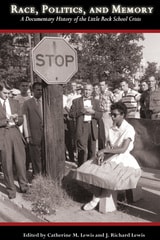
Race, Politics, and Memory
A Documentary History of the Little Rock School CrisisCatherine M. Lewis
University of Arkansas Press, 2007
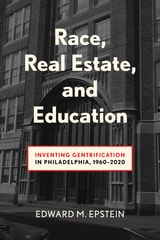
Race, Real Estate and Education
Inventing Gentrification in Philadelphia, 1960-2020Edward M. Epstein
Temple University Press, 2025
Epstein outlines the citywide context for the plan to create “University City” in West Philadelphia. He recounts the attempts to correct the segregation, overcrowding, and authoritarian management that plagued Philadelphia’s public schools. As the West Philadelphia Corporation, the proxy for the universities and hospitals, initiated gentrification efforts, the local community resisted and protested, causing the project to fail. The effort was revived with spectacular success, however, with the launch of the well-funded Penn Alexander School in 2001.
Race, Real Estate, and Education shows how the pursuit of urbanist ideals sometimes deepens neighborhood injustice. Epstein’s exploration of whether Philadelphia’s overall approach was beneficial or misguided presents a cautionary tale.
In the series Urban Life, Landscape, and Policy
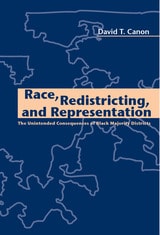
Race, Redistricting, and Representation
The Unintended Consequences of Black Majority DistrictsDavid T. Canon
University of Chicago Press, 1999
In the most comprehensive treatment of the subject to date, David Canon shows that the unintended consequences of black majority districts actually contradict the common wisdom that whites will not be adequately represented in these areas. Not only do black candidates need white votes to win, but this crucial "swing" vote often decides the race. And, once elected, even the black members who appeal primarily to black voters usually do a better job than white members of walking the racial tightrope, balancing the needs of their diverse constituents.
Ultimately, Canon contends, minority districting is good for the country as a whole. These districts not only give African Americans a greater voice in the political process, they promote a politics of commonality—a biracial politics—rather than a politics of difference.
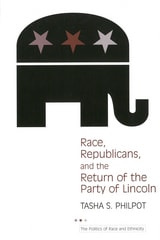
Race, Republicans, and the Return of the Party of Lincoln
Tasha S. Philpot
University of Michigan Press, 2007
Whether their slogan is “compassionate conservatism” or “hawkish liberalism,” political parties have always sought to expand their electoral coalitions by making minor adjustments to their public image. How do voters respond to these, often short-term, campaign appeals? Race, Republicans, and the Return of the Party of Lincoln is Tasha Philpot’s insightful study of how parties use racial images to shape and reshape the way citizens perceive them.
“Philpot has produced a timely, provocative, and nuanced analysis of political party image change, using the Republican Party’s attempts to recast itself as a party sensitive to issues of race with its 2000, and later 2004, national conventions as case examples. Using a mixture of experiments, focus groups, national surveys, and analyses of major national and black newspaper articles, Philpot finds that if race-related issues are important to individuals, such as blacks, the ability of the party to change its image without changing its political positions is far more difficult than it is among individuals who do not consider race-related issues important, e.g., whites. This book makes a major contribution
to our understanding of party image in general, and political parties’ use of race in particular. Bravo!”
—Paula D. McClain, Duke University
“This book does an excellent job of illuminating the linkages between racial images and partisan support. By highlighting Republican efforts to ‘play against type’ Philpot emphasizes the limits of successfully altering partisan images. That she accomplishes this in the controversial, yet salient, domain of race is no small feat. In short, by focusing on a topical issue, and by adopting a novel theoretical approach, Philpot is poised to make a significant contribution to the literatures on race and party images.”
—Vincent Hutchings, University of Michigan
Tasha S. Philpot is Assistant Professor of Government and African and African American Studies at the University of Texas at Austin.

Race, Resistance, and the Boy Scout Movement in British Colonial Africa
In British Colonial AfricaTimothy H. Parsons
Ohio University Press, 2004
Conceived by General Sir Robert Baden-Powell as a way to reduce class tensions in Edwardian Britain, scouting evolved into an international youth movement. It offered a vision of romantic outdoor life as a cure for disruption caused by industrialization and urbanization. Scouting’s global spread was due to its success in attaching itself to institutions of authority. As a result, scouting has become embroiled in controversies in the civil rights struggle in the American South, in nationalist resistance movements in India, and in the contemporary American debate over gay rights.
In Race, Resistance, and the Boy Scout Movement in British Colonial Africa, Timothy Parsons uses scouting as an analytical tool to explore the tensions in colonial society. Introduced by British officials to strengthen their rule, the movement targeted the students, juvenile delinquents, and urban migrants who threatened the social stability of the regime. Yet Africans themselves used scouting to claim the rights of full imperial citizenship. They invoked the Fourth Scout Law, which declared that a scout was a brother to every other scout, to challenge racial discrimination.
Parsons shows that African scouting was both an instrument of colonial authority and a subversive challenge to the legitimacy of the British Empire. His study of African scouting demonstrates the implications and far-reaching consequences of colonial authority in all its guises.
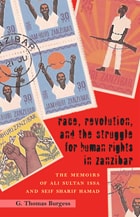
Race, Revolution, and the Struggle for Human Rights in Zanzibar
The Memoirs of Ali Sultan Issa and Seif Sharif HamadG. Thomas Burgess
Ohio University Press, 2009
Zanzibar has had the most turbulent postcolonial history of any part of the United Republic of Tanzania, yet few sources explain the reasons why. The current political impasse in the islands is a contest over the question of whether to revere and sustain the Zanzibari Revolution of 1964, in which thousands of islanders, mostly Arab, lost their lives. It is also about whether Zanzibar’s union with the Tanzanian mainland—cemented only a few months after the revolution—should be strengthened, reformed, or dissolved. Defenders of the revolution claim it was necessary to right a century of wrongs. They speak the language of African nationalism and aspire to unify the majority of Zanzibaris through the politics of race. Their opponents instead deplore the violence of the revolution, espouse the language of human rights, and claim the revolution reversed a century of social and economic development. They reject the politics of race, regarding Islam as a more worthy basis for cultural and political unity.
From a series of personal interviews conducted over several years, Thomas Burgess has produced two highly readable first-person narratives in which two nationalists in Africa describe their conflicts, achievements, failures, and tragedies. Their life stories represent two opposing arguments, for and against the revolution. Ali Sultan Issa traveled widely in the 1950s and helped introduce socialism into the islands. As a minister in the first revolutionary government he became one of Zanzibar’s most controversial figures, responsible for some of the government’s most radical policies. After years of imprisonment, he reemerged in the 1990s as one of Zanzibar’s most successful hotel entrepreneurs. Seif Sharif Hamad came of age during the revolution and became disenchanted with its broken promises and excesses. In the 1980s he emerged as a reformist minister, seeking to roll back socialism and authoritarian rule. After his imprisonment he has ever since served as a leading figure in what has become Tanzania’s largest opposition party
As Burgess demonstrates in his introduction, both memoirs trace Zanzibar’s postindependence trajectory and reveal how Zanzibaris continue to dispute their revolutionary heritage and remain divided over issues of memory, identity, and whether to remain a part of Tanzania. The memoirs explain how conflicts in the islands have become issues of national importance in Tanzania, testing that state’s commitment to democratic pluralism. They engage our most basic assumptions about social justice and human rights and shed light on a host of themes key to understanding Zanzibari history that are also of universal relevance, including the legacies of slavery and colonialism and the origins of racial violence, poverty, and underdevelopment. They also show how a cosmopolitan island society negotiates cultural influences from Africa, the Middle East, Asia, and Europe.

Race, Rights, and Rifles
The Origins of the NRA and Contemporary Gun CultureAlexandra Filindra
University of Chicago Press, 2023
An eye-opening examination of the ties between American gun culture and white male supremacy from the American Revolution to today.
One-third of American adults—approximately 86 million people—own firearms. This is not just for protection or hunting. Although many associate gun-centric ideology with individualist and libertarian traditions in American political culture, Race, Rights, and Rifles shows that it rests on an equally old but different foundation. Instead, Alexandra Filindra shows that American gun culture can be traced back to the American Revolution when republican notions of civic duty were fused with a belief in white male supremacy and a commitment to maintaining racial and gender hierarchies.
Drawing on wide-ranging historical and contemporary evidence, Race, Rights, and Rifles traces how this ideology emerged during the Revolution and became embedded in America’s institutions, from state militias to the National Rifle Association (NRA). Utilizing original survey data, Filindra reveals how many White Americans —including those outside of the NRA’s direct orbit—embrace these beliefs, and as a result, they are more likely than other Americans to value gun rights over voting rights, embrace antidemocratic norms, and justify political violence.
Race/Class Conflict and Urban Financial Threat
Jennifer L. Hochschild
Russell Sage Foundation, 2024
Hochschild investigates the root causes of disputes in the arenas of policing, development, schooling, and budgeting. She finds that race and class are central to the Stop-Question-Frisk policing policy in New York City and the development of Atlanta’s Beltline. New York’s Stop-Question-Frisk policy was intended to fight crime and keep all New Yorkers safe. In practice, however, young Black and Latino men in low-income neighborhoods were disproportionately stopped by a predominantly White police force. The goal of the Atlanta Beltline, a redevelopment project that includes public parks, new housing, commercial development, and a robust public transit system, is to expand access around the city and keep working-class residents in the city by constructing affordable housing. Instead, the construction completed thus far has encouraged gentrification and displacement of poor, disproportionately Black residents, and has increased the wealth and power of both Black and White city elites.
However, Hochschild finds that race and class inequality are not central to all urban policy disputes. When investigating the issues of charter schools in Los Angeles and Chicago’s pension system she identifies a third driver: financial threat that feels existential to the policy and political actors. In Los Angeles, there is a battle between traditional public schools and independent charter schools. Increasingly, families with sufficient resources are moving out of L.A. to areas with better school districts. Traditional public schools and charter schools must fight for the remaining students and the funding that comes with them. There are not enough students to teach and not enough money to teach them. The school district risks school closures, layoffs, and pension deficits; in this context, race/class conflict fades into the background.
Chicago’s public sector pension debt is at least three times as large as the city’s annual budget and continues to grow. Policy actors agree that the pension system needs to be stably funded. Yet city leaders, fearful of upsetting constituents and jeopardizing their political careers, fail to implement policies that would do so. Meaningful policy change to rectify the pension deficit continues to get kicked down the line for future policy actors to address. In this context also, race/class conflict fades into the background.
Race/Class Conflict and Urban Financial Threat is a compelling examination of the role that race, class, and political and fiscal threat play in shaping urban policy.
Races to Modernity
Metropolitan Aspirations in Eastern Europe, 1890–1940Martin Kohlrausch
Central European University Press, 2014
Racial Alterity, Wixarika Youth Activism, and the Right to the Mexican City
Diana Negrín
University of Arizona Press, 2019
This book examines the legacy of the racial imaginary in Mexico with a focus on the Wixarika (Huichol) Indigenous peoples of the western Sierra Madre from the colonial period to the present. Through an examination of the politics of identity, space, and activism among Wixarika university students living and working in the western Mexican cities of Tepic and Guadalajara, geographer Diana Negrín analyzes the production of racialized urban geographies and reveals how Wixarika youth are making claims to a more heterogeneous citizenship that challenges these deep-seated discourses and practices. Through the weaving together of historical material, critical interdisciplinary scholarship, and rich ethnography, this book sheds light on the racialized history, urban transformation, and contemporary Indigenous activism of a region of Mexico that has remained at the margins of scholarship.
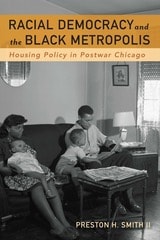
Racial Democracy and the Black Metropolis
Housing Policy in Postwar ChicagoPreston H. Smith II
University of Minnesota Press, 2012
“The African American community.” “The black position.” In accounts of black politics after the Second World War, these phrases reflect how the African American perspective generally appeared consistent, coherent, and unified. In Racial Democracy and the Black Metropolis, Preston H. Smith II examines housing debates in Chicago that go beyond black and white politics, and he shows how class and factional conflicts among African Americans actually helped to reproduce stunning segregation along economic lines.
Class and factional conflicts were normal in the rough-and-tumble world of land use politics. They are, however, often not visible in accounts of the postwar fight against segregation. Smith outlines the ideological framework that black civic leaders in Chicago used to formulate housing policy, both within and outside the black community, to reveal a surprising picture of leaders who singled out racial segregation as the source of African Americans’ inadequate housing rather than attacking class inequalities. What are generally presented as black positions on housing policy in Chicago, Smith makes clear, belonged to the black elite and did not necessarily reflect black working-class participation or interests.
This book details how black civic leaders fought racial discrimination in ways that promoted—or at least did not sacrifice—their class interests in housing and real estate struggles. And, as Smith demonstrates, their accommodation of the real estate practices and government policy of the time has had a lasting effect: it contributed to a legacy of class segregation in the housing market in Chicago and major metropolitan areas across the country that is still felt today.
Racial Politics in Contemporary Brazil
Michael Hanchard, ed.
Duke University Press, 1999
The contributors to Racial Politics in Contemporary Brazil examine such topics as the legacy of slavery and its abolition, the historical impact of social movements, race-related violence, and the role of Afro-Brazilian activists in negotiating the cultural politics surrounding the issue of Brazilian national identity. These essays also provide comparisons of racial discrimination in the United States and Brazil, as well as an analysis of residential segregation in urban centers and its affect on the mobilization of blacks and browns. With a focus on racialized constructions of class and gender and
sexuality, Racial Politics in Contemporary Brazil reorients the direction of Brazilian studies, providing new insights into Brazilian culture, politics, and race relations.
This volume will be of importance to a wide cross section of scholars engaged with Brazil in particular, and Latin American studies in general. It will also appeal to those invested in the larger issues of political and social movements centered on the issue of race.
Contributors. Benedita da Silva, Nelson do Valle Silva, Ivanir dos Santos, Richard Graham, Michael Hanchard, Carlos Hasenbalg, Peggy A. Lovell, Michael Mitchell, Tereza Santos, Edward Telles, Howard Winant
Racial Resentment in the Political Mind
Darren W. Davis and David C. Wilson
University of Chicago Press, 2022
In Racial Resentment in the Political Mind, Darren W. Davis and David C. Wilson challenge the commonly held notion that all racial negativity, disagreements, and objections to policies that seek to help racial minorities stem from racial prejudice. They argue that racial resentment arises from just-world beliefs and appraisals of deservingness that help explain the persistence of racial inequality in America in ways more consequential than racism or racial prejudice alone.
The culprits, as many White people see it, are undeserving people of color, who are perceived to benefit unfairly from, and take advantage of, resources that come at Whites’ expense—a worldview in which any attempt at modest change is seen as a challenge to the status quo and privilege. Yet, as Davis and Wilson reveal, many Whites have become racially resentful due to their perceptions that African Americans skirt the “rules of the game” and violate traditional values by taking advantage of unearned resources. Resulting attempts at racial progress lead Whites to respond in ways that retain their social advantage—opposing ameliorative policies, minority candidates, and other advancement on racial progress. Because racial resentment is rooted in beliefs about justice, fairness, and deservingness, ordinary citizens, who may not harbor racist motivations, may wind up in the same political position as racists, but for different reasons.
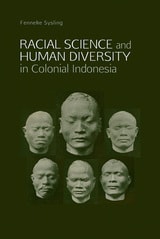
Racial Science and Human Diversity in Colonial Indonesia
Fenneke Sysling
National University of Singapore Press, 2016
In this new monograph, Fenneke Sysling draws on published works and private papers to describe the way Dutch racial scientists tried to make sense of the human diversity in the Indonesian archipelago. The making of racial knowledge, it contends, cannot be explained solely in terms of internal European intellectual developments. It was ‘on the ground’ that ideas about race were made and unmade with a set of knowledge strategies that did not always combine well. Sysling describes how skulls were assembled through the colonial infrastructure, how measuring sessions were resisted, what role photography and plaster casting played in racial science and shows how these aspects of science in practice were entangled with the Dutch colonial Empire.
Racial Stasis
The Millennial Generation and the Stagnation of Racial Attitudes in American PoliticsChristopher D. DeSante and Candis Watts Smith
University of Chicago Press, 2020
With Racial Stasis, Christopher D. DeSante and Candis Watts Smith argue persuasively that this is because millennials, a generational cohort far removed from Jim Crow and the Civil Rights era, lack sufficient understanding of the structural nature of racial inequalities in the United States and therefore also the contextual and historical knowledge to be actively anti-racist. While these younger whites may be open to the idea of interracial marriage or living next to a family of a different race, they often do not understand why policies like affirmative action still need to exist and are weary about supporting these kinds of policies. In short, although millennials’ language and rationale around race, racism, and racial inequalities are different from previous generations’, the end result is the same.
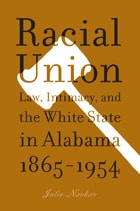
Racial Union
Law, Intimacy, and the White State in Alabama, 1865-1954Julie Novkov
University of Michigan Press, 2008
In November 2001, the state of Alabama opened a referendum on its long-standing constitutional prohibition against interracial marriage. A bill on the state ballot offered the opportunity to relegate the state's antimiscegenation law to the dustbin of history. The measure passed, but the margin was alarmingly slim: more than half a million voters, 40 percent of those who went to the polls, voted to retain a racist and constitutionally untenable law.
Julie Novkov's Racial Union explains how and why, nearly forty years after the height of the civil rights movement, Alabama struggled to repeal its prohibition against interracial marriage---the last state in the Union to do so. Novkov's compelling history of Alabama's battle over miscegenation shows how the fight shaped the meanings of race and state over ninety years. Novkov's work tells us much about the sometimes parallel, sometimes convergent evolution of our concepts of race and state in the nation as a whole.
"A remarkably nuanced account of interlocked struggles over race, gender, class and state power. Novkov's site is Alabama, but her insights are for all America."
---Rogers M. Smith, Christopher H. Browne Distinguished Professor of Political Science, University of Pennsylvania
"Hannah Arendt shocked Americans in the 1950s by suggesting that interracial intimacy was the true measure of a society's racial order. Julie Novkov's careful, illuminating, powerful book confirms Arendt's judgment. By ruling on who may be sexually linked with whom, Alabama's courts and legislators created a racial order and even a broad political order; Novkov shows us just how it worked in all of its painful, humiliating power."
---Jennifer L. Hochschild, Henry LaBarre Jayne Professor of Government, Professor of African and African American Studies, and Harvard College Professor
Racialized Politics
The Debate about Racism in AmericaEdited by David O. Sears, James Sidanius, and Lawrence Bobo
University of Chicago Press, 1999
In Racialized Politics, political scientists, sociologists, and psychologists explore the current debate surrounding the sources of racism in America. Published here for the first time, the essays represent three major approaches to the topic. The social psychological approach maintains that prejudice socialized early in life feeds racial stereotypes, while the social structural viewpoint argues that behavior is shaped by whites' fear of losing their privileged status. The third perspective looks to non-racially inspired ideology, including attitudes about the size and role of government, as the reason for opposition to policies such as affirmative action. Timely and important, this collection provides a state-of-the-field assessment of the current issues and findings on the role of racism in mass politics and public opinion.
Contributors are Lawrence Bobo, Gretchen C. Crosby, Michael C. Dawson, Christopher Federico, P. J. Henry, John J. Hetts, Jennifer L. Hochschild, William G. Howell, Michael Hughes, Donald R. Kinder, Rick Kosterman, Tali Mendelberg, Thomas F. Pettigrew, Howard Schuman, David O. Sears, James Sidanius, Pam Singh, Paul M. Sniderman, Marylee C. Taylor, and Steven A. Tuch.
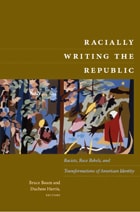
Racially Writing the Republic
Racists, Race Rebels, and Transformations of American IdentityBruce Baum and Duchess Harris, eds.
Duke University Press, 2009
The contributors analyze Thomas Jefferson’s legacy in light of his sexual relationship with his slave, Sally Hemings; the way that Samuel Gompers, the first president of the American Federation of Labor, rallied his organization against Chinese immigrant workers; and the eugenicist origins of the early-twentieth-century birth-control movement led by Margaret Sanger. They draw attention to the writing of Sarah Winnemucca, a Northern Piute and one of the first published Native American authors; the anti-lynching activist Ida B. Wells-Barnett; the Filipino American writer Carlos Bulosan; and the playwright Lorraine Hansberry, who linked civil rights struggles in the United States to anticolonial efforts abroad. Other figures considered include Alexis de Tocqueville and his traveling companion Gustave de Beaumont, Juan Nepomuceno Cortina (who fought against Anglo American expansion in what is now Texas), Abraham Lincoln, Theodore Roosevelt, and W. E. B. Du Bois. In the afterword, George Lipsitz reflects on U.S. racial politics since 1965.
Contributors. Bruce Baum, Cari M. Carpenter, Gary Gerstle, Duchess Harris, Catherine A. Holland, Allan Punzalan Isaac, Laura Janara, Ben Keppel, George Lipsitz, Gwendolyn Mink, Joel Olson, Dorothy Roberts, Patricia A. Schechter, John Kuo Wei Tchen, Jerry Thompson
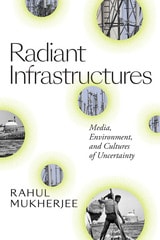
Radiant Infrastructures
Media, Environment, and Cultures of UncertaintyRahul Mukherjee
Duke University Press, 2020
Radical American Partisanship
Mapping Violent Hostility, Its Causes, and the Consequences for DemocracyNathan P. Kalmoe and Lilliana Mason
University of Chicago Press, 2022
Political violence is rising in the United States, with Republicans and Democrats divided along racial and ethnic lines that spurred massive bloodshed and democratic collapse earlier in the nation’s history. The January 6, 2021 insurrection and the partisan responses that ensued are a vivid illustration of how deep these currents run. How did American politics become so divided that we cannot agree on how to categorize an attack on our own Capitol?
For over four years, through a series of surveys and experiments, Nathan P. Kalmoe and Lilliana Mason have been studying radicalism among ordinary American partisans. In this groundbreaking book, they draw on new evidence—as well as insights from history, psychology, and political science—to put our present partisan fractiousness in context and to explain broad patterns of political and social change. Early chapters reveal the scope of the problem, who radical partisans are, and trends over time, while later chapters identify the conditions that partisans say justify violence and test how elections, political violence, and messages from leaders enflame or pacify radical views. Kalmoe and Mason find that ordinary partisanship is far more dangerous than pundits and scholars have recognized. However, these findings are not a forecast of inevitable doom; the current climate also brings opportunities to confront democratic threats head-on and to create a more inclusive politics. Timely and thought-provoking, Radical American Partisanship is vital reading for understanding our current political landscape.

Radical Desires
French Gay Liberation and Anticolonial CritiqueEdited by Hauke Branding and Julian Volz
Diaphanes, 2025
Despite a historically rich tradition of thinking about the relation between sexuality, desire, and revolution, there is little engagement with desire’s radicality today. This volume attends to the radicality of desire as a starting point for overcoming heteropatriarchal capitalism by turning to the specific radical homosexual critique as it was first formulated in France in the 1970s in the writings of the Mouvement de Libération des Femmes and the Front Homosexuel d’Action Révolutionnaire, as well as in the conceptions of their most important protagonists, Monique Wittig and Guy Hocquenghem.
Radical Desires seeks to emphasize the anti-identitarian character of the French gay liberation movement, as well as its implicit and explicit critique of gender and sexual binaries. At the same time, the volume is also interested in intersectionally expanding this critique by confronting it with anticolonial and queer of color perspectives. As French gay liberation activists’ relations to North African men were often problematic, several contributions engage with the latent orientalist and racist tropes that appear in the movement’s writings. By aiming to go beyond a mere historicization of these ambivalences and exploring which contemporary problems appear in a different light as a result, Radical Desires highlights the (dis-)continuous relationship between current debates and those in 1970s France.
To explore the multiplicity of forms with or in which these critiques were expressed, this volume places theoretical perspectives in conversation with artistic perspectives on queer liberation in a transnational context. Contributors include Friederike Beier, Antoine Idier, Émilie Notéris, Lukas Betzler, Mohammad Shawky Hassan, Sido Lansari, Todd Shepard, and Julian Volz.
Radical Enfranchisement in the Jury Room and Public Life
Sonali Chakravarti
University of Chicago Press, 2019
With Radical Enfranchisement in the Jury Room and Public Life, Sonali Chakravarti offers a full-throated defense of juries as a democratic institution. She argues that juries provide an important site for democratic action by citizens and that their use should be revived. The jury, Chakravarti argues, could be a forward-looking institution that nurtures the best democratic instincts of citizens, but this requires a change in civic education regarding the skills that should be cultivated in jurors before and through the process of a trial. Being a juror, perhaps counterintuitively, can guide citizens in how to be thoughtful rule-breakers by changing their relationship to their own perceptions and biases and by making options for collective action salient, but they must be better prepared and instructed along the way.
Radical Enfranchisement in the Jury Room and Public Life
Sonali Chakravarti
University of Chicago Press, 2019
This is an auto-narrated audiobook edition of this book.
With Radical Enfranchisement in the Jury Room and Public Life, Sonali Chakravarti offers a full-throated defense of juries as a democratic institution. She argues that juries provide an important site for democratic action by citizens and that their use should be revived. The jury, Chakravarti argues, could be a forward-looking institution that nurtures the best democratic instincts of citizens, but this requires a change in civic education regarding the skills that should be cultivated in jurors before and through the process of a trial. Being a juror, perhaps counterintuitively, can guide citizens in how to be thoughtful rule-breakers by changing their relationship to their own perceptions and biases and by making options for collective action salient, but they must be better prepared and instructed along the way.

Radical Family
Trailblazing Lesbian Moms Tell Their StoriesEdited by Margaret Mooney
Wisconsin Historical Society Press, 2025
A powerful collection of personal essays from lesbian moms who fought for the right to raise children
For generations, lesbians across the United States were systematically denied opportunities to raise children and build families, opportunities that were readily available to straight people. Radical Family honors the history-making struggles and triumphs of lesbian families in Madison, Wisconsin, who raised children in the 1980s, ’90s, and early 2000s—a time when lesbian motherhood was widely considered extreme and unnatural. In a collection of nine profoundly personal essays, the contributors recount their diverse paths to parenthood, as well as the hopes and challenges each family experienced. While the stories in Radical Family are unique, they all share a common thread: the mothers’ resilience and the risks they took, both small and sweeping, to defend their family’s right to exist.
For lesbians, the desire to raise children has historically been met with vilification and legal and social prejudice. Adoption agencies consistently rejected applications from out lesbians. Doctors and clinics refused to provide fertility treatments and other medical options to help them get pregnant. Lesbians who were able to raise children commonly lost custody to estranged spouses or grandparents.
Trailblazing lesbian mothers—and their children—fought to defy and, ultimately, shift this paradigm. Lesbian parents, like those in Radical Family, created informal networks in their local communities, where they could share survival strategies and find acceptance among other families that looked like theirs. With no rule book to guide them, and few laws to protect them, lesbian mothers created a new—some might even say radical—standard for what it means to be a family.
Over and over, the stories in Radical Family show how families fought back against hatred and homophobia with love, resilience, commitment, and creativity. Their stories deepen our understanding of what it means to be a mother—while showing how safety, belonging, and acceptance are universal human needs.
Radical Gotham
Anarchism in New York City from Schwab's Saloon to Occupy Wall StreetEdited by Tom Goyens
University of Illinois Press, 2017