Results by title
105 books match the query 'Political activists' and 4 start with r
Reading Public Opinion
How Political Actors View the Democratic ProcessSusan Herbst
University of Chicago Press, 1998
Public opinion is one of the most elusive and complex concepts in democratic theory, and we do not fully understand its role in the political process. Reading Public Opinion offers one provocative approach for understanding how public opinion fits into the empirical world of politics. In fact, Susan Herbst finds that public opinion, surprisingly, has little to do with the mass public in many instances.
Herbst draws on ideas from political science, sociology, and psychology to explore how three sets of political participants—legislative staffers, political activists, and journalists—actually evaluate and assess public opinion. She concludes that many political actors reject "the voice of the people" as uninformed and nebulous, relying instead on interest groups and the media for representations of public opinion. Her important and original book forces us to rethink our assumptions about the meaning and place of public opinion in the realm of contemporary democratic politics.
Herbst draws on ideas from political science, sociology, and psychology to explore how three sets of political participants—legislative staffers, political activists, and journalists—actually evaluate and assess public opinion. She concludes that many political actors reject "the voice of the people" as uninformed and nebulous, relying instead on interest groups and the media for representations of public opinion. Her important and original book forces us to rethink our assumptions about the meaning and place of public opinion in the realm of contemporary democratic politics.
[more]
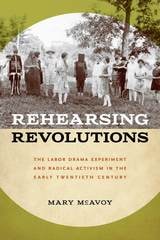
Rehearsing Revolutions
The Labor Drama Experiment and Radical Activism in the Early Twentieth CenturyMary McAvoy
University of Iowa Press, 2019
Choice Outstanding Academic Title, 2019
George Freedley Memorial Award Finalist, 2020
Between the world wars, several labor colleges sprouted up across the U.S. These schools, funded by unions, sought to provide members with adult education while also indoctrinating them into the cause. As Mary McAvoy reveals, a big part of that learning experience centered on the schools’ drama programs. For the first time, Rehearsing Revolutions shows how these left-leaning drama programs prepared American workers for the “on-the-ground” activism emerging across the country. In fact, McAvoy argues, these amateur stages served as training grounds for radical social activism in early twentieth-century America.Using a wealth of previously unpublished material such as director’s reports, course materials, playscripts, and reviews, McAvoy traces the programs’ evolution from experimental teaching tool to radically politicized training that inspired overt—even militant—labor activism by the late 1930s. All the while, she keeps an eye on larger trends in public life, connecting interwar labor drama to post-war arts-based activism in response to McCarthyism, the Cold War, and the Civil Rights movement. Ultimately, McAvoy asks: What did labor drama do for the workers’ colleges and why did they pursue it? She finds her answer through several different case studies in places like the Portland Labor College and the Highlander Folk School in Tennessee.
[more]
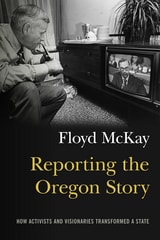
Reporting the Oregon Story
How Activists and Visionaries Transformed a StateFloyd J. McKay
Oregon State University Press, 2016
Oregon entered a new era in 1964 with the election of Tom McCall as Secretary of State and Bob Straub as State Treasurer. Their political rivalry formed the backdrop for two of Oregon’s most transformative decades, as they successively fought for, lost, and won the governorship. Veteran Oregon journalist Floyd McKay had a front-row seat.
As a political reporter for The Oregon Statesman in Salem, and then as news analyst for KGW-TV in Portland, McKay was known for asking tough questions and pulling no punches. His reporting and commentaries ranged from analysis of the “Tom and Bob” rivalry, to the Vietnam War’s impact on Senators Wayne Morse and Mark Hatfield and the emergence of a new generation of Portland activists in the 1970s.
McKay and his colleagues were on the beaches as Oregon crafted its landmark Beach Bill, ensuring the protection of beaches for public use. They watched as activists turned back efforts to build a highway on the sand at Pacific City. Pitched battles over Oregon’s Bottle Bill, and the panic-inducing excitement of “Vortex”—the nation’s only state-sponsored rock festival—characterized the period. Covering the period from 1964-1986, McKay remembers the action, the players and the consequences, in this compelling and personal account.
As major actors fade from the scene and new leaders emerge, McKay casts a backwards glance at enduring Oregon legends. Half a century later, amid today’s cynicism and disillusionment with media, politics, and politicians, Reporting the Oregon Story serves as a timely reminder that charged politics and bitter rivalries can also come hand-in-hand with lasting social progress.
Reporting the Oregon Story will be relished by those who lived the history, and it will serve as a worthy introduction to Oregonians young and old who want a first-hand account of Oregon’s mid- twentieth-century political history and legislative legacy.
[more]
Routing the Opposition
Social Movements, Public Policy, and DemocracyDavid S. Meyer
University of Minnesota Press, 2005
On one side are the policy makers, on the other, the movements and organizations that challenge public policy. Where and how the two meet is a critical juncture in the democratic process. Bringing together a distinguished group of scholars from several different disciplines in the social sciences, Routing the Opposition connects the substance and content of policies with the movements that create and respond to them. Local antidrug coalitions, the organic agriculture movement, worker's compensation reforms, veterans' programs, prison reform, immigrants' rights campaigns: these are some of the diverse areas in which the contributors to this volume examine the linkages between the practices, organization, and institutional logic of public policy and social movements. The authors engage such topics as the process of involving multiple stakeholders in policy making, the impact of overlapping social networks on policy and social movement development, and the influence of policy design on the increase or decline of civic involvement. Capturing both successes and failures, Routing the Opposition focuses on strategies and outcomes that both transform social movements and guide the development of public policy, revealing as well what happens when the very different organizational cultures of activists and public policy makers interact.
[more]