Results by title
93 books match the query 'Political violence' and 7 start with r
Radical American Partisanship
Mapping Violent Hostility, Its Causes, and the Consequences for DemocracyNathan P. Kalmoe and Lilliana Mason
University of Chicago Press, 2022
Political violence is rising in the United States, with Republicans and Democrats divided along racial and ethnic lines that spurred massive bloodshed and democratic collapse earlier in the nation’s history. The January 6, 2021 insurrection and the partisan responses that ensued are a vivid illustration of how deep these currents run. How did American politics become so divided that we cannot agree on how to categorize an attack on our own Capitol?
For over four years, through a series of surveys and experiments, Nathan P. Kalmoe and Lilliana Mason have been studying radicalism among ordinary American partisans. In this groundbreaking book, they draw on new evidence—as well as insights from history, psychology, and political science—to put our present partisan fractiousness in context and to explain broad patterns of political and social change. Early chapters reveal the scope of the problem, who radical partisans are, and trends over time, while later chapters identify the conditions that partisans say justify violence and test how elections, political violence, and messages from leaders enflame or pacify radical views. Kalmoe and Mason find that ordinary partisanship is far more dangerous than pundits and scholars have recognized. However, these findings are not a forecast of inevitable doom; the current climate also brings opportunities to confront democratic threats head-on and to create a more inclusive politics. Timely and thought-provoking, Radical American Partisanship is vital reading for understanding our current political landscape.
Radical Sensations
World Movements, Violence, and Visual CultureShelley Streeby
Duke University Press, 2013
Radicalizing Men
Fascist Desires, Great Replacement Propaganda, and Political ViolenceJessica Johnson
Duke University Press, 2026

Recording Memories from Political Violence
A Film-maker's JourneyCahal McLaughlin
Intellect Books, 2010
Based on work the author has carried out with survivor groups in Northern Ireland and South Africa, Recording Memories from Political Violence draws on written and audiovisual texts to describe and analyze the use of documentary filmmaking in recording experiences of political conflict. A variety of issues relevant to the genre are addressed at length, including the importance of ethics in the collaboration between the filmmaker and the participant and the effect of location on the accounts of participants. Cahal McLaughlin draws on the diverse fields of film and cultural studies, as well as nearly twenty years of production experience, in this informed and instructive contribution to documentary filmmaking and post-conflict studies.
Regimes and Repertoires
Charles Tilly
University of Chicago Press, 2006
The means by which people protest—that is, their repertoires of contention—vary radically from one political regime to the next. Highly capable undemocratic regimes such as China's show no visible signs of popular social movements, yet produce many citizen protests against arbitrary, predatory government. Less effective and undemocratic governments like the Sudan’s, meanwhile, often experience regional insurgencies and even civil wars. In Regimes and Repertoires, Charles Tilly offers a fascinating and wide-ranging case-by-case study of various types of government and the equally various styles of protests they foster.
Using examples drawn from many areas—G8 summit and anti-globalization protests, Hindu activism in 1980s India, nineteenth-century English Chartists organizing on behalf of workers' rights, the revolutions of 1848, and civil wars in Angola, Chechnya, and Kosovo—Tilly masterfully shows that such episodes of contentious politics unfold like loosely scripted theater. Along the way, Tilly also brings forth powerful tools to sort out the reasons why certain political regimes vary and change, how the people living under them make claims on their government, and what connections can be drawn between regime change and the character of contentious politics.
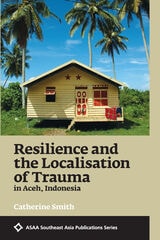
Resilience and the Localisation of Trauma in Aceh, Indonesia
Catherine Smith
National University of Singapore Press, 2017
In this book, Catherine Smith examines the global reach of the contested, yet compelling, concept of trauma. She explores how what is considered “trauma” has expanded well beyond the bounds of therapeutic practice to become a powerful cultural idiom shaping the ways people understand the effects of violence and imagine possible responses to suffering. In Aceh, conflict survivors have incorporated the ideas of trauma into their local languages, healing practices, and political imaginaries. The appearance of this idiom of distress into the Acehnese medical-moral landscape provides an ethnographic perspective on suffering and recovery, and contributes to our contemporary debates about the international reach of psychiatry and the cultural consequences as it spreads beyond the domain of medicine.
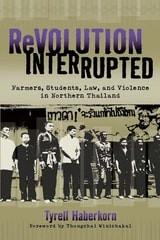
Revolution Interrupted
Farmers, Students, Law, and Violence in Northern ThailandTyrell Haberkorn; Foreword by Thongchai Winichakul
University of Wisconsin Press, 2011
In October 1973 a mass movement forced Thailand’s prime minister to step down and leave the country, ending nearly forty years of dictatorship. Three years later, in a brutal reassertion of authoritarian rule, Thai state and para-state forces quashed a demonstration at Thammasat University in Bangkok. In Revolution Interrupted, Tyrell Haberkorn focuses on this period when political activism briefly opened up the possibility for meaningful social change. Tenant farmers and their student allies fomented revolution, she shows, not by picking up guns but by invoking laws—laws that the Thai state ultimately proved unwilling to enforce.
In choosing the law as their tool to fight unjust tenancy practices, farmers and students departed from the tactics of their ancestors and from the insurgent methods of the Communist Party of Thailand. To first imagine and then create a more just future, they drew on their own lived experience and the writings of Thai Marxian radicals of an earlier generation, as well as New Left, socialist, and other progressive thinkers from around the world. Yet their efforts were quickly met with harassment, intimidation, and assassinations of farmer leaders. More than thirty years later, the assassins remain unnamed.
Drawing on hundreds of newspaper articles, cremation volumes, activist and state documents, and oral histories, Haberkorn reveals the ways in which the established order was undone and then reconsolidated. Examining this turbulent period through a new optic—interrupted revolution—she shows how the still unnameable violence continues to constrict political opportunity and to silence dissent in present-day Thailand.