Results by title
191 books match the query 'Politics and literature' and 11 start with r
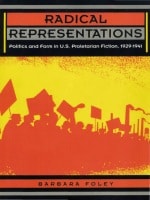
Radical Representations
Politics and Form in U.S. Proletarian Fiction, 1929–1941Barbara Foley
Duke University Press, 1994
Josephine Herbst, William Attaway, Jack Conroy, Thomas Bell and Tillie Olsen, are among the radical writers whose work Foley reexamines. Her fresh approach to the U.S. radicals' debates over experimentalism, the relation of art to propaganda, and the nature of proletarian literature recasts the relation of writers to the organized left. Her grasp of the left's positions on the "Negro question" and the "woman question" enables a nuanced analysis of the relation of class to race and gender in the proletarian novel. Moreover, examining the articulation of political doctrine in different novelistic modes, Foley develops a model for discussing the interplay between politics and literary conventions and genres.
Radical Representations recovers a literature of theoretical and artistic value meriting renewed attention form those interested in American literature, American studies, the U. S. left, and cultural studies generally.

Raising Your Kids Right
Children's Literature and American Political ConservatismAbate, Michelle Ann
Rutgers University Press, 2011
Highlighting the works of William Bennett, Lynne Cheney, Bill O'Reilly, and others, Michelle Ann Abate brings together such diverse fields as cultural studies, literary criticism, political science, childhood studies, brand marketing, and the cult of celebrity. Raising Your Kids Right dispels lingering societal attitudes that narratives for young readers are unworthy of serious political study by examining a variety of texts that offer information, ideology, and even instructions on how to raise kids right, not just figuratively but politically.
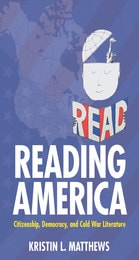
Reading America
Citizenship, Democracy, and Cold War LiteratureKristin L. Matthews
University of Massachusetts Press, 2016
During the Cold War, the editor of Time magazine declared, “A good citizen is a good reader.” As postwar euphoria faded, a wide variety of Americans turned to reading to understand their place in the changing world. Yet, what did it mean to be a good reader? And how did reading make you a good citizen?
In Reading America, Kristin L. Matthews puts into conversation a range of political, educational, popular, and touchstone literary texts to demonstrate how Americans from across the political spectrum—including “great works” proponents, New Critics, civil rights leaders, postmodern theorists, neoconservatives, and multiculturalists—celebrated particular texts and advocated particular interpretive methods as they worked to make their vision of "America" a reality. She situates the fiction of J. D. Salinger, Ralph Ellison, Thomas Pynchon, John Barth, and Maxine Hong Kingston within these debates, illustrating how Cold War literature was not just an object of but also a vested participant in postwar efforts to define good reading and citizenship.

Reading North by South
On Latin American Literature, Culture, and PoliticsNeil Larsen
University of Minnesota Press, 1995
Reading North by South was first published in 1995. Minnesota Archive Editions uses digital technology to make long-unavailable books once again accessible, and are published unaltered from the original University of Minnesota Press editions.
Neil Larsen is concerned with misleading interpretations of literature and culture that dominate Latin American studies in North America. In Reading North by South he attempts to correct the distorted views that have prevailed by proposing the need for a freshly conceived historical materialist approach to Latin American texts and cultural practices.
Reading North by South opens with reflections on how North America has read Latin America since the advent of popular fiction from authors like Cortázar and García Márquez. Larsen argues that the North American academy tends to interpret Latin American texts through a postmodern lens of cultural politics that ignores historical realism, and he contends that more attention needs to be paid to historical and class issues. He provides insightful commentaries on political discourses, cultural events, films, and literary texts, and maintains that the canonization of the modernist aesthetic in the United States has resulted in a marginalization of writers and writing that reflect the historical realities of Latin American politics.
As it analyzes important points of debate within and outside of Latin American studies, Reading North by South draws upon a wide diversity of texts written in Portuguese, Spanish and English. Of particular interest is Larsen's discussion of writings from the Caribbean, an area that is not frequently included in Latin American studies. Reading North by South will lead readers to question the expectations and preconceptions that inform their readings of Latin American literature.
Neil Larsen is associate professor of Spanish and Latin American literature at Northeastern University. He is the author of Modernism and Hegemony: A Materialist Critique of Aesthetic Agencies (Minnesota, 1990), and editor of The Discourse of Power: Culture, Hegemony, and the Authoritarian State in Latin America (1983).
Reading after Actium
Vergil's Georgics, Octavian, and RomeChristopher Nappa
University of Michigan Press, 2005
Reading after Actium is a study of Vergil's Georgics, a didactic poem ostensibly about farming but in fact a brilliant exercise challenging readers to develop a broader perspective on the basic problems and the dangers of human life. Octavian is treated as one of the poet's students and given the opportunity to learn lessons in handling power, in controlling Rome's vast resources, and in preventing the bloody cycle of civil war from beginning again. Most of all the Georgics asks Octavian to consider what is involved in assuming godlike power over his fellow citizens.
Reading after Actium provides an introduction to the history of scholarship surrounding the Georgics and the political questions surrounding Octavian and his career. Nappa gives a book by book analysis of the entire poem, and a conclusion that draws together the themes of the whole. Reading after Actium will appeal to students and critics of Vergil and other Augustan Literature as well as those of didactic poetry and its traditions. Students of Roman history and politics should read this as well.
Christopher Nappa is Assistant Professor of Classics at the University of Minnesota.
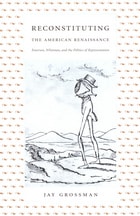
Reconstituting the American Renaissance
Emerson, Whitman, and the Politics of RepresentationJay Grossman
Duke University Press, 2003
Reconstituting the American Renaissance describes how Emerson and Whitman came into the period of their greatest productivity with different conceptions of the functions and political efficacy of the word in the world. It challenges Emerson’s position as Whitman’s necessary precursor and offers a cultural history that emphasizes the two writers’ differences in social class, cultural experience, and political perspective. In their writings between 1830 and 1855, the book finds contrasting conceptions of the relations between the “representative man” and the constituencies to whom, and for whom, he speaks. Reconstituting the American Renaissance opens up the canonical relationship between Emerson and Whitman and multiplies the historical and discursive contexts for understanding their published and unpublished works.
Representing the Troubles in Irish Short Fiction
Michael L. Storey
Catholic University of America Press, 2004
Resisting Dialogue
Modern Fiction and the Future of DissentJuan Meneses
University of Minnesota Press, 2019
A bold new critique of dialogue as a method of eliminating dissent
Is dialogue always the productive political and communicative tool it is widely conceived to be? Resisting Dialogue reassesses our assumptions about dialogue and, in so doing, about what a politically healthy society should look like. Juan Meneses argues that, far from an unalloyed good, dialogue often serves as a subtle tool of domination, perpetuating the underlying inequalities it is intended to address.
Meneses investigates how “illusory dialogue” (a particular dialogic encounter designed to secure consensus) is employed as an instrument that forestalls—instead of fostering—articulations of dissent that lead to political change. He does so through close readings of novels from the English-speaking world written in the past hundred years—from E. M. Forster’s A Passage to India and Jeanette Winterson’s The Passion to Indra Sinha’s Animal’s People and more. Resisting Dialogue demonstrates how these novels are rhetorical exercises with real political clout capable of restoring the radical potential of dialogue in today’s globalized world. Expanding the boundaries of postpolitical theory, Meneses reveals how these works offer ways to practice disagreement against this regulatory use of dialogue and expose the pitfalls of certain other dialogic interventions in relation to some of the most prominent questions of modern history: cosmopolitanism at the end of empire, the dangers of rewriting the historical record, the affective dimension of neoliberalism, the racial and nationalist underpinnings of the “war on terror,” and the visibility of environmental violence in the Anthropocene.
Ultimately, Resisting Dialogue is a complex, provocative critique that, melding political and literary theory, reveals how fiction can help confront the deployment of dialogue to preempt the emergence of dissent and, thus, revitalize the practice of emancipatory politics.
Responding to Crisis in Contemporary Mexico
The Political Writings of Paz, Fuentes, Monsiváis, and PoniatowskaClaire Brewster
University of Arizona Press, 2005
Claire Brewster has mined direct quotations from a host of publications to illustrate the techniques that they used in combating government and editorial restraints. Brewster first addresses the Student Movement of 1968—the violent suppression of which was a watershed in the relationship between the Mexican government and people—and illustrates the ways in which the student crisis affected the writers’ relationships with presidents Luis Echeverría Alvarez and José López Portillo. She next considers the profound social and political repercussions of the 1985 earthquake as described by Poniatowska and Monsiváis and the consequent emergence of Mexican civil society. She then outlines Paz’s and Monsiváis’s vociferous responses to the 1988 presidential election campaigns and their highly contentious result, and lastly she examines the Chiapas rebellion from January to July 1994.
The eloquent Zapatista spokesman, Subcomandante Marcos, challenged Mexican writers to a duel of words, and Brewster analyzes the ways in which the four writers took up the gauntlet—and in so doing reveals the development of their political thoughts and their relationships with the Mexican people and the federal government. The work of these four authors charts an important historical era, and a close examination of their essays reveals their maturation as writers and provides an understanding of the development of Mexican society. By bringing their opinions and attitudes to light, Brewster unearths a rich lode of insight into the inner workings of Mexican intellectuals and invites observers of contemporary Mexico to reconsider their role in reflecting social change.
Revel with a Cause
Liberal Satire in Postwar AmericaStephen E. Kercher
University of Chicago Press, 2006
Revel with a Cause is their story. Stephen Kercher here provides the first comprehensive look at the satiric humor that flourished in the United States during the 1950s and early 1960s. Focusing on an impressive range of comedy—not just standup comedians of the day but also satirical publications like MAD magazine, improvisational theater groups such asSecond City, the motion picture Dr. Strangelove, and TV shows like That Was the Week That Was—Kercher reminds us that the postwar era saw varieties of comic expression that were more challenging and nonconformist than we commonly remember. His history of these comedic luminaries shows that for a sizeable audience of educated, middle-class Americans who shared such liberal views, the period’s satire was a crucial mode of cultural dissent. For such individuals, satire was a vehicle through which concerns over the suppression of civil liberties, Cold War foreign policies, blind social conformity, and our heated racial crisis could be productively addressed.
A vibrant and probing look at some of the most influential comedy of mid-twentieth-century America, Revel with a Cause belongs on the short list of essential books for anyone interested in the relationship between American politics and popular culture.
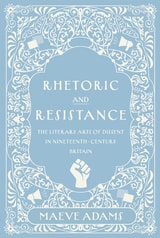
Rhetoric and Resistance
The Literary Arts of Dissent in Nineteenth-Century BritainMaeve Adams
Ohio University Press, 2025
A fresh perspective on the enduring relationship between literature, democracy, and dissent
Rhetoric and Resistance explores the transformative role of nineteenth-century literature in shaping modern concepts and practices of democratic dissent. By examining the works of Romantic and Victorian novelists, poets, and journalists, Maeve Adams identifies origins of modern theories and practices of resistance in nineteenth-century literary forms. Offering a literary history of dissent, the book recovers the intertwined development of democracy and aesthetics, revealing how narrative form became a potent tool for challenging authority.
Tracing the lineage of dissent from the radical fiction and journalism of the 1800s to contemporary movements like #MeToo, Adams offers a genealogy that highlights how literary texts experimented with political power, granting new and consequential voices to working-class individuals, women, colonized peoples, and other marginalized groups.
Adams takes an interdisciplinary approach, weaving together close readings of works by Thomas De Quincey, Walter Scott, Elizabeth Gaskell, and H. G. Wells, as well as lesser-known journalists, with insights from modern moral and political philosophy. Drawing on theories of democratic ethics and justice from scholars such as Miranda Fricker, Sharon Krause, Martha Nussbaum, and Philip Pettit, the book bridges literary history and contemporary debates about political agency and expression.