Results by title
262 books match the query 'Public health' and 5 start with r
RSF
The Russell Sage Foundation Journal of the Social Sciences: The Social, Political, and Economic Effects of the Affordable Care ActAndrea Campbell
Russell Sage Foundation, 2020
This journal issue explores the political dimensions of the rollout of the ACA and the attendant backlash. Contributors Helen Levy, Andrew Ying, and Nicholas Bagley argue that despite repeated efforts at repeal, over 80 percent of the Act has been implemented as it was originally intended. Julianna Pacheco, Jake Haselswerdt, and Jamila Michener show that when Republican governors support Medicaid expansion, Republican voters become more favorable toward the ACA, and polarization between Republican and Democrat voters decreases. Yet Charles Courtemanche, James Marton, and Aaron Yelowitz find little impact of the ACA on voter participation. Lisa Beauregard and Edward Miller examine states’ adoption of the ACA’s home and community-based care services for the elderly and people with disabilities, finding that states with more liberal elected officials and more fiscal capacity were more likely to adopt these provisions. Paul Shafer, David Anderson, Seciah Aquino, Laura Baum, Erika Franklin Fowler, and Sarah Gollust probe the role of different types of health insurance and political advertising on insurance enrollment. Richard Fording and Dana Patton explain the emergence of contentious Medicaid work requirements and patient co-pays that limit access to Medicaid.
Other contributors address how the ACA affects marginalized populations. Carrie Fry, Thomas McGuire, and Richard Frank link Medicaid expansion to lower rates of recidivism among the formerly incarcerated. Radhika Gore, Ritu Dhar, Sadia Mohaimin, Priscilla Lopez, Anna Divney, Jennifer Zanowiak, Lorna Thorpe, and Nadia Islam study primary care practices serving South Asian immigrants in New York City and highlight the importance of social context and organizational constraints in designing population health interventions. The issue also examines the economic effects of the ACA, especially on access to private and public health insurance. Both Mark Hall and Jean Abraham study instability in ACA health insurance markets, with Hall focusing on uncertainty arising from political factors and Abraham examining the factors that lead local markets to face high premiums and low insurer participation. Philip Rocco and Andrew Kelly explore the mechanisms included in the ACA to try to spur innovations in care delivery that both improve health and generate long-term cost savings.
As the COVID-19 pandemic affects healthcare in unprecedented ways, affordable healthcare access is critical. This RSF journal issue offers a timely, thoughtful consideration of one of the most pressing issues in American life.
Raw Material
Producing Pathology in Victorian CultureErin O'Connor
Duke University Press, 2000
O’Connor focuses on how four particularly troubling physical conditions were represented in a variety of literature. She begins by exploring how Asiatic cholera, which reached epidemic proportions on four separate occasions between 1832 and 1865, was thought to represent the dangers of cultural contamination and dissolution. The next two chapters concentrate on the problems breast cancer and amputation posed for understanding gender. After discussing how breast cancer was believed to be caused by the female body’s intolerance to urban life, O'Connor turns to men’s bodies, examining how new prosthetic technology allowed dismembered soldiers and industrial workers to reconstruct themselves as productive members of society. The final chapter explores how freak shows displayed gross deformity as the stuff of a new and improved individuality. Complicating an understanding of the Victorian body as both a stable and stabilizing structure, she elaborates how Victorians used disease as a messy, often strategically unintelligible way of articulating the uncertainties of chaotic change. Over the course of the century, O’Connor shows, the disfiguring process of disease became a way of symbolically transfiguring the self. While cholera, cancer, limb loss, and deformity incapacitated and even killed people, their dramatic symptoms provided opportunities for imaginatively adapting to a world where it was increasingly difficult to determine not only what it meant to be human but also what it meant to be alive.
Raw Material will interest an audience of students and scholars of Victorian literature, cultural history, and the history of medicine.
Reimagining Social Medicine from the South
Abigail H. Neely
Duke University Press, 2021
Revolutionizing Women's Healthcare
The Feminist Self-Help Movement in AmericaHannah Dudley-Shotwell
Rutgers University Press, 2020
Revolutionizing Women’s Healthcare is the story of a feminist experiment: the self-help movement. This movement arose out of women’s frustration, anger, and fear for their health. Tired of visiting doctors who saw them as silly little girls, suffering shame when they asked for birth control, seeking abortions in back alleys, and holding little control over their own reproductive lives, women took action. Feminists created “self-help groups” where they examined each other’s bodies and read medical literature. They founded and ran clinics, wrote books, made movies, undertook nationwide tours, and raided and picketed offending medical institutions. Some performed their own abortions. Others swore off pharmaceuticals during menopause. Lesbian women found “at home” ways to get pregnant. Black women used self-help to talk about how systemic racism affected their health. Hannah Dudley-Shotwell engagingly chronicles these stories and more to showcase the creative ways women came together to do for themselves what the mainstream healthcare system refused to do.
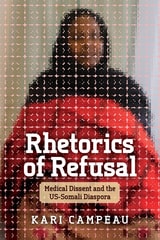
Rhetorics of Refusal
Medical Dissent and the US-Somali DiasporaKari Campeau
The Ohio State University Press, 2025
Rhetorics of Refusal focuses on a recent public health crisis—Minnesota’s 2017 measles outbreak—to recast vaccine refusals less as products of poor health literacy or disinformation and more as strategic and generative acts of noncompliance. The outbreak, which primarily affected unvaccinated Somali children, occurred at the nexus of declining vaccination rates, spiking autism concerns, antivaccination predation, and a fraying public health infrastructure. However, during a year-long ethnographic study at a Somali health center, Kari Campeau found that personal stories from parents offered a much different picture of vaccine refusal than the one painted by news media. Tracking refusals across four sites, Campeau argues for the importance of approaching refusals as rhetorical and participatory strategies that hold institutions accountable, press for change, and practice care within emergent biosocial communities. Moreover, she views refusal as necessary and potentially transformative in situations where refusers have little access to power or platform. By contextualizing refusals in longer cultural and political histories, Campeau unsettles traditional narratives of medical dissent while offering new entry points into discussions on racialized biopolitics, care, disability, and public health.