Results by title
151 books match the query 'Radicalism' and 18 start with r
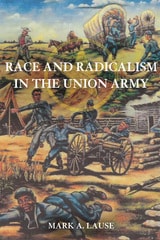
Race and Radicalism in the Union Army
Mark A. Lause
University of Illinois Press, 2013
In this compelling portrait of interracial activism, Mark A. Lause documents the efforts of radical followers of John Brown to construct a triracial portion of the Federal Army of the Frontier. Mobilized and inspired by the idea of a Union that would benefit all, black, Indian, and white soldiers fought side by side, achieving remarkable successes in the field. Against a backdrop of idealism, racism, greed, and the agonies and deprivations of combat, Lause examines links between radicalism and reform, on the one hand, and racialized interactions among blacks, Indians, and whites, on the other.
Lause examines how this multiracial vision of American society developed on the Western frontier. Focusing on the men and women who supported Brown in territorial Kansas, Lause examines the impact of abolitionist sentiment on relations with Indians and the crucial role of nonwhites in the conflict. Through this experience, Indians, blacks, and whites began to see their destinies as interdependent, and Lause discusses the radicalizing impact of this triracial Unionism upon the military course of the war in the upper Trans-Mississippi.
The aftermath of the Civil War destroyed much of the memory of the war in the West, particularly in the Indian Territory (now Oklahoma). The opportunity for an interracial society was quashed by the government's willingness to redefine the lucrative field of Indian exploitation for military and civilian officials and contractors.
Assessing the social interrelations, ramifications, and military impact of nonwhites in the Union forces, Race and Radicalism in the Union Army explores the extent of interracial thought and activity among Americans in this period and greatly expands the historical narrative on the Civil War in the West.
Radical American Partisanship
Mapping Violent Hostility, Its Causes, and the Consequences for DemocracyNathan P. Kalmoe and Lilliana Mason
University of Chicago Press, 2022
Political violence is rising in the United States, with Republicans and Democrats divided along racial and ethnic lines that spurred massive bloodshed and democratic collapse earlier in the nation’s history. The January 6, 2021 insurrection and the partisan responses that ensued are a vivid illustration of how deep these currents run. How did American politics become so divided that we cannot agree on how to categorize an attack on our own Capitol?
For over four years, through a series of surveys and experiments, Nathan P. Kalmoe and Lilliana Mason have been studying radicalism among ordinary American partisans. In this groundbreaking book, they draw on new evidence—as well as insights from history, psychology, and political science—to put our present partisan fractiousness in context and to explain broad patterns of political and social change. Early chapters reveal the scope of the problem, who radical partisans are, and trends over time, while later chapters identify the conditions that partisans say justify violence and test how elections, political violence, and messages from leaders enflame or pacify radical views. Kalmoe and Mason find that ordinary partisanship is far more dangerous than pundits and scholars have recognized. However, these findings are not a forecast of inevitable doom; the current climate also brings opportunities to confront democratic threats head-on and to create a more inclusive politics. Timely and thought-provoking, Radical American Partisanship is vital reading for understanding our current political landscape.
Radical Jewish Politics
A Global PerspectiveNathaniel Deutsch
Rutgers University Press, 2026

Radical Philosophy
Tradition, Counter-Tradition, PoliticsRoger Gottlieb
Temple University Press, 1993
Radical Sociologists
Martin Oppenheimer
Temple University Press, 1991
Radicalism and Reputation
The Career of Bronterre O'BrienMichael J. Turner
Michigan State University Press, 2017
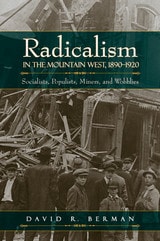
Radicalism in the Mountain West, 1890-1920
Socialists, Populists, Miners, and WobbliesDavid R. Berman
University Press of Colorado, 2013
Focusing on the populist and socialist movements, David R. Berman sheds light on American radicalism with this study of a region that epitomized its rise and fall. As the frontier industrialized, self-reliant pioneers and prospectors transformed into wage- laborers for major corporations with government, military, and church ties. Economically and politically stymied, westerners rallied around homegrown radicals such as William "Big Bill" Haywood and Vincent "the Saint" St. John and touring agitators such as Eugene Debs and Mary "Mother" Jones. Radicalism in the Mountain West tells how volleys of strikes, property damage, executions, and deportations ensued in the absence of negotiation.
Drawing on years of archival research and diverse materials such as radical newspapers, reports filed by labor spies and government agents, and records of votes, subscriptions, and memberships, Berman offers Western historians and political scientists an unprecedented view into the region's radical past.

Radicalism in the States
The Minnesota Farmer-Labor Party and the American Political EconomyRichard M. Valelly
University of Chicago Press, 1989
Richard M. Valelly treats in detail the political economy of the Minnesota Farmer-Labor Party (1918-1944), the most successful radical, state-level party in American history. With the aid of numerous interviews of surviving organizers and participants in the party's existence, Valelly recreates the party's rise to power and subsequent decline, seeking answers to some broad, developmental questions. Why did this type of politics arise, and why did it collapse when it did? What does the party's history tell us about national political change? The answers lie, Valelly argues, in America's transition from the political economy of the 1920s to the New Deal. Combining case study and comparative state politics, he reexamines America's political economy prior to the New Deal and the scope and ironies of the New Deal's reorganization of American politics. The results compellingly support his argument that the federal government's increasing intervention in the economy profoundly transformed state politics. The interplay between national economy policy-making and federalism eventually reshaped the dynamics of interest-group politics and closed off the future of "state-level radicalism." The strength of this argument is highlighted by Valelly's cross-national comparison with Canadian politics. In vivid contrast to the fate of American movements, "province level radicalism" thrived in the Canadian political environment.
In the course of analyzing one of the "supressed alternatives" of American politics, Valelly illuminates the influence of the national political economy on American political development. Radicalism in the States will interest students of economic protest, of national policy-making, of interest-group politics and party politics.
Radicalizing Men
Fascist Desires, Great Replacement Propaganda, and Political ViolenceJessica Johnson
Duke University Press, 2026
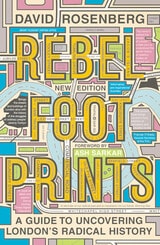
Rebel Footprints
A Guide to Uncovering London's Radical HistoryDavid Rosenberg
Pluto Press, 2019
If you visit London, and you’ve only experienced Buckingham Palace, The Tower of London, and The Millennium Wheel, you’ve missed the true essence of London, and its politically-charged, rebellious history. A truly radical response to conservative heritage tours and banal day trips, Rebel Footprints brings to life the history of social movements in England's capital by providing lively commentary, maps, and walking tours you will not find anywhere else.
David Rosenberg transports readers from well-known landmarks to history-making hidden corners, while telling the story of protest and struggle in London from the early nineteenth to the mid-twentieth century.
From the suffragettes to the socialists, from the chartists to the trade unionists: Rosenberg invites us to step into the footprints of a diverse cast of dedicated fighters for social justice. Individual chapters highlight particular struggles and their participants, from famous faces to lesser-known luminaries. Chapters include:
*Writers and Rioters in the Fleet Street Precinct
*Trailblazers for Democracy in Clerkenwell Green
*The Spark of Rebellion in Bow
*Coming in from the Cold: Immigrant Agitators and Radicals in Spitalfields
*No Gods, No Masters: Radical Bloomsbury
*Life on the Boundary: Fighting for Housing in Bethnal Green and Shoreditch
*Stirrings from the South: The Battersea Four
*peaking Truth to Power: Suffragettes and Westminster
*Not Afraid of the Prison Walls: Rebel Women and Men of Poplar
*People's Power in Bermondsey
Rebel Footprints sets London's radical campaigners against the backdrop of the city's multi-faceted development. Self-directed walks pair with narratives that seamlessly blend history, politics, and geography, while specially commissioned maps and illustrations immerse the reader in the story of the city.
Whether you're visiting London for the first time, or born and raised there, Rosenberg invites you to see London as you never have before—the radical center of the English-speaking world.
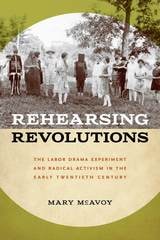
Rehearsing Revolutions
The Labor Drama Experiment and Radical Activism in the Early Twentieth CenturyMary McAvoy
University of Iowa Press, 2019
Choice Outstanding Academic Title, 2019
George Freedley Memorial Award Finalist, 2020
Between the world wars, several labor colleges sprouted up across the U.S. These schools, funded by unions, sought to provide members with adult education while also indoctrinating them into the cause. As Mary McAvoy reveals, a big part of that learning experience centered on the schools’ drama programs. For the first time, Rehearsing Revolutions shows how these left-leaning drama programs prepared American workers for the “on-the-ground” activism emerging across the country. In fact, McAvoy argues, these amateur stages served as training grounds for radical social activism in early twentieth-century America.Using a wealth of previously unpublished material such as director’s reports, course materials, playscripts, and reviews, McAvoy traces the programs’ evolution from experimental teaching tool to radically politicized training that inspired overt—even militant—labor activism by the late 1930s. All the while, she keeps an eye on larger trends in public life, connecting interwar labor drama to post-war arts-based activism in response to McCarthyism, the Cold War, and the Civil Rights movement. Ultimately, McAvoy asks: What did labor drama do for the workers’ colleges and why did they pursue it? She finds her answer through several different case studies in places like the Portland Labor College and the Highlander Folk School in Tennessee.
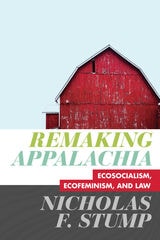
Remaking Appalachia
Ecosocialism, Ecofeminism, and LawNicholas F. Stump
West Virginia University Press, 2021
Environmental law has failed spectacularly to protect Appalachia from the ravages of liberal capitalism, and from extractive industries in particular. Remaking Appalachia chronicles such failures, but also puts forth hopeful paths for truly radical change.
Remaking Appalachia begins with an account of how, over a century ago, laws governing environmental and related issues proved fruitless against the rising power of coal and other industries. Key legal regimes were, in fact, explicitly developed to support favored industrial growth. Aided by law, industry succeeded in maximizing profits not just through profound exploitation of Appalachia’s environment but also through subordination along lines of class, gender, and race. After chronicling such failures and those of liberal development strategies in the region, Stump explores true system change beyond law “reform.” Ecofeminism and ecosocialism undergird this discussion, which involves bottom-up approaches to transcending capitalism that are coordinated from local to global scales.
Resist the Punitive State
Grassroots Struggles Across Welfare, Housing, Education and PrisonsEmily Luise Hart
Pluto Press, 2019

Resist the Punitive State
Grassroots Struggles Across Welfare, Housing, Education and PrisonsEmily Luise Hart
Pluto Press, 2019
Resisting State Violence
Radicalism, Gender, and Race in U.S. CultureJoy James
University of Minnesota Press, 1996
An incendiary critique of contemporary American society that also offers concrete solutions for the dilemmas facing progressive politics.
As the political climate of the United States moves rightward, effective and visionary voices from the left become both rarer and more essential. In Resisting State Violence, African American scholar-activist Joy James provides such a voice. Taking the convergence of race, gender, and class as fundamental trajectories, James offers a stimulating and iconoclastic account of a world in which the United States functions as the political-police center.
At its core, Resisting State Violence is about the many ways the current structure of American government and society is inimical to human rights. James examines the prevalence of racist violence in U.S. policies, making provocative connections between seemingly disparate themes and events, and always, insistently, linking global and U.S. domestic politics. She creates a picture of a nation that consistently uses dehumanization to normalize and rationalize violence in foreign policy, all the while creating a domestic climate that pathologizes blackness and sexuality, portraying those most vulnerable to violence as its carriers. In the systematic and ubiquitous nature of state violence, however, James sees a possibility of hope in the building of coalitions across race, class, gender, and national divides. She argues that the very commonality that makes the system seem so overpowering can serve as the basis for resistance-that the elements that hold together a web of oppression and misuse of power also mark its vulnerabilities, especially when confronted with an equally systematic resistance. James offers concrete solutions for the dilemmas facing progressive politics and the individuals who work to achieve social justice. Resisting State Violence is a clear-sighted and uncompromising guidebook for those who want to understand the forces that hinder social change, and to effectively move beyond them.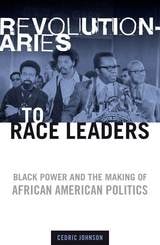
Revolutionaries to Race Leaders
Black Power and the Making of African American PoliticsCedric Johnson
University of Minnesota Press, 2007
The Black Power movement represented a key turning point in American politics. Disenchanted by the hollow progress of federal desegregation during the 1960s, many black citizens and leaders across the United States demanded meaningful self-determination. The popular movement they created was marked by a vigorous artistic renaissance, militant political action, and fierce ideological debate.
Exploring the major political and intellectual currents from the Black Power era to the present, Cedric Johnson reveals how black political life gradually conformed to liberal democratic capitalism and how the movement’s most radical aims—the rejection of white aesthetic standards, redefinition of black identity, solidarity with the Third World, and anticapitalist revolution—were gradually eclipsed by more moderate aspirations. Although Black Power activists transformed the face of American government, Johnson contends that the evolution of the movement as a form of ethnic politics restricted the struggle for social justice to the world of formal politics.
Johnson offers a compelling and theoretically sophisticated critique of the rhetoric and strategies that emerged in this period. Drawing on extensive archival research, he reinterprets the place of key intellectual figures, such as Harold Cruse and Amiri Baraka, and influential organizations, including the African Liberation Support Committee, the National Black Political Assembly, and the National Black Independent Political Party in postsegregation black politics, while at the same time identifying the contradictions of Black Power radicalism itself.
Documenting the historical retreat from radical, democratic struggle, Revolutionaries to Race Leaders ultimately calls for the renewal of popular struggle and class-conscious politics.
Cedric Johnson is assistant professor of political science at Hobart and William Smith Colleges.
Revolutionary Social Change in Colombia
The Origin and Direction of the FARC-EPJames J. Brittain
Pluto Press, 2010
This book presents an insider's account of Columbia's internal conflict. At the forefront are the Revolutionary Armed Forces of Colombia-People's Army (FARC-EP).
Although they are one of the most powerful military forces in Latin American history, little is known about the FARC-EP. James J. Brittain explains where and why this political military movement came into existence and assesses whether the methods employed by the insurgency have the potential to free those marginalised in Colombia.
As democratic socialism develops in Venezuela and Bolivia, Brittain's fascinating study assesses the relevance of armed struggle to 21st century Latin American politics. This is an essential title for those wishing to develop a full understanding of the continent.
By evaluating the FARC-EP's actions, ideological construction, and their theoretical placement, the book gauges how this guerrilla movement relates to revolutionary theory and practice and through what tangible mechanisms, if any, they are creating a new Colombia.
Righteous Sisterhood
The Politics and Power of an All-Women's Motorcycle ClubSarah L. Hoiland
Temple University Press, 2025
Granted unprecedented access to the MC’s initiation rituals, annual ceremonies, and the extensive socialization process, Hoiland investigates this fascinating subculture, why women choose to join, and why, in some cases, they exit or become exiled.
Righteous Sisterhood also reveals complex and contradictory gender and political dynamics within the club and within the larger subculture. The MC provides a unique, liberatory, womanist space within the larger male-dominated MC social world, but these women remain outsiders, with political voices that are lost in the misogyny of alt-right spaces. As Hoiland emphasizes, the quest for righteous sisterhood is about finding individual excellence and camaraderie while seeking recognition and immortality within the MC.