Results by title
57 books match the query 'Realism in literature' and 9 start with r
Reading Capitalist Realism
Alison Shonkwiler and Leigh Claire LaBerge
University of Iowa Press, 2014
Reading Capitalist Realism presents some of the latest and most sophisticated approaches to the question of the relation between capitalism and narrative form, partly by questioning how the “realism” of austerity, privatization, and wealth protection relate to the realism of narrative and cultural production. Even as critics have sought to locate a new aesthetic mode that might consider and move beyond theorizations of the postmodern, this volume contends that narrative realism demands renewed scrutiny for its ability to represent capitalism’s latest scenes of enclosure and indebtedness.
Ranging across fiction, nonfiction, television, and film, the essays collected here explore to what extent realism is equipped to comprehend and historicize our contemporary economic moment and what might be the influence or complicity of the literary in shaping the global politics of lowered expectations. Including essays on writers such as Mohsin Hamid, Lorrie Moore, Jess Walter, J. M. Coetzee, James Kelman, Ali Smith, Russell Banks, William Vollmann, and William Gibson, as well as examinations of Hollywood film productions and The Wire television series, Reading Capitalist Realism calls attention to a resurgence of realisms across narrative genres and questions realism’s ability to interrogate the crisis-driven logic of political and economic “common sense.”

Realism and Naturalism in Nineteenth-Century American Literature, Revised Edition
Donald Pizer
Southern Illinois University Press, 1984
The 1966 edition of this book has become a standard work. In this new, revised edition, Pizer has dropped three chapters and has refined and extended the work by adding six: “American Literary Naturalism: An Approach Through Form,” “American Literary Naturalism: The Example of Dreiser,” “The Problem of Philosophy in the Naturalistic Novel,” “Hamlin Garland’s 1891 Main-Travelled Roads: Local Color as Art,” “Jack London: The Problem of Form,” and “Dreiser’s ‘Nigger Jeff’: The Development of an Aesthetic.”
The book contains definitions of realism and naturalism based on representative novels of the period ranging from Howells’ Rise of Silas Lapham to Crane’s Red Badge of Courage; analyses of the literary criticism of the age, stressing that of Howells, Garland, and Norris; and close readings of specific works by major figures of the period.
Realism and the American Dramatic Tradition
William W. Demastes
University of Alabama Press, 1996
This book reconsiders realism on the American stage by addressing the great variety and richness of the plays that form the American theatre canon.
Any review of 20th-century American theatre invariably leads to the term realism. Yet despite the strong tradition of theatrical realism on the American stage, the term is frequently misidentified, and the practices to which it refers are often attacked as monolithically tyrannical, restricting the potential of the American national theatre.This book reconsiders realism on the American stage by addressing the great variety and richness of the plays that form the American theatre canon. By reconsidering the form and revisiting many of the plays that contributed to the realist tradition, the authors provide the opportunity to apprise strengths often overlooked by previous critics. The volume traces the development of American dramatic realism from James A. Herne, the "American Ibsen," to currently active contemporaries such as Sam Shepard, David Mamet, and Marsha Norman. This frank assessment, in sixteen original essays, reopens a critical dialog too long closed.
Essays include:
American Dramatic Realisms, Viable Frames of Thought
The Struggle for the Real--Interpretive Conflict, Dramatic Method, and the Paradox of Realism
The Legacy of James A. Herne: American Realities and Realisms
Whose Realism? Rachel Crothers's Power Struggle in the American Theatre
The Provincetown Players' Experiments with Realism
Servant of Three Masters: Realism, Idealism, and "Hokum" in American High Comedy
Realism's Empire
Empiricism and Enchantment in the Nineteenth-Century NovelGeoffrey Baker
The Ohio State University Press, 2009
Realism, Writing, Disfiguration
On Thomas Eakins and Stephen CraneMichael Fried
University of Chicago Press, 1987
"An extraordinary achievement of scholarship and critical analysis. It is a book distinguished not only for its brilliance but for its courage, its grace and wit, its readiness to test its arguments in tough-minded ways, and its capacity to meet the challenge superbly. . . . This is a landmark in American cultural and intellectual studies."—Sacvan Bercovitch, Harvard University
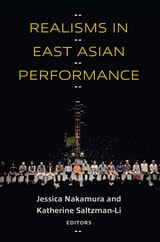
Realisms in East Asian Performance
Jessica Nakamura and Katherine Saltzman-Li, Editors
University of Michigan Press, 2023
Existing scholarly discussions of theatrical realism have been predominantly limited to 19th-century European and Russian theater, with little attention paid to wider explorations and alternative definitions of the practice. Examining theater forms and artists from China, Japan, and Korea, Realisms in East Asian Performance brings together a group of theater historians to reconsider realism through the performing arts of East Asia.
The book’s contributors emphasize trans-regional conversations and activate inter-Asian dialogues on theatrical production. Tracing historical trajectories, starting from premodern periods through today, the book seeks to understand realisms’ multiple origins, forms, and cultural significances, and examines their continuities, disruptions, and divergences. In its diversity of topics, geographic locations, and time periods, Realisms in East Asian Performance aims to globalize and de-center the dominant narratives surrounding realism in theater, and revise assumptions about the spectacular and theatrical forms of Asian performance. Understanding realism as a powerful representational style, chapters collectively reevaluate acts of representation on stage not just for East Asia, but for theater and performance studies more broadly.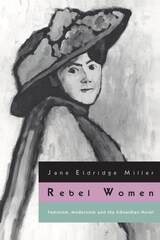
Rebel Women
Feminism, Modernism and the Edwardian NovelJane Eldridge Miller
University of Chicago Press, 1996
"Miller's is the best account we have, not only of Edwardian women novelists, but of early 20th-century women novelists; the measure of her achievement is that the distinction no longer seems workable." —David Trotter, The London Review of Books
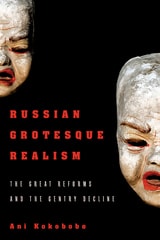
Russian Grotesque Realism
The Great Reforms and the Gentry DeclineAni Kokobobo
The Ohio State University Press, 2018
Russian Grotesque Realism: The Great Reforms and the Gentry Decline offers a comprehensive reevaluation of the Russian realist novel and proposes that a composite style, “grotesque realism,” developed in response to social upheaval during the post-Reform era. In this compelling new study, Ani Kokobobo argues that if the realism of pre-Reform Russia could not depict socioeconomic change directly, the grotesque provided an indirect means for Russian writers to capture the instability of the times and the decline of the gentry. While realism historically represented the psychological depth of characters, the grotesque focused more on the body, materialism, and categorical confusions in order to depict characters whose humanity had eroded.
With original readings of some of Russian realism’s greatest novels, Anna Karenina, Demons, and Brothers Karamazov, as well as lesser known novels like The Family Golovlev, The Precipice, Resurrection, and Cathedral Folk, Russian Grotesque Realism traces the transformation of gentry representation from spiritual strivers and thinkers to more materialist beings. By the end of the nineteenth century, the gentry, originally seen as society’s preservers, were represented as grotesque, reflecting a broader societal breakdown that would eventually precipitate the end of the novel genre itself.
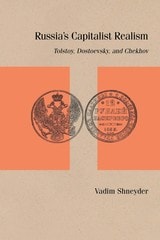
Russia’s Capitalist Realism
Tolstoy, Dostoevsky, and ChekhovVadim Shneyder
Northwestern University Press, 2021
Russia’s Capitalist Realism examines how the literary tradition that produced the great works of Leo Tolstoy, Fyodor Dostoevsky, and Anton Chekhov responded to the dangers and possibilities posed by Russia’s industrial revolution. During Russia’s first tumultuous transition to capitalism, social problems became issues of literary form for writers trying to make sense of economic change. The new environments created by industry, such as giant factories and mills, demanded some kind of response from writers but defied all existing forms of language.
This book recovers the rich and lively public discourse of this volatile historical period, which Tolstoy, Dostoevsky, and Chekhov transformed into some of the world’s greatest works of literature. Russia’s Capitalist Realism will appeal to readers interested in nineteenth‑century Russian literature and history, the relationship between capitalism and literary form, and theories of the novel.