Results by title
4743 books match the query 'Religion' and 288 start with r
RIGHTEOUS INDIGNATION
Religion and the Populist RevolutionJoe Creech
University of Illinois Press, 2010
This illuminating study shows how Populists wove their political and economic reforms into a grand cosmic narrative pitting the forces of God and democracy against those of Satan and tyranny, and energizing their movement with a sacred sense of urgency. This book also unpacks the southern Protestants’ complicated approach to political and economic questions, as well as addressing broader issues about protest movements, race relations, and the American South.
Rabbi Esriel Hildesheimer and the Creation of a Modern Jewish Orthodoxy
David Ellenson
University of Alabama Press, 1990
Tradition, Modernity, and the Making of Modern Orthodoxy.
For many histories of Modern Orthodox Judaism, Rabbi Samson Raphael Hirsch stands as the primary architect of the movement's encounter with modernity. In Rabbi Esriel Hildesheimer and the Creation of a Modern Jewish Orthodoxy, distinguished scholar David Ellenson expands that narrative by recovering the life, thought, and enduring influence of one of Hirsch's most important contemporaries. Through a careful examination of Rabbi Esriel Hildesheimer's writings, leadership, educational initiatives, and responses to the social and intellectual challenges of nineteenth-century Europe, Ellenson demonstrates how Hildesheimer helped forge a model of Orthodoxy that remained firmly committed to Jewish tradition while engaging constructively with the modern world.
Set against a period of profound cultural, political, and religious transformation, this volume explores the tensions confronting European Jewry as modernization, secular education, religious pluralism, and changing political realities reshaped Jewish communal life. Ellenson shows how Hildesheimer addressed these challenges not through rigid isolation but through a pragmatic and intellectually sophisticated approach that balanced fidelity to halakhah with openness to selected aspects of modern culture and scholarship. His vision helped establish a framework for Modern Orthodoxy that continues to influence contemporary Jewish thought and practice.
Beyond its biographical focus, the study provides broader insights into the emergence of Modern Orthodoxy as a religious and intellectual movement. By illuminating Hildesheimer's efforts to integrate traditional scholarship with contemporary realities, Ellenson offers readers a deeper understanding of how Judaism has negotiated the relationship between heritage and change. The result is both a compelling portrait of an influential rabbinic figure and an important examination of the forces that shaped modern Jewish religious identity.
Rabbi Esriel Hildesheimer and the Creation of a Modern Jewish Orthodoxy is essential reading for scholars and students of Jewish studies, religious studies, theology, European history, intellectual history, and modern Judaism. It will also appeal to rabbis, educators, and general readers seeking to understand the historical roots of contemporary Orthodox Jewish life and the ongoing dialogue between tradition and modernity.
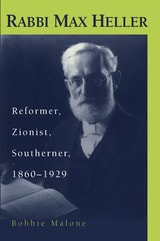
Rabbi Max Heller
Reformer, Zionist, Southerner, 1860-1929Barbara S. Malone
University of Alabama Press, 1997
Max Heller was a man of both passionate conviction and inner contradiction. He sought to be at the center of current affairs, not as a spokesperson of centrist opinion, but as an agitator or mediator, constantly struggling to find an acceptable path as he confronted the major issues of the day--racism and Jewish emancipation in eastern Europe, nationalism and nativism, immigration and assimilation. Heller's life experience provides a distinct vantage point from which to view the complexity of race relations in New Orleans and the South and the confluence of cultures that molded his development as a leader. A Bohemian immigrant and one of the first U.S.-trained rabbis, Max Heller served for 40 years as spiritual leader of a Reform Jewish congregation in New Orleans--at that time the largest city in the South. Far more than a congregational rabbi, Heller assumed an activist role in local affairs, Reform Judaism, and the Zionist movement, maintaining positions often unpopular with his neighbors, congregants, and colleagues. His deep concern for social justice led him to question two basic assumptions that characterized his larger social milieu--segregation and Jewish assimilation.
Heller, a consummate Progressive with clear vision and ideas substantially ahead of their time, led his congregation, his community, Reform Jewish colleagues, and Zionist sympathizers in a difficult era.
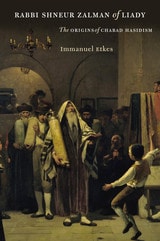
Rabbi Shneur Zalman of Liady
The Origins of Chabad HasidismImmanuel Etkes
Brandeis University Press, 2014

Rabbi's Manual
David Polish
Central Conference of American Rabbis, 1988
Rabbinic Authority
Elliot L. Stevens
Central Conference of American Rabbis, 1982
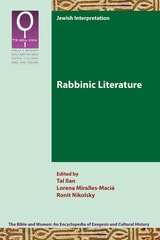
Rabbinic Literature
Tal Ilan
SBL Press, 2022
This volume in the Bible and Women series is devoted to rabbinic literature from late Jewish antiquity to the early Middle Ages. Fifteen contributions feature different approaches to the question of biblical women and gender and encompass a wide variety of rabbinic corpora, including the Mishnah-Tosefta, halakhic and aggadic midrashim, Talmud, and late midrash. Some essays analyze biblical law and gender relations as they are reflected in the rabbinic sages’ argumentation, while others examine either the rabbinic portrayal of a certain woman or a group of women or the role of biblical women in a specific rabbinic context. Contributors include Judith R. Baskin, Yuval Blankovsky, Alexander A. Dubrau, Cecilia Haendler, Tal Ilan, Gail Labovitz, Moshe Lavee, Lorena Miralles-Maciá, Ronit Nikolsky, Susanne Plietzsch, Natalie C. Polzer, Olga I. Ruiz-Morell, Devora Steinmetz, Christiane Hannah Tzuberi, and Dvora Weisberg.
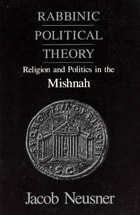
Rabbinic Political Theory
Religion and Politics in the MishnahJacob Neusner
University of Chicago Press, 1991
Neusner begins his study with a modification of Weber's categories for a theory of politics: myth, institutions, administration, passion, responsibility, and proportion. Detailing the Mishnah's conception of politics, Neusner considers what he calls the stable and static structure and system through comparison with Aristotle. Although Aristotle's Politics and the Mishnah share a common economic theory based on the fundamental unit of the householder, they diverge in their conceptions of political structure and order. Aristotle embeds economics within political economy, while, Neusner argues, the Mishnah presents the anomaly of an economics separated from politics.
Using modern political terms, this study explicates the complicated politics developed by the philosopher-theologians of the Mishnah. It is a first-rate contribution to our understanding of the intersection of politics, political philosophy, and the Mishnaic system.
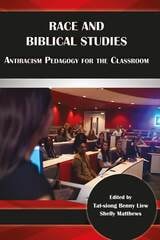
Race and Biblical Studies
Antiracism Pedagogy for the ClassroomTat-siong Benny Liew
SBL Press, 2022
Classrooms as communities are temporary, but the racial effects can be long term.
The biblical studies classroom can be a site of personal and social transformation. To make it a space for positive change, the contributors to this volume question and reevaluate traditional teaching practices and assessment tools that foreground white, Western scholarship in order to offer practical guidance for an antiracist pedagogy. The introduction and fifteen essays provide tools for engaging issues of social context and scriptural authority, nationalism and religious identities, critical race theory, and how race, gender, and class can be addressed empathetically. Contributors Sonja Anderson, Randall C. Bailey, Eric D. Barreto, Denise Kimber Buell, Greg Carey, Haley Gabrielle, Wilda C. Gafney, Julián Andrés González Holguín, Sharon Jacob, Tat-siong Benny Liew, Francisco Lozada Jr., Shelly Matthews, Roger S. Nam, Wongi Park, Jean-Pierre Ruiz, Abraham Smith, and Kay Higuera Smith share their experience creating classrooms that are spaces that enable the production of new knowledge without reproducing a white subject of the geopolitical West.
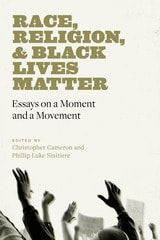
Race, Religion, and Black Lives Matter
Essays on a Moment and a MovementChristopher Cameron
Vanderbilt University Press, 2021
This volume has a simple, but far-reaching argument: religion is an important thread in BLM. To advance this claim, Race, Religion, and Black Lives Matter examines religion’s place in the movement through the lenses of history, politics, and culture. While this collection is not exhaustive or comprehensive in its coverage of religion and BLM, it selectively anthologizes unique aspects of Black religious history, thought, and culture in relation to political struggle in the contemporary era. The chapters aim to document historical change in light of current trends and current events. The contributors analyze religion and BLM in a current historical moment fraught with aggressive, fascist, authoritarian tendencies and one shaped by profound ingenuity, creativity, and insightful perspectives on Black history and culture.
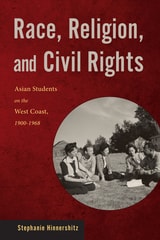
Race, Religion, and Civil Rights
Asian Students on the West Coast, 1900-1968Hinnershitz, Stephanie
Rutgers University Press, 2015
Stephanie Hinnershitz tells the story of the Asian American campus organizations that flourished on the West Coast from the 1900s through the 1960s. Using their faith to point out the hypocrisy of fellow American Protestants who supported segregation and discriminatory practices, the student activists in these groups also performed vital outreach to communities outside the university, from Californian farms to Alaskan canneries. Highlighting the unique multiethnic composition of these groups, Race, Religion, and Civil Rights explores how the students' interethnic activism weathered a variety of challenges, from the outbreak of war between Japan and China to the internment of Japanese Americans during World War II.
Drawing from a variety of archival sources to bring forth the authentic, passionate voices of the students, Race, Religion, and Civil Rights is a testament to the powerful ways they served to shape the social, political, and cultural direction of civil rights movements throughout the West Coast.
Rachel's Daughters
Newly Orthodox Jewish WomenKaufman, Debra Renee
Rutgers University Press, 1991
Debra Kaufman writes about ba'alot teshuva women who have returned to Orthodox Judaism, a form of Judaism often assumed to be oppressive to women. She addresses many of the most challenging issues of family, feminism, and gender. Why, she asks, have these women chosen an Orthodox lifestyle? What attracts young, relatively affluent, well-educated, and highly assimilated women to the most traditional, right-wing, patriarchal, and fundamentalist branch of Judaism? The answers she discovers lead her beyond an analysis of religious renewal to those issues all women and men confront in public and private life.
Kaufman interviewed and observed 150 ba'alot teshuva. She uses their own stories, in their own words, to show us how they make sense of the choices they have made. Lamenting their past pursuit of individual freedom over social responsibility, they speak of searching for shared meaning and order, and finding it in orthodoxy.
The laws and customs of Orthodox Judaism have been formulated by men, and it is men who enforce those laws and control the Orthodox community. The leadership is dominated by men. But the women do not experience theologically-imposed subordination as we might expect. Although most ba'alot teshuva reject feminism or what they perceive as feminism, they maintain a gender consciousness that incorporates aspects of feminist ideology, and often use feminist rhetoric to explain their lives.
Kaufman does not idealize the ba'alot teshuva world. Their culture does not accommodate the non-Orthodox, the homosexual, the unmarried, the divorced. Nor do the women have the mechanisms or political power to reject what is still oppressive to them. They must live within the authority of a rabbinic tradition and social structure set by males. Like other religious right women, their choices reinforce authoritarian trends current in today's society. Rachel's Daughters provides a fascinating picture of how newly orthodox women perceive their role in society as more liberating than oppressive.
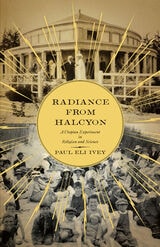
Radiance from Halcyon
A Utopian Experiment in Religion and SciencePaul Eli Ivey
University of Minnesota Press, 2013
In May 1904, the residents of Halcyon—a small utopian community on California’s central coast—invited their neighbors to attend the grand opening of the Halcyon Hotel and Sanatorium. As part of the entertainment, guests were encouraged to have their hands X-rayed. For the founders and members of Halcyon, the X-ray was a demonstration of mysterious spiritual forces made practical to human beings.
Radiance from Halcyon is the story not only of the community but also of its uniquely inventive members’ contributions to religion and science. The new synthesis of religion and science attempted by Theosophy laid the foundation for advances produced by the children of the founding members, including microwave technology and atomic spectral analysis. Paul Eli Ivey’s narrative starts in the 1890s in Syracuse, New York, with the rising of the Temple of the People, a splinter group of the theosophical movement. After developing its ideals for an agricultural and artisanal community, the Temple purchased land in California and in 1903 began to live its dream there.
In addition to an intriguing account of how a little-known utopian religious community profoundly influenced modern science, Ivey offers a wide-ranging cultural history, encompassing Theosophy, novel healing modalities, esoteric architecture, Native American concepts of community, socialist utopias, and innovative modern music.
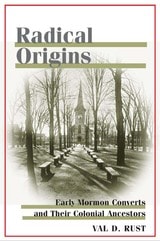
Radical Origins
Early Mormon Converts and Their Colonial AncestorsVal D. Rust
University of Illinois Press, 2004
Utilizing a unique set of meticulously compiled genealogical data, Rust uncovers the ancestors of early church members throughout what we understand as the radical segment of the Protestant Reformation. Coming from backgrounds in the Antinomians, Seekers, Anabaptists, Quakers, and the Family of Love, many colonial ancestors of the church(s early members had been ostracized from their communities. Expelled from the Massachusetts Bay Colony, some were whipped, mutilated, or even hanged for their beliefs.
Rust shows how family traditions can be passed down through the generations, and can ultimately shape the outlook of future generations. This, he argues, extends the historical role of Mormons by giving their early story significant implications for understanding the larger context of American colonial history. Featuring a provocative thesis and stunning original research, Radical Origins is a remarkable contribution to our understanding of religion in the development of American culture and the field of Mormon history.
Radical Poetics and Secular Jewish Culture
Edited by Stephen Paul Miller and Daniel Morris
University of Alabama Press, 2009
--Franz Kafka
Kafka's quip--paradoxical, self-questioning, ironic--highlights vividly some of the key issues of identity and self-representation for Jewish writers in the 20th century. No group of writers better represents the problems of Jewish identity than Jewish poets writing in the American modernist tradition--specifically secular Jews: those disdainful or suspicious of organized religion, yet forever shaped by those traditions.
This collection of essays is the first to address this often obscured dimension of modern and contemporary poetry: the secular Jewish dimension. Editors Daniel Morris and Stephen Paul Miller asked their contributors to address what constitutes radical poetry written by Jews defined as "secular," and whether or not there is a Jewish component or dimension to radical and modernist poetic practice in general. These poets and critics address these questions by exploring the legacy of those poets who preceded and influenced them--Stein, Zukofsky, Reznikoff, Oppen, and Ginsberg, among others.
While there is no easy answer for these writers about what it means to be a Jew, in their responses there is a rich sense of how being Jewish reflects on their aesthetics and practices as poets, and how the tradition of the avant-garde informs their identities as Jews. Fragmented identities, irony, skepticism, a sense of self as "other" or "outsider," distrust of the literal, and belief in a tradition that questions rather than answers--these are some of the qualities these poets see as common to themselves, the poetry they make, and the tradition they work within.

Radical Tragedy
Religion, Ideology and Power in the Drama of Shakespeare and His ContemporariesJonathan Dollimore
Duke University Press, 2004
Radicalizing Men
Fascist Desires, Great Replacement Propaganda, and Political ViolenceJessica Johnson
Duke University Press, 2026
Rage and Carnage in the Name of God
Religious Violence in NigeriaAbiodun Alao
Duke University Press, 2022

Rainer Maria Rilke
Das Marien-LebenRainer Maria Rilke, translated by Christopher Anderson
Bridwell Press, 2025
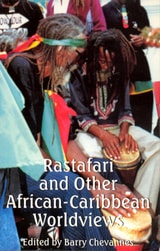
Rastafari & Other African-Caribbean Worldviews
Chevannes, Barry
Rutgers University Press, 1997
Rastafari has been seen as a political organization, a youth movement, and a millenarian cult. This lively collection of papers challenges these categories and offers a "new approach" to the study of Rastafari. Chevannes and his contributors suggest that we can better understand Rastafari-and Caribbean culture, for that matter-by seeing the movement as both a departure from and a continuance of Revivalism, an African-Caribbean folk religion. By linking Rastafari to Revival, we can enrich our understanding of an African-Caribbean worldview, and we can appreciate Rastafari not only as a political force but as a powerful expression of African-Caribbean culture and tradition.
Barry Chevannes provides a concise overview of Rastafari and Revivalism and clearly lays out the volume's "new approach." Leading scholars of Rastafari illustrate and develop the theme with chapters on Rastafari as resistance, the origin of the dreadlocks, Rastafari and language, women in African-Caribbean religions and more. With chapters that range from the specific to the general, this volume will be important to specialists of Caribbean religion and the African diaspora and to those with a burgeoning interest in Rastafari.
The contributors include Jean Besson, Ellis Cashmore, Barry Chevannes, John P. Homiak, Roland Littlewood, H.U.E Thoden van Velzen, and Wilhelmina van Wetering.
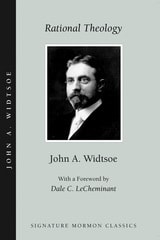
Rational Theology
John A. Widtsoe
Signature Books, 1998
In keeping with the times, it is not surprising that former professor of chemistry and university president John A. Widtsoe was called to the LDS Quorum of Twelve Apostles in 1921. An inheritor and promoter of “reasonable” religion, his popular book, Joseph Smith as Scientist, and his influential LDS Melchizedek priesthood manual (later released as a book), Rational Theology, underscored his and other Mormon leaders’ positivist assumptions about the world—that science was good, that Mormonism would be proven true, and, drawing from Herbert Spencer’s application of evolution to ethics, that society would be perfected.
Like Widtsoe’s secular books (published nationally and internationally by Macmillan, Webb, and J. Wiley & Sons), Rational Theology would enjoy multiple printings domestically and several foreign translations. Although his other church writings (Evidences and Reconciliations, The Gospel in the Service of Man, Guide Posts to Happiness: The Right to Personal Satisfaction, and others) proved to be influential, none so thoroughly summarized his embrace of science and Mormonism as Rational Theology.
John Andreas Widtsoe was born in Dalöe, Island of Fröyen, Norway, in 1872. He immigrated to Utah in 1883 and graduated from Brigham Young College in 1891 and from Harvard with high honors in 1894. Widtsoe married Leah Eudora Dunford, daughter of Susa Young Gates, in 1898 and had seven children. In 1899 he was awarded a Ph.D. with high honors from the University of Göttingen, Germany. He both taught at and served as president of Utah State Agricultural College and the University of Utah. He was elected to the Victoria Institute in England, an honor received by only one other Mormon scholar—James E. Talmage. Widtsoe served as editor of the Improvement Era and wrote more than thirty books, including religious, autobiographical, and professional publications. His essay on LDS temple worship has been included in the new edition of The House of the Lord: A Study of Holy Sanctuaries Ancient and Modern. He was an apostle from 1921 until his death in 1952.
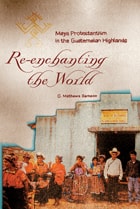
Re-Enchanting the World
Maya Protestantism in the Guatemalan HighlandsC. Mathews Samson
University of Alabama Press, 2007
Christian evangelicals among native people in Latin America.
What does it mean to be both Maya and Protestant in Guatemala? Burgeoning religious pluralism in Mesoamerica and throughout Latin America is evident as Protestantism permeates a region that had been overwhelmingly Catholic for nearly five centuries.
In considering the interplay between contemporary Protestant practice and native cultural traditions among Maya evangelicals, Samson documents the processes whereby some Maya have converted to new forms of Christianity and the ways in which the Maya are incorporating Christianity for their own purposes. At the intersection of religion and cultural pluralism, contemporary evangelicals focus on easing the tension between Maya identity and the Protestant insistence that old ways must be left behind in the conversion process.
Against the backdrop of the 36-year civil war that ended in 1996 and the rise of the indigenous Maya Movement in the late 1980s, this work provides a unique portrait of social movements, cultural and human rights, and the role that religion plays in relation to the nation-state in post-conflict political processes. Re-enchanting the World fills a niche within the anthropological literature on evangelicals in Latin America during a time of significant social change.
Re-Envisioning Past Musical Cultures
Ethnomusicology in the Study of Gregorian ChantPeter Jeffery
University of Chicago Press, 1992
Peter Jeffery offers an innovative new approach for understanding how these melodies were created, memorized, performed, and modified. Drawing on a variety of disciplines, including anthropology and ethnomusicology, he identifies characteristics of Gregorian chant that closely resemble other oral traditions in non-Western cultures and demonstrates ways music historians can take into account the social, cultural, and anthropological contexts of chant's development.
Re-Reading Gregory of Nazianzus
Christoper A. Beeley
Catholic University of America Press, 2012
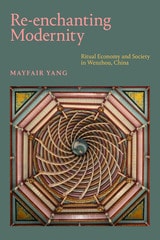
Re-enchanting Modernity
Ritual Economy and Society in Wenzhou, ChinaMayfair Yang
Duke University Press, 2020
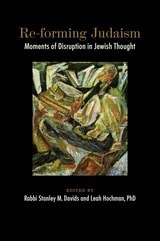
Re-forming Judaism
Moments of Disruption in Jewish ThoughtRabbi Stanley M. Davids and Leah Hochman, PhD
Central Conference of American Rabbis, 2023
Throughout Jewish history, revolutionary events and subversive ideas have burst forth, repeatedly transforming Jewish experience. Re-forming Judaism seeks to explore these ideas—and the individuals behind them—by delving into historical disruptions that led to lasting change in Jewish thought. A distinguished array of scholars take us on a journey from the disruptive prophets of ancient times, through rational, mystical, and extremist medievalists, to the impact of Haskalah and early Reform thought in modernity. Contemporary innovations such as changes in liturgy and music, feminism, and post-Holocaust theology are included, as are insights into Sephardic and North African experiences. By showing how Judaism forms—then re-forms, and re-forms again—the contributors demonstrate that tensions between continuity and change have always been part of Jewish life, helping us to both understand the past and contemplate the future.
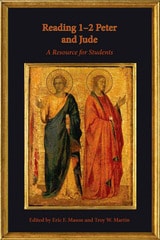
Reading 1-2 Peter and Jude
A Resource for StudentsEric F. Mason
SBL Press, 2014
An essential textbook on 1–2 Peter and Jude for readers of all levels
Scholars engage the best contemporary work on 1–2 Peter and Jude in this student-oriented book. The first four chapters in this collection—on authorship and pseudonymity, literary relationships among the three books, epistolary rhetoric, and apocalyptic elements—consider important, foundational issues related to all three epistles. These essays lay the groundwork for more focused chapters that examine theology and theory in 1 Peter as well a stylistic, theological, and thematic overlap in Jude and 2 Peter.
Features:
- A range of theological, literary, and theoretical approaches
- Definitions for specialized terminology
- Historical and cultural background information
- Explanations of methodologies

Reading Akkadian Prayers and Hymns
An IntroductionAlan Lenzi
SBL Press, 2011
A thorough text for students of ancient Mesopotamian religion and the Hebrew Bible
Alan Lenzi places Akkadian prayers and hymns within both a religious studies perspective and a Mesopotamian studies perspective. Complete with vocabulary glosses, grammatical notes, literary commentary, and comparative suggestions to biblical material, this book provides a crucial tool for accessing ancient texts related to our understanding of the Hebrew Bible.
Features:
- Background essays
- Discussion of classes of Mesopotamian prayers and their comparative use in biblical studies
- Akkadian text, transliteration, translation, and commentary
- Notes on vocabulary and grammar
Alan Lenziis Associate Professor of Hebrew Bible and Ancient Near East at University of the Pacific. He is the author of Secrecy and the Gods: Secret Knowledge in Ancient Mesopotamia and Biblical Israel (Neo-Assyrian Text Corpus Project).
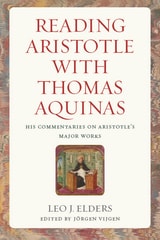
Reading Aristotle with Thomas Aquinas
His Commentaries on Aristotle's Major WorksLeo J. Elders
Catholic University of America Press, 2022
Reading Biblical Texts Together
Pursuing Minoritized Biblical CriticismTat-Siong Benny Liew
SBL Press, 2022
A solid and suggestive foundation for the future of ethnic-racial minority biblical criticism
This volume, edited by Tat-siong Benny Liew and Fernando F. Segovia, expands the work begun in They Were All Together in One Place? Toward Minority Biblical Criticism (2009) by focusing on specific texts for scholarly engagement and exchange. Essays by scholars of racial/ethnic minoritized criticism of the Bible highlight the various factors and dynamics at play in the formation of power relations within and through four biblical texts: two from the Hebrew Bible (Genesis 21 and 1 Kings 12) and two from the New Testament (John 4 and Revelation 18). Contributors include Ahida Calderón Pilarski, Ronald Charles, Stephanie Buckhanon Crowder, Lynne St. Clair Darden, Steed Vernyl Davidson, Mary F. Foskett, Jione Havea, Tat-siong Benny Liew, Roberto Mata, Henry W. Morisada Rietz, Raj Nadella, Miranda N. Pillay, David Arthur Sánchez, Timothy J. Sandoval, Fernando F. Segovia, Mitzi J. Smith, Angeline M. G. Song, Linzie M. Treadway, Nasili Vaka’uta, Demetrius K. Williams, and Gale A. Yee. Each essay expands our understandings of minoritization from a global perspective.
Reading Clocks, Alla Turca
Time and Society in the Late Ottoman EmpireAvner Wishnitzer
University of Chicago Press, 2015
Drawing on a wealth of archival and literary sources, Wishnitzer’s original and highly important work presents the shifting culture of time as an arena in which Ottoman social groups competed for legitimacy and a medium through which the very concept of modernity was defined. Reading Clocks, Alla Turca breaks new ground in the study of the Middle East and presents us with a new understanding of the relationship between time and modernity.
Reading Darwin in Arabic, 1860-1950
Marwa Elshakry
University of Chicago Press, 2013
Reading Death in Ancient Rome
Mario Erasmo
The Ohio State University Press, 2008
Reading Ezra 9-10 Tu'a-wise
Rethinking Biblical Interpretation in OceaniaNasili Vaka'uta
SBL Press, 2011
An alternative approach to biblical interpretation from a Tongan standpoint
In Reading Ezra 9–10 Tu'a-wise, Nasili Vaka'uta establishes a theoretical framework for reading that is informed by Tongan cultural perspectives—in this case the “eye-/I-s” of a Tongan commoner (tu’a). She applies a methodology for analysis of biblical texts based on the established theoretical framework and tests the methodology on Ezra 9–10. The book emphasizes contextualizing the task of biblical interpretation (using contextual or specifically indigenous categories of analysis) rather than contextualizing the Bible (applying the insights from one’s reading to one’s situation).Features
- Oceanic way of reading the Biblical texts
- Critical engagement with contextual biblical interpretation
- Practice-based interpretation
Reading Gender in Judges
An Intertextual ApproachShelley L. Birdsong
SBL Press, 2023
Much of the content of Judges can be understood only when read together with other parts of the Hebrew Bible. Narratives in Judges comment, criticize, and reinterpret other texts from across what became the canon, often by troubling gender, disrupting stereotypical binaries, and creating a kind of gender chaos. This volume brings together gender criticism and intertextuality, methods that logically align with intersectional lenses, to draw attention to how race, ethnicity, class, religion, ability, sex, and sexuality all play a role in how one is gendered in the book of Judges. Contributors Elizabeth H. P. Backfish, Shelley L. Birdsong, Zev Farber, Serge Frolov, Susanne Gillmayr-Bucher, Susan E. Haddox, Hyun Chul Paul Kim, Richard D. Nelson, Pamela J. W. Nourse, Tammi J. Schneider, Joy A. Schroeder, Soo Kim Sweeney, Rannfrid I. Lasine Thelle, J. Cornelis de Vos, Jennifer J. Williams, and Gregory T. K. Wong provide substantial new and significant contributions to the study of gender, the book of Judges, and biblical hermeneutics in general. This volume illustrates why biblical scholars and students need to take the intersectional identities of characters and their intertextual environments seriously.
Reading Job with St. Thomas Aquinas
Matthew Levering
Catholic University of America Press, 2020
Reading John with St. Thomas Aquinas
Theological Exegesis and Speculative TheologyMichael Dauphinais
Catholic University of America Press, 2005
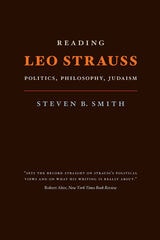
Reading Leo Strauss
Politics, Philosophy, JudaismSteven B. Smith
University of Chicago Press, 2006
Smith asserts that this philosophical skepticism defined Strauss’s thought. It was as a skeptic, Smith argues, that Strauss considered the seemingly irreconcilable conflict between reason and revelation—a conflict Strauss dubbed the “theologico-political problem.” Calling this problem “the theme of my investigations,” Strauss asked the same fundamental question throughout his life: what is the relation of the political order to revelation in general and Judaism in particular? Smith organizes his book with this question, first addressing Strauss’s views on religion and then examining his thought on philosophical and political issues.
In his investigation of these philosophical and political issues, Smith assesses Strauss’s attempt to direct the teaching of political science away from the examination of mass behavior and interest group politics and toward the study of the philosophical principles on which politics are based. With his provocative, lucid essays, Smith goes a long way toward establishing a distinctive form of Straussian liberalism.
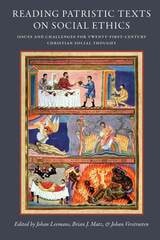
Reading Patristic Texts on Social Ethics
Issues and Challenges for the Twenty-First CenturyJohan Leemans
Catholic University of America Press, 2011
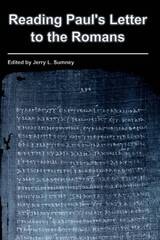
Reading Paul's Letter to the Romans
Jerry L. Sumney
SBL Press, 2012
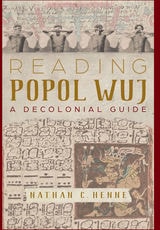
Reading Popol Wuj
A Decolonial GuideNathan C. Henne
University of Arizona Press, 2020
Popol Wujis considered one of the oldest books in the Americas. Various elements of Popol Wuj have appeared in different written forms over the last two millennia and several parts of Popol Wuj likely coalesced in hieroglyphic book form a few centuries before contact with Europeans. Popol Wuj offers a unique interpretation of the Maya world and ways of being from a Maya perspective. However, that perspective is often occluded since the extant Popol Wuj is likely a copy of a copy of a precontact Indigenous text that has been translated many times since the fifteenth century.
Reading Popol Wujoffers readers a path to look beyond Western constructions of literature to engage with this text through the philosophical foundation of Maya thought and culture. This guide deconstructs various translations to ask readers to break out of the colonial mold in approaching this seminal Maya text.
Popol Wuj, or Popol Vuh, in its modern form, can be divided thematically into three parts: cosmogony (the formation of the world), tales of the beings who inhabited the Earth before the coming of people, and chronicles of different ethnic Maya groups in the Guatemala area. Examining thirteen translations of the K’iche’ text, Henne offers a decolonial framework to read between what translations offer via specific practice exercises for reading, studying, and teaching. Each chapter provides a close reading and analysis of a different critical scene based on a comparison of several translations (English and Spanish) of a key K’iche’ word or phrase in order to uncover important philosophical elements of Maya worldviews that resist precise expression in Indo-European languages.
Charts and passages are frontloaded in each chapter so the reader engages in the comparative process before reading any leading arguments. This approach challenges traditional Western reading practices and enables scholars and students to read Popol Wuj—and other Indigenous texts—from within the worldview that created them.
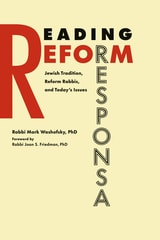
Reading Reform Responsa
Jewish Tradition, Reform Rabbis, and Today's IssuesRabbi Mark Washofsky, PhD
Central Conference of American Rabbis, 2024
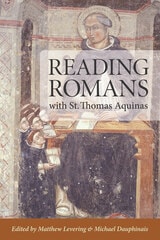
Reading Romans with St. Thomas Aquinas
Matthew Levering
Catholic University of America Press, 2012
Reading Ruth in Asia
Jione Havea
SBL Press, 2015
Reading Women in the New Testament Letters
Korinna Zamfir
SBL Press, 2024
Reading and Teaching Ancient Fiction
Jewish, Christian, and Greco-Roman NarrativesSara R. Johnson
SBL Press, 2018
The third volume of research on ancient fiction
This volume includes essays presented in the Ancient Fiction and Early Christian and Jewish Narrative section of the Society of Biblical Literature. Contributors explore facets of ongoing research into the interplay of history, fiction, and narrative in ancient Greco-Roman, Jewish, and Christian texts. The essays examine the ways in which ancient authors in a variety of genre and cultural settings employed a range of narrative strategies to reflect on pressing contemporary issues, to shape community identity, or to provide moral and educational guidance for their readers. Not content merely to offer new insights, this volume also highlights strategies for integrating the fruits of this research into the university classroom and beyond.
Features
- Insight into the latest developments in ancient Mediterranean narrative
- Exploration of how to use ancient texts to encourage students to examine assumptions about ancient gender and sexuality or to view familiar texts from a new perspective
- Close readings of classical authors as well as canonical and noncanonical Jewish and Christian texts
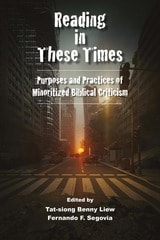
Reading in These Times
Purposes and Practices of Minoritized Biblical CriticismTat-siong Benny Liew
SBL Press, 2024
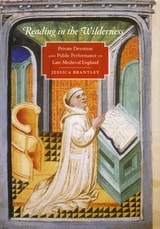
Reading in the Wilderness
Private Devotion and Public Performance in Late Medieval EnglandJessica Brantley
University of Chicago Press, 2007
Drawing on the work of W. J. T. Mitchell, Michael Camille, and others working at the image-text crossroads, Reading in the Wilderness addresses the manuscript’s texts and illustrations to examine connections between reading and performance within the solitary monk’s cell and also outside. Brantley reimagines the medieval codex as a site where the meanings of images and words are performed, both publicly and privately, in the act of reading.
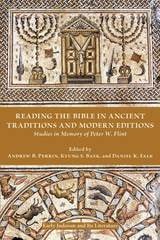
Reading the Bible in Ancient Traditions and Modern Editions
Studies in Memory of Peter W. FlintAndrew B. Perrin
SBL Press, 2017
A collection of essays commemorating the career contributions of Peter W. Flint
An international group of scholars specializing in various disciplines of biblical studies—Dead Sea Scrolls, Septuagint, Hebrew Bible/Old Testament, Second Temple Judaism, and Christian origins—present twenty-seven new contributions that commemorate the career of Peter W. Flint (1951–2016). Each essay interacts with and gives fresh insight into a field shaped by Professor Flint’s life work. Part 1 explores the interplay between text-critical methods, the growth and formation of the Hebrew Scriptures, and the making of modern critical editions. Part 2 maps dynamics of scriptural interpretation and reception in ancient Jewish and Christian literatures of the Second Temple period.
Features
- Essays that assess the state of the field and reflect on the methods, aims, and best practices for textual criticism and the making of modern critical text editions
- Demonstrations of how the processes of scriptural composition, transmission, and reception converge and may be studied together for mutual benefit
- Clarification of the state/forms of scripture in antiquity and how scripture was extended, rewritten, and recontextualized by ancient Jewish and Christian scribes and communities
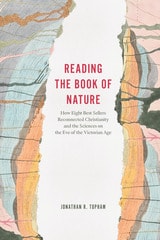
Reading the Book of Nature
How Eight Best Sellers Reconnected Christianity and the Sciences on the Eve of the Victorian AgeJonathan R. Topham
University of Chicago Press, 2022
When Charles Darwin returned to Britain from the Beagle voyage in 1836, the most talked-about scientific books of the day were the Bridgewater Treatises. This series of eight works was funded by a bequest of the last Earl of Bridgewater and written by leading men of science appointed by the president of the Royal Society to explore "the Power, Wisdom, and Goodness of God, as manifested in the Creation." Securing public attention beyond all expectations, the series offered Darwin’s generation a range of approaches to one of the great questions of the age: how to incorporate the newly emerging disciplinary sciences into Britain’s overwhelmingly Christian culture.
Drawing on a wealth of archival and published sources, including many unexplored by historians, Jonathan R. Topham examines how and to what extent the series contributed to a sense of congruence between Christianity and the sciences in the generation before the fabled Victorian conflict between science and religion. Building on the distinctive insights of book history and paying close attention to the production, circulation, and use of the books, Topham offers new perspectives on early Victorian science and the subject of science and religion as a whole.