Results by title
123 books match the query 'Religious life' and 10 start with r
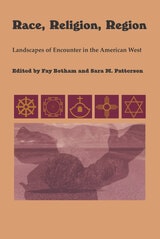
Race, Religion, Region
Landscapes of Encounter in the American WestEdited by Fay Botham and Sara M. Patterson
University of Arizona Press, 2006
This book moves beyond familiar stereotypes to achieve a more nuanced understanding of race while also showing how ethnicity formed in conjunction with religious and regional identity. The chapters demonstrate how religion shaped cultural encounters, contributed to the construction of racial identities, and served as a motivating factor in the lives of historical actors. The opening chapters document how religion fostered community in Los Angeles in the first half of the twentieth century. The second section examines how physical encounters—such as those involving Chinese immigrants, Hermanos Penitentes, and Pueblo dancers—shaped religious and racial encounters in the West. The final essays investigate racial and religious identity among the Latter-day Saints and southern California Muslims. As these contributions clearly show, race, religion, and region are as critical as gender, sexuality, and class in understanding the melting pot that is the West. By depicting the West as a unique site for understanding race and religion, they open a new window on how we view all of America.
Rachel's Daughters
Newly Orthodox Jewish WomenKaufman, Debra Renee
Rutgers University Press, 1991
Debra Kaufman writes about ba'alot teshuva women who have returned to Orthodox Judaism, a form of Judaism often assumed to be oppressive to women. She addresses many of the most challenging issues of family, feminism, and gender. Why, she asks, have these women chosen an Orthodox lifestyle? What attracts young, relatively affluent, well-educated, and highly assimilated women to the most traditional, right-wing, patriarchal, and fundamentalist branch of Judaism? The answers she discovers lead her beyond an analysis of religious renewal to those issues all women and men confront in public and private life.
Kaufman interviewed and observed 150 ba'alot teshuva. She uses their own stories, in their own words, to show us how they make sense of the choices they have made. Lamenting their past pursuit of individual freedom over social responsibility, they speak of searching for shared meaning and order, and finding it in orthodoxy.
The laws and customs of Orthodox Judaism have been formulated by men, and it is men who enforce those laws and control the Orthodox community. The leadership is dominated by men. But the women do not experience theologically-imposed subordination as we might expect. Although most ba'alot teshuva reject feminism or what they perceive as feminism, they maintain a gender consciousness that incorporates aspects of feminist ideology, and often use feminist rhetoric to explain their lives.
Kaufman does not idealize the ba'alot teshuva world. Their culture does not accommodate the non-Orthodox, the homosexual, the unmarried, the divorced. Nor do the women have the mechanisms or political power to reject what is still oppressive to them. They must live within the authority of a rabbinic tradition and social structure set by males. Like other religious right women, their choices reinforce authoritarian trends current in today's society. Rachel's Daughters provides a fascinating picture of how newly orthodox women perceive their role in society as more liberating than oppressive.
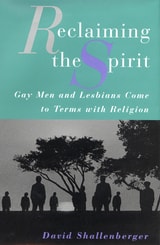
Reclaiming the Spirit
Gay Men and Lesbians Come to Terms with Their ReligionShallenberger, David
Rutgers University Press, 1998
In a world in which religion and homosexuality are often by definition incompatible, it is crucial to hear from gay men and women about how they perceive themselves to be religious or spiritual people. Eliciting powerful, frank, and sometimes troubling responses, David Shallenberger interviewed gay men and women who grew up in families that belonged to traditional religions-Jewish, Roman Catholic, and Protestant-that rejected homosexuality as an unacceptable life-style. When these children grew into adulthood and "came out," many rejected the religion of their childhood as they sought out a more accepting gay community. But once they became comfortable with their new gay identity, they began to experience a spiritual hunger and a desire to be part of a religious community. Some sought to return to the traditions from which they came; others desired membership in new religious communities.
The quest for an integration of homosexuality and spirituality is the focus of Reclaiming the Spirit. Shallenberger asks how individuals can balance both a gay and a religious identity, whether coming out is a spiritual experience, and how coming out affects an individual's relationship to a traditional religious community. Divided into chapters that correspond to the common stages of spiritual integration, Reclaiming the Spirit is immensely readable and introduces an important group of voices into the hotly contested debates surrounding religion and gay participation.
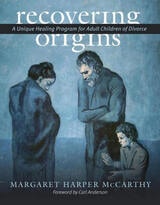
Recovering Origins
A Unique Healing Program for Adult Children of DivorceMargaret Harper McCarthy
Catholic University of America Press, 2021
Religion and Sexuality
The Shakers, the Mormons, and the Oneida CommunityLawrence Foster
University of Illinois Press, 2009
Winner of the Best Book Award, Mormon History Association
Religion and Social Justice For Immigrants
Hondagneu-Sotelo, Pierrette
Rutgers University Press, 2006
Religion has jumped into the sphere of global and domestic politics in ways that few would have imagined a century ago. Some expected that religion would die as modernity flourished. Instead, it now stares at us almost daily from the front pages of newspapers and television broadcasts. Although it is usually stories about the Christian Right or conservative Islam that grab headlines, there are many religious activists of other political persuasions that are working quietly for social justice. This book examines how religious immigrants and religious activists are working for equitable treatment for immigrants in the United States.
The essays in this book analyze the different ways in which organized religion provides immigrants with an arena for mobilization, civic participation, and solidarity. Contributors explore topics including how non-Western religious groups such as the Vietnamese Caodai are striving for community recognition and addressing problems such as racism, economic issues, and the politics of diaspora; how interfaith groups organize religious people into immigrant civil rights activists at the U.S.–Mexican border; and how Catholic groups advocate governmental legislation and policies on behalf of refugees.
Religion and Spirituality in Korean America
Edited by David K. Yoo and Ruth H. Chung
University of Illinois Press, 2007
Contributors: Ruth H. Chung, Jae Ran Kim, Jung Ha Kim, Rebecca Kim, Sharon Kim, Okyun Kwon, Sang Hyun Lee, Anselm Kyongsuk Min, Sharon A. Suh, Sung Hyun Um, and David K. Yoo
Religion at the Corner of Bliss and Nirvana
Politics, Identity, and Faith in New Migrant CommunitiesLois Ann Lorentzen, Joaquin Jay Gonzalez III, Kevin M. Chun and Hien Duc Do, eds.
Duke University Press, 2009
As they conducted research, the contributors not only visited churches and temples but also single-room-occupancy hotels, brothels, tattoo-removal clinics, and the streets of San Francisco, El Salvador, Mexico, and Vietnam. Their essays include an exploration of how faith-based organizations can help LGBT migrants surmount legal and social complexities, an examination of transgendered sex workers’ relationship with the unofficial saint Santisima Muerte, a comparison of how a Presbyterian mission and a Buddhist temple in San Francisco help Chinese immigrants to acculturate, and an analysis of the transformation of baptismal rites performed by Mayan migrants. The voices of gang members, Chinese and Vietnamese Buddhist nuns, members of Pentecostal churches, and many others animate this collection. In the process of giving voice to these communities, the contributors interrogate theories about acculturation, class, political and social capital, gender and sexuality, the sociology of religion, transnationalism, and globalization. The collection includes twenty-one photographs by Jerry Berndt.
Contributors. Luis Enrique Bazan, Kevin M. Chun, Hien Duc Do, Patricia Fortuny Loret de Mola, Joaquin Jay Gonzalez III, Sarah Horton, Cymene Howe, Mimi Khúc, Jonathan H. X. Lee, Lois Ann Lorentzen, Andrea Maison, Dennis Marzan, Rosalina Mira, Claudine del Rosario, Susanna Zaraysky
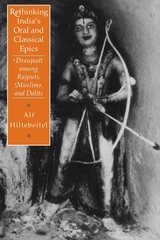
Rethinking India's Oral and Classical Epics
Draupadi among Rajputs, Muslims, and DalitsAlf Hiltebeitel
University of Chicago Press, 1999
Using his own fieldwork as a starting point, Alf Hiltebeitel analyzes how the oral tradition of the south Indian cult of the goddess Draupadi and five regional martial oral epics compare with one another and tie in with the Sanskrit epics. Drawing on literary theory and cultural studies, he reveals the shared subtexts of the Draupadi cult Mahabharata and the five oral epics, and shows how the traditional plots are twisted and classical characters reshaped to reflect local history and religion. In doing so, Hiltebeitel sheds new light on the intertwining oral traditions of medieval Rajput military culture, Dalits ("former Untouchables"), and Muslims.
Breathtaking in scope, this work is indispensable for those seeking a deeper understanding of South Asia's Hindu and Muslim traditions.
This work is the third volume in Hiltebeitel's study of the Draupadi cult. Other volumes include Mythologies: From Gingee to Kuruksetra (Volume One), On Hindu Ritual and the Goddess (Volume Two), and Rethinking the Mahabharata (Volume Four).

Riders for God
The Story of a Christian Motorcycle GangRich Remsberg
University of Illinois Press, 2000
Founded by a former biker and located in southern Indiana, the Unchained Gang is a group of former outlaw bikers, ex-convicts, and recovering addicts who are now born-again Christians. Although they have given up drugs, alcohol, tobacco, and violence they have kept their motorcycles--which they consider to be anointed--and use them as tools in their witness of the word of God as they understand it. The Unchained Gang is an outreach ministry, going into prisons and jails, biker rallies, and other places where people on the fringe are often ignored by other churches and the rest of society.
Combining powerful photographic images with gang members' first-person testimonies, Rich Remsberg shows the ironic juxtaposition of tattoos, leather vests, and the iconography of the biker world with the Christian practices of Bible study, speaking in tongues, and praying at an altar. He explores the lives of men and women who have redirected the extreme nature of their former ways.
Through their own powerful stories, they explain how the addictions and uncontrollable violence that once shaped their lives have given way to dramatic worship and zealous ministry.
An afterword by Colleen McDannell situates the Unchained Gang's
interpretation of Christian living in the larger constellation of pentecostal, born-again, fundamentalist, and mainstream churches.