Results by title
231 books match the query 'Revolutionary Period (1775-1800)' and 9 start with r
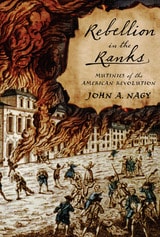
Rebellion in the Ranks
Mutinies of the American RevolutionJohn A. Nagy
Westholme Publishing, 2007
How General Washington Avoided the Peril From Within His Own Forces
"It gives me great pain to be obliged to solicit the attention of the honorable Congress to the state of the army...the greater part of the army is in a state not far from mutiny...I know not to whom to impute this failure, but I am of the opinion, if the evil is not immediately remedied and more punctuality observed in future, the army must absolutely break up."—George Washington, September 1775
Mutiny has always been a threat to the integrity of armies, particularly under trying circumstances, and since Concord and Lexington, mutiny had been the Continental Army's constant traveling companion. It was not because the soldiers lacked resolve to overturn British rule or had a lack of faith in their commanders. It was the scarcity of food—during winter months it was not uncommon for soldiers to subsist on a soup of melted snow, a few peas, and a scrap of fat—money, clothing, and proper shelter, that forced soldiers to desert or organize resistance. Mutiny was not a new concept for George Washington. During his service in the French and Indian War he had tried men under his command for the offense and he knew that disaffection and lack of morale in an army was a greater danger than an armed enemy.
In Rebellion in the Ranks: Mutinies of the American Revolution, John A. Nagy provides one of the most original and valuable contributions to American Revolutionary War history in recent times. Mining previously ignored British and American primary source documents and reexamining other period writings, Nagy has corrected misconceptions about known events, such as the Pennsylvania Line Mutiny, while identifying for the first time previously unknown mutinies. Covering both the army and the navy, Nagy relates American officers' constant struggle to keep up the morale of their troops, while highlighting British efforts to exploit this potentially fatal flaw.
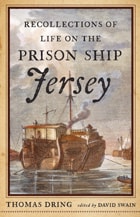
Recollections of Life on the Prison Ship Jersey
Thomas Dring
Westholme Publishing, 2010
“Among the many events which took place during the Revolutionary War from its commencement to its termination [are] the cruelties inflicted upon that unfortunate class of men who had the misfortune to be numbered among the prisoners [of the British] and more particularly those whom the dreadful chance of war had placed on board their prison ships at New York.” So begins the remarkable narrative of Thomas Dring. In 1824, Dring was an aging man of 65, retired in his native state of Rhode Island. Forty-two years before, he, like thousands of other young men, had been caught up in the American cause. In 1782, he had been captured by the British and sentenced to the infamous prison ship Jersey, a demasted hulk anchored in the East River off New York City. It is estimated that more than 11,000 men perished on the British prison ships over the course of the war, and their bones regularly washed up on the shore long after hostilities ceased. Dring survived to tell the tale, and in 1824, he decided to do just that. He was motivated partly because the fate of the prisoners was beginning to be doubted, that their hardships were thought to have been grossly exaggerated, and even that the entire experience had never occurred.
This book publishes for the first time the complete text of Dring’s handwritten manuscript, a major primary-source document, in which he describes the horrible conditions, treatment by guards, and experiences that he and others endured during captivity. Recollections of Life on the Prison Ship Jersey is a plea not to forget but instead to remember the inhumanity of the captors and the sacrifices of the captives—a message that continues to resonate today. Editor David Swain has provided an introductory essay and extensive notes that contain background information and historical documentation to accompany and illuminate the original manuscript.
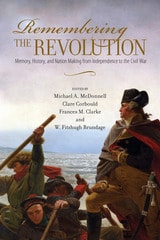
Remembering the Revolution
Memory, History, and Nation Making from Independence to the Civil WarMichael A. McDonnell
University of Massachusetts Press, 2013
In today's United States, the legacy of the American Revolution looms large. From presidential speeches to bestselling biographies, from conservative politics to school pageants, everybody knows something about the Revolution. Yet what was a messy, protracted, divisive, and destructive war has calcified into a glorified founding moment of the American nation. Disparate events with equally diverse participants have been reduced to a few key scenes and characters, presided over by well-meaning and wise old men.
Recollections of the Revolution did not always take today's form. In this lively collection of essays, historians and literary scholars consider how the first three generations of American citizens interpreted their nation's origins. The volume introduces readers to a host of individuals and groups both well known and obscure, from Molly Pitcher and “forgotten father” John Dickinson to African American Baptists in Georgia and antebellum pacifists. They show how the memory of the Revolution became politicized early in the nation's history, as different interests sought to harness its meaning for their own ends. No single faction succeeded, and at the outbreak of the Civil War the American people remained divided over how to remember the Revolution.

Revolution Downeast
The War for American Independence in MaineJames S. Leamon
University of Massachusetts Press, 1993
The history of the Revolution in Maine is the story of a people who did not really want a revolution—at least at first.
Since the middle of the seventeenth century, the powerful Massachusetts Bay Colony had exercised an increasing hegemony over the settlements downeast—a hegemony legalized in the Massachusetts royal charter of 1691. From then until 1820, when it became a state, Maine remained an integral part of Massachusetts. Geographically isolated from the Bay Colony by the province of New Hampshire, and dependent on Massachusetts for its very existence, Maine was indeed a colony, in every sense of the word.
The larger Massachusetts context has tended to obscure Maine as a legitimate object of study, nowhere more than in the period of the American Revolution. Even historians in Maine have slighted the period of the American Revolution. Where appropriate, town historians devote a chapter or so to the event, but only in the context of a particular community.
In his book, Leamon aims to meet that deficiency by drawing together town and general histories, specialized studies, and primary sources, both published and unpublished. He examines why and how Maine fought the Revolution and the changes that occurred in Maine during and after the war.
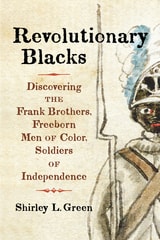
Revolutionary Blacks
Discovering the Frank Brothers, Freeborn Men of Color, Soldiers of IndependenceShirley L. Green
Westholme Publishing, 2026
In Revolutionary Blacks: Discovering the Frank Brothers, Freeborn Men of Color, Soldiers of Independence historian Shirley L. Green takes the reader on a journey based on her family’s history, rooted in its oral tradition. Putting together the pieces of this puzzle through archival research, interviews, and DNA evidence, the author authenticates and expands the family’s oral history. In addition to providing context and substance to the Black experience during the war years, the author underscores the significant distinction between free Blacks in military service and those who had been enslaved, and how they responded in different ways to the harsh realities of racism. An original and important contribution to American history, Revolutionary Blacks presents a complex account of Black life during the Revolutionary Era and demonstrates that free men of color shared with white soldiers the desire to improve their condition in life and to maintain their families safely in postcolonial North America.
Rhetoric, Independence, and Nationhood, 1760–1800, Volume II
Stephen E Lucas
Michigan State University Press, 2022
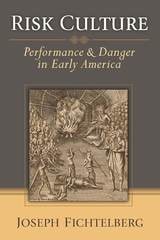
Risk Culture
Performance and Danger in Early AmericaJoseph Fichtelberg
University of Michigan Press, 2010
---David Shields, University of South Carolina
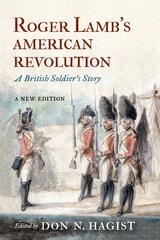
Roger Lamb's American Revolution
A British Soldier's StoryDon N. Hagist
Westholme Publishing, 2022
Of all the British soldiers who served in North America during the American Revolution, none wrote more about his experiences than Roger Lamb. He certainly had a lot to say: his service in two of the most important campaigns—the 1777 Saratoga campaign and the 1781 campaign through the Carolinas to Virginia—put him in the thick of some of the war’s most famous battles. Moreover, he was twice captured and twice escaped, making his way through hostile territory to rejoin the British army. Later in his life he wrote two books chronicling these experiences in great detail. Hundreds of British soldiers went through similar ordeals, sharing in the campaigns, the battles, the captivities, the escapes, but none recounted any aspect of these activities in the level of detail that Lamb did.
The first edition of this book, published in 2004, combined all of Roger Lamb’s first-hand recollections from his two books, An Original and Authentic Journal of Occurrences during the late American War, from its Commencement to the Year 1783 (Dublin, 1809) and Memoir of his Own Life (Dublin, 1811). Since that publication, two more important documents written by Lamb have come to light—an intelligence report written in 1782 recounting details of one of his escapes, and a “commonplace book” kept later in his life to record a vast range of memories, thoughts, and observations. Roger Lamb’s American Revolution: A British Soldier’s Story combines all of the material from these four sources pertaining to Lamb’s career as a soldier, from the time he joined the army to his departure from it, plus his recollections of childhood and post-military life. The result is the most comprehensive first-hand account by a British soldier in the American Revolution, an essential record for understanding the war in its totality.

Romance, Remedies, and Revolution
The Journal of Dr. Elihu Ashley of Deerfield, Massachusetts, 1773-1775Edited by Amelia F. Miller and A. R. Riggs
University of Massachusetts Press, 2007
With flashes of humor and close attention to detail, Ashley describes a broad range of activities and experiences in the small village of Deerfield and the surrounding towns of the Connecticut River valley. Articulate as well as observant, this former schoolteacher conveys a sense of immediacy that brings even the most mundane daily events to life. He discusses medical theory and practice, revolutionary politics, farming, his family, his circle of friends, and amusements ranging from singing and dancing to sleigh riding and bouts of drunkenness. He also writes about his love life, including a dalliance with the older sister of his fiancee, Polly Williams, while the latter is away visiting relatives in the Berkshires.
For Ashley, personal relationships and politics were the prominent issues of 1773 and 1774, as events in Massachusetts drew the province toward rebellion. He discusses the gathering of angry mobs in response to the so-called Intolerable Acts, the stoppage of the courts in Hampshire County, the anarchy that ensued, and the persecution of loyalists, with or without the sanction of law. When the revolution breaks out in April 1775, he describes the departure of companies of minutemen as they set out for Boston to challenge the British Army.
Six months later, in November 1775, the journal abruptly ends. By then, however, Elihu Ashley had already bequeathed to posterity an extraordinary firsthand account of life in rural New England in the years immediately preceding the War of Independence.