70 books match the query 'Rock music' and 9 start with r

cover of Race, Rock, and Elvis

Race, Rock, and Elvis

Michael T. Bertrand

University of Illinois Press, 2000

Did Elvis Presley's brand of rock 'n' roll help revise racial attitudes in postwar America? Michael T. Bertrand delves into this question and many others to investigate popular music's revolutionary influence on black-white relations in the South. 

Youthful fans of rhythm and blues, rock 'n' roll, and other black-inspired music often broke from their segregationist elders and ignored the color line. Not coincidentally, these same young white people--the southern branch of a national and commercialized youth culture--led a general relaxation of racist attitudes. Bertrand argues that African American music facilitated a new recognition of black people as fellow human beings. African American audiences welcomed Elvis with enthusiasm while racially mixed audiences flocked to music venues at a time when adults expected separate performances for black and white audiences. Bertrand also describes the critical role of radio and recordings in making African American culture available to white fans on an unprecedented scale. Over time, southern working-class youth used the new music to define and express new values and build their own identities.
[more]
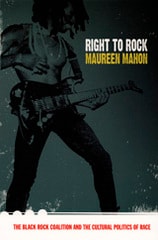
cover of Right to Rock: The Black Rock Coalition and the Cultural Politics of Race

Right to Rock

The Black Rock Coalition and the Cultural Politics of Race

Maureen Mahon

Duke University Press, 2004
The original architects of rock ’n’ roll were black musicians including Little Richard, Etta James, and Chuck Berry. Jimi Hendrix electrified rock with his explosive guitar in the late 1960s. Yet by the 1980s, rock music produced by African Americans no longer seemed to be “authentically black.” Particularly within the music industry, the prevailing view was that no one—not black audiences, not white audiences, and not black musicians—had an interest in black rock. In 1985 New York-based black musicians and writers formed the Black Rock Coalition (brc) to challenge that notion and create outlets for black rock music. A second branch of the coalition started in Los Angeles in 1989. Under the auspices of the brc, musicians organized performances and produced recordings and radio and television shows featuring black rock. The first book to focus on the brc, Right to Rock is, like the coalition itself, about the connections between race and music, identity and authenticity, art and politics, and power and change. Maureen Mahon observed and participated in brc activities in New York and Los Angeles, and she conducted interviews with more than two dozen brc members. In Right to Rock she offers an in-depth account of how, for nearly twenty years, members of the brc have broadened understandings of black identity and black culture through rock music.
[more]
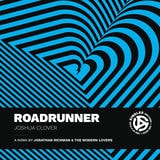
cover of Roadrunner: A Song by Jonathan Richman and the Modern Lovers

Roadrunner

A Song by Jonathan Richman and the Modern Lovers

Joshua Clover

Duke University Press, 2021
Jonathan Richman and the Modern Lovers' 1972 song “Roadrunner” captures the freedom and wonder of cruising down the highway late at night with the radio on. Although the song circles Boston's beltway, its significance reaches far beyond Richman's deceptively simple declarations of love for modern moonlight, the made world, and rock & roll. In Roadrunner, cultural theorist and poet Joshua Clover charts both the song's emotional power and its elaborate history, tracing its place in popular music from Chuck Berry to M.I.A. He also locates “Roadrunner” at the intersection of car culture, industrialization, consumption, mobility, and politics. Like the song itself, Clover tells a story about a particular time and place—the American era that rock & roll signifies—that becomes a story about love and the modern world.
[more]
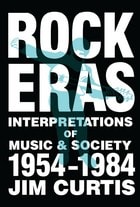
cover of Rock Eras: Interpretations of Music and Society, 1954-1984

Rock Eras

Interpretations of Music and Society, 1954-1984

Jim Curtis

University of Wisconsin Press, 1987

From 1954 to 1984, the media made rock n’ roll an international language. In this era of rapidly changing technology, styles and culture changed dramatically, too. In the 1950s, wild-eyed Southern boys burst into national consciousness on 45 rpm records, and then 1960s British rockers made the transition from 45s to LPs. By the 1970s, rockers were competing with television, and soon MTV made obsolete the music-only formats that had first popularized rock n’ roll.

Paper is temporarily out of stock, Cloth (0-87972-368-8) is available at the paper price until further notice.
[more]
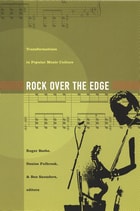
cover of Rock Over the Edge: Transformations in Popular Music Culture

Rock Over the Edge

Transformations in Popular Music Culture

Roger Beebe, Denise Fulbrook, and Ben Saunders, eds.

Duke University Press, 2002

This collection brings new voices and new perspectives to the study of popular—and particularly rock—music. Focusing on a variety of artists and music forms, Rock Over the Edge asks what happens to rock criticism when rock is no longer a coherent concept. To work toward an answer, contributors investigate previously neglected genres and styles, such as “lo fi,” alternative country, and “rock en español,” while offering a fresh look at such familiar figures as Elvis Presley, the Beatles, and Kurt Cobain.
Bridging the disciplines of musicology and cultural studies, the collection has two primary goals: to seek out a language for talking about music culture and to look at the relationship of music to culture in general. The editors’ introduction provides a backward glance at recent rock criticism and also looks to the future of the rapidly expanding discipline of popular music studies. Taking seriously the implications of critical theory for the study of non-literary aesthetic endeavors, the volume also addresses such issues as the affective power of popular music and the psychic construction of fandom.
Rock Over the Edge will appeal to scholars and students in popular music studies and American Studies as well as general readers interested in popular music.

Contributors. Ian Balfour, Roger Beebe, Michael Coyle, Robert Fink, Denise Fulbrook, Tony Grajeda, Lawrence Grossberg, Trent Hill, Josh Kun, Jason Middleton, Lisa Ann Parks, Ben Saunders, John J. Sheinbaum, Gayle Wald, Warren Zanes
[more]
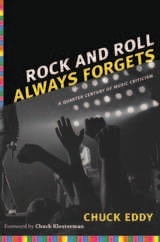
cover of Rock and Roll Always Forgets: A Quarter Century of Music Criticism

Rock and Roll Always Forgets

A Quarter Century of Music Criticism

Chuck Eddy

Duke University Press, 2011

Chuck Eddy is one of the most entertaining, idiosyncratic, influential, and prolific music critics of the past three decades. His byline has appeared everywhere from the Village Voice and Rolling Stone to Creem, Spin, and Vibe. Eddy is a consistently incisive journalist, unafraid to explore and defend genres that other critics look down on or ignore. His interviews with subjects ranging from the Beastie Boys, the Pet Shop Boys, Robert Plant, and Teena Marie to the Flaming Lips, AC/DC, and Eminem’s grandmother are unforgettable. His review of a 1985 Aerosmith album reportedly inspired the producer Rick Rubin to pair the rockers with Run DMC. In the eighties, Eddy was one of the first critics to widely cover indie rock, and he has since brought his signature hyper-caffeinated, hyper-hyphenated style to bear on heavy metal, hip-hop, country—you name it. Rock and Roll Always Forgets features the best, most provocative reviews, interviews, columns, and essays written by this singular critic. Essential reading for music scholars and fans, it may well be the definitive time-capsule comment on pop music at the turn of the twenty-first century.
[more]
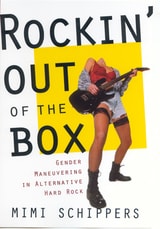
cover of Rockin' Out Of The Box: Gender Maneuvering in Alternative Hard Rock

Rockin' Out Of The Box

Gender Maneuvering in Alternative Hard Rock

Schippers, Mimi

Rutgers University Press, 2002

Given the long history of feminism and its contested place in popular culture, important, practical questions arise: What effect, if any, have feminist ideas and practices had on the lives of young men and women who grew up with them? How do these individuals negotiate the realities of gender in their daily lives?

In Rockin’ Out of the Box, Mimi Schippers, employing the crucial feminist insight that gender is a constantly shifting performance and not an essential quality related to sex, explores the gender roles, assumptions, and transgressions of the men and women involved in the alternative hard rock scene. The author focuses on this sizable section of rock music both because it is widely inclusive of men and women and because it explicitly adopted feminism as its point of departure from mainstream music. Schippers uses the innovative term gender maneuvering to explain her observations that gender and sexuality are negotiated and always changing features of social relations. This process, she demonstrates, operates as a cultural practice and as an individual strategy of resistance to socially prescribed gender roles.

Schippers, who spent more than two years frequenting alternative hard rock clubs and concerts in Chicago, conducted extensive interviews with fans as well as musicians, including Ian MacKaye of Fugazi, Eddie Vedder of Pearl Jam, Kim Thayil of Soundgarden, Donita Sparks and Jennifer Finch of L7, Kat Bjelland and Lori Barbero of Babes in Toyland, Rose of Poster Children, Louise Post and Nina Gordon of Veruca Salt, and Liz Davis and Valerie Agnew of 7 Year Bitch. As it documents the development of a rock music genre that has so far received little academic attention, this book  also demonstrates how this musical culture contributes to our understanding of the daily practices of gender relations among young people.
[more]
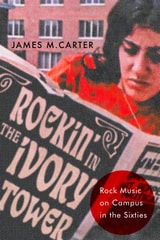
cover of Rockin' in the Ivory Tower: Rock Music on Campus in the Sixties

Rockin' in the Ivory Tower

Rock Music on Campus in the Sixties

James M. Carter

Rutgers University Press, 2023

Histories of American rock music and the 1960s counterculture typically focus on the same few places: Woodstock, Monterey, Altamont. Yet there was also a very active college circuit that brought edgy acts like the Jefferson Airplane and the Velvet Underground to different metropolitan regions and smaller towns all over the country. These campus concerts were often programmed, promoted, and reviewed by students themselves, and their diverse tastes challenged narrow definitions of rock music.  

Rockin’ in the Ivory Tower takes a close look at two smaller universities, Drew in New Jersey and Stony Brook on Long Island, to see how the culture of rock music played an integral role in student life in the late 1960s. Analyzing campus archives and college newspapers, historian James Carter traces connections between rock fandom and the civil rights protests, free speech activism, radical ideas, lifestyle transformations, and anti-war movements that revolutionized universities in the 1960s. Furthermore, he finds that these progressive students refused to segregate genres like folk, R&B, hard rock, and pop. Rockin’ in the Ivory Tower gives readers a front-row seat to a dynamic time for the music industry, countercultural politics, and youth culture.
[more]
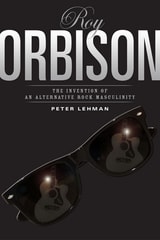
cover of Roy Orbison: Invention Of An Alternative Rock Masculinity

Roy Orbison

Invention Of An Alternative Rock Masculinity

Peter Lehman

Temple University Press, 2003

Roy Orbison's music—whether heard in his own recordings or in cover versions of his songs—is a significant part of contemporary American culture despite the fact that he died almost a generation ago. Few of today's listeners know or remember how startlingly unique he seemed at the height of his career in the early 1960s. In this book, Peter Lehman looks at the long span of Orbison's career and probes into the uniqueness of his songs, singing, and performance style, arguing that singer/songwriters no less than filmmakers can be considered as auteurs.Unlike other pop stars, Orbison was a constant presence on the Top 40, but virtually invisible in the media during his heyday. Ignoring the conventions of pop music, he wrote complex songs and sang them with a startling vocal range and power. Wearing black clothes and glasses and standing motionless on stage, he rejected the macho self confidence and strutting that characterized the male rockers of his time. He sang about a man lost in a world of loneliness and fear, one who cried in the dark or escaped into a dream world, the only place his desires could be fulfilled. This was a man who reveled in passivity, pain, and loss.Lehman traces Orbison's development of this alternative masculinity and the use of his music in films by Wim Wenders and David Lynch. Widely admired by fellow musicians from Elvis to Jagger, Springsteen and Bono, Orbison still attracts new listeners. As a devoted fan and insightful scholar, Lehman gives us a fascinating account of "the greatest white singer on the planet," and a new approach to understanding individual singer/songwriters.
[more]