74 books match the query 'Russian literature' and 6 start with r
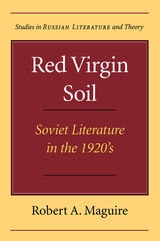
cover of Red Virgin Soil: Soviet Literature in the 1920's

Red Virgin Soil

Soviet Literature in the 1920's

Robert A. Maguire

Northwestern University Press, 2000
First published in 1968, this classic is a richly detailed study of the eponymous journal that was the most significant Soviet literary journal of the 1920s. It is also a comprehensive survey of Soviet literary culture in a critical period when writers could still engage in public debate.
[more]
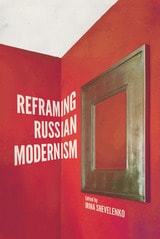
cover of Reframing Russian Modernism

Reframing Russian Modernism

Edited by Irina Shevelenko

University of Wisconsin Press, 2018

Presenting a multifaceted portrait of modernist culture in Russia, an array of distinguished scholars shows how artists and writers in the early twentieth century engaged with politics, science, and religion. At a time when many Russian social institutions looked to the past, modernist arts powerfully amplified a gamut of new ideas about individual and collective transformation.

Expanding upon prior studies that focus more specifically on literary manifestations of the movement, Reframing Russian Modernism features original research that ranges broadly, from political aesthetics to Darwinism to yoga. These unique complementary perspectives counter reductionism of any kind, integrating the study of Russian modernism into the larger body of humanistic scholarship devoted to modernity.
[more]
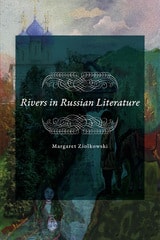
cover of Rivers in Russian Literature

Rivers in Russian Literature

Margaret Ziolkowski

University of Delaware Press, 2011

Rivers in Russian Literature focuses on the Russian literary and folkloric treatment of five rivers—the Dnieper, Volga, Neva, Don, and Angara. Each chapter traces, within a geographical and historical context, the evolution of the literary representation of one river. Imagination may endow a river with aesthetic or spiritual qualities; ethnic, national, or racial associations; or commercial or agricultural symbolism of many kinds. Russian literary responses to these five rivers have much to tell us about the society that produced them as well as the rivers they treat.

Published by University of Delaware Press. Distributed worldwide by Rutgers University Press.
 
 
[more]
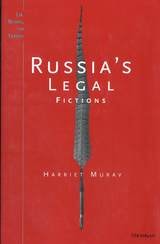
cover of Russia's Legal Fictions

Russia's Legal Fictions

Harriet Murav

University of Michigan Press, 1998
Legal scholars and literary critics have shown the significance of storytelling, not only as part of the courtroom procedure, but as part of the very foundation of law. Russia's Legal Fictions examines the relationship between law, narrative and authority in nineteenth- and twentieth-century Russia.
The conflict between the Russian writer and the law is a well-known feature of Russian literary life in the past two centuries. With one exception, the authors discussed in this book--Sukhovo-Kobylin, Akhsharumov, Suvorin, and Dostoevsky in the nineteenth century and Solzhenitsyn and Siniavskii in the twentieth--were all put on trial. In Russia's Legal Fictions, Harriet Murav starts with the authors' own writings about their experience with law and explores the history of these Russian literary trials, including censorship, libel cases, and one case of murder, in their specific historical context, showing how particular aspects of the culture of the time relate to the case.
The book explores the specifically Russian literary and political conditions in which writers claim the authority not only as the authors of fiction but as lawgivers in the realm of the real, and in which the government turns to the realm of the literary to exercise its power. The author uses specific aspects of Russian culture, history and literature to consider broader theoretical questions about the relationship between law, narrative, and authority. Murav offers a history of the reception of the jury trial and the development of a professional bar in late Imperial Russia as well as an exploration of theories of criminality, sexuality, punishment, and rehabilitation in Imperial and Soviet Russia.
This book will be of interest to scholars of law and literature and Russian law, history and culture.
Harriet Murav is Associate Professor of Russian and Comparative Literature, University of California at Davis.
[more]
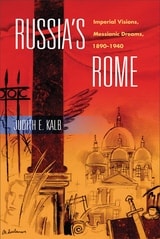
cover of Russia's Rome: Imperial Visions, Messianic Dreams, 1890–1940

Russia's Rome

Imperial Visions, Messianic Dreams, 1890–1940

Judith E. Kalb

University of Wisconsin Press, 2008
A wide-ranging study of empire, religious prophecy, and nationalism in literature, Russia’s Rome: Imperial Visions, Messianic Dreams, 1890–1940 provides the first examination of Russia’s self-identification with Rome during a period that encompassed the revolutions of 1905 and 1917 and the rise of the Soviet state. Analyzing Rome-related texts by six writers—Dmitrii Merezhkovskii, Valerii Briusov, Aleksandr Blok, Viacheslav Ivanov, Mikhail Kuzmin, and Mikhail Bulgakov—Judith E. Kalb argues that the myth of Russia as the “Third Rome” was resurrected to create a Rome-based discourse of Russian national identity that endured even as the empire of the tsars declined and fell and a new state replaced it.
            Russia generally finds itself beyond the purview of studies concerned with the ongoing potency of the classical world in modern society. Slavists, for their part, have only recently begun to note the influence of classical civilization not only during Russia’s neo-classical eighteenth century but also during its modernist period. With its interdisciplinary scope, Russia’s Rome fills a gap in both Russian studies and scholarship on the classical tradition, providing valuable material for scholars of Russian culture and history, classicists, and readers interested in the classical heritage.
[more]
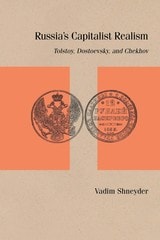
cover of Russia’s Capitalist Realism: Tolstoy, Dostoevsky, and Chekhov

Russia’s Capitalist Realism

Tolstoy, Dostoevsky, and Chekhov

Vadim Shneyder

Northwestern University Press, 2021

Russia’s Capitalist Realism examines how the literary tradition that produced the great works of Leo Tolstoy, Fyodor Dostoevsky, and Anton Chekhov responded to the dangers and possibilities posed by Russia’s industrial revolution. During Russia’s first tumultuous transition to capitalism, social problems became issues of literary form for writers trying to make sense of economic change. The new environments created by industry, such as giant factories and mills, demanded some kind of response from writers but defied all existing forms of language.

This book recovers the rich and lively public discourse of this volatile historical period, which Tolstoy, Dostoevsky, and Chekhov transformed into some of the world’s greatest works of literature. Russia’s Capitalist Realism will appeal to readers interested in nineteenth‑century Russian literature and history, the relationship between capitalism and literary form, and theories of the novel.

[more]