254 books match the query 'Sex' and 10 start with r

cover of Race and Sex in Latin America

Race and Sex in Latin America

Peter Wade

Pluto Press, 2009

The intersection of race and sex in Latin America is a subject touched upon by many disciplines but this is the first book to deal solely with these issues.

Interracial sexual relations are often a key mythic basis for Latin American national identities, but the importance of this has been underexplored. Peter Wade provides a pioneering overview of the growing literature on race and sex in the region, covering historical aspects and contemporary debates. He includes both black and indigenous people in the frame, as well as mixed and white people, avoiding the implication that "race" means "black-white" relations.

Challenging but accessible, this book will appeal across the humanities and social sciences, particularly to students of anthropology, gender studies, history and Latin American studies.
[more]
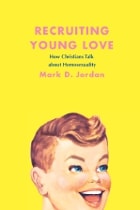
cover of Recruiting Young Love: How Christians Talk about Homosexuality

Recruiting Young Love

How Christians Talk about Homosexuality

Mark D. Jordan

University of Chicago Press, 2011

In the view of many Christians, the teenage years are simultaneously the most dangerous and the most promising. At the very moment when teens are trying to establish a sense of identity and belonging, they are beset by temptation on all sides—from the pressure of their peers to the nihilism and materialism of popular culture. Add the specter of homosexuality to the mix, and you’ve got a situation ripe for worry, sermonizing, and exploitation.


In Recruiting Young Love, Mark D. Jordan explores more than a half century of American church debate about homosexuality to show that even as the main lesson—homosexuality is bad, teens are vulnerable—has remained constant, the arguments and assumptions have changed remarkably. At the time of the first Kinsey Report, in 1948, homosexuality was simultaneously condemned and little discussed—a teen struggling with same-sex desire would have found little specific guidance. Sixty years later, church rhetoric has undergone a radical shift, as silence has given way to frequent, public, detailed discussion of homosexuality and its perceived dangers. Along the way, churches have quietly adopted much of the language and ideas of modern sexology, psychiatry, and social reformers—deploying it, for example, to buttress the credentials of anti-gay “deprogramming” centers and traditional gender roles.


Jordan tells this story through a wide variety of sources, including oral histories, interviews, memoirs, and even pulp novels; the result is a fascinating window onto the never-ending battle for the teenage soul.

[more]
cover of Red War on the Family: Sex, Gender, and Americanism in the First Red Scare

Red War on the Family

Sex, Gender, and Americanism in the First Red Scare

Erica J Ryan

Temple University Press, 2016

In the 1920s, cultural and political reactions to the Red Scare in America contributed to a marked shift in the way Americans thought about sexuality, womanhood, manhood, and family life. The Russian Revolution prompted anxious Americans sensing a threat to social order to position heterosexuality, monogamy, and the family as a bulwark against radicalism.
 
In her probing and engaging book, Red War on the Family, Erica Ryan traces the roots of sexual modernism and the history of antiradicalism and antifeminism. She illuminates how Americans responded to foreign and domestic threats and expressed nationalism by strengthening traditional gender and family roles-especially by imposing them on immigrant groups, workers, women, and young people.
 
Ryan argues that the environment of political conformity in the 1920s was maintained in part through the quest for cultural and social conformity, exemplified by white, middle-class family life. Red War on the Family charts the ways Americanism both reinforced and was reinforced by these sexual and gender norms in the decades after World War I. 
[more]
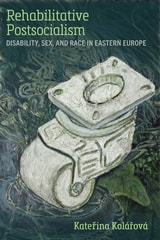
cover of Rehabilitative Postsocialism: Disability, Sex, and Race in Eastern Europe

Rehabilitative Postsocialism

Disability, Sex, and Race in Eastern Europe

Katerina Kolárová

University of Michigan Press, 2025

Winner of the 2019 Tobin Siebers Prize for Disability Studies in the Humanities

Kateřina Kolářová’s Rehabilitative Postsocialism offers a timely interdisciplinary and intersectional analysis of how disability, race, class, and gender operate as ideological tools within the postsocialist Czech Republic (formerly Czechoslovakia). Kolářová presents postsocialism as an analytic that can and should be brought to bear to understand cultural politics, economic formations, and state politics through the present day. 

Rehabilitative Postsocialism names disability, sexuality, and race as central yet invisible to negotiations of the postsocialist consensus. Drawing from a rich and varied archive, Rehabilitative Postsocialism maps the formation of new structures of inequalities and social imaginaries of wellness, merit, and justice in order to understand current articulations of global disenchantment with democracy, social justice, and solidarity. The book also makes clear that disability, race, and ethnicity continue to circulate in depictions of Eastern Europe as suspended in a chronic developmental “delay.” Rehabilitative Postsocialism both situates this positioning within its political and historical formation and offers the analytical tools to challenge its continued deployment.
[more]
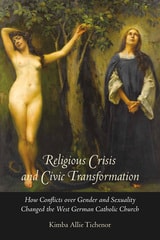
cover of Religious Crisis and Civic Transformation: How Conflicts over Gender and Sexuality Changed the West German Catholic Church

Religious Crisis and Civic Transformation

How Conflicts over Gender and Sexuality Changed the West German Catholic Church

Kimba Allie Tichenor

Brandeis University Press, 2016
This book offers a fresh interpretation of the connection between the West German Catholic Church and post-1950s political debates on women’s reproductive rights and the protection of life in West Germany. According to Tichenor, Catholic women in West Germany, influenced by the culture of consumption, the sexual revolution, Vatican II reforms, and feminism, sought to renegotiate their relationship with the Church. They demanded a more active role in Church ministries and challenged the Church’s hierarchical and gendered view of marriage and condemnation of artificial contraception. When the Church refused to compromise, women left en masse. In response, the Church slowly stitched together a new identity for a postsecular age, employing an elaborate nuptial symbolism to justify its stance on celibacy, women’s ordination, artificial contraception, abortion, and reproductive technologies. Additionally, the Church returned to a radical interventionist agenda that embraced issue-specific alliances with political parties other than the Christian parties. In her conclusion, Tichenor notes more recent setbacks to the German Catholic Church, including disappointment with the reactionary German Pope Benedict XVI and his failure in 2010 to address over 250 allegations of sexual abuse at twenty-two of Germany’s twenty-seven dioceses. How the Church will renew itself in the twenty-first century remains unclear. This closely observed case study, which bridges religious, political, legal, and women’s history, will interest scholars and students of twentieth-century European religious history, modern Germany, and the intersection of Catholic Church practice and women’s issues.
[more]
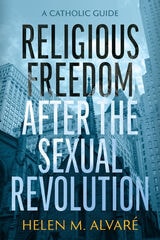
cover of Religious Freedom after the Sexual Revolution: A Catholic Guide

Religious Freedom after the Sexual Revolution

A Catholic Guide

Helen Alvare

Catholic University of America Press, 2022
Laws mandating cooperation with the state’s new sexual orthodoxy are among the leading contemporary threats to the religious freedom of Catholic institutions in the United States. These demand that Catholic schools, health-care providers, or social services cooperate with contraception, cohabitation, abortion, same-sex marriage, or transgender identity and surgeries. But Catholic institutions’ responses seem thin and uninspiring to many. They are criticized as legalistic, authoritarian, bureaucratic, retrograde and hurtful to women and to persons who identify as LGBTQ. They are even called “un-Christian.” They invite disrespect both for Catholic sexual responsibility norms and for religious freedom generally, not only among lawmakers and judges, but also in the court of public opinion, which includes skeptical Catholics. The U.S. Constitution protects Catholic institutions’ “autonomy” – their authority over faith and doctrine, internal operations, and the personnel involved in personifying and transmitting the faith. Other constitutional and statutory provisions also safeguard religious freedom, if not always perfectly. Catholic institutions could take far better advantage of all of these existing protections if they communicated, first, how they differ from secular institutions: how their missions emerge from their faith in Jesus Christ, and their efforts both to make his presence felt in the world today, and to display the inbreaking of the Kingdom of God. Second, they need to draw out the link between their teachings on sexual responsibility and love of God and neighbor. Drawing upon Scripture, tradition, history, theology and empirical evidence, Helen Alvaré frames a more complete, inspiring and appealing response to current laws’ attempts to impose a new sexual orthodoxy upon Catholic institutions. It clarifies the “ecclesial” nature of Catholic schools, hospitals and social services. It summarizes the empirical evidence supporting the link between personnel decisions and mission, and between Catholic sexual responsibility norms and human flourishing. It grounds Catholic sexual responsibility teachings in the same love of God and neighbor that animate the existence, operations, and services of Catholic institutions.
[more]
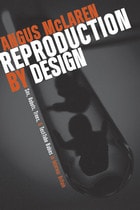
cover of Reproduction by Design: Sex, Robots, Trees, and Test-Tube Babies in Interwar Britain

Reproduction by Design

Sex, Robots, Trees, and Test-Tube Babies in Interwar Britain

Angus McLaren

University of Chicago Press, 2012
Modernity in interwar Europe frequently took the form of a preoccupation with mechanizing the natural; fears and fantasies revolved around the notion that the boundaries between people and machines were collapsing. Reproduction in particular became a battleground for those debating the merits of the modern world.
 
That debate continues today, and to understand the history of our anxieties about modernity, we can have no better guide than Angus McLaren. In Reproduction by Design, McLaren draws on novels, plays, science fiction, and films of the 1920s and '30s, as well as the work of biologists, psychiatrists, and sexologists, to reveal surprisingly early debates on many of the same questions that shape the conversation today: homosexuality, recreational sex, contraception, abortion, euthanasia, sex change operations, and in vitro fertilization.
 
Here, McLaren brings together the experience and perception of modernity with sexuality, technology, and ecological concerns into a cogent discussion of science’s place in reproduction in British and American cultural history.

[more]
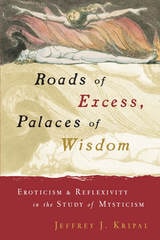
cover of Roads of Excess, Palaces of Wisdom: Eroticism and Reflexivity in the Study of Mysticism

Roads of Excess, Palaces of Wisdom

Eroticism and Reflexivity in the Study of Mysticism

Jeffrey J. Kripal

University of Chicago Press, 2001

William Blake once wrote that "The road of excess leads to the palace of wisdom." Inspired by these poetic terms, Jeffrey J. Kripal reveals how the works of scholars of mysticism are often rooted in their own mystical experiences, "roads of excess," which can both lead to important insights into these scholars' works and point us to our own "palaces of wisdom."

In his new book, Kripal addresses the twentieth-century study of mysticism as a kind of mystical tradition in its own right, with its own unique histories, discourses, sociological dynamics, and rhetorics of secrecy. Fluidly combining autobiography and biography with scholarly exploration, Kripal takes us on a tour of comparative mystical thought by examining the lives and works of five major historians of mysticism—Evelyn Underhill, Louis Massignon, R. C. Zaehner, Agehananda Bharati, and Elliot Wolfson—as well as relating his own mystical experiences. The result, Kripal finds, is seven "palaces of wisdom": the religious power of excess, the necessity of distance in the study of mysticism, the relationship between the mystical and art, the dilemmas of male subjectivity and modern heterosexuality, a call for ethical criticism, the paradox of the insider-outsider problem in the study of religion, and the magical power of texts and their interpretation.

An original and penetrating analysis of modern scholarship and scholars of mysticism, Roads of Excess, Palaces of Wisdom is also a persuasive demonstration of the way this scholarly activity is itself a mystical phenomenon.
[more]
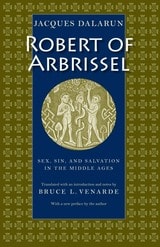
cover of Robert of Arbrissel: Sex, Sin, and Salvation in the Middle Ages

Robert of Arbrissel

Sex, Sin, and Salvation in the Middle Ages

Jacques Dalarun

Catholic University of America Press, 2006
This book tells the fascinating story of Robert of Arbrissel (ca. 1045-1116). Robert was a parish priest, longtime student, reformer, hermit, wandering preacher, and, most famously, founder of the abbey of Fontevraud
[more]
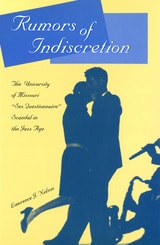
cover of Rumors of Indiscretion: The University of Missouri's "Sex Questionnaire" Scandal in the Jazz Age

Rumors of Indiscretion

The University of Missouri's "Sex Questionnaire" Scandal in the Jazz Age

Lawrence J. Nelson

University of Missouri Press, 2003

In March 1929 hundreds of students at the University of Missouri received a questionnaire that asked their opinions of marriage, family, and sexual issues. Several questions were regarded as too intimate for university students, especially females. The so-called Sex Questionnaire, the product of a sociology class project, soon fell into the hands of the university’s president, dean of women, and the local press, which deemed it “A Filthy Questionnaire.” The Missouri legislature soon jumped into the controversy as the ensuing uproar went statewide and attracted national attention; a cry arose for the expulsion of the students and professors responsible. Beyond the questionnaire, rumors also circulated that something “too terrible” to mention had gone on at the university. Investigations followed, including one by the American Association of University Professors.
Although the controversy surrounding the questionnaire was not limited to sharp generational lines, college students—part of the decade’s “modern youth”—challenged Victorian ideas held by those who were frightened by the path American society seemed to be following during the 1920s. Nelson places the episode within the history and development of the University of Missouri as well as the “culture war” in America during the Jazz Age. He argues that the decade was marked by both change and the persistence of tradition. But while many sought change, radicals were few. What was actually lost in the Jazz Age was Victorianism and its rigid requirements for an orderly culture in which each member had a sharply defined role, violations of which carried societal sanctions.
Nelson uses the University of Missouri episode to demonstrate that while Victorianism’s unrealistic notions were lost, tradition and its most basic tenets—decorum, respect for authority, a sense of shame, strong family relationships, and the definition of right and wrong—survived. Employing previously untapped archival and printed material, Rumors of Indiscretion examines sexual attitudes, divorce, the “new woman,” the limits of academic expression, and much more in an exciting but uneasy time in American life.
[more]