171 books match the query 'Soldiers' and 6 start with r
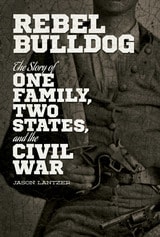
cover of Rebel Bulldog: The Story of One Family, Two States, and the Civil War

Rebel Bulldog

The Story of One Family, Two States, and the Civil War

Jason Lantzer

Indiana Historical Society Press, 2017
Rebel Bulldog tells the story of Preston Davidson, a Northerner who fought for the Confederacy, and his family who lived in Indiana and Virginia. It is a story that examines antebellum religion, education, reform, and politics, and how they affected the identity of not just one young man, but of a nation caught up in a civil war. Furthermore, it discusses how a native-born Hoosier reached the decision to fight for the South, while detailing a unique war experience and the postwar life of a proud Rebel who returned to the North after the guns fell silent and tried to remake his life in a very different state and nation than the ones he had left in 1860. Using the lives of Preston and his family as a lens to help us glimpse the past, Rebel Bulldog delves into the human experience on multiple levels, asks us to reconsider what we think we know of the Civil War, and complicates, while it complements the existing literature. It is a story that perhaps could only have happened in Indiana.
[more]
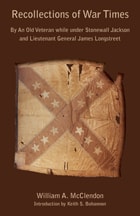
cover of Recollections of War Times: By An Old Veteran while under Stonewall Jackson and Lieutenant General James Longstreet

Recollections of War Times

By An Old Veteran while under Stonewall Jackson and Lieutenant General James Longstreet

William A. McClendon, with an introduction by Keith S. Bohannon

University of Alabama Press, 2010

Recollections of War Times is a dramatically improved edition of William A. “Gus” McClendon’s memoir of his service in the 15th Alabama Infantry. It has long been recognized among the rarest books by any veteran of the Army of Northern Virginia.
Keith Bohannon has conducted relentless research that uncovered a gratifying array of new information about McClendon, as well as new photographs. The introduction based on that research might be a model for the genre, full of details acquired from arcane sources that throw new light on the subject. Bohannon's new exhaustive index also makes McClendon's memoir notably more accessible.
 

"Gus" McClendon joined the 15th Alabama Infantry Regiment, and served in many of the Eastern Theater engagements. More than fifty years later, he sent down his reminiscences, still an unreconstructed Southern patriot, although able to look back with some amusement on his younger self.
[more]
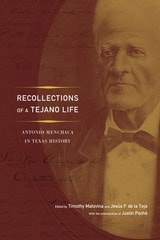
cover of Recollections of a Tejano Life: Antonio Menchaca in Texas History

Recollections of a Tejano Life

Antonio Menchaca in Texas History

Edited by Timothy Matovina and Jesús F. de la Teja

University of Texas Press, 2013

San Antonio native, military veteran, merchant, and mayor pro tem José Antonio Menchaca (1800–1879) was one of only a few Tejano leaders to leave behind an extensive manuscript of recollections. Portions of the document were published in 1907, followed by a “corrected” edition in 1937, but the complete work could not be published without painstaking reconstruction. At last available in its entirety, Menchaca’s book of reminiscences captures the social life, people, and events that shaped the history of Texas’s tumultuous transformation during his lifetime. Highlighting not only Menchaca’s acclaimed military service but also his vigorous defense of Tejanos’ rights, dignity, and heritage, Recollections of a Tejano Life charts a remarkable legacy while incorporating scholarly commentary to separate fact from fiction.

Revealing how Tejanos perceived themselves and the revolutionary events that defined them, this wonderfully edited volume presents Menchaca’s remembrances of such diverse figures as Antonio López de Santa Anna, Jim Bowie, Davy Crockett, Sam Houston, General Adrián Woll, Comanche chief “Casamiro,” and Texas Ranger Jack Hays. Menchaca and his fellow Tejanos were actively engaged in local struggles as Mexico won her independence from Spain; later many joined the fight to establish the Republic of Texas, only to see it annexed to the United States nine years after the Battle of San Jacinto. This first-person account corrects important misconceptions and brings previously unspoken truths vividly to life.
[more]
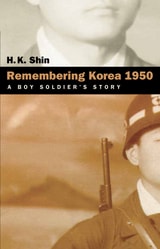
cover of Remembering Korea 1950: A Boy Soldier's Story

Remembering Korea 1950

A Boy Soldier's Story

H. K. Shin

University of Nevada Press, 2001
Hyung K. Shin was sixteen years old when the North Korean army invaded South Korea in June 1950. Fleeing his home, Shin soon found himself alone in Pusan, a refugee without resources or any means of support. To save himself from destitution, he lied about his age and volunteered for service in the South Korean army. Shin’s account of the months that followed is a moving record of the Korean War from the perspective of an ordinary ROK soldier. He recounts his hasty training and subsequent experiences as a battlefield soldier in North Korea, as a guard in a prisoner-of-war camp, and as a refugee again in the massive flight of civilians and ROK military personnel retreating before the onslaught of the Chinese invasion. Through it all, Shin struggles to retain his humanity and pursue his education. In the process, the naïve schoolboy becomes a man. Today, Hyung K. Shin is an internationally respected chemist, but in the pages of this memoir he carries us back to Korea during a pivotal moment in that country’s history. This is the first account in English that describes the war from the perspective of a Korean who lived through and fought in it. Shin’s detailed and lively narrative is a stirring monument to the survival of human decency and kindness in the midst of terror, cruelty, despair, and the destruction of a proud nation.
[more]
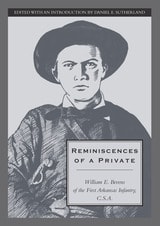
cover of Reminiscences of a Private: William E. Bevens of the First Arkansas Infantry C.S.A.

Reminiscences of a Private

William E. Bevens of the First Arkansas Infantry C.S.A.

Daniel E. Sutherland

University of Arkansas Press, 1999
Reminiscences of a Private is William Bevens’s personal chronicle of his participation in such famous Civil War battles as Shiloh, Chickamauga, Atlanta, and Nashville. There is no supernal heroism here, no pretension, no grandiose analysis. Bevens is neither introspective nor philosophical, and he rarely dwells on the larger issues of the war. He concerns himself with what mattered to him as a common foot soldier. There are longer and fuller accounts of the war; however, few are as honest or as direct as this frank and forthright journal. By confining his contributions as editor to filling gaps in Bevens’s narrative, to correcting some misspellings, and to providing dates and explanatory notes, Daniel Sutherland allows Bevens to tell his story of a young Arkansan at war. His unassuming voice will speak to all readers with compelling candor.
[more]
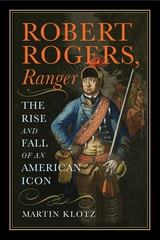
cover of Robert Rogers, Ranger: The Rise and Fall of an American Icon

Robert Rogers, Ranger

The Rise and Fall of an American Icon

Martin Klotz

Westholme Publishing, 2026

Robert Rogers, commander of Rogers’ Rangers during the French and Indian War, was the war’s best-known colonial military hero and, in the ensuing peace, one of the best-known Americans of any description, rivaling Benjamin Franklin in popularity. He was revered in the colonies as an example of the self-made man based on merit, in contrast to the hide-bound, hierarchical British military establishment. Yet this American icon ultimately alienated his peers,fought as a loyalist in the Revolutionary War, ruined himself financially, and died in obscurity in London, estranged from the country of his birth. Rogers is known today for his role in developing the mystique of the modern Ranger, but what explains his meteoric rise and his long, depressing fall?
            Robert Rogers, Ranger: The Rise and Fall of an American Icon by Martin Klotz is a fresh look at the life of this famous, yet highly flawed man. Rogers undeniably had great personal strengths. He was brave nearly to the point of fearlessness. He was physically robust, always the one to cover the retreat, carry the wounded, or go for help when no one else could carry on. He was an intrepid explorer who wrote with eloquence about the splendors of the American frontier. He was bold and unconventional, good at thinking outside the box. He was an outstanding scout and intelligence gatherer who provided invaluable service to a British army inexperienced in woodland warfare. At the same time Rogers had enormous weaknesses that undermined his ability to lead effectively. His boldness was never tempered by judgment, and he was prone to grandiose schemes that came to nothing or, worse, to disaster. His constant self-promotion—including embellishing and lying about his battlefield successes—contributed to his popularity but damaged his reputation with peers and superiors. He succumbed to alcoholism and gambling, was profligate, especially with money—his debts were enormous—and routinely skirted the edges of the law. Rogers never found a comfortable place in America. Instead, his aristocratic patrons in London, who knew him mostly from his own self-description, gave him his most valuable opportunities, including commanding an important military and trading center on the colonial frontier and establishing the Queen’s Rangers to fight alongside Crown forces during the Revolution. But when the British cause failed in America, Rogers became an anathema on both sides of the Atlantic. A fascinating inquiry into an eighteenth-century life, Robert Rogers, Ranger presents this American legend as he lived, crossing the line between fame and misfortune.
[more]