Results by title
418 books match the query 'Southern States' and 28 start with r
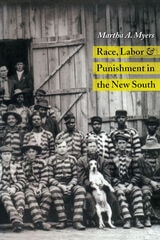
RACE LABOR PUNISHMENT IN NEW SOUTH
MARTHA A. MYERS
The Ohio State University Press, 1998

Race and Repast
Foodscapes in Twentieth-Century Southern LiteratureUrszula Niewiadomska-Flis
University of Arkansas Press, 2022
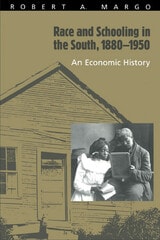
Race and Schooling in the South, 1880-1950
An Economic HistoryRobert A. Margo
University of Chicago Press, 1990
"A concise, lucid account of the bases of racial inequality in the South between Reconstruction and the Civil Rights era. . . . Deserves the careful attention of anyone concerned with historical and contemporary race stratification."—Kathryn M. Neckerman, Contemporary Sociology
"Margo has produced an excellent study, which can serve as a model for aspiring cliometricians. To describe it as 'required reading' would fail to indicate just how important, indeed indispensable, the book will be to scholars interested in racial economic differences, past or present."—Robert Higgs, Journal of Economic Literature
"Margo shows that history is important in understanding present domestic problems; his study has significant implications for understanding post-1950s black economic development."—Joe M. Richardson, Journal of American History
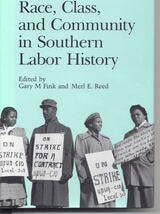
Race, Class, and Community in Southern Labor History
Gary M. Fink
University of Alabama Press, 1994
Exploring the intertwined histories of race, labor, and community in the American South.
Under the leadership of Gary M. Fink and Merl E. Reed, Georgia State University hosts the Southern Labor Studies Conferences approximately every two years. The conferences have yielded two previous volumes, published in 1977 and 1981, and this volume, which contains selected papers from the seventh conference held in 1991.
As evidence by the quality of these essays, the field of southern labor history has come into its own. Research interest is peaking: the practitioners are younger scholars, and much of their work emphasizes the new social and political history. While the topics covered in this volume usually reflect that methodology, their chronology ranges from the antebellum period to the 1970s, suggesting the variety of sources and changing research approaches that can be used in rendering new meaning to the past. Although the subject of gender was generally a minor theme in these sessions, work now being done leaves no doubt that at some future conference gender will attract a commanding amount of attention.
In introducing and describing their respective areas, the associate editors, Robert H. Zieger (textile workers), Joe W. Trotter (African Americans), and Clifford Kuhn (labor politics), have provided a rich historiographical background.
The essays in this volume will enlighten the reader on many important aspects of the history of southern labor, and they will also raise new questions to be explained by other scholars and future conferences.

Race, Rock, and Elvis
Michael T. Bertrand
University of Illinois Press, 2000
Did Elvis Presley's brand of rock 'n' roll help revise racial attitudes in postwar America? Michael T. Bertrand delves into this question and many others to investigate popular music's revolutionary influence on black-white relations in the South.
Youthful fans of rhythm and blues, rock 'n' roll, and other black-inspired music often broke from their segregationist elders and ignored the color line. Not coincidentally, these same young white people--the southern branch of a national and commercialized youth culture--led a general relaxation of racist attitudes. Bertrand argues that African American music facilitated a new recognition of black people as fellow human beings. African American audiences welcomed Elvis with enthusiasm while racially mixed audiences flocked to music venues at a time when adults expected separate performances for black and white audiences. Bertrand also describes the critical role of radio and recordings in making African American culture available to white fans on an unprecedented scale. Over time, southern working-class youth used the new music to define and express new values and build their own identities.
Racializing Objectivity
How the White Southern Press Used Journalism Standards to Defend Jim CrowGwyneth Mellinger
University of Massachusetts Press, 2024
Winner of the 2025 American Journalism Historians Association Book of the Year Award
Winner of the 2025 Association for Education in Journalism and Mass Communication (AEJMC)'s Tankard Book Award and the AEJMC's History Division Book Award
When the civil rights movement began to challenge Jim Crow laws, the white southern press reframed the coverage of racism and segregation as a debate over journalism standards. Many white southern editors, for instance, designated Black Americans as “Negro” in news stories, claiming it was necessary for accuracy and “objectivity,” even as white subjects went unlabeled. These news professionals disparaged media outlets that did not adhere to these norms, such as the Black press. In this way, the southern white press weaponized journalism standards—and particularly the idea of objectivity—to counter and discredit reporting that challenged white supremacy.
Through deep engagement with letters and other materials in numerous archives from editors, journalists, and leaders of newswire services, Racializing Objectivity interrogates and exposes how the white southern press used journalism standards as a professional rationalization for white supremacy and a political strategy to resist desegregation. Gwyneth Mellinger argues that white skin privilege gave these news professionals a stake in the racial status quo and was thus a conflict of interest as they defended Jim Crow. Her study includes an examination of the Southern Education Reporting Service, an objectivity project whose impartiality, she contends, instead affirmed systemic racism. In a pointed counternarrative, Mellinger highlights Black editors and academics who long criticized the supposed objectivity of the press and were consequently marginalized and often dismissed as illegitimate, fanciful, and even paranoid.
Elegant and incisive, Racializing Objectivity unequivocally demonstrates that a full telling of twentieth-century press history must reckon with the white southern press’s cooptation of objectivity and other professional standards to skew racial narratives about Black Americans, the freedom struggle, and democracy itself.

Radical Protest and Social Structure
The Southern Farmers' Alliance and Cotton Tenancy, 1880-1890Michael Schwartz
University of Chicago Press, 1988

Reading Southern History
Essays on Interpreters and InterpretationsGlenn Feldman
University of Alabama Press, 2001
This collection of essays examines the contributions of some of the most notable interpreters of southern history and culture, furthering our understanding of the best historical work produced on the region.
Historian Glenn Feldman gathers together a group of essays that examine the efforts of important scholars to discuss and define the South's distinctiveness. The volume includes 18 chapters on such notable historians as John Hope Franklin, Anne Firor Scott, Frank L. Owsley, W. J. Cash, and C. Vann Woodward, written by 19 different researchers, both senior historians and emerging scholars, including Jacquelyn Dowd Hall, John Shelton Reed, Bruce Clayton, and Ted Ownby. The essays examine the major work or works of each scholar under consideration as well as that scholar's overall contribution to the study of southern history.
Reading Southern History will enlighten readers on the more compelling themes currently and traditionally explored by southern historians. It will appeal greatly to professors and students as a valuable multidisciplinary introduction to the study of southern history, since several of the essays are on scholars who are working outside the discipline of history proper, in the fields of political science, sociology, journalism, and economics. Feldman's collection, therefore, sheds light on a broad spectrum of themes important in southern history, including the plight of poor whites, race, debates over race and class, the "reconstruction syndrome," continuity versus discontinuity in relation to blacks and whites, and regional culture and distinctiveness.
Reading Southern History will be valuable to students and scholars of women's studies, African American history, working-class history, and ethnic studies, as well as traditional southern history. Most important, the publication makes a significant contribution to the development and ongoing study of the historiography of the South.
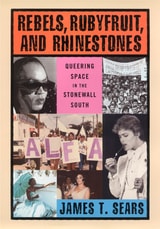
Rebels, Rubyfruit, and Rhinestones
Queering Space in the Stonewall SouthSears, James T.
Rutgers University Press, 2001
Recent Developments in Southeastern Archaeology
From Colonization to ComplexityDavid G. Anderson
University Press of Colorado, 2012

Reconsidering Mississippian Communities and Households
Edited by Elizabeth Watts Malouchos and Alleen Betzenhauser
University of Alabama Press, 2021
Advancing the study of Mississippian societies through innovative archaeological theory and method.
Published in 1995, Mississippian Communities and Households, edited by J. Daniel Rogers and Bruce D. Smith, was a foundational text that advanced southeastern archaeology in significant ways and brought household-level archaeology to the forefront of the field. Reconsidering Mississippian Communities and Households revisits and builds on what has been learned in the years since the Rogers and Smith volume, advancing the field further with the diverse perspectives of current social theory and methods and big data as applied to communities in Native America from the AD 900s to 1700s and from northeast Florida to southwest Arkansas.
Watts Malouchos and Betzenhauser bring together scholars researching diverse Mississippian Southeast and Midwest sites to investigate aspects of community and household construction, maintenance, and dissolution. Thirteen original case studies prove that community can be enacted and expressed in various ways, including in feasting, pottery styles, war and conflict, and mortuary treatments.

Reconstructing Dixie
Race, Gender, and Nostalgia in the Imagined SouthTara McPherson
Duke University Press, 2003
Illuminating crucial connections between understandings of race, gender, and place on the one hand and narrative and images on the other, McPherson reads a number of representations of the South produced from the 1930s to the present. These are drawn from fiction, film, television, southern studies scholarship, popular journalism, music, tourist sites, the internet, and autobiography. She examines modes of affect or ways of "feeling southern" to reveal how these feelings, along with the narratives and images she discusses, sanction particular racial logics. A wide-ranging cultural studies critique, Reconstructing Dixie calls for vibrant new ways of thinking about the South and for a revamped and reinvigorated southern studies.
Reconstructing Dixie will appeal to scholars in American, southern, and cultural studies, and to those in African American, media, and women’s studies.
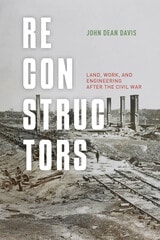
Reconstructors
Land, Work, and Engineering After the Civil WarJohn Dean Davis
University of Chicago Press, 2026
Explores the institutional and environmental transformations that occurred during the Reconstruction Era.
While the Reconstruction Era in America saw a paradigmatic realignment of the country’s core institutions and values, there was a physical quality to Reconstruction as well: the country was not only rebuilding the South after the Civil War, but flat-out building as it expanded westward.
In Reconstructors, John Dean Davis details how the Army Corps of Engineers and its subcontractors designed and redesigned the infrastructural landscape to support the republic’s rebirth. The Corps’ projects not only transformed the landscape; they created markets, fostered a distinctive expansionist culture, and—for a time—enacted a less discriminatory economic and social agenda across the South and West. Davis aims to bring federal power, environmentalism, and capitalism into a frame that reveals the landscape's power to further ideology.

Red River Blues
The Blues Tradition in the SoutheastBruce Bastin
University of Illinois Press, 1986
A Classic of Blues Literature inductee into the Blues Foundation's Blues Hall of Fame
Drawing on archives and interviews with musicians, Red River Blues remains an acclaimed work of blues scholarship. Bruce Bastin traces the origins of the music to the turn of the twentieth century, when African Americans rejected slave songs, worksongs, and minstrel music in favor of a potent new vehicle for secular musical expression. Bastin looks at the blues' early emerging popularity and its spread via the Great Migration, delves into a wealth of field recordings, and looks at the careers of Brownie McGhee, Blind Boy Fuller, Curly Weaver, Sonny Terry, and many other foundational artists.

Reformed America
The Middle and Southern States 1783-1837Fred J. Hood
University of Alabama Press, 1980
The success of the Reformed of the middle and southern states at shaping a distinctly American ideology of the relationship of religion and government was truly amazing. Unlike their New England counterparts, many of whom continued to enjoy some sort of establishment well into the nineteenth century, these Reformed entered the national experience with a backlog of experience in religious diversity and practical disestablishment, and even, in the South, as religious dissenters. They would have preferred a religious establishment that would have essentially recognized the validity of their understanding of Christianity. It was perhaps their own rigidity that caused them to fail in that attempt, especially in Virginia. But for such a rigid people, and they were rigid, they demonstrated a remarkable flexibility. When it became apparent that the American legal settlement would be one in which the state disengaged from the support of religion, the Reformed of the middle and southern states welcomed it and declared it to be the solution that would be most conducive to the spread and ultimate domination of Reformed Christianity. Unlike twentieth-century liberals, the Reformed interpreted disestablishment as the legal and official recognition of the twin Reformation doctrines of the priesthood of all believers and the absolute and unquestioned authority of the Christian Scriptures. And, to a very large degree, it was their definition, rather than the thinking of Jefferson and Madison, that captured the imagination of the American people and became the dominant popular opinion in the land.
But perhaps of even greater significance, the Reformed of the middle and southern states forged an ideology that ultimately based American national prosperity on national adherence to Reformed Christianity. Under the tutelage of John Witherspoon and Samuel Stanhope Smith, the Reformed captured the Enlightenment and brought it into the service of Reformed Christianity, altering traditional Calvinism in the process. Witherspoon and Smith, declaring that the truth of the law of nations could be devised by observation and reason alone, propounded a doctrine of natural law and political science that substantially reinforced the Calvinistic doctrine of providence in an era of skepticism and enlightenment. All history, they argued, proved beyond any reasonable doubt that those nations that adhered to the moral principles taught by Christianity had prospered and those that had taken a contrary route had fallen into ruin. The Reformed preachers of whatever denomination picked up this message and proclaimed it throughout the land. The United States, if it were to prosper, was required to be a Christian nation.
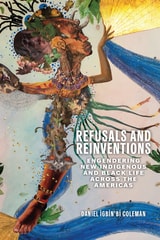
Refusals and Reinventions
Engendering New Indigenous and Black Life across the AmericasDaniel Ìgbín’bí Coleman
The Ohio State University Press, 2024
Reinventing the South
Versions of a Literary RegionMark Royden Winchell
University of Missouri Press, 2006
Religion and Race
Southern Presbyterians, 1946 to 1983Joel L. Alvis Jr
University of Alabama Press, 1994
Joel Alvis focuses on the relationships and tensions in the Presbyterian Church, U.S., whose ecclesiastical boundaries never expanded significantly beyond its original territory in the Confederacy and border South. By the time of the civil rights movement, the church was actively involved in ecumenical activities despite its regional isolation, and that involvement created unease in some quarters of the denomination. This concise institutional history traces how the church shaped and was shaped by its regional culture and explores the denomination's own cultural struggle to determine what role race issues would play in the definition of being Presbyterian.
Religion in the Old South
Donald G. Mathews
University of Chicago Press, 1979
"A major achievement—a magnificently provocative contribution to the understanding of the history of religion in America."—William G. McLoughlin, Book Reviews
"A meticulous and well-documented study . . . In the changing connotations of the word 'liberty' lie most of the dilemmas of Southern (and American) history, dilemmas Dr. Mathews analyses with considerable penetration."—Times Literary Supplement
"The most compact and yet comprehensive view of the Old South in its religious dimension that is presently available. This is a pioneering work by one who is widely read in the sources and is creative enough to synthesize and introduce fresh themes. . . . He makes a unique contribution to southern historiography which will act as a corrective upon earlier works. . . . Boldly stated, every library that consults Choice should purchase this volume."—Choice
"Mathews presents us with the findest and grandest history of old southern religion that one could imagine finding in so short a book on so large a topic. . . . Here stands in its own right a masterpiece of regional historiography of religion in America."—William A. Clebsch, Reviews in American History
Remaking the Democratic Party
Lyndon B. Johnson as a Native-Son Presidential CandidateHanes Walton Jr., Pearl K. Ford Dowe, and Josephine A. V. Allen
University of Michigan Press, 2016
Although ridiculed by contemporaries for his apparent lack of control over formal party politics and the national committee, Johnson excelled at leading the Democratic Party’s policy agenda. While a senator and as president, Johnson advocated for—and secured—liberal social welfare and civil rights legislation, forcing the party to break with its Southern tradition of elitism, conservatism, and white supremacy. In a way, Johnson set the terms for the continuing partisan battle because, by countering the Democrats’ new ideology, the Republican Party also underwent a transformation.

Republic of Barbecue
Stories Beyond the BrisketBy Elizabeth S. D. Engelhardt
University of Texas Press, 2009
Winner, Barbara Sudler Award, Colorado Historical Society, 2010
It's no overstatement to say that the state of Texas is a republic of barbecue. Whether it's brisket, sausage, ribs, or chicken, barbecue feeds friends while they catch up, soothes tensions at political events, fuels community festivals, sustains workers of all classes, celebrates brides and grooms, and even supports churches. Recognizing just how central barbecue is to Texas's cultural life, Elizabeth Engelhardt and a team of eleven graduate students from the University of Texas at Austin set out to discover and describe what barbecue has meant to Texans ever since they first smoked a beef brisket.
Republic of Barbecue presents a fascinating, multifaceted portrait of the world of barbecue in Central Texas. The authors look at everything from legendary barbecue joints in places such as Taylor and Lockhart to feedlots, ultra-modern sausage factories, and sustainable forests growing hardwoods for barbecue pits. They talk to pit masters and proprietors, who share the secrets of barbecue in their own words. Like side dishes to the first-person stories, short essays by the authors explore a myriad of barbecue's themes—food history, manliness and meat, technology, nostalgia, civil rights, small-town Texas identity, barbecue's connection to music, favorite drinks such as Big Red, Dr. Pepper, Shiner Bock, and Lone Star beer—to mention only a few. An ode to Texas barbecue in films, a celebration of sports and barbecue, and a pie chart of the desserts that accompany brisket all find homes in the sidebars of the book, while photographic portraits of people and places bring readers face-to-face with the culture of barbecue.

Return of the Gar
Mark Spitzer
University of North Texas Press, 2015

Revelation and Convergence
Mark Bosco
Catholic University of America Press, 2017
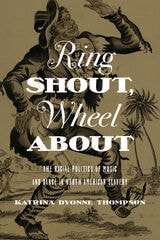
Ring Shout, Wheel About
The Racial Politics of Music and Dance in North American SlaveryKatrina D. Thompson
University of Illinois Press, 2014
In this ambitious project, historian Katrina Thompson examines the conceptualization and staging of race through the performance, sometimes coerced, of black dance from the slave ship to the minstrel stage. Drawing on a rich variety of sources, Thompson explicates how black musical performance was used by white Europeans and Americans to justify enslavement, perpetuate the existing racial hierarchy, and mask the brutality of the domestic slave trade. Whether on slave ships, at the auction block, or on plantations, whites often used coerced performances to oppress and demean the enslaved.
As Thompson shows, however, blacks' "backstage" use of musical performance often served quite a different purpose. Through creolization and other means, enslaved people preserved some native musical and dance traditions and invented or adopted new traditions that built community and even aided rebellion.
Thompson shows how these traditions evolved into nineteenth-century minstrelsy and, ultimately, raises the question of whether today's mass media performances and depictions of African Americans are so very far removed from their troublesome roots.
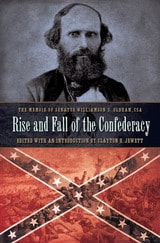
Rise and Fall of the Confederacy
The Memoir of Senator Williamson S. Oldham, CSAEdited & Intro by Clayton E. Jewett
University of Missouri Press, 2006

Road Sides
An Illustrated Companion to Dining and Driving in the American SouthBy Emily Wallace
University of Texas Press, 2019
An illustrated glovebox essential, Road Sides explores the fundamentals of a well-fed road trip through the American South, from A to Z. There are detours and destinations, accompanied by detailed histories and more than one hundred original illustrations that document how we get where we’re going and what to eat and do along the way.
Learn the backstory of food-shaped buildings, including the folks behind Hills of Snow, a giant snow cone stand in Smithfield, North Carolina, that resembles the icy treats it sells. Find out how kudzu was used to support a burgeoning highway system, and get to know Edith Edwards—the self-proclaimed Kudzu Queen—who turns the obnoxious vine into delicious teas and jellies. Discover the roots of kitschy roadside attractions, and have lunch with the state-employed mermaids of Weeki Wachee Springs in Florida.
Road Sides is for everyone—the driver in search of supper or superlatives (the biggest, best, and even worst), the person who cannot resist a local plaque or snack and pulls over for every historical marker and road stand, and the kid who just wants to gawk at a peach-shaped water tower.

Romances of the White Man's Burden
Race, Empire, and the Plantation in American Literature, 1880-1936Jeremy Wells
Vanderbilt University Press, 2011
Romances of the White Man's Burden takes on works in American literature in which the proverbial "old plantation" is made to seem not a relic but a harbinger, a sign that the South had arrived at a multiracial modernity and harmony before the rest of the United States. Focusing on writers such as Joel Chandler Harris, Thomas Nelson Page, Henry W. Grady, Thomas Dixon, and William Faulkner, Jeremy Wells reveals their shared fixation on the figure of the white southern man as specially burdened by history. Each of these writers, in his own way, presented the plantation South as an emblem, not an aberration, of America.

Rube Tube
CBS and Rural Comedy in the SixtiesSara K. Eskridge
University of Missouri Press, 2022