Results by title
53 books match the query 'Southwest' and 3 start with r
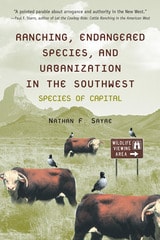
Ranching, Endangered Species, and Urbanization in the Southwest
Species of CapitalNathan F. Sayre
University of Arizona Press, 2002
Nathan Sayre now takes a close look at how the ranching ideal has come into play in the conversion of a large tract of Arizona rangeland from private ranch to National Wildlife Refuge. He tells how the Buenos Aires Ranch, a working operation for a hundred years, became not only a rallying point for multiple agendas in the "rangeland conflict" after its conversion to a wildlife refuge but also an expression of the larger shift from agricultural to urban economies in the Southwest since World War II.
The U.S. Fish and Wildlife Service bought the Buenos Aires Ranch in 1985, removed all livestock, and attempted to restore the land to its "original" grassland in order to protect an endangered species, the masked bobwhite quail. Sayre examines the history of the ranch and the bobwhite together, exploring the interplay of social, economic, and ecological issues to show how ranchers and their cattle altered the land—for better or worse—during a century of ranching and how the masked bobwhite became a symbol for environmentalists who believe that the removal of cattle benefits rangelands and wildlife.
Sayre evaluates both sides of the Buenos Aires controversy—from ranching's impact on the environment to environmentalism's sometimes misguided efforts at restoration—to address the complex and contradictory roles of ranching, endangered species conservation, and urbanization in the social and environmental transformation of the West. He focuses on three dimensions of the Buenos Aires story: the land and its inhabitants, both human and animal; the role of government agencies in shaping range and wildlife management; and the various species of capital—economic, symbolic, and bureaucratic—that have structured the activities of ranchers, environmentalists, and government officials.
The creation of the Buenos Aires National Wildlife Refuge has been a symbolic victory for environmentalists, but it comes at the cost of implicitly legitimizing the ongoing fragmentation and suburbanization of Arizona's still-wild rangelands. Sayre reveals how the polarized politics of "the rangeland conflict" have bound the Fish and Wildlife Service to a narrow, ineffectual management strategy on the Buenos Aires, with greater attention paid to increasing tourism from birdwatchers than to the complex challenge of restoring the masked bobwhite and its habitat. His findings show that the urban boom of the late twentieth century echoed the cattle boom of a century before—capitalizing on land rather than grass, humans rather than cattle—in a book that will serve as a model for restoration efforts in any environment.
Reconstructing a Chicano/a Literary Heritage
Hispanic Colonial Literature of the SouthwestEdited by María Herrera-Sobek
University of Arizona Press, 1993
Contributors:
Juan Bruce-Novoa
Ramón Gutiérrez
María Herrera-Sobek
Enrique Lamadrid
Luis Leal
Francisco A. Lomelí
Genaro Padilla
Tey Diana Rebolledo
Tino Villanueva
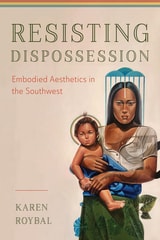
Resisting Dispossession
Embodied Aesthetics in the SouthwestKaren R. Roybal
University of Arizona Press, 2027
Illuminating the impacts of ongoing dispossession across the modern American Southwest
Resisting Dispossession examines how Native/Indigenous, Chicana/o/x, and Black communities in the American Southwest have confronted displacement and dispossession from the nineteenth century to the present. Moving beyond abstract theory, Karen R. Roybal centers cultural expression and embodied knowledge, revealing how colonialism, preservation, urban renewal, and gentrification continue to shape relationships to land, place, and belonging.
Drawing on Indigenous, Chicana feminist, and Black epistemologies, Roybal explores a diverse cultural archive of photographs, literature, musical compositions, oral histories, and storytelling practices. Through analyses of figures such as Kali Fajardo-Anstine, Raven Chacon, and Louis Carlos Bernal, alongside the stories of Chicana land grant heirs in New Mexico and southern Colorado, she demonstrates how artistic and cultural expression becomes a powerful tool for resisting erasure and reclaiming presence. Contesting representations of the Southwest made popular by figures like Ansel Adams and Georgia O’Keeffe, these works preserve alternative histories, challenge dominant narratives, and illuminate the ongoing impacts of dispossession across the region.
Interdisciplinary in scope, this work offers a fresh perspective on the intersections of aesthetics, embodiment, and power in the West and Southwest.