Results by title
382 books match the query 'Southwest (AZ, NM, OK, TX)' and 14 start with r
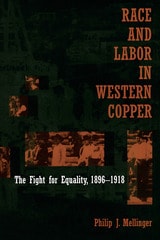
Race and Labor in Western Copper
The Fight for Equality, 1896-1918Philip J. Mellinger
University of Arizona Press, 1995
Mellinger's book is the first regional history of these ordinary working people—miners, muckers, millhands, and smelter workers—who labored in the thousands of mountain and desert mining camps across the western heartland early in this century. These men, largely uneducated, frequently moving from camp to camp, subjected to harsh and dangerous conditions, often poorly paid, nevertheless came together for a common purpose.
They came from Mexico, from the U.S. Hispanic Southwest, and from several European countries, especially from Greece, Italy, the former Yugoslavia, and Spain. They were far from a homogeneous group. Yet, in part because they set aside ethnic differences to pursue cooperative labor action, they were able to make demands, plan strikes, carry them out, and sometimes actually win. They also won the aid of the Western Federation of Miners and the more radical Industrial Workers of the World. After initial rejection, they were eventually accepted by mainstream unionists.
Mellinger discusses towns, mines, camps, companies, and labor unions, but this book is largely about people. In order to reconstruct their mining-community lives, he has used little-known union and company records, personal interviews with old-time workers and their families, and a variety of regional sources that together have enabled him to reveal a complex and significant pattern of social, economic, and political change in the American West.
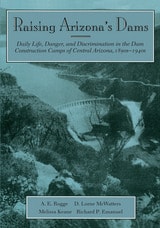
Raising Arizona's Dams
Daily Life, Danger, and Discrimination in the Dam Construction Camps of Central Arizona, 1890s-1940sA. E. Rogge, D. Lorne McWatters, Melissa Keane, and Richard P. Emanuel
University of Arizona Press, 1995

Reckon
Logan Phillips
University of Arizona Press, 2026
In Reckon, artist Logan Phillips returns to the fabled town to face the history he was raised on as a boy—gunfights, outlaws, and Hollywood cowboys—for a new, personal confrontation with the West’s foundational mythology. This hybrid memoir also explores sexuality, masculinity, parenting, and what it means to love a land rife with contradiction and “slathered in murder.”
As innovative as it is moving, this memoir is constructed of essays, photography, poetry, newspaper clippings from the Tombstone Epitaph Local Edition, and of course, movie screenplays. As he writes the characters of his past––including Youngfather and Teenme––Phillips finds the real history to be much more complex than the stories he was told. This is Tombstone in the 1980s and 90s, a century after the West’s most famous gunfight––a fifteen-second event still performed every day in historical reenactments––where Phillips’s father works as a historical exhibit designer at the Courthouse Museum and his uncle as a stuntman at Old Tucson Studios.
With an original, searing voice, Reckon is an essential answer to the tough questions of past and future, inheritance and reinvention, all from the perspective of a boy stuck in the middle.
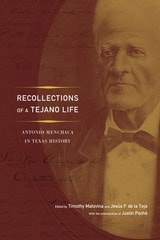
Recollections of a Tejano Life
Antonio Menchaca in Texas HistoryEdited by Timothy Matovina and Jesús F. de la Teja
University of Texas Press, 2013
San Antonio native, military veteran, merchant, and mayor pro tem José Antonio Menchaca (1800–1879) was one of only a few Tejano leaders to leave behind an extensive manuscript of recollections. Portions of the document were published in 1907, followed by a “corrected” edition in 1937, but the complete work could not be published without painstaking reconstruction. At last available in its entirety, Menchaca’s book of reminiscences captures the social life, people, and events that shaped the history of Texas’s tumultuous transformation during his lifetime. Highlighting not only Menchaca’s acclaimed military service but also his vigorous defense of Tejanos’ rights, dignity, and heritage, Recollections of a Tejano Life charts a remarkable legacy while incorporating scholarly commentary to separate fact from fiction.
Revealing how Tejanos perceived themselves and the revolutionary events that defined them, this wonderfully edited volume presents Menchaca’s remembrances of such diverse figures as Antonio López de Santa Anna, Jim Bowie, Davy Crockett, Sam Houston, General Adrián Woll, Comanche chief “Casamiro,” and Texas Ranger Jack Hays. Menchaca and his fellow Tejanos were actively engaged in local struggles as Mexico won her independence from Spain; later many joined the fight to establish the Republic of Texas, only to see it annexed to the United States nine years after the Battle of San Jacinto. This first-person account corrects important misconceptions and brings previously unspoken truths vividly to life.
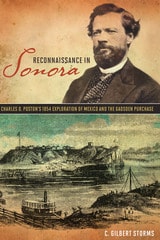
Reconnaissance in Sonora
Charles D. Poston’s 1854 Exploration of Mexico and the Gadsden PurchaseC. Gilbert Storms
University of Arizona Press, 2015
Poston led his party through Sonora and the territory of the 1854 Gadsden Purchase, which today encompasses southern Arizona and a portion of southern New Mexico. The syndicate’s charge to the young adventurer was to acquire land in Mexico in anticipation of the Gadsden Purchase and the building of the transcontinental railroad. Reconnaissance in Sonora details Poston’s expedition, including the founding of the town of Colorado City at the site of present-day Yuma, Arizona.
C. Gilbert Storms explores the American ideas of territorial expansion and Manifest Destiny, the national debate over a route for a transcontinental railroad, the legends of rich gold and silver mines in northern Mexico, and the French and American filibusters that plagued northern Mexico in the early 1850s.

Red Scare
Right-Wing Hysteria, Fifties Fanaticism, and Their Legacy in TexasBy Don Carleton
University of Texas Press, 2014

Red State
An Insider's Story of How the GOP Came to Dominate Texas PoliticsBy Wayne Thorburn
University of Texas Press, 2014
In November 1960, the Democratic party dominated Texas. The newly elected vice president, Lyndon Johnson, was a Texan. Democrats held all thirty statewide elective positions. The state legislature had 181 Democrats and no Republicans or anyone else. Then fast forward fifty years to November 2010. Texas has not voted for a Democratic president since 1976. Every statewide elective office is held by Republicans. Representing Texas in Washington is a congressional delegation of twenty-five Republicans and nine Democrats. Republicans control the Texas Senate by a margin of nineteen to twelve and the Texas House of Representatives by 101 to 49.
Red State explores why this transformation of Texas politics took place and what these changes imply for the future. As both a political scientist and a Republican party insider, Wayne Thorburn is especially qualified to explain how a solidly one-party Democratic state has become a Republican stronghold. He analyzes a wealth of data to show how changes in the state’s demographics—including an influx of new residents, the shift from rural to urban, and the growth of the Mexican American population—have moved Texas through three stages of party competition, from two-tiered politics, to two-party competition between Democrats and Republicans, and then to the return to one-party dominance, this time by Republicans. His findings reveal that the shift from Democratic to Republican governance has been driven not by any change in Texans’ ideological perspective or public policy orientation—even when Texans were voting Democrat, conservatives outnumbered liberals or moderates—but by the Republican party’s increasing identification with conservatism since 1960.

Rehab on the Range
A History of Addiction and Incarceration in the American WestHolly M. Karibo
University of Texas Press, 2024
2026 Texas Christian University (TCU) Texas Book Award Winner
2025 Coral Horton Tullis Memorial Prize, Texas State Historical Association
2025 Outstanding Academic Title, CHOICE
The first study of the Fort Worth Narcotic Farm, an institution that played a critical role in fusing the War on Drugs, mass incarceration, and public health in the American West.
In 1929, the United States government approved two ground-breaking and controversial drug addiction treatment programs. At a time when fears about a supposed rise in drug use reached a fevered pitch, the emergence of the nation’s first “narcotic farms” in Fort Worth, Texas, and Lexington, Kentucky, marked a watershed moment in the treatment of addiction. Rehab on the Range is the first in-depth history of the Fort Worth Narcotic Farm and its impacts on the American West. Throughout its operation from the 1930s to the 1970s, the institution was the only federally funded drug treatment center west of the Mississippi River. Designed to blend psychiatric treatment, physical rehabilitation, and vocational training, the Narcotic Farm, its proponents argued, would transform American treatment policies for the better. The reality was decidedly more complicated.
Holly M. Karibo tells the story of how this institution—once framed as revolutionary for addiction care—ultimately contributed to the turn towards incarceration as the solution to the nation’s drug problem. Blending an intellectual history of addiction and imprisonment with a social history of addicts’ experiences, Rehab on the Range provides a nuanced picture of the Narcotic Farm and its cultural impacts. In doing so, it offers crucial historical context that can help us better understand our current debates over addiction, drug policy, and the rise of mass incarceration.
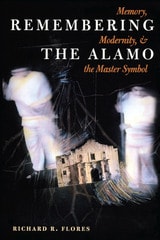
Remembering the Alamo
Memory, Modernity, and the Master SymbolBy Richard R. Flores
University of Texas Press, 2002
"Remember the Alamo!" reverberates through Texas history and culture, but what exactly are we remembering? Over nearly two centuries, the Mexican victory over an outnumbered band of Alamo defenders has been transformed into an American victory for the love of liberty. Why did the historical battle of 1836 undergo this metamorphosis in memory and mythology to become such a potent master symbol in Texan and American culture?
In this probing book, Richard Flores seeks to answer that question by examining how the Alamo's transformation into an American cultural icon helped to shape social, economic, and political relations between Anglo and Mexican Texans from the late nineteenth to the mid-twentieth centuries. In the first part of the book, he looks at how the attempts of heritage society members and political leaders to define the Alamo as a place have reflected struggles within Texas society over the place and status of Anglos and Mexicans. In the second part, he explores how Alamo movies and the transformation of Davy Crockett into an Alamo hero/martyr have advanced deeply racialized, ambiguous, and even invented understandings of the past.
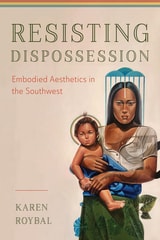
Resisting Dispossession
Embodied Aesthetics in the SouthwestKaren R. Roybal
University of Arizona Press, 2027
Illuminating the impacts of ongoing dispossession across the modern American Southwest
Resisting Dispossession examines how Native/Indigenous, Chicana/o/x, and Black communities in the American Southwest have confronted displacement and dispossession from the nineteenth century to the present. Moving beyond abstract theory, Karen R. Roybal centers cultural expression and embodied knowledge, revealing how colonialism, preservation, urban renewal, and gentrification continue to shape relationships to land, place, and belonging.
Drawing on Indigenous, Chicana feminist, and Black epistemologies, Roybal explores a diverse cultural archive of photographs, literature, musical compositions, oral histories, and storytelling practices. Through analyses of figures such as Kali Fajardo-Anstine, Raven Chacon, and Louis Carlos Bernal, alongside the stories of Chicana land grant heirs in New Mexico and southern Colorado, she demonstrates how artistic and cultural expression becomes a powerful tool for resisting erasure and reclaiming presence. Contesting representations of the Southwest made popular by figures like Ansel Adams and Georgia O’Keeffe, these works preserve alternative histories, challenge dominant narratives, and illuminate the ongoing impacts of dispossession across the region.
Interdisciplinary in scope, this work offers a fresh perspective on the intersections of aesthetics, embodiment, and power in the West and Southwest.

Roll Away Saloon
Rowland W. Rider as told to Deirdre M. Paulsen
Utah State University Press, 1985

Rotten Boroughs, Political Thickets, and Legislative Donnybrooks
Redistricting in TexasEdited by Gary A. Keith
University of Texas Press, 2013
Every ten years, the Texas legislature redistricts itself and the state’s congressional districts in an attempt to ensure equality in representation. With a richly textured cultural fabric, Texas often experiences redistricting battles that are heated enough to gain national attention. Collecting a variety of voices, including legislators themselves, in addition to lawyers, community organizers, political historians, and political scientists, Rotten Boroughs, Political Thickets, and Legislative Donnybrooks delivers a multidimensional picture of how redistricting works in Texas today, and how the process evolved.
In addition to editor Gary Keith’s historical narrative, which emphasizes the aftermath of the Warren Court’s redistricting decisions, longtime litigators David Richards and J. D. Pauerstein describe the contentious lines drawn from the 1970s into the 2000s. Former state legislator and congressman Craig Washington provides an insider’s view, while redistricting attorney and grassroots organizer Jose Garza describes the repercussions for Mexican Americans in Texas. Balancing these essays with a quantitative perspective, political scientists Seth McKee and Mark McKenzie analyze the voting data for the 2000 decade to describe the outcomes of redistricting. The result is a timely tour that provides up-to-date context, particularly on the role of the Voting Rights Act in the twenty-first century. From local community engagement to the halls of the Capitol, this is the definitive portrait of redistricting and its repercussions for all Texans.
Rudo Ensayo
A Description of Sonora and Arizona in 1764Juan Nentvig; Translated, Clarified, and Annotated by Alberto Francisco Pradeau and Robert R. Rasmussen
University of Arizona Press, 1980
Rules and Precepts of the Jesuit Missions of Northwestern New Spain
Charles W. Polzer
University of Arizona Press, 1976