Results by title
234 books match the query 'Technological innovations' and 6 start with r
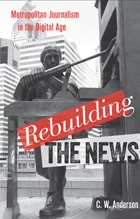
Rebuilding the News
Metropolitan Journalism in the Digital AgeC. W. Anderson
Temple University Press, 2013
Breaking down the walls of the traditional newsroom, Rebuilding the News traces the evolution of news reporting as it moves from print to online. As the business models of newspapers have collapsed, author C. W. Anderson chronicles how bloggers, citizen journalists, and social networks are implicated in the massive changes confronting journalism.
Through a combination of local newsroom fieldwork, social-network analysis, and online archival research, Rebuilding the News places the current shifts in news production in socio-historical context. Focusing on the Philadelphia Inquirer, the Philadelphia Daily News, Anderson presents a gripping case study of how these papers have struggled to adapt to emerging economic, social, and technological realities.
As he explores the organizational, networked culture of journalism, Anderson lays bare questions about the future of news-oriented media and its evolving relationship with “the public” in the digital age.
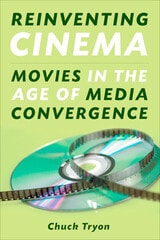
Reinventing Cinema
Movies in the Age of Media ConvergenceTryon, Chuck
Rutgers University Press, 2009
Reinventing Cinema examines film culture at the turn of this century, at the precise moment when digital media are altering our historical relationship with the movies. Spanning multiple disciplines, Chuck Tryon addresses the interaction between production, distribution, and reception of films, television, and other new and emerging media.Through close readings of trade publications, DVD extras, public lectures by new media leaders, movie blogs, and YouTube videos, Tryon navigates the shift to digital cinema and examines how it is altering film and popular culture.
Reproductive Labor and Innovation
Against the Tech Fix in an Era of HypeJennifer Denbow
Duke University Press, 2024

Resistance to Innovation
Its Sources and ManifestationsShaul Oreg and Jacob Goldenberg
University of Chicago Press, 2015
Shaul Oreg and Jacob Goldenberg bring the insights of marketing and organizational behavior to bear on the attitudes and behaviors of the remaining 80 percent who resist innovation. The authors identify two competing definitions of resistance: In marketing, resistance denotes a reluctance to adopt a worthy new product, or one that offers a clear benefit and carries little or no risk. In the field of organizational behavior, employees are defined as resistant if they are unwilling to implement changes regardless of the reasons behind their reluctance. Seeking to clarify the act of rejecting a new product from the reasons—rational or not—consumers may have for doing so, Oreg and Goldenberg propose a more coherent definition of resistance less encumbered by subjective, context-specific factors and personality traits. The application of this tighter definition makes it possible to disentangle resistance from its sources and ultimately offers a richer understanding of consumers’ underlying motivations. This important research is made clear through the use of many real-life examples.

Restoring Baird's Image
Donald F. McLean
The Institution of Engineering and Technology, 2000
Rhetorical Mediator
Understanding Agency in Indigenous Translation and Interpretation through Indigenous Approaches to UXNora K. Rivera
Utah State University Press, 2023
In places where Indigenous language translation and interpretation are greatly needed, Indigenous language mediators often lack adequate systems to professionalize their field while withstanding Western practices that do not align with their worldviews. Through a “design thinking” methodology based on her work organizing and participating in an Indigenous-focused interpreter and translator conference, Rivera examines testimonios and semi-structured interviews conducted with Indigenous interpreters and translators to emphasize dialogue and desahogo (emotional release) as Indigenous communication practices.
The Rhetorical Mediator advocates for Indigenous language practices that have been sidelined by Western scholarship and systems, helping to create more equitable processes to directly benefit Indigenous individuals and other underrepresented groups. This book benefits specialists, including UX researchers, technical and professional communicators, interpreters and translators, and Indigenous professionals, as well as academics teaching graduate and undergraduate methods, Indigenous rhetoric and translation, and UX courses.