Results by title
111 books match the query 'Trials, litigation, etc' and 6 start with r
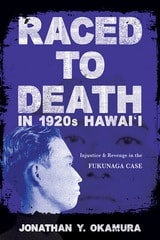
Raced to Death in 1920s Hawai i
Injustice and Revenge in the Fukunaga CaseJonathan Y. Okamura
University of Illinois Press, 2019
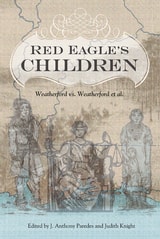
Red Eagle's Children
Weatherford vs. Weatherford et al.Edited by J. Anthony Paredes and Judith Knight
University of Alabama Press, 2012
Tracing identity, law, and legacy in an inheritance dispute that reveals the intersection of two cultural and legal systems: Creek Indian and Euro-American.
In 1846, in the Chancery Court of Mobile, Alabama, William “Red Eagle” Weatherford’s son, by the Indian woman Supalamy, sued his half siblings fathered by Weatherford with two other Creek women, Polly Moniac and Mary Stiggins, for a greater share of Weatherford’s estate. While the court recognized William Jr. as the son of William Sr., he nevertheless lost his petition for inheritance due to the lack of legal evidence concerning the marriage of his biological mother to William Sr. The case, which went to the Alabama Supreme Court in 1851, provides a record of an attempt to interrelate and, perhaps, manipulate differences in cultures as they played out within the ritualized, arcane world of antebellum Alabama jurisprudence.
Although the case has value in the classic mold of salvage ethnography of Creek Indian culture, Red Eagle’s Children, edited by J. Anthony Paredes and Judith Knight, shows that its more enduring value lies in being a source for historical ethnography—that is, for anthropological analyses of cultural dynamics of the past events that complement the narratives of professional historians.
CONTRIBUTORS: David I. Durham / Robbie Ethridge / Judith Knight / J. Anthony Paredes / Paul M. Pruitt Jr. / Nina Gail Thrower / Robert Thrower / Gregory A. Waselkov
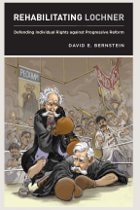
Rehabilitating Lochner
Defending Individual Rights against Progressive ReformDavid E. Bernstein
University of Chicago Press, 2011
In this timely reevaluation of an infamous Supreme Court decision, David E. Bernstein provides a compelling survey of the history and background of Lochner v. New York. This 1905 decision invalidated state laws limiting work hours and became the leading case contending that novel economic regulations were unconstitutional. Sure to be controversial, Rehabilitating Lochner argues that the decision was well grounded in precedent—and that modern constitutional jurisprudence owes at least as much to the limited-government ideas of Lochner proponents as to the more expansive vision of its Progressive opponents.
Tracing the influence of this decision through subsequent battles over segregation laws, sex discrimination, civil liberties, and more, Rehabilitating Lochner argues not only that the court acted reasonably in Lochner, but that Lochner and like-minded cases have been widely misunderstood and unfairly maligned ever since.
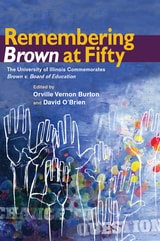
Remembering Brown at Fifty
The University of Illinois Commemorates Brown v. Board of EducationEdited by Orville Vernon Burton and David O'Brien
University of Illinois Press, 2009
Inspired by the University of Illinois's celebration of the Brown v. Board of Education decision's fiftieth anniversary, this collection addresses the significance of Brown in the contributors' lives or work in education and civil rights. Several authors describe their personal roles in the Brown case or similar cases, while others examine and illustrate events, performances, and exhibitions that were part of the anniversary commemoration. The book not only explores the repercussions of the Brown decision, but also stands as a historic document in its own right, preserving the reactions of many prominent intellectuals, artists, and activists fifty years after the decision.
Contributors are Kal Alston, Margaret L. Andersen, Kathryn H. Anthony, Nathaniel C. Banks, Bernice McNair Barnett, Christopher Benson, Ed Blankenheim, Julian Bond, Orville Vernon Burton, Jason Chambers, Constance Curry, Joseph A. De Laine Jr., Mary L. Dudziak, Joe R. Feagin, John Hope Franklin, Ophelia De Laine Gona, Lani Guinier, Darlene Clark Hine, Freeman A. Hrabowski III, John Jennings, Ralph Lemon, George Lipsitz, Jim Loewen, Laughlin McDonald, David O'Brien, James C. Onderdonk, Sekou Sundiata, Christopher Teal, Nicholas Watkins, Carrie Mae Weems, Juan Williams, and Joy Ann Williamson.
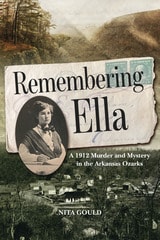
Remembering Ella
A 1912 Murder and Mystery in the Arkansas OzarksNita Gould
Butler Center for Arkansas Studies, 2018
This examination of the murder of Ella Barham and the trial of her alleged killer opens a window into the meaning of community and due process during a time when politicians and judges sought to professionalize justice, moving from local hangings to state-run executions. Davidson’s appeal has been cited as a precedent in numerous court cases and his brief was reviewed by the lawyers in Georgia who prepared Leo Frank’s appeal to the U.S. Supreme Court in 1915.
Author Nita Gould is a descendant of the Barhams of Boone County and Ella Barham’s cousin. Her tenacious pursuit to create an authoritative account of the community, the crime, and the subsequent legal battle spanned nearly fifteen years. Gould weaves local history and short biographies into her narrative and also draws on the official case files, hundreds of newspaper accounts, and personal Barham family documents. Remembering Ella reveals the truth behind an event that has been a staple of local folklore for more than a century and still intrigues people from around the country.
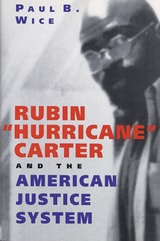
Rubin ' Hurricane' Carter and the American Justice System
Wice, Paul B
Rutgers University Press, 2000
Winner of the 2001 New Jersey Author's Award by the New Jersey Academic Alliance
Paul Wice takes the famous case of Rubin “Hurricane” Carter to another level of scrutiny as he puts the criminal justice system itself on trial. The case illustrates many of the strengths and weaknesses of our nation’s much maligned criminal justice system while affirming the power and resoluteness of the human spirit.
Early on the morning of June 17, 1966, the sound of gunfire echoed through the quite streets of Paterson, New Jersey, as four people were shot, three fatally, inside the Lafayette Bar and Grill. Twenty-nine-year-old Rubin “Hurricane” Carter, a prominent professional boxer, along with his companion, John Artis, were arrested and charged with committing this brutal crime. Prosecutors would later theorize that the murders were racially motivated — Carter and Artis are black, the victims white — to avenge the killing of a black Paterson tavern owner. Despite barely credible and oft-times contradictory evidence presented by both sides, a year after the killings Carter and Artis were convicted of murder and sentenced to life in prison. A second jury upheld the previous convictions in 1976. Artis was imprisoned until 1981, when he was released on parole. Carter remained in jail until 1988, when acting prosecutor John Goceljak elected not to pursue a third trial following the reversal of the 1976 retrial by the Federal District Court, a decision ultimately affirmed by the Circuit Court of Appeals and the U.S. Supreme Court. With the release of the widely discussed movie on Carter starring Denzel Washington, the case has again become visible and controversial.
Wice follows the torturous legal path of this case as it wound its way through first the New Jersey then the federal justice system for the next twenty-two years. His interpretations are informed by interviews with key members of both the prosecution and defense as well as previously unused court documents and transcripts. Wice evaluates the Carter case within a larger theoretical framework to illustrate many of the critical weaknesses of the adversary system and appeals process that is so basic to the American judicial system. Here is what can happen when police and prosecutors act unprofessionally, when critical witnesses lie, and when the justice system itself is unwilling to correct its errors or admit its mistakes.