Results by title
441 books match the query 'Women and literature' and 22 start with r
REGULATIONS OF ROBBERS
LEGAL FICTIONS OF SLAVERY AND RESISTANCEChristina Accomando
The Ohio State University Press, 2001
Race and Time
American Women's Poetics from Antislavery to Racial ModernityJanet Gray
University of Iowa Press, 2004
Gray clarifies the cultural roles women’s poetry played in the nineteenth-century United States and also reveals that these poems offer a fascinating, dynamic, and diverse field for students of social and cultural history. Gray’s readings provide a rich sense of the contexts in which this poetry is embedded and examine its aesthetic and political vitality in meticulous detail, linking careful explication of the texts with analysis of the history of poetry, canons, literacy, and literary authority.
Race and Time distinguishes itself from other critical studies not only through its searching, in-depth readings but also through its sustained attention to less known poets and its departure from a Dickinson-centered model. Most significantly, it offers a focus on race, demonstrating how changes in both the U.S. racial structure and women’s place in public culture set the terms for change in how women poets envisioned the relationship between poetry and social power.
Gray’s work makes contributions to several fields of study: poetry, U.S. literary history and American studies, women’s studies, African American studies and whiteness studies, children’s literature, and cultural studies. While placing the works of figures who have been treated elsewhere (e.g., Dickinson and Harper) into revealing new relationships, Race and Time does much to open interdisciplinary discussion of unfamiliar works.

Raising the Dust
The Literary Housekeeping of Mary Ward, Sarah Grand, and Charlotte Perkins GilmanBeth Sutton-Ramspeck
Ohio University Press, 2004
To Mary Augusta Ward, Sarah Grand, and Charlotte Perkins Gilman, housekeeping represented public responsibilities: making the food supply safe, reforming politics, and improving the human race itself. Raising the Dust places their writing in the context of the late-Victorian era, in particular the eugenics movement, the proliferation of household conveniences, the home economics movement, and decreased reliance on servants. These changes affected relationships between the domestic sphere and the public sphere, and hence shaped the portrayal of domesticity in the era's fiction and nonfiction.
Moreover, Ward, Grand, and Gilman articulated a domestic aesthetic that swept away boundaries. Sutton-Ramspeck uncovers a new paradigm here: literature as engaging the public realm through the devices and perspectives of the domestic. Her innovative and ambitious book also connects fixations on cleaning with the discovery of germs (the first bacterium discovered was anthrax, and knowledge of its properties increased fears of dust); analyzes advertising cards for soap; and links the mental illness in Gilman's “The Yellow Wall-Paper” to fears during the period of arsenic poisoning from wallpaper.

Rape Of Clarissa
Writing, Sexuality, and Class Struggle in Samuel RichardsonTerry Eagleton
University of Minnesota Press, 1982
Rape and Writing in the Heptameron of Marguerite de Navarre
Patricia Francis Cholakian
Southern Illinois University Press, 1991
Marguerite de Navarre (1492–1549), the sister of the French king François I, composed the Heptaméron as a complex collection of seventy-two novellas, creating one of the first examples of realistic, psychological fiction in French literature. These novellas, framed by debates among ten storytellers, all noble lords and ladies, reveal the author’s desire to depart from the purely masculine voice of the age.
Cholakian contends that this Renaissance text is characterized by feminine writing. She reads the text as the product of the author’s personal experience. Beginning her study with the rape narrative in the autobiographical novella 4, she examines how the Heptaméron interacts with male literary traditions and narrative conventions about gender relations. She analyzes such words as rape, and honor, noting how they are defined differently by men and women and how these differences in perception affect the development of both plot and character.
Reading the East India Company 1720-1840
Colonial Currencies of GenderBetty Joseph
University of Chicago Press, 2003
Drawing on the British East India Company's records as well as novels, memoirs, portraiture and guidebooks, Joseph shows how the company's economic and archival practices intersected to produce colonial "fictions" or "truth-effects" that strictly governed class and gender roles—in effect creating a "grammar of power" that kept the far-flung empire intact. And while women were often excluded from this archive, Joseph finds that we can still hear their voices at certain key historical junctures. Attending to these voices, Joseph illustrates how the writing of history belongs not only to the colonial project set forth by British men, but also to the agendas and mechanisms of agency—of colonized Indian, as well as European women. In the process, she makes a valuable and lasting contribution to gender studies, postcolonial theory, and the history of South Asia.

Rebecca Harding Davis
A Life Among WritersSharon M. Harris
West Virginia University Press, 2019
2018 Choice Outstanding Academic Title
This accessible treatment of Davis’s life, based on deep research in archival sources, provides new perspective on topics ranging from sectional tensions in the border South to the gendered world of nineteenth-century publishing. It promises to be the authoritative treatment of an important figure in the literary history of West Virginia and the wider world.
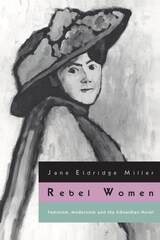
Rebel Women
Feminism, Modernism and the Edwardian NovelJane Eldridge Miller
University of Chicago Press, 1996
"Miller's is the best account we have, not only of Edwardian women novelists, but of early 20th-century women novelists; the measure of her achievement is that the distinction no longer seems workable." —David Trotter, The London Review of Books
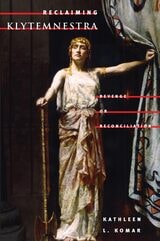
Reclaiming Klytemnestra
REVENGE OR RECONCILIATIONKathleen L. Komar
University of Illinois Press, 2003
By slaying her husband, Klytemnestra exposed the competing ethics of motherhood and matrimony at the beginnings of the Western tradition. In this interdisciplinary study, Kathleen L. Komar first examines the classical archetype of Klytemnestra established by writers such as Aeschylus, Sophocles, and Euripides. Turning to the twentieth century, she investigates the work of modern writers who, since the 1960s, have reconceptualized Klytemnestra’s actions and motivations in the contemporary contexts of dance, fiction, drama, poetry, and the Internet. These revisions include a Martha Graham ballet; a performance piece by multiple authors; a play by Dacia Maraini; novels by Christa Reinig, Nancy Bogen, Christa Wolf, and Marie Cardinal; a short story by Christine Brückner; a poem by Laura Kennelly; a mixed-genre piece by Séverine Auffret; and two Internet presentations.
Eloquent, provocative, and richly detailed, Reclaiming Klytemnestra asks us to reassess the roles women were assigned at the beginnings of Western culture and to reenvision how those roles might be changed in the new millennium.
Rediscovering Nancy Drew
Carolyn Stewart Dyer
University of Iowa Press, 1995
Reinterpreting the Spanish American Essay
Women Writers of the 19th and 20th CenturiesEdited by Doris Meyer
University of Texas Press, 1995
Latin American women have long written essays on topics ranging from gender identity and the female experience to social injustice, political oppression, lack of educational opportunities, and the need for female solidarity in a patriarchal environment. But this rich vein of writing has often been ignored and is rarely studied.
This volume of twenty-one original studies by noted experts in Latin American literature seeks to recover and celebrate the accomplishments of Latin American women essayists. Taking a variety of critical approaches, the authors look at the way women writers have interpreted the essay genre, molded it to their expression, and created an intellectual tradition of their own. Some of the writers they treat are Flora Tristan, Gertrudis Gómez de Avellaneda, Clorinda Matto de Turner, Victoria Ocampo, Alfonsina Storni, Rosario Ferré, Christina Peri Rossi, and Elena Poniatowska.
This book is the first of a two-volume project that reexamines the Latin American essay from a feminist perspective. The second volume, also edited by Doris Meyer, contains thirty-six essays in translation by twenty-two women authors.

Reinventing Romantic Poetry
Russian Women Poets of the Mid-Nineteenth CenturyDiana Greene
University of Wisconsin Press, 2003
Reinventing Romantic Poetry offers a new look at the Russian literary scene in the nineteenth century. While celebrated poets such as Aleksandr Pushkin worked within a male-centered Romantic aesthetic—the poet as a bard or sexual conqueror; nature as a mother or mistress; the poet’s muse as an idealized woman—Russian women attempting to write Romantic poetry found they had to reinvent poetic conventions of the day to express themselves as women and as poets. Comparing the poetry of fourteen men and fourteen women from this period, Diana Greene revives and redefines the women’s writings and offers a thoughtful examination of the sexual politics of reception and literary reputation.
The fourteen women considered wrote poetry in every genre, from visions to verse tales, from love lyrics to metaphysical poetry, as well as prose works and plays. Greene delves into the reasons why their writing was dismissed, focusing in particular on the work of Evdokiia Rostopchina, Nadezhda Khvoshchinskaia, and Karolina Pavlova. Greene also considers class as a factor in literary reputation, comparing canonical male poets with the work of other men whose work, like the women’s, was deemed inferior at the time. The book also features an appendix of significant poems by Russian women discussed in the text. Some, found in archival notebooks, are published here for the first time, and others are reprinted for the first time since the mid-nineteenth century.
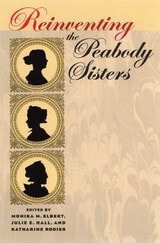
Reinventing the Peabody Sisters
Monika M. Elbert
University of Iowa Press, 2006
Reinventing the Peabody Sisters seeks to redefine this dynamic trio’s relationship to the literary and political movements of the mid nineteenth century. Previous scholarship has romanticized, vilified, or altogether erased their influences and literary productions or viewed these individuals solely in light of their relationships to other nineteenth-century luminaries, particularly men—Ralph Waldo Emerson, Nathaniel Hawthorne, Horace Mann. This collection underscores that each woman was a creative force in her own right.
Despite their differences and sibling conflicts, all three sisters thrived in the rarefied—if economically modest—atmosphere of a childhood household that glorified intellectual and artistic pursuits. This background allowed each woman to negotiate the nineteenth-century literary marketplace and in the process redefine its scope. Elizabeth, Mary, and Sophia remained linked throughout their lives, encouraging, complementing, and sometimes challenging each other's endeavors while also contributing to each other’s literary work.
The essays in this collection examine the sisters’ confrontations with and involvement in the intellectual movements and social conflicts of the nineteenth century, including Transcendentalism, the Civil War, the role of women, international issues, slavery, Native American rights, and parenting. Among the most revealing writings that the sisters left behind, however, are those which explore the interlaced relationship that continued throughout their remarkable lives.
Resisting Regionalism
Gender And Naturalism In American Fiction, 1885-1915Donna Campbell
Ohio University Press, 1997
When James Lane Allen defined the “Feminine Principle” and the “Masculine Principle” in American fiction for the Atlantic Monthly in 1897, he in effect described local color fiction and naturalism, two branches of realism often regarded as bearing little relationship to each other. In this award-winning study of both movements, Resisting Regionalism explores the effect the cultural dominance of women’s local color fiction in the 1890’s had on young male naturalist writers, who rebelled against the local colorists and their “teacup tragedies.”
An immensely popular genre, local color fiction reached its peak in the 1880s in such literary journals as Harper’s Monthly, Scribner’s, the Atlantic Monthly, and the Century. These short stories exhibited local “characters,” depicted marginal groups and vanishing folkways, and addressed issues of absence, loss, limitation, and the past. Despite such prickly themes, according to Donna Campbell, local color fiction “fulfilled some specific needs of the public – for nostalgia, for a retreat into mildly exotic locales, for a semblance of order preserved in ritual.”
By the turn of the century, however, local color fiction was fading from the scene, supplanted by writers of adventure fiction and historical romances, with whom local colorists increasingly merged, and opposed by the naturalists. In examining this historic shift, Resisting Regionalism shows that far from being distanced from local color fiction, nationalism emerged in part as a dissenting response to its popularity and to the era’s concerns about the dominance of feminine influence in American literature. The new generation of authors, including Crane, Norris, London, Frederic, Wharton, resisted the cultural myths and narrative strategies common to local colorists Sarah Orne Jewett, Rose Terry Cooke, Mary E. Wilkins Freeman, and Constance Fenimore Woolson. Yet, as Campbell underscores in her analysis of Stephan Crane’s The Monster, the naturalists could, and did, integrate local color conventions with the grotesque and horrifying to powerful effect.
In clear, accessible prose, Resisting Regionalism provides fresh readings of naturalistic works in the context of the dispute between local color and naturalism. In the process, this book shows the debt naturalism owes to local color fiction and illuminates a neglected but significant literary era.
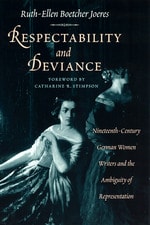
Respectability and Deviance
Nineteenth-Century German Women Writers and the Ambiguity of RepresentationRuth-Ellen Boetcher Joeres
University of Chicago Press, 1998
Studying a period of German literary history that has been largely ignored by modern readers, Ruth-Ellen Boetcher Joeres demonstrates that these writings offer intriguing opportunities to examine such critical topics as canon formation; the relationship between gender, class, and popular culture; and women, professionalism, and technology. The writers she explores range from Annette von Droste-Hülshoff, who managed to work her way into the German canon, to the popular serial novelist E. Marlitt, from liberal writers such as Louise Otto and Fanny Lewald, to the virtually unknown novelist and journalist Claire von Glümer. Through this investigation, Boetcher Joeres finds ambiguities, compromises, and subversions in these texts that offer an extensive and informative look at the exciting and transformative epoch that so much shaped our own.
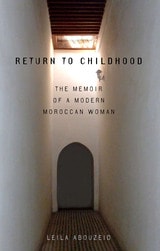
Return to Childhood
The Memoir of a Modern Moroccan WomanBy Leila Abouzeid
University of Texas Press, 1998
Leila Abouzeid, whose novel Year of the Elephant has gone through six reprintings, has now translated her childhood memoir into English. Published in Rabat in 1993 to critical acclaim, the work brings to life the interlocking dramas of family ties and political conflict.
Against a background of Morocco's struggle for independence from French colonial rule, Abouzeid charts the development of personal relationships, between generations as well as between husbands and wives. Abouzeid's father is a central figure; as a strong advocate of Moroccan nationalism, he was frequently imprisoned by the French and his family forced to flee the capital. Si Hmed was a public hero, but the young daughter's memories of her famous father and of the family's plight because of his political activities are not so idyllic.
The memoir utilizes multiple voices, especially those of women, in a manner reminiscent of the narrative strategies of the oral tradition in Moroccan culture. Return to Childhood may also be classified as an autobiography, a form only now gaining respect as a valid literary genre in the Middle East. Abouzeid's own introduction and Elizabeth Fernea's foreword discuss this new development in Arabic literature.

Revising the Word and the World
Essays in Feminist Literary CriticismEdited by Vèvè A. Clark, Ruth-Ellen Boetcher Joeres, and Madelon Sprengnether
University of Chicago Press, 1993
Three powerful interviews with writers of different nationalities (Audre Lorde, Simone de Beauvoir, and Carmen Naranjo) introduce topics echoed in the essays that follow: the interplay between women's writing and feminist theory, the politics of writing, and the roles of race, class, and sexual orientation in artistic production. These issues are engaged on a theoretical level by three essays that represent today's most prominent areas of concern for feminist literary criticism. The theoretical perspectives advanced in this anthology provide models for reading the traditional expressions of women worldwide including oratory and performance as well as literature in the more conventional sense.
Contributors include Jane Flax on "Postmodernism and Gender Relations in Feminist Theory," Evelyn Brooks Higginbotham on "African-American Women's History and the Metalanguage of Race," Paula Bennett on "Female Sexual Imagery and Feminist Psychoanalytic Theory," Leslie Rabine on "Social Gender and Symbolic Gender in the Writings of Maxine Hong Kingston," Joyce Zonana on "Feminist Orientalism and the Structure of Jane Eyre," Jane Desmond on "Cultural Imperialism and Ruth St. Denis's 'Radha' of 1906," Terri Brint Joseph on "Poetry as a Strategy of Power: The Case of Riffian Berber Women," Chikwenye Ogunyemi on "The Contemporary Black Female Novel in English," and Sandra Zagarell on "Narrative of Community."
This collection is especially appropriate for scholars and students of feminist literary criticism, women's studies, English, and ethnic studies.
Essays were originally published in Signs: Journal of Women in Culture and Society.
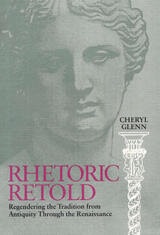
Rhetoric Retold
Regendering the Tradition from Antiquity Through the RenaissanceCheryl Glenn
Southern Illinois University Press, 1997
After explaining how and why women have been excluded from the rhetorical tradition from antiquity through the Renaissance, Cheryl Glenn provides the opportunity for Sappho, Aspasia, Diotima, Hortensia, Fulvia, Julian of Norwich, Margery Kempe, Margaret More Roper, Anne Askew, and Elizabeth I to speak with equal authority and as eloquently as Plato, Aristotle, Cicero, and Augustine. Her aim is nothing less than regendering and changing forever the history of rhetoric.
To that end, Glenn locates women’s contributions to and participation in the rhetorical tradition and writes them into an expanded, inclusive tradition. She regenders the tradition by designating those terms of identity that have promoted and supported men’s control of public, persuasive discourse—the culturally constructed social relations between, the appropriate roles for, and the subjective identities of women and men.
Glenn is the first scholar to contextualize, analyze, and follow the migration of women’s rhetorical accomplishments systematically. To locate these women, she follows the migration of the Western intellectual tradition from its inception in classical antiquity and its confrontation with and ultimate appropriation by evangelical Christianity to its force in the medieval Church and in Tudor arts and politics.
Ritual, Myth, and Mysticism in the Work of Mary Butts
Between Feminism and ModernismFOY ROSLYN
University of Arkansas Press, 2000
Robert Frost and Feminine Literary Tradition
Karen L. Kilcup
University of Michigan Press, 1998
Romance and the Erotics of Property
Mass-Market Fiction for WomenJan Cohn
Duke University Press, 1988
Cohn argues that a full understanding of the contemporary romance requires an investigation of its literary and historical sources and analogues. Three principal sources are examined in the context of women's history in bourgeois society. Pride and Prejudice, Jane Erye, and Gone With the Wind demonstrate the development of romance fiction's themes, yet in all three the central love story is complicated by issues of property, the sign of male power. Jan Cohn further considers the development of the genre n the fictions of Harriet Lewis and May Agnes Fleming, prolific and popular American romance writers of the late nineteenth century who developed the role of the villain, thereby bringing into focus the sexual and economic struggles faced by the heroine.
Romance and the Erotics of Property sets romance fiction against a historic and literary background, arguing that contemporary romance disguises as tales of love the subversive fantasies of female appropriation and male property and power.
Romantic Women Writers
Voices and CountervoicesPaula R. Feldman and Theresa M. Kelley
Brandeis University Press, 1995